
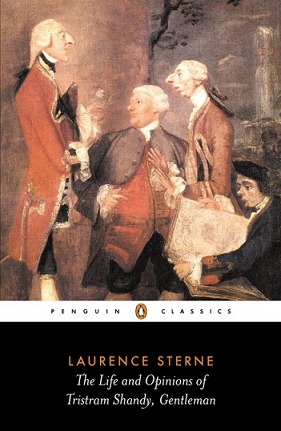
 If you type ‘Tristram Shandy’ into the search field on WordPress’s “Reader” pages, you will be presented with a large number of results. Look more closely, and it turns out that for every review of Sterne’s ridiculous, extravagant, often nonsensical novel, there is another post lamenting its unreadability. I sympathise. ‘Tristram Shandy’ was published over the course of eight years (1759-1767), so reading it now over the course of a week is a very different experience. It is a pointedly experimental novel: if ‘Tristram Shandy’ was a radio programme, it would be The Goons; if it was a television show it would be The Mighty Boosh; if it was a painting it would be something by Dali or Magritte (whether these comparisons are compliments or criticisms is of course a matter of personal taste).
The novel as a literary construct was still in its formative years when Sterne composed ‘Tristram’. The manner in which he takes the early conventions of the form and strips them apart still seems audacious. The novel fully deserves the post-Modernist label often applied to it. It overflows with quirky self-conscious reflections on the role of the narrative, deliberately subverting the reader’s expectations and literary conventions; and rejects almost any pretence of realism. This playfulness extends to an extensive use of typographical jokes, such as blank or black pages, jumps in the page numbering to suggest the passage of time, little sketches to represent the narrative flow, etc – anarchic ideas that feel original and new even today.
But spread over 450+ pages, this whimsy, because at the end of the day that is really all it amounts to, can be tiresome. There is little or no plot in ‘Tristram’ to maintain momentum and whenever a short story line starts we soon recognise it is unlikely to finish. Characterisation is a stronger feature of the novel, although neither Tristram’s life nor his opinions feature to any extent. His uncle Toby, with his ‘hobby horse’, a comic fascination (more of an obsession) with military construction, is the nearest the novel comes to having a central character, and Tristram himself only appears late in the novel, several volumes having been devoted to his conception and birth.
Interruptions to the narrative become the narrative themselves – occasions where the reader is simply told something happens without numerous digressions are rare, and rather than attempting to follow precisely what is happening at any particular point, most readers will I suspect have joined me in abandoning any such attempt, and instead sat back and enjoyed the moment. As Sterne points out:
“Digressions, incontestably, are the sunshine;—they are the life, the soul of reading;—take them out of this book for instance,—you might as well take the book along with them”
But there is a serious novel lurking within the pages of ‘Tristram’, with some interesting thoughts on sexuality. Emasculation emerges as a persistent theme – Tristram seems doomed to a series of castration experiences quite unlike any other unfortunate in literature. At his birth his “nose” is crushed by the doctor’s forceps. Later he is “circumcised” when the sash window he is urinating out of comes crashing down – that’s one extraordinarily precise window! At another point his uncle Toby is wounded in the “groin” – to the extent that he needs four years bed rest to recover. The novel ends with confusion about the extent of this wound.
‘Tristram’ positively groans with euphemisms and metaphors for sexual organs and experiences, although like its twentieth century filmic equivalent, the ‘Carry On’ films, there is very little sexual activity itself; indeed sex is portrayed as something alarming and dangerous. (The exception, a scene where Trim, Uncle Toby’s valet, is given a very intimate massage by a young french woman, is filthy!) And reviewers have noticed that the strongest relationships in the novel are between the central male characters – there is one scene where Toby and Walter, Tristram’s father, hold hands to comfort one another, which was touchingly affectionate. However these nudge nudge references to pricks, keyholes, (“keyholes are the occasions of more sin and wickedness, than all other holes in this world put together”) candles, slits, and ‘noses’ eventually get a little wearing – we get it.
It wasn’t all hard work – I enjoyed moments in this novel. The opening, in which the moment of Tristram’s conception is interrupted by his mother’s untimely coitus interruptus question completely puts his father off his stroke, setting a comic standard which the rest of the novel only inconsistently sustains, provides one of the great first paragraphs:
Pray my Dear, quoth my mother, have you not forgot to wind up the clock?……
—Good G..! cried my father, making an exclamation, but taking care to moderate his voice at the same time,—Did ever woman, since the creation of the world, interrupt a man with such a silly question?”
But these moments are outweighed by the long sections of rambling. It’s not hard to find passages in this novel that descend into gibberish, such as this from Book 3 chapter 40, representing either the tuning or the playing of a fiddle:
“Ptr…r…r…ing—twing—twang—prut—trut—’tis a cursed bad fiddle.—Do you know whether my fiddle’s in tune or no?—trut…prut.. .—They should be fifths.—’Tis wickedly strung—tr…a.e.i.o.u.-twang.—The bridge is a mile too high, and the sound post absolutely down,—else—trut…prut—hark! tis not so bad a tone.—Diddle diddle, diddle diddle, diddle diddle, dum. …Twaddle diddle, tweddle diddle,—twiddle diddle,—twoddle diddle,—twuddle diddle,—prut trut—krish—krash—krush”
You can see what Sterne is trying to do here without having to enjoy it. And the same applies to much of the novel.
 The Reading Bug
Ive often wondered whether I should read this – its been on the reading list of so many university literature courses that I would be foolish to overlook such a renowned text. But when I pick it up and sample a few pages I end up thinking that its not going to be worth the effort needed….
LikeLiked by 1 person
Took me about 10 days give or take. I can’t say that there weren’t times when my focus slipped and I found I had to double back, but the novel is so incoherent that there was never a question of not following the plot – there was no plot to follow.
LikeLike
I just finished Ulysses for a read along I hosted, of which, no one completed but myself. I can relate. It was a rambling hot mess but the last 200 pages or so made the book for me.
LikeLiked by 2 people
Ulysses is one of my next three reads. It will be a re-read, but from a long time ago.
LikeLike
I’m afraid I love it! There is a good audio recording from Naxos, and I think listening to it helps. It’s not a lot more disconnected than Ulysses, which I see another commenter mentions above. I suppose what amazes me most is that, at such an early stage in the development of the novel, a writer could do something so ‘off-the-wall’. Incidentally, if you’re ever in North Yorkshire, Shandy Hall is well worth a visit…
LikeLiked by 1 person
Completely agree re the innovative nature of the novel, but that wasn’t enough to sustain it for me. I can see how an audio version might work better though.
LikeLike
I finally gor round to reading TS a couple of years ago. I was also bemused by it but have to say that I enjoyed its playfullness. I intend to read it again…and again…
I think it would be interesting whenever we come across somesuch cleverness in any postmodern work to check to see if it had already been done by Sterne.
LikeLiked by 1 person
I can’t remember anyone doing some of the typographical gags Sterne does in TS until the post-war era – possibly they make printing the books more expensive!
LikeLike