1950's post war fiction, 20th century Literature, apocalypse, Book review, cosy catastrophe, John Wyndham, science fiction', The Day of the Triffids

Supplementary: The Day of the Triffids – a closer look at murder/suicide

Yesterday’s post on ‘The Day of the Triffids’ was getting overly long, and I wanted to spend some time looking more closely at the scene below from chapter 5, ‘A Light in the Night’. I think it demonstrates Wyndham’s “less is more” technique. it also provides a further perspective on the question of how to respond to overwhelming tragedy from which there appears no escape.

Bill and Joella have found a flat in which to hide overnight on the first night after the mass-blinding. They have chosen an opulent third floor flat to celebrate what they both think will be their last night of ‘civilised’ living. While Joella is out scavenging for clothes, Bill witnesses the following scene. I have included it in full because I think it merits it:

“As I stepped outside, another door farther down the passage opened. I stopped, and stood still where I was. A young man came out, leading a fair-haired girl by the hand. As she stepped over the threshold he released his grasp.  “Wait just a minute, darling” he said.

He took three or four steps on the silencing carpet. His out-stretched hands found the window which ended the passage. His fingers went straight to the catch and opened it. I had a glimpse of a fire-escape outside. “What are you doing Jimmy?” she asked. “Just making sure” he said, stepping quickly back to her and feeling for her hand again.

“Come along darling”. She hung back. “Jimmy I don’t like leaving here. At least we know where we are in our own flat. “How are we going to feed? How are we going to live? In the flat darling we shan’t feed at all, and therefore not live long. Come along sweetheart don’t be afraid”. “But I am Jimmy, I am”. She clung to him and he put one arm around her.

“We’ll be alright darling, come along”. “But Jimmy that’s the wrong way…” “You’ve got it twisted round dear. It’s the right way”.

“Jimmy, I’m so frightened. Let’s go back”. “It’s too late darling”. By the window he paused. With one hand he felt his position very carefully. Then he put both arms around her., holding her to him. “Too wonderful to last”, he said softly. “I love you my sweet, I love you so very, very much”. She turned her lips up to be kissed. As he lifted her he turned and stepped out of the window…

I found this is a chilling scene. It is mutely observed by the narrator. He makes no attempt to intervene, not a sound. He could have tried to help this loving young couple, but decides to do nothing. Passively he accepts the young man’s judgment that death is the preferable option for the blind. Note by the way that this is clearly a murder/suicide – the young girl is frightened and suspicious (perhaps they have already discussed their options previously).

Bill’s observation is detailed – he watches them carefully. He describes events more in the manner of an omniscient narrator than an observer, without judgment. He glimpses the fire escape outside, hears the fear in the girl’s voice, counts the man’s steps to the window, and notices that he finds the catch easily, rather than fumbling for it. He records their conversation word for word, even the telling repetition of ‘very’ in the final line. The fact that he records this scene in such detail, when he looks away from so many others that must be occurring all around him, suggests he feels it has a particular significance.

Bill has already seen a suicide by jumping earlier in the novel, by a doctor in the hospital; he also has met a man in a pub who goes to join his wife and children in death by gas after getting properly drunk:

“Wha’s good of living blind’s a bat?. . . Thash what my wife said. An’ she was right-only she’s more guts than I have. When she found as the kids was blind too, what did she do? Took ’em into our bed with her an turned on the gas”

Suicide is a rational, sensible, even brave, option in the new world, is the implication.

The scene ends with an ellipsis and a paragraph break. In the next scene no mention is made of what Masen has witnessed – he chooses not to tell the reader (nor Joella) what happens to the couple after this point. A more horrific description would have followed their fall, the screams, the crunch of mangled bodies on pavement, the blood slowly pooling. Wyndham gives us none of this, just those three little dots after the word “window”.

Is this an example of the author protecting the reader from the worst of the apocalypse, making it more cosy? It is interesting that it is Bill only who witnesses this scene – Joella is conveniently out ‘shopping’. Personally I found the scene powerful and effective, and a description of their fall and death would have added little. The reader is left to fill in the gaps with their imagination. But I accept that this narrative approach allows readers to also look away if they choose, to decide not to engage emotionally with the enormity of what is being shown, as Bill effectively does.
Standard
20th century Literature, Book review, Ian Fleming, James Bond, Spy stories

Casino Royale by Ian Fleming, 1953

As you know, I have been reading a lot of pre-war novels recently. Even in those published more recently, in the 50’s and 60’s, the use of offensive terms to describe black and ethnic minority people and others is common place. Quite often the terms are used casually, not actively intended to offend but as part of the speaker’s everyday idiolect, Casino Royalshowever brutal that may have been. Authors setting the events of their novels in the past have to make a difficult decision whether to have their characters talk ‘authentically’ – that is using offensive words that were common terms- or to sanitise their portrayal of how people spoke and thought. As a result of all this I’ve become a bit de-sensitised to authors using offensive terminology or hateful language. In any event I knew not to expect James Bond to be politically correct or sensitive to other people’s feelings and ideas. But the venom and sheer unpleasantness of his portrayal in ‘Casino Royale’ was still shocking.
This short novel is the first of the Bond franchise, and sets the template for many of what were to become clichés about Bond. The repressed public school boy, the cold blooded killer (although he kills no-one in this novel, he does boast (twice) about his killings to date, two to be precise) his lechery, his misogyny, his tendency to drink and drive. We are told of his 00 designation, although here it is not a licence to kill, (that would come later), but rather confirmation that he has killed in the course of his work; in other words it is a designation of work experience, not an indication of authority. The femme fatale sidekick fated to die by the end of the novel is here, but missing are the dead-pan quips in the face of danger, and the gadgets provided by Q.

The novel’s plot is flimsy. The villain, Le Chiffre, a Russian Agent, controlled by SMERSH, is treasurer of a French trade union. Some villain. He is morbidly obese, and just to round the characterisation off, a sexual predator. He has lost the union’s money by investing in a chain of loss-making brothels, so tries to recover his losses at the baccarat tables at the Casino Royale. Bond’s master plan is to beat him at cards, bankrupt him, forcing into becoming a double agent. The novel is very clear that the trade union members he represents are a communist fifth column under the control of the Soviet Union, and must be broken up as part of the defence of the realm.

As a plan this obviously has its flaws, depending as it does on the luck of the draw, and is in any event always vulnerable to either Le Chiffre cheating, which is the sort of thing corrupt trade union officials are prone to, or violence after the event. The latter is the option chosen – after fluking a win at chards, Bond is kidnapped, stripped, tied to a chair and then tortured at length in a bizarre homoerotic sadomasochistic fashion which threatens his manhood painfully and literally.

As a spy novel this is flimsy stuff, but the portrayal of women, and Bond’s Neanderthal attitudes, is what I wanted to focus on. As I have said, I am not naïve enough to have expected Bond to have been a feminist. But he is an appalling throwback. When he hears he is going to have to work with a woman, he is dismayed.

“These blithering women who thought they could do a man’s work. Why the hell couldn’t they stay at home and mind their pots and pans and stick to their frocks and gossip and leave men’s work to the men”. (15)

Lynd, the female agent in question (Vesper Lynd is a homophone for ‘West Berlin’ by the way, a clue that she is a double agent) is in turns lusted over and treated with contempt by Bond. His reaction when she is kidnapped is:

“For Vesper to fall for an old trick like that and get herself snatched ad probably held to ransom…the silly bitch. “

He imagines sex with her as having the “sweet tang of rape”. (23)

The final line of the novel is the blunt “The bitch is dead now”. (This of a woman who he was planning to marry a few pages earlier)

It’s important obviously to avoid the mistake of assuming that the thoughts and ideas of the novel’s central character are those of the novelist. But equally that doesn’t mean that sometimes authors don’t use their characters to articulate their prejudices. It’s not too difficult to spot the difference between this happening, and a character being constructed to represent prejudices which are held up to ridicule or contempt. If Bond was being presented as a misogynist in order to demonstrate how out of date these ideas had become, someone in the novel would challenge him, confront his chauvinism. That never happens. Alternatively his bigotry would be confronted by the events of the novel – for example when he consistently under-estimates women they go on to prove him wrong. Again, no such thing happens – by the end of the novel the reader is invited to agree that staying at home minding pots and pans and sticking to her frocks would indeed have been the better course of action for Vesper. It is hard to escape the conclusion that Fleming, the wealthy, Eton and Sandhurst educated former naval intelligence officer, was using Bond to express his own chauvinism.

The later Bond novels do nothing to dispel this idea. These are his thoughts on lesbians and gay men in ‘Goldfinger’, all caused apparently by giving women the vote!

Bond came to the conclusion that Tilly Masterson was one of those girls whose hormones had got mixed-up. He knew the type well and thought they and their male counterparts were a direct consequence of giving votes to women and “sex equality.” As a result of fifty years of emancipation, feminine qualities were dying out or being transferred to the males. Pansies of both sexes were everywhere, not yet completely homosexual, but confused, not knowing what they were. The result was a herd of unhappy sexual misfits – barren and full of frustrations, the women wanting to dominate and the men to be nannied.”

Standard
100 Best Novels Guardian list, 20th century Literature, Book review, Irish literature, James Joyce, Ulysses

Ulysses, by James Joyce, 1922

“Every life is in many days, day after day. We walk through ourselves, meeting robbers, ghosts, giants, old men, young men, wives, widows, brothers-in-love, but always meeting ourselves.”

‘Ulysses’ was a hard read, 933 pages of Ulyssescomplex, allusive text, full of echoes, references, challenges and puzzles. Reading this novel passively, without paying full attention, is pretty pointless, and even with three weeks of concentrated reading, most readers, myself included, working without the benefit of one of the many guides available, will probably only scratch the surface of this novel’s complexity.
The novel’s reputation as being unreadable, on the other hand, is unjustified. A parallel with Shakespeare’s prose might help – Shakespeare is often described as being hard to follow, but if you take care and pay attention there is little in the canon that can’t be understood by a native speaker. ‘Ulysses’ is the same. (Incidentally, Shakespeare, and specifically Hamlet, echoes repeatedly throughout the novel)

Take Molly Bloom’s stream of consciousness chapter at the end of the novel. Joyce attempts to capture Molly’s thoughts as she drifts back off to sleep after being woken by Leopold, returning worse for wear from his adventures. Her thoughts range widely from her childhood memories to the events of the day. We all know that as we fall asleep our thoughts become incoherent and even bizarre. But the thread of Molly’s thoughts can almost always be followed, if one takes the time to do so.

“and Gibraltar as a girl where I was a Flower of the mountain yes when I put the rose in my hair like the Andalusian girls used or shall I wear a red yes and how he kissed me under the Moorish wall and I thought well as well him as another and then I asked him with my eyes to ask again yes and then he asked me would I yes to say yes my mountain flower and first I put my arms around him yes and drew him down to me so he could feel my breasts all perfume yes and his heart was going like mad and yes I said yes I will Yes.”

Remove some of the conjunctions, add in a full stop or two, and this is a simple memory of her first kiss and more. It is a lovely memory to close the novel, life affirming and positive.

I first read ‘Ulysses’ several decades ago, and had inevitably forgotten large chunks of it – although I was surprised at how much still remained familiar, most strikingly the chapter Nausicaa. Here Leopold watches poor lame Gerty MacDowell, on the rocks and on the shelf. This is a wonderful, tender portrait of a delusional young woman, affecting to feel superior to her friends, but sadly unable to wish away of her lameness, which is likely to make it difficult for her to marry and have children. Equally I little realised how much Stephen Dedalus’s thoughts on Shakespeare in chapter 9, Scylla and Charybdis had influenced much of my own thoughts (not really mine, Stephen’s/Joyce’s) on the subject.

Other chapters are less accessible. Chapter 12, Cyclops, includes streams of legal jargon, biblical passages, and elements of Irish mythology, and Chapter 14, Oxen of the Sun, is bravura attempt to capture the entire history of the English language, from latinate prose to Anglo-Saxon alliteration. It ends in a long paragraphs gibberish, which I will be kind and avoid quoting. I think Joyce is predicting the decline of the language into a yahooish form of slang, but I could be missing the point?

The character of Leopold Bloom is at the heart of the novel. He doesn’t appear until chapter 4, and often slips out of view, but is a likeable, easy going chap. His wife is being unfaithful to him, but he doesn’t seem to mind very much. His thoughts touchingly often wander back to the death of his baby son Rudy. He is subjected to anti-semitic abuse, but doesn’t let it get him down, and pursues his narrow life and interests with an amiable persistence. The drawer of memories and effects that he reflects on at the end of the novel is a little pathetic, but Poldy is an everyman who bounces back and survives, a humanist but puts up with being christened three times, a pacifist prepared to stick up for himself, and a bit of a dirty old man. He makes the novel ultimately worthwhile.

Standard
20th century Literature, Book review, Booker Prizewinner, Empire, J G Farrell, The Siege of Krishnapur

The Siege of Krishnapur, by J G Farrell, 1973

I found myself becoming increasingly troubled by J G Farrell’s Booker prize winning ‘The Siege of Krishnapur’. It is not a bad novel, but it has some serious flaws. It is based on the Indian Mutiny of 1857/8. In India this conflict is known as the Indian rebellion, but Siegeyou would not know that from reading this novel. The narrative perspective is entirely from the point of view of the ‘plucky’ British settlers. The Indian people who appear in the novel are either cannon fodder, mown down in their thousands by the plucky British defenders, or ridiculous caricatures, such as the entirely dumb ‘Prime Minister’. Even the Sikhs who loyally refuse to join the rebellion are given non-speaking parts and diminutive nicknames.
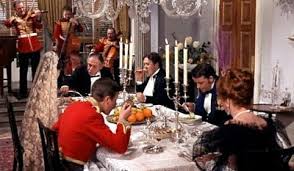
I wonder – did it ever occur to Farrell that the Indian people might have had a different perspective on events from the British characters, and that giving a voice to one of them might have been an interesting counterpoint to the stubbornly imperialist perspective otherwise offered? I am sure that anyone wanting to defend the novel will say that Farrell is comically pointing out the absurdities of Empire. Quite why this was necessary in the 1970’s is a moot point, but the fact that the British behaved ridiccarry onulously in the Raj, keeping up the croquet on the lawn, tea parties, and cucumber sandwiches while the natives rebelled isn’t particularly original funny – Carry on Up the Khyber made the same point far more succinctly five years earlier.
Let’s call this what it is – racism.  A novel set in the time of the British Empire in which all the non-British characters are marginalised and ridiculed wouldn’t find a publisher these days, would it? The novel made me wonder whether you can actually write a novel in which all of the predominant characters share a colonialist mindset, and use these attitudes and situations to challenge and undermine that perspective? In other words, how do you write a novel about racism without being racist? That’s a very broad question, but I would expect to see racist attitudes challenged robustly – which doesn’t really happen here – and some progression in the characters’ attitudes on the issues, which again is missing. In the novel’s final chapter set several years after the siege, there is no indication that the protagonists have come to realise they bore some responsibility for the uprising and the deaths that followed.

I am sure Farrell tried to make the novel a serious discussion about Empire. Many of the British characters are sympathetic and well-meaning, but misguided. There are some heavy-handed points made about the Great Exhibition of 1851, a few years before the novel’s setting. The senior British official organising the defence of the besieged community is known as ‘The Collector’, and while this title refers to the collection of taxes, it also refers to his hobby of collecting small technical devices from the Exhibition. These all eventually end up forming part of the barricades or are broken down to be remade into ammunition – so much for the value of civilisation in such a backward country.

There were a number of other features of the novel that caused me concern. The women characters are mainly there for decorative purposes, to provide wives and babies. There is a regular and rather uncomfortable series of references to the women’s sexual attractiveness, their smell, and even the effect the siege has on the plumpness of their bodies. In one bizarre scene a woman strips naked to escape a plague of insects that has descended on her, covering her head to toe, and two of the officers scrape the insects off her body using the hard-back covers torn from a Bible. They are bemused by her pubic hair, not knowing whether to scrape that off as well! This scene was I am sure intended to be funny, but my sense of humour failed me. Not only was it distasteful, but the clubbingly heavy-handed point being made – she is a “fallen” woman being redeemed of her sexual misconduct by the literal application of the Bible – made me groan.

And….the plot is slight – the siege becomes a game of survival, but there is never any doubt that it will eventually be relieved. Several characters are set up with potentially interesting story lines, which are not followed up. A lengthy debate about the causes of cholera is obviously well-researched, but utterly pointless given we now know who was right and who was wrong. But despite all these reservations, I didn’t hate this novel. It was well constructed and skips along with just enough pace to sustain the otherwise static narrative.

I know I am in a small minority in this one – novel’s don’t win the Booker without any merit, let alone be shortlisted for the Booker of Bookers.  So the question is, what am I missing?

Standard
100 Best Novels Guardian list, 20th century Literature, Book review, Henry James, Rebecca West, The Golden Bowl

Supplementary: “A cartload of apes and ivory” – Rebecca West on ‘The Golden Bowl’

‘The Golden Bowl’ certainly divides opinion. Reading some online reviews I came across a wonderful demolition of the novel by the awesome Rebecca West. I make no apologies for quoting at length from her analysis – West never pulls her punches and has a magnificent turn of phrase.rebecca west

She opens by calling the novel “an ugly and incompletely invented story about some people who are sexually mad.” (“Completely invented” may harm her argument, as inventiveness is usually seen as a strength in a novelist, but this is passionate rhetoric, not measured argument) This gets straight to the point – sex drives the behaviour of the novel’s central characters, (however obliquely James may disguise his sexual references), and leads them to behave out of character. West knew all about how this could happen to even the most aristocratic people.

Her plot summary savages the novel’s central characters;

“Adam Verver, an American millionaire, buys an Italian prince for his daughter Maggie, and in her turn she arranges a marriage between her father and Charlotte, her school friend, because she thinks he may be lonely without her.

This is fair comment – at its heart, the marriage between Amerigo and Maggie is based upon Maggie’s ability, through her father, to pay off the Prince’s many debts. James is clear (or as clear as anything is in this novel) that the marriage is a contractual and commercial agreement.

West’s critique of James’s writing style is equally robust. She writes of his

“sentences which sprawl over the pages of ‘The Golden Bowl’ with such an effect of rank vegetable growth that one feels that if one took cuttings of them one could raise a library in the garden.”

But this is not simply a question of name-calling – West has a serious critique to present. Her point is that the plot of the novel, and the behaviour of the primary characters, is utterly unrealistic. The characters

are presented … as vibrating exquisitely to every fine chord of life, as thinking about each other with the anxious subtlety of lovers, as so steeped in a sense of one another that they invent a sea of poetic phrases, beautiful images, discerning metaphors that break on the reader’s mind like the unceasing surf.

But

when one tries to discover from the recorded speeches of these people whether there was no palliation of their ugly circumstances one finds that the dialogue, usually so compact a raft for the conveyance of the meaning of Mr James’ novels, has been smashed up on this sea of phrases and drifts in, a plank at a time, on the copious flood….

To cap it all these people are not even human, for their thoughts concerning their relationships are so impassioned and so elaborate that they can never have had either energy or time for the consideration of anything else in the world. A race of creatures so inveterately specialist as Maggie Verver could never have attained man’s mastery over environment, but would still be specialising on the cocoa-nut or some such simple form of diet.”

I can’t argue with this, nor express it better – I doubt anyone could.

West goes on to claim to have identified why James’s writing style at the end of his life become so ornate and complex; the explanation she offers certainly has a ring of plausibility to it:

“in these later days, Mr James … began by dictating a short draft which, even in the case of such a cartload of apes and ivory as The Golden Bowl, might be no longer than thirty thousand words. Then he would take this draft in his hand and would dictate it all over again with what he intended to be enlightening additions, but which, since the mere act of talking set all his family on to something quite different from the art of letters, made it less and less of a novel. …

Always it was good, rambling talk, although fissured now and then with an old man’s lapses into tiresomeness, when he split hairs until there were no longer any hairs to split and his mental gesture became merely the making of agitated passes over a complete baldness…

Here and there the prose achieves a beauty of its own; but it is no longer the beauty of a living thing, but rather the “made” beauty which bases its claims to admiration chiefly on its ingenuity, like those crystal clocks with jewelled works and figures moving as the hours chimed, which were the glory of mediæval palaces.”

“A cartload of apes and ivory” has instantly become my all-time favourite phrase for a good bad novel!


Standard
20th century Literature, Book review, Henry James, The Golden Bowl

Unreadable novels, with specific reference to ‘The Golden Bowl’ by Henry James, 1904

What makes a novel unreadable? We all have our own breaking points – I may have just have found mine. This post explores the features of ‘The Golden Bowl’ that are making it, for me, almost unreadable.

  1. Sentence structure

He found it convenient, oddly, even for his relation with himself—though not unmindful that there might still, as time went on, be others, including a more intimate degree of that one, that would seek, possibly with violence, the larger or the finer issue—which was it?—of the vernacular.James

Here’s another example from the same novel:

‘The things, or many of them, that had made Mr. Verver what he was seemed practically to bring a charge of waste against the other things that, with the other people known to the young man, had failed of such a result.”

I am sure it is possible to parse these sentences, particularly with the benefit of the surrounding context, but this level of complexity made reading chapter after chapter exhausting.

2. Paragraphs

What makes some novels harder to read than others is often a matter of personal taste. For me, paragraphs are one such feature. Paragraphs are like decent broadband or clean tap water – something we usually take for granted, but boy we don’t half miss them when they aren’t there. ‘The Golden Bowl’ has some paragraphs, but far fewer than it needs. Reading page after page of text uninterrupted by a paragraph break, indeed uninterrupted by a change of thought or pause for breath, can be tiring and tiresome.

3. Subordinate clauses and qualifiers

Another question of personal taste involves the use of subordinate clauses and qualifiers. There’s nothing wrong with these in the right place, but James seems unable to write a single sentence without, as it were, a subordinate clause. In most cases they serve little purpose, as in the previous sentence. Take it out and the meaning is unchanged. Was this just a habit, a feature of his literary style that he found it hard to shake off, or was something more complex going on? I am usually keen to give authors the benefit of the doubt and assume that they will have noticed when they are doing something that might annoy the reader, and that they have good reason to do so. I assumed on that basis that James was using this style to tell us something about the equivocating, ambivalent character of Prince Amerigo:

“His own estimate, he saw ways, at one time or another of dealing with; but theirs, sooner or later, say what they might, would put him to the practical proof.”

Granted, each of the subordinate clauses here change the sense of the sentence subtly, qualifying the meaning in various ways. But wouldn’t the sense be just as clear written as:

“He saw ways of dealing with his own estimate, but theirs would put him to the practical proof.”

Here’s another example:

“But his actual situation under the head in question positively so little mattered to them that, having by that time lived deep into the sense of his advantage, he had kept no impression of the girl’s rejoinder”

You will either find sentences like this (from Chapter 2)  elegant and sophisticated, or clumsy and obscure:

“The spectator of whom they would thus well have been worthy might have read meanings of his own into the intensity of their communion—or indeed, even without meanings, have found his account, aesthetically, in some gratified play of our modern sense of type, so scantly to be distinguished from our modern sense of beauty.”

Undoubtedly writing like this has an impact – in my case the impact was to make me pause and reread the sentence to try to work out what was being said. But this is not a question of characterisation: James adopts this style throughout the novel – it is the only narrative voice.

These aspects of James’s prose have thus far made ‘The Golden Bowl’ one of the hardest novels I have tried to read since starting this blog.

That’s the case for the prosecution. The defence is that modernist novels aren’t supposed to be easy reads. In describing a situation or a statement of fact in a roundabout way, so that it takes time for the reader to grasp the meaning of what is being said, and in exploring the unspoken and half-conscious thought processes behind speech, James was inventing the distinguishing characteristics of modernism. Certainly there is much in this novel that ticks these boxes, and it is these more positive features of ‘The Golden Bowl’ that I will return to in my next post.

Finally, for the avoidance of any doubt, I am not giving up on this novel. I may not read it with the care and attention James seems to expect, but that is not the same as not reading it altogether.

Standard
100 Best Novels Guardian list, 1919, 20th century Literature, American literature, Book review, John Dos Passos

1919, by John Dos Passos, 1932

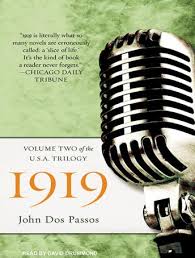
‘1919’ is the second book in Dos Passos’s ‘USA’ trilogy. Which immediately begs the question, why read only the middle book in a trilogy? You wouldn’t read only ‘The Two Towers’, would you? I think there are several reasons why I am going to resist the temptation to read the rest of ‘USA’. Firstly, ‘1919’ (and only ‘1919’) was recommended by the Guardian’s list of 100 best novels written in English; second, having now read this novel, to go back to the first volume seems a bit pointless; third1919, I just don’t have the appetite for another 800 pages of this trilogy. The novels are intended to stand alone and I am going to take the author at his word on this (even though many online reviews argue that reading the whole trilogy is the only way to properly appreciate its constituent parts).
At one time Dos Passos was ranked with the greats of American post-war literature – Hemingway, Faulkner, Steinbeck and Fitzgerald. While their novels have stood the test of time, I don’t think the same can be said for Dos Passos. ‘1919’ has only two reviews on Amazon’s UK site, compared to over 2,000 for Gatsby, and 1,500 for The Grapes of Wrath (Faulkner, by comparison, is little reviewed – go figure). ‘1919’ uses many innovative techniques, and these are some of the most successful aspects of the novel. Chapters are introduced with short scraps of text from newspaper and magazine headlines, followed by stream of consciousness, camera-reel impressions of the events of the following chapter. Interspersed elsewhere are short pen pictures of a series of American political and military figures who played a part in the First World War, and the industrial struggles in the United States at about the same time. (The Los Angeles Review of Books described these sections of the novels as “disruptive bumps in the reader’s way (which) have no bearing on the story, but add Americana-flavored flamboyance to the proceedings”. (It’s worth reading the whole of this review which is a pretty magisterial take down of the trilogy, describing it as “The Great American Novel That Wasn’t”!)

The body of the novel is a more traditional narrative telling the stories of five principal characters. Although these characters are Americans, the war takes them all to Europe, when the bulk of the novel’s events occur. Despite America’s extensive involvement in the war, none of the characters are involved directly in the conflict, serving as merchant seamen, ambulance drivers, or working with the Red Cross. There is a relentlessness about these stories – things happen, then something else happens, then yet more events; with troubled love affairs acting as the inevitable punctuation to another round of meetings, dinners, drinks, journeys back and forth between Rome and Paris, and so on. Because I didn’t care about these characters – possibly because I had not read about them in the first volume – I found these parts of the novel tiresome.

As an invocation of what it was like to be an American in Europe in 1917-1919 – privileged, largely immune from the conflict, endlessly bumping into one another – I am sure this is a faithful portrait. But apart from the tediousness of the primary narrative, there were other aspects of the novel which jarred. The condescending attitude towards Europeans often found in American popular culture crops up here far too often. Also prevalent is a racist (the n-word is used freely), anti-semitic, misogynist bundle of nasty prejudices which are given full rein and go completely unchallenged, despite Dos Passos’s apparent left wing ideals. As a small concession to this reactionary tide the novel closes with a historically arguable portrait of an attack on American Trade Unionists (the Centralia massacre) which is very sympathetic to the IWW (the international Workers of the World, also known as the Wobblies).

As an attempt to describe how a better world could have emerged from the ashes of the First World War ‘1919’ fails completely – it is desperately pessimistic. All strikes are defeated, all socialists are isolated and the Red Scare (which swept post-War America and is in many ways still underway) looks unstoppable. From 1932 Dos Passos’s defeatism is understandable, and probably explains his subsequent steady drift to the Republican right.

‘1919’ was the third from last novel in my current reading challenge. Next up is Henry James’s ‘The Golden Bowl’, leaving’ Ulysses’ to last.

Standard
20th century Literature, Book review, Glory, literature in translation, Pale Fire, Russian literature, Vladimir Nabokov

Glory by Vladimir Nabokov, 1932

This semi-autobiographical early novel was written in the early 1930’s, but only translated into English in 1971, when Nabokov’s reputation as an author was secure. It did little to enhance it.

‘Glory’ follows the childhood and early life of Nabokov’s romantic protagonist, Martin Edelweiss, who escapes from the bloodshed of Nabokov Gloryrevolutionary Russia.to Switzerland and thence to England. In London he meets the Zilanov family, expatriate Russians like himself, and falls for their teenage daughter, Sonia. At Cambridge University he becomes friends with Darwin, a war hero and published author, now a fellow student. Cambridge is a period of restlessness for Martin – he finds it hard to settle on a field of academic study, or an occupation thereafter. His family is sufficiently wealthy for this to not be too much of a problem. A summer working as a farmhand in France does not quieten this restiveness. Slowly a plan forms in his mind – to return undercover to Soviet Russia. A search for glory will quieten his dissatisfaction with life. The precise purpose of this perilous journey is never articulated, and remains a mystery to Darwin even when Martin reveals his intended journey.
The novel closes on a consciously downbeat almost offhand tone – Martin leaves Darwin with some postcards for his mother to explain his absence, and sets off for Russia via Latvia. Darwin, although he argues with him, finds his plans ridiculous. Martin’s eventual fate is hinted at but never revealed, and the narrator even turns away from portraying the scene when Darwin explains what has happened to Martin’s mother.

‘Glory’ is an unsatisfying novel. If you come to this book having read the pyrotechnics of ‘Pale Fire’ or ‘Lolita’ you will be disappointed. As a stylist Nabokov is extraordinary, and in this respect ‘Glory’ can stand comparison with anything he wrote. He takes sentence construction and extended metaphor to the very limits of sustainability:

“Human thought, flying on the trapezes of the star-filled universe, with mathematics stretched beneath, was like an acrobat working with a net but suddenly noticing that in reality there is no net.”

Any further and this would read like parody. As it is the slight clumsiness at the end – “with a net but suddenly noticing that in reality there is no net” is the character’s, not the author’s awkwardness, and captures perfectly the gap between Martin’s perception of himself, as someone significant, and the reader’s understanding that he is something of a fantasist.

In his introduction to the English edition, written decades after the novel itself, Nabokov typically misleads and challenges the reader. He offers an interpretation of the novel in which:

 “(the fun of Glory) is to be sought in the echoing and linking of minor events in back-and-forth switches, which produce an illusion of impetus”.

This invites us to read the novel looking for intricacies of construction which are undoubtedly present, but which nevertheless fail to add much to the novel. Just because an author introduces a motif at the opening of a novel – here for example a path leading through a wood – and returns to it in a subsequent scene at the close, that in itself does little to enhance our appreciation, particularly if we have already had the author point out the device. There are undoubted traces in ‘Glory’ of the elusive genius that was to emerge in ‘Pale Fire’ (for example) but for all its skill and technique the former suffers from comparison with the later work.

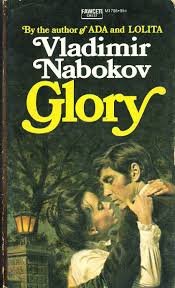
One last point – apologies for the book cover illustration. I suspect the publishers were trying to cash in on Nabokov’s reputation as the author of ‘racy’ novels.


Standard
100 Best Novels Guardian list, 20th century Literature, American literature, As I lay dying, Book review, Southern Gothic, William Faulkner

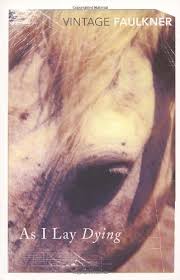
As I Lay Dying, by William Faulkner, 1930

William Faulkner’s ‘As I Lay Dying’ tells the story of the death of Addie Bundren and her last journey to her hometown, Jefferson, Mississippi. The novel opens with the dying Addie watching her son Cash construct her coffin. The ominous sounds of his carpentry echo around the house, forming an aural backdrop to the family’s hushed conversations about their mother’s imminent death. The summer heat is oppressive, but the night after Addie dies the expected rainstorm breaks, washing out the bridges and fords that lay on the long road to Jefferson. Undetermined, infinitely stubborn, the family set out with Addie’s body on the back of the wagon. The journey is of biblical proportions, with the family having to overcome trials of fire and flood.  As I lay dying

‘As I Lay Dying’ is Faulkner’s masterpiece, a virtuoso epic that is one of the most extraordinary novels I have read in a very long time. The task of doing it justice in a review is daunting, so rather than trying to explore every aspect of its astonishing variety and sophistication I am going to focus on two related aspects of the novel – Faulkner’s use of narration techniques, and the more general issue of complexity: in other words, how does the novel tell its story?

The narrative voice in ‘As I Lay Dying’ is highly complex. Ostensibly, the novel is constructed from a sequence of “stream-of-consciousness monologues, in which the characters’ thoughts are presented in all their uncensored chaos, without the organizing presence of an objective narrator” (SparkNotes). But that’s only part of the story. Underneath the naturalistic voices of the characters is another, insistent authorial voice. The narrative switches between these voices so frequently and seamlessly that it is often easy to miss the transition.

Here’s an example. The narrator here is ten-year old Vardaman. He is distressed because of his mother’s death, and struggling to process his reactions:

“I can cry quiet now, feeling and hearing my tears. It is dark. I can hear wood, silence. I know them. But not living sounds, not even him. It is as though the dark were resolving him out of his integrity into an unrelated scattering of components”.

The first sentences in this paragraph are short, child-like. Then in the sentence beginning “It is as though” another voice intrudes, and the repetition of the personal pronoun “him” is ambiguous – is this the “him” of the previous sentence, referring to one of Vardaman’s brothers that he can hear in the dark, or Vardaman himself. In other words this ultimate sentence can be read as being either by or about Vardaman. In any event, it uses a language and vocabulary that a ten-year old child would not be familiar with – it is another narrative voice.

Here’s another example from Darl, one of Vardaman’s older brothers:

“The horse moving with a light, high-kneed driving out…We go on with a motion so soporific, so dream-like, as to be uninferant of progress, as though time and not space were decreasing between us”.

Some critics have seen this change in voice, used throughout the novel, as an error. They have complained that Darl’s vocabulary, for example, is far more extensive than a Mississippi farm-hand would have known. I think it is reasonable to assume that these transitions are deliberate, which begs the question “So what’s going on?”

I can only describe the effect this technique had on me. The fragmented nature of the monologues causes the reader to concentrate to follow what is going on – no-one voice is telling us clearly what happens. Instead we slowly build up a picture of events from the thoughts and reactions of the characters. Some events are only referred to incidentally rather than directly described, and others are described from multiple, conflicting points of view. The characters’ back stories and the context of the family tragedy that unfolds has to be pieced together slowly. The presence of an ambiguous, unnamed authorial voice that intrudes into the narrative, using rich language and elaborate metaphor, gives an additional layer of complexity and opulence to the novel. The best explanation I can offer for this voice is that it is an articulation of the characters’ unconscious thoughts and feelings. This is why it invariably follows the initial, more straightforward thoughts.

The narrative voice can change within a sentence. This demands that the novel is read carefully. Another technique Faulkner uses to require this form of reading is his use of complexity.  ‘As I Lay Dying’ has an ostensibly simple structure. The storyline follows the family’s journey to Jefferson. There were however points during the narrative where I found it hard to be sure precisely what was going on. The ford-crossing scene is a good example. The family attempt to cross a flooded ford with two mules and a wagon carrying the coffin and body. The stormy waters knock them off their feet, and while the coffin is saved the mules drown, and Cash, one of Addie’s sons, breaks his leg. This scene is narrated by Darl in the present tense – “Carl and I sit in the wagon; Jewel sits the horse at the off-rear wheel”. His descriptions range from the straightforward, as in this example, to ornate, elaborate sentences we have come to expect from the elusive authorial narrator “Above the ceaseless surface they stand – trees, cane, vines – rootless, severed from the earth, spectral above a scene of immense yet circumscribed desolation”.

Darl gives the initial description of the crossing, which is followed by a past tense description from ten-year old Vardaman, and another past tense version from the Bundren’s neighbour, Vernon Tull. It is not until the narration switches back to Darl that we learn that in the accident Cash has at some point re-broken his leg, and lost all his tools, but that he has somehow rescued his mother’s coffin.

The reader is able to follow what broadly happens – the crossing is perilous, a log smashes into the wagon, and the sons fall into the water. But some of the detail is elusive, and only emerges in the later descriptions. Darl’s present tense narration puts the reader directly onto the ford with the characters, struggling with the rising waters, scared, shouting but unable to make themselves heard. This is why the description is chaotic – to capture the sense of confusion and fear that the characters are feeling.

Darl is at the heart of the novel, narrating a third of all chapters, including the one describing his mother’s last moments, even though he is not present for these scenes. In post-publication interviews Faulkner insisted on Darl’s insanity but the textual evidence for this is limited – even his act of arson can be seen as a pragmatic response to the problems the family has faced in reaching Jefferson. In his last chapter Darl’s voice has progressed from present first person narrative to third person past tense – on other words he describes his actions as if he was another person observing them.

I have never really understood the stock reaction to a wonderful book – that the reader reached the last page, only to turn back to the beginning and start again. If I had just enjoyed a steak the last thing I would want is another steak straight away (some ice-cream, maybe?). But with ‘As I Lay Dying’ this phrase began to make sense – I really did want to re-read the novel and enjoy the skill with which it is constructed all over again, and to appreciate the subtle nuances and detail with a fresh pair of eyes.

‘As I Lay Dying’ is the 96th novel in my reading challenge. I have four left: ‘Ulysses’ by James Joyce, ‘The Golden Bowl’ by Henry James, ‘1919’ by John Dos Passos, and ‘Tristram Shandy’ by Laurence Sterne. I haven’t got a particular reading order in mind – any suggestions?

Standard
20th century Literature, Book review, Bronte, Empire, Jane Eyre, Jean Rhys, Slavery, Wide Sargasso Sea

Wide Sargasso Sea, by Jean Rhys, 1966

“There is always another side, always.”

As you may know, Jean Rhys’s ‘Wide Sargasso Sea’ tells the story from ‘Jane Eyre’ of Mr Rochester’s first wife, the ‘mad woman in the attic’, Bertha Mason.wide-sargasso-sea

The idea of giving a voice to a relatively minor character from a classic work of literature may not have been invented by Jean Rhys, but I can’t think of an earlier example.*

The thematic heart of this short novel is an attempt to understand Bertha’s descent into madness. Is Rochester’s description of her condition correct, or is she the victim of a loveless marriage and the brutal property and marriage laws of the time, which allowed a husband to treat an inconvenient wife as mere property? rhys reminds us that in this world wives have fewer rights than the recently emancipated slaves.

‘Wide Sargasso Sea’ opens with Bertha, known at this point as Antoinette, as a child, living on an estate in Jamaica. Slavery has recently been abolished, and the comfortable world order in which white plantation owners ruled unchallenged is under threat. Antoinette is mixed race, although her precise racial lineage is unclear – all we are told is that her mother is a ‘Creole’. In ‘Jane Eyre’ an association is clearly drawn between this racial background and the madness that runs in the family. Rochester in particular associates “madness” with Bertha’s racially “impure” lineage. He claims

Bertha Mason is mad [because] she came of a mad family;–idiots and maniacs through three generations! Her mother, the Creole, was both a mad woman and a drunkard!” (Jane Eyre, ch 26).

Rochester on the other hand is never vulnerable to this affliction, because he comes from undiluted racial stock:

“Her family wished to secure me because I was of good race” (JE ch 27).

‘Sargasso Sea’ never directly challenges this racist association, although it does contextualise it. Antoinette’s madness is given a much clearer explanation. It seems to derive from a combination of factors. A series of traumatic events in her childhood, not least the burning down of her family home, sets her illness in motion. (This scene of course echoes the end of Thornfield Hall.) The idea that her mother’s madness has played a part in Bertha’s condition is preserved in Rhys’s version of events – Rochester’s explanation that Bertha/Antoinette is mad because she came from a mad family is at least not wholly invented. Finally, Rochester’s cold and harsh treatment of Bertha plays a part in confirming and exacerbating her illness.

In renaming Antoinette, calling her Bertha for no apparent reason except that he seems to like the name, Rochester is treating her like a slave. The plantation’s slaves lost their African names and had easy to remember Christian names imposed upon them. This enslavement is perpetuated throughout the marriage – Bertha loses all her property rights and is eventually imprisoned and kept confined in a foreign land far from home.

In the second section of the novel, Rochester’s narrative voice intervenes. We have already heard his self-justifying version of events in the original novel, but by and large this account shows him to have been mainly honest in his portrayal of his engagement and marriage. Rhys may not have wanted to diverge too much from the original version, but at times I found this voice to be inauthentic. Rochester is admittedly an alien in this land, bewildered by the strange environment, language, and culture. But when he described the honeymoon period of his marriage, it sounds more like locker room boasting than the regretful reminiscences of a man who has lost his wife to illness:

“I watched her die many times. In my way, not in hers. In sunlight, in shadow, by moonlight, by candlelight. In the long afternoons when the house was empty. Only the sun was there to keep us company. We shut him out. And why not? Very soon she was as eager for what’s called loving as I was – more lost and drowned afterwards.”

I know I have only scratched the surface of this complex and compelling novel, and it probably merits a second, closer read. But I am glad that in giving a voice to the ‘mad woman in the attic’, Rhys gave the first Mrs Rochester a dignity and a depth of character that she is deprived of in ‘Jane Eyre’. In the original novel she is little more than a plot device, an inconvenience whose death is ultimately a cause for celebration. I can’t help thinking of other victims in literature who are denied a voice by their authors, and cry out for the right to be heard.

*Tom Stoppard’s ‘Rosencrantz and Guildernstern are Dead’, first produced in the same year that ‘Wide Sargasso Sea’ was published, takes a similar idea as its inspiration, but then goes in a very different, less naturalistic, direction.

Standard