Monthly Archives: June 2012
The Sea – John Banville
Waiting for Sunrise by William Boyd
Supplementary: The Sense of an Ending (2) – Julian Barnes
I wanted to add a few comments to my notes on Julian Barnes’s “A Sense of an Ending”. I have spotted what I think is a significant flaw at the heart of the novel, although to be fair it is one that is not apparent on a casual read.
The novel’s primary theme is the imperfection of memory, which the narrator describes more eloquently as “some approximate memories which time has deformed into certainty” (page 4), and “that certainty produced at the point where the imprefections of memory meet the inadequacies of documentation” (page 17). To illustrate this the letter Tony writes to Adrian and Veronica is exhibit A. In Tony’s memory this letter is unremarkable:
“as far as I remember,I told him pretty much what I thought of their joint moral scruples. I also advised him to be prudent” (page 42)
– all fairly restrained, dignified stuff. The actual letter is far more robust, and is positioned by the narrator as being the cause of all the subsequent problems in their various relationships.
But this doesn’t work, because when Tony describes his recollection of the letter he is already aware of what he wrote, he has seen the original – unless we are being invited to understand that the narration of part one is divided from part two by the reading of Mrs Page’s will.
While possible that is unconvincing – why would Tony record the events of part one unless to provide background to part two? So he already knows his language was harsher than he describes it in his softened page 42 version. This is important to the understanding of Barnes’s central theme, that memory is fallible, but that documentary evidence can often teach us how flawed our memory is. Here the documentary evidence is to hand, but Tony still presents us with the pre-documentary version.
I appreciate that I need to set this out more clearly, but for now I think my central point is that the points Barnes are discussing are not fully thought through.
The Sense of an Ending – Julian Barnes, 2011
Read in a Vintage books edition 2012.
Plot outline – Part 1
The narrator of the novel, Tony Webster, looking back over 40 years to his youth, tells us about his group of friends at school in the 1960s. The tight knit group is joined by a slightly detached fourth member, Adrian. Adrian sees the world from a different perspective from the others, but is clearly very bright, and goes on to Cambridge. Tony goes to Bristol, another friend to Sussex, and the fourth goes into his father’s business (Barnes having fun there with the subtle gradations of university attainment and status.) Just before they leave school another boy commits suicide, ostensibly because he has got his girlfriend pregnant. This is a portent of things to come, a rather clunking clue in fact. There are along the way some irritating “if this were a novel” comments from the narrator, drawing our attention to the artificiality of the construct, just in case we weren’t aware that we are reading a book rather than watching real life unfold.
At university Tony has a relationship with a girl, Veronica, including an awkward weekend stay at her parents’ house. He later introduces her to his former school-friends; shortly afterwards they separate, and shortly after that she and Adrian get involved. Hearing from them about the relationship, Tony writes a spiteful letter cursing them. In the end it appears to have been a literal curse, because Adrian commits suicide. At the time we are told this was an existential act of someone unable to see the point of life, but it doesn’t take much to detect that it might be more complicated than that.
Part 2
Forty years flash past, and we are brought to the present. As this is a routine and predictable discursion on the fallibility of memory, we know that the way Tony remembers things is unlikely to be an accurate recollection of the past (even Tony knows and acknowledges this). It comes as no surprise therefore when these events are given a new focus. This is precipitated by the death of Veronica’s mother, who bequeaths Tony £500 “blood money” (Veronica’s description) and Adrian’s diary. We are left to guess how she came into possession of this document, but Veronica has requisitioned it and refuses to honour her mother’s will.
Tony pesters Veronica for the diary, which leads to several abrupt, uncomfortable meetings. She persistently tells T he “doesn’t get it” – there is clearly some dark secret from their youth that has yet to emerge. She takes him to meet a disabled person who we are led to believe is her child. Finally, in the last scenes from the novel it is suggested that the disabled person is Veronica’s brother, the product of a late pregnancy of her mother’s (am I the only one offended by the simple leap that equates late pregnancy with an undefined disability?) It is also suggested, but never made explicit, that the child’s father was Adrian, and that Tony’s spiteful letter had been the catalyst of this affair, which in turn had led to Adrian’s suicide and Veronica’s embitterment.
Although Barnes is trying hard to be modern here – having a flawed narrator retelling tales of their past through the perspective of the present, and then having to re-evaluate that initial view because of an unexpected catalyst – is in many ways very traditional.
Does it work as a novel? Well the Booker judges obviously though so, for what that is worth. But the book is not without its problems. First of these is Veronica. Her behaviour is irrational. Even if we fill in some of the gaps of the story in line with Barnes’ s hints and assume that Tony’s letter to Adrian was the catalyst for an affair with veronica’s mother, and subsequently Adrian’s suicide, this still asks us to accept that:
a) Veronica believes that Tony’s letter was the sole reason for the affair and suicide, and that none of the principal actors bore virtually any responsibility for their behaviour. She maintains a relationship with Sarah, her mother, until her death in old age, despite the suggestion that she (Sarah) had stolen her boyfriend from her, borne him a child, and provoked his suicide.
b) She would bottle up her anger and resentment for forty years without saying anything to Tony
c) When finally her mother dies and the diary comes to light she is willing to show Tony the consequences of his actions, but not simply tell him. If he doesn’t “get it” telling him he doesn’t get it seems a pretty stupid waste of time.
None of this is in any way psychologically convincing. It just doesn’t ring true. Barnes tries to disguise this by showing us events solely from Tony’s point of view, which works for a while, but not after some reflection on the puzzles he sets us at the end of the novel.
Some other observations:
· The novel opens with a series of vivid images, almost all of which relate to water in one way or another, including steam, the Severn Bore, and bodily fluids being washed down a basin. What is the significance of this symbolism – is water being used to represent memory, or time?
· There are some strong connections between this novel and Amis’s On Chesil Beach – a relatively banal incident in the early but unliberated 1960’s looked back on in older age and seen in a different light.
· The novel is to my mind about a third too long – the meetings between Veronica and Tony where she seethes with anger about his betrayal could easily be collapsed into a single, much more powerful meeting. This would have made it a long short story rather than a novella, and disqualified it for the Booker – is Barnes really that cynical?
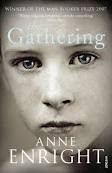
The Gathering by Anne Enright, 2007
Read in the Vintage 2008 edition shown
The decision of the 2007 Booker prize judges to give this book the nod over On Chesil Beach must rank as one of the all-time puzzling decisions of a prize panel. Because this was lame. The novel’s central premise is very traditional – a family member has committed suicide, and the clan gathers to mourn their loss and review his life. This is shown us by Veronica Hegarty, the book’s narrator, sister of the suicide, Liam. We are told early on that Liam’s death can be traced back to an event in his childhood. The traditional dark secret revolves around her grandmother, Ada – I was irresistibly reminded of another Ada, great-aunt Ada Doom, who saw something nasty in the woodshed, and has never been the same since.
The reveal – that Liam was sexually assaulted by a friend of the grandmother. (he was staying with his grandmother as his mother went through yet another pregnancy) is underwhelming. The line between this assualt and his eventual suicide decades later is never drawn – in fact Liam is a very lightly sketched character, and we understand little about his life and why he took it. The disclosure of this incident from the past is not the turning point we are led to expect – it is not revealed to the wider family, and nothing comes from it.
Stylistically the prose is wooden and at times comically so. When the narrator has sex with her husband she describes lying there “quartered like a chicken”. The narrator says of the young undertaker “You could unpeel him and he would still be true” (75) which is not just a whacky metaphor but gibberish isn’t it? Whether this disjointed narrative is supposed to reflect the distressed psyche of the narrator is besides the point – it is still clumsyily written. P.S. As with The Accidental, negative reviews on Amazon outweigh the positive – and I genuinely don’t believe this is just Booker bashing.
Comment: Reading Lists
Remarkably this will be one of the only resolutions I have ever kept. The aim was to keep a record of books read in 2012 for posterity’s sake, and to allow me space to record my thoughts and impressions of the books. It has led me to think of some possible new resolutions for 2013 and beyond:
- Shakespeare – reading the whole of the canon, including the poetry, in one year. More than do-able, especially as I have read probably 75% already (although I would have to reread, as most of this was 30 years ago!)
- Russian classics – a big black hole in my reading thus far, although I am coming close to finishing Crime and Punishment, finally.
- Booker prize winners – about 40 novels or so which is comfortably do-able in a year – again I can tick off a good dozen or so already, although some, such as Cloud Atlas would definitely be worth revisiting. Other, like The Old Devils, Amis senior, probably less so. I reckon I could take a good bite out of all shortlisted books as well, but I think that counts as sadism.
- Noble laureates – lots of world literature out there which I know nothing about.
Any other ideas?
The Accidental by Ali Smith
The Inheritance of Loss – Kiran Desai
Of Mice and Men by John Steinbeck
Firstly, we are encouraged throughout the story to think of Lennie as an animal – all of the imagery used to describe him focuses on this aspect of his appearance and behaviour. When we first see him he is described as “dragging his feet a little, the way a bear drags his paws” (page 19); later he is said to be “as strong as a bull” (43); and later still he “came as silently as a creeping bear” (140). Bears and bulls are of course dangerous, and frequently killed by man.
The story is set in a world in which it is legitimate for man to destroy animals – for example to avoid unnecessary suffering. We are given two examples if this in the text – the killing of Candy’s dog, and the killing of four of Slim’s puppies. The putting down of Candy’s dog is particularly poignant and telling – Candy is told it is the right thing to do, and the reasons are compelling, but at the same time we can clearly see that it is not a straightforward decision. He is told to shoot the dog in the back of the head, which prefigures Lennie’s death. And of course it is Candy’s gun which is used to kill Lennie, underlining the connection between the two deaths, if such emphasis were needed. So Lennie is little more than an animal, and it is acceptable to put animals down when their owners feel it is appropriate to do so, therefore….
But Lennie isn’t an animal, and killing him is not legitimate.
Lennie is brain-damaged and disabled, and whatever his crimes did not deserved to be put down like a dumb beast. Across the Atlantic, the Nazis were treating disabled people in pretty much the same way as George does Lennie, weighing their value in the balance and killing those found too much of a burden.
So why, when George kills Lennie, do so many readers see it as nothing less than an act of love, more than a mercy killing, a gift, sending Lennie to the promised land he has no prospect of inheriting on earth? Steinbeck spends the whole book leading us to this point, painting the choices George makes as unavoidable. We are told of their near escape from their previous town, when Lennie scares a young woman, sparking a manhunt. We are told of Lennie’s troubled childhood and George’s charity in taking him on. We see Lennie’s propensity for killing animals accidentally. And George loves Lennie, cares for him as best he can, and doesn’t want him to suffer the painful death Curley threatens.