Book review

King Solomon’s Mines, by H Rider Haggard 1885

King Solomon’s Mines, by H Rider Haggard, 1885

When I was very much younger, so much younger than today, my parents had a lavishly illustrated collector’s edition of ‘King Solomon’s Mines’ in their modest collection of books. The illustrations were vivid and I can remember them to this day. This must have been why I was able to recall a vast amount of detail about the text, brought to mind by those lurid sketches, when I finally returned to reread the novel this week.
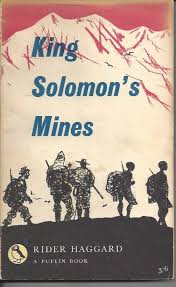
Advertised on publication as “The Most Amazing Book Ever Written”, quite a bold claim, ‘King Solomon’s Mines’ is a classic ‘boy’s own’ adventure story (the dedication is “to all the big and little boys who read it” and describes it as a “story of treasure, war, and wild adventure… I can safely say that there is not a petticoat in the whole history.”). This is a novel that has no pretensions to be anything other than escapist. Published at a time when explorers were still uncovering ancient treasures and when parts of the world were still unexplored by Europeans, (although probably not as many as Haggard suggests) it is easy to see how the adventures of Allen Quatermain and his friends would have captured the public’s imagination in the way it did mine three quarters of a century later.

It is said that Haggard wrote the novel as a result of a bet with his brother, who claimed that he could not write a novel half as good as Robert Louis Stevenson’s ‘Treasure Island’. Whether this is apocryphal or not I have no way of knowing – people tell stories about the origins of their novels because they are asked the question so often. Nevertheless it makes sense – King Solomon’s Mines is essentially a big treasure hunt. Allan Quatermain is employed by Sir Henry Curtis and his friend Captain Good to help find Sir Henry’s long-lost brother, missing in the uncharted African interior. Quatermain suspects this will be a wild goose chase and a highly dangerous one at that, but agrees in return for a share of any treasure they find. They are joined on the quest by various native bearers, porters, and servants, including one, Umbopa, who obviously is more than meets the eye.

After a perilous journey across a deadly desert they travel into a valley, hidden from the outside world by the protective desert and mountains. This is Kukuanaland. A patrol of warriors are about to kill our adventurers, but are so impressed by Captain Good false teeth, monocle, and white legs that they decide to save them. I must admit I groaned at the clichéd nature of these scenes before reminding myself that these are possibly the source of the cliché itself, or one of the earliest such versions at least. Later they prove their divinity as “white men from the stars” by accurately predicting (and claiming personal responsibility for) a lunar eclipse, one such event just happening to be due at just the right time.

King Twala, ruler of Kukuanaland, is a brutal dictator who has come to power by killing his brother. It is soon revealed that Umbopa is actually Ignosi, the rightful king of the Kukuanas. Civil war breaks out with the Englishmen and tribes loyal to Umbopa/Ignosi on one side, and King Twala and his troops on the other. After a lengthy and bloody battle, the rebel alliance triumphs and Twala is beheaded by Sir Henry in a duel. The adventures continue with the search for the lost treasure that has driven them this far. I won’t fill in all the gaps in their adventures but the path to the diamonds is not an easy one.

It is clear that Haggard knew his setting well. There is enough convincing detail to make the scenes realistic, although I did notice that the travellers suffer from ravenous hunger and terrible thirsts after only a few hours of fasting, presumably a way for Haggard to make the passage of time seem longer.

King Solomon’s Mines is credited with creating the “Lost World”, genre. Typically in stories of this period of European exploration in and exploitation of Africa, there is a general assumption that the white man is superior, the natives are brutal, stupid, and easily tricked. Haggard doesn’t deploy these lazy clichés thoughtlessly, although there is barbarism aplenty. While some of his African characters are depicted as monstrous animals, such as ‘The Elephant’, King Twala , others are noble, brave and heroic. The racism is generally muted – Quatermain refuses to use the n-word and says that many Africans are more worthy of the title of “gentleman” than Europeans. The romance between a Kukuana woman, Foulata, and Captain Good is an extremely early and quite touching portrait of an interracial relationship. Quatermain is also opposed to slavery:

“ Now I know your low-class Delagoa Portugee well. There is no greater devil unhung in a general way, battening as he does upon human agony and flesh in the shape of slaves.”

This isn’t an academic analysis, but the commentary on imperialism in late colonial Africa is fascinating. Haggard goes out of his way to present an image of undiscovered territory deep in the interior of the continent, protected by natural barriers. He also sexualises the landscape, most notably with the descriptions of the mountains as “Sheba’s breasts”. Is Haggard recreating an aspect of the continent that by 1885 was almost completely lost?

As a narrator Quatermain is self-effacing, constantly stressing his absence of courage. In the introduction he misleadingly presents himself as a scientist and anthropologist:

“if I had given way to my own impulses, I should have wished to go into the differences, some of which are to my mind very suggestive, between the Zulu and Kukuana dialects. Also a few pages might have been given up profitably to the consideration of the indigenous flora and fauna of Kukuanaland.”.

But this is not going to be a complex narrative about the flora and fauna of darkest Africa:

“The fact of the matter is, I thought… that the best plan would be to tell my story in a plain, straightforward manner…It only remains for me to offer apologies for my blunt way of writing. I can but say in excuse of it that I am more accustomed to handle a rifle than a pen, and cannot make any pretence to the grand literary flights and flourishes which I see in novels—for sometimes I like to read a novel.

Quatermain is initially a digressive author, giving away at least some of his plot (he tells us that at least two of his party die, and that he has to account for their deaths to a magistrate). This framing introduction, and the editorial footnotes which gently tease the narrator, reassure the reader than whatever the perils our hero comes through in the end.

Finally, I probably didn’t notice the homo-eroticism gaze that Quatermain uses in his descriptions of the other members of his party – but I think it’s there if you read between the lines. Here is our first introduction to the Umbopa:

“Presently a tall, handsome-looking man, somewhere about thirty years of age, and very light-coloured for a Zulu, entered, and lifting his knob-stick by way of salute, squatted himself down in the corner on his haunches, and sat silent.”

Later Quatermain describes the scene when Sir Henry inspects the tattoo which is Umbopa’s evidence that he is the long-lost prince of Kukuanaland:

“Sir Henry told me to ask him to stand up. Umbopa did so, at the same time slipping off the long military great coat which he wore, and revealing himself naked except for the moocha round his centre and a necklace of lions’ claws. Certainly he was a magnificent-looking man; I never saw a finer native. Standing about six foot three high he was broad in proportion, and very shapely. In that light, too, his skin looked scarcely more than dark, except here and there where deep black scars marked old assegai wounds. Sir Henry walked up to him and looked into his proud, handsome face.”

Later still, when preparing for battle, Sir Henry chooses to dress as a native warrior:

“When you are in Kukuanaland, do as the Kukuanas do,” he remarked…round his throat he fastened the leopard-skin cloak of a commanding officer, on his brows he bound the plume of black ostrich feathers worn only by generals of high rank, and about his middle a magnificent moocha of white ox-tails. A pair of sandals, a leglet of goat’s hair, a heavy battle-axe with a rhinoceros-horn handle, a round iron shield covered with white ox-hide, and the regulation number of tollas, or throwing-knives…I am bound to say that I seldom saw a finer sight than Sir Henry Curtis presented in this guise. It showed off his magnificent physique to the greatest advantage, and when Ignosi arrived presently, arrayed in a similar costume, I thought to myself that I had never before seen two such splendid men”.

Possibly for reasons of nostalgia I have a soft spot for King Solomon’s Mines, and I enjoyed revisiting it. It’s an important text in the history of imperial novels about Africa, but also an enjoyable and not particularly offensive adventure story in the Indiana Jones mould.
Standard
Book review

Castle Rackrent by Maria Edgeworth, 1800

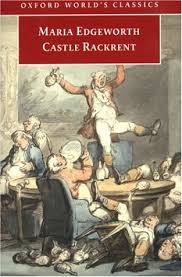
Maria Edgeworth was, in her time, an extremely successful author, and is claimed as an influence on a number of other writers, not least of which is Jane Austen. ‘Castle Rackrent’ is an early work, a short novella with a title suggestive of the gothic, but actually totally devoid of anything mysterious, other-worldly or supernatural. 

Castle Rackrent is the tale of how four generations of Rackrent heirs mismanage and squander their estate. The narrative is told through the family steward, Thady Quirk, who is sometimes cited as an example of an early if not the first unreliable narrator. Thady has only a limited grasp of what is going on most of the time; his one dominant interest is loyalty to his master, whoever that happens to be. The heirs are variously spendthrifts, litigious, gamblers and careless with money, but the end result is always a continuation of the slow decline of the castle and its estate.

There is very little here by way of a plot. Each Rackrent inherits the castle, makes a mess of it is fairly quick time, then expires. As a satire on the land-owning classes of the English aristocracy in Ireland the novel has some limited interest, but it is gentle satire indeed. When the novel was published the UK and Ireland were working to formalise a political union, and Edgeworth clearly illustrates the dangers or weaknesses of English dominance of Ireland, so the satire had some immediate relevance which has long since faded.

The novel is bookended by a preface and conclusion by an anonymous editor, as well as being interspersed with footnotes which provide an ironic commentary on the text. This has a distancing effect – the reader is invited to treat the novel more as a second-hand artefact, a personal memoir rather than as a narrative. Thady himself appears as only an otherwise minor character in the novel, and his voice seems unauthentic – there is little attempt to capture the accent or language of an Irish native. The text has some examples of local dialect but these seem shoe-horned into the text for local ‘colour’ rather than with any authenticity. 

The text also has a breath-taking example of anti-semitism. This is how Thady, admittedly not the most reliable observers, describes his first meeting with his master’s new bride:

I got the first sight of the bride; for when the carriage door opened, just as she had her foot on the steps, I held the flam full in her face to light her, at which she shut her eyes, but I had a full view of the rest of her, and greatly shocked I was, for by that light she was little better than a blackamoor, and seemed crippled; but that was only sitting so long in the chariot…‘Will I have a fire lighted in the state-room to-night?’ was the next question I put to her, but never a word she answered; so I concluded she could not speak a word of English, and was from foreign parts. The short and the long of it was, I couldn’t tell what to make of her; so I left her to herself, and went straight down to the servants’ hall to learn something for certain about her. Sir Kit’s own man was tired, but the groom set him a-talking at last, and we had it all out before ever I closed my eyes that night. The bride might well be a great fortune—she was a JEWISH by all accounts, who are famous for their great riches. I had never seen any of that tribe or nation before, and could only gather that she spoke a strange kind of English of her own, that she could not abide pork or sausages, and went neither to church or mass. Mercy upon his honour’s poor soul, thought I; what will become of him and his, and all of us, with his heretic blackamoor at the head of the Castle Rackrent estate? I never slept a wink all night for thinking of it; but before the servants I put my pipe in my mouth, and kept my mind to myself, for I had a great regard for the family; and after this, when strange gentlemen’s servants came to the house, and would begin to talk about the bride, I took care to put the best foot foremost, and passed her for a nabob in the kitchen, which accounted for her dark complexion and everything.

This bride then refuses to surrender her family jewels to her husband, so he proceeds to lock her in her room for seven years, until he finally dies in a duel and she is released, to quite understandably fly the country. 

I appreciate this description is Thady’s, not the author’s, and is being presented to the reader as an example of his prejudice and backwardness. The principle intent here seems to present the reader with a comedic situation rather than satirise or comment on attitudes towards anti-semitism or indeed the relationships between abusive husbands and their wives. Compare how Anne Bronte compassionately deals with the latter issue a few years later in ‘The Tenant of Wildfell Hall‘. 

Edgeworth’s novels remain widely in print, and seem to be read if Goodreads reviews are anything to go by. So far I have yet to see the attraction. If you have read any of her other novels that you can recommend please let me know. 

Standard
Book review

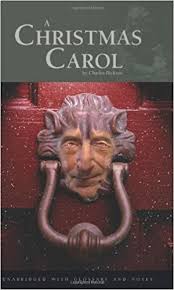
A Christmas Carol, by Charles Dickens, 1843

Or to give it its full title, ‘A Christmas Carol in prose, being a Ghost story of Christmas’.

I challenge you to find a better first line that the one Dickens uses to open ‘A Christmas Carol’:

“Marley was dead: to begin with.”

I love that use of the colon in the middle of this sentence. It works perfectly, giving a long pause before the punchline. This is an author at the top of his page. The reader is compelled to know who Marley is, and why his death seems such a temporary state of affairs.

‘A Christmas Carol’ is a miniature masterpiece, and seems more popular than ever. The reasons for its success aren’t hard to find. Dickens is hardly known for the economy of his writing – he is usually pretty verbose – but when he needs to he can cover a lot of ground very quickly. In less than 100 pages he manages to give us so much. Where to begin?

Well first the novel gives us a vivid, definitive portrait of a miser, to the extent that not only has ‘Scrooge’ become synonymous with the word, but that some of his phrases, such as ‘humbug!’ have also passed into common usage:

Oh! But he was a tight-fisted hand at the grindstone, Scrooge! a squeezing, wrenching, grasping, scraping, clutching, covetous, old sinner! Hard and sharp as flint, from which no steel had ever struck out generous fire; secret, and self-contained, and solitary as an oyster. The cold within him froze his old features, nipped his pointed nose, shrivelled his cheek, stiffened his gait; made his eyes red, his thin lips blue; and spoke out shrewdly in his grating voice. A frosty rime was on his head, and on his eyebrows, and his wiry chin. He carried his own low temperature always about with him; he iced his office in the dog-days; and didn’t thaw it one degree at  Christmas.”

It is easy to forget the impact of the text as a a ghost story. It has some genuinely chilling moment, such as when Scrooge pleads for a chance from the voiceless ghost of Christmas yet to be. Dickens is sometimes not given credit for his skill as a writer, with critical comment focusing on his storytelling and characterisation. But he takes us into Scrooge’s mind, capturing wonderfully his fear and paranoia, such as here when he is searching this rooms for the ghosts Marley has told him will come to visit:
Nobody under the bed; nobody in the closet; nobody in his dressing-gown, which was hanging up in a suspicious attitude against the wall.

Scrooge’s story is not just a portrait, but it is also a story of redemption, which tells us that no-one however troubled or lost is completely beyond hope. Scrooge’s backstory is filled in very lightly, with just a few sketches of his early life during his time with the ghost of Christmas Past, but it is more than enough for us to understand how he has come to be the pathetic sad man he is.

The text also includes some descriptive passages and scenes which have come to define a Victorian Christmas. It is for historians to judge whether Dickens defined many of the traditional features of Christmas that we now treasure, or simply recorded them. But either way there is no doubt that he captures brilliantly some of what we now think of as quintessentially Christmassy elements. As it is nearly Christmas I am going to indulge myself by including below some long excerpts from the text with little by way of annotation or analysis – it quite obviously doesn’t need it. But look out for the wonderful, opulent use of verbs and adjectives, and the way almost everything is personified, from the misanthropic ice to the old bell peeping down from its tower – everything can join in the Christmas celebrations!

Meanwhile the fog and darkness thickened so, that people ran about with flaring links, proffering their services to go before horses in carriages, and conduct them on their way.The ancient tower of a church, whose gruff old bell was always peeping slily down at Scrooge out of a Gothic window in the wall, became invisible, and struck the hours and quarters in the clouds, with tremulous vibrations afterwards as if its teeth were chattering in its frozen head up there. The cold became intense. In the main street, at the corner of the court, some labourers were repairing the gas-pipes, and had lighted a great fire in a brazier, round which a party of ragged men and boys were gathered: warming their hands and winking their eyes before the blaze in rapture. The water-plug being left in solitude, its overflowings sullenly congealed, and turned to misanthropic ice. The brightness of the shops where holly sprigs and berries crackled in the lamp heat of the windows, made pale faces ruddy as they passed.Poulterers’ and grocers’ trades became a splendid joke: a glorious pageant,with which it was next to impossible to believe that such dull principles as bargain and sale had anything to do. The Lord Mayor, in the stronghold of the mighty Mansion House, gave orders to his fifty cooks and butlers to keep Christmas as a Lord Mayor’s household should; and even the little tailor, whom he had fined five shillings on the previous Monday for being drunk and bloodthirsty in the streets, stirred up to-morrow’s pudding in his garret,while his lean wife and the baby sallied out to buy the beef”

The walls and ceiling were so hung with living green, that it looked a perfect grove; from every part of which, bright gleaming berries glistened. The crisp leaves of holly, mistletoe, and ivy reflected back the light, as if so many little mirrors had been scattered there; and such a mighty blaze went roaring up the chimney, as that dull petrification of a hearth had never known in Scrooge’s time, or Marley’s, or for many and many a winter season gone. Heaped up on the floor, to form a kind of throne, were turkeys,geese, game, poultry, brawn, great joints of meat, sucking-pigs, long wreaths of sausages, mince-pies, plum-puddings, barrels of oysters, red-hot chestnuts,cherry-cheeked apples, juicy oranges, luscious pears, immense twelfth-cakes,and seething bowls of punch, that made the chamber dim with their delicious steam. In easy state upon this couch, there sat a jolly Giant, glorious to see;who bore a glowing torch, in shape not unlike Plenty’s horn, and held it up,high up, to shed its light on Scrooge, as he came peeping round the door.

For, the people who were shovelling away on the housetops were jovial and full of glee; calling out to one another from the parapets, and now and then exchanging a facetious snowball—better-natured missile far than many a wordy jest—laughing heartily if it went right and not less heartily if it went wrong. The poulterers’ shops were still half open, and the fruiterers’were radiant in their glory. There were great, round, pot-bellied baskets of chestnuts, shaped like the waistcoats of jolly old gentlemen, lolling at the doors, and tumbling out into the street in their apoplectic opulence. There were ruddy, brown-faced, broad-girthed Spanish Onions, shining in the fatness of their growth like Spanish Friars, and winking from their shelves in wanton slyness at the girls as they went by, and glanced demurely at the hung-up mistletoe. There were pears and apples, clustered high in blooming pyramids;there were bunches of grapes, made, in the shopkeepers’ benevolence to dangle from conspicuous hooks, that people’s mouths might water gratis as they passed;there were piles of filberts, mossy and brown, recalling, in their fragrance,ancient walks among the woods, and pleasant shufflings ankle deep through withered leaves; there were Norfolk Biffins, squat and swarthy, setting off the yellow of the oranges and lemons, and, in the great compactness of their juicy persons, urgently entreating and beseeching to be carried home in paper bags and eaten after dinner. 

The Grocers’! oh, the Grocers’! nearly closed, with perhaps two shutters down, or one; but through those gaps such glimpses! It was not alone that the scales descending on the counter made a merry sound, or that the twine and roller parted company so briskly, or that the canisters were rattled up and down like juggling tricks, or even that the blended scents of tea and coffee were so grateful to the nose, or even that the raisins were so plentiful and rare, the almonds so extremely white, the sticks of cinnamon so long and straight, the other spices so delicious, the candied fruits so caked and spotted with molten sugar as to make the coldest lookers-on feel faint and subsequently bilious. Nor was it that the figs were moist and pulpy, or that the French plums blushed in modest tartness from their highly-decorated boxes,or that everything was good to eat and in its Christmas dress; but the customers were all so hurried and so eager in the hopeful promise of the day,that they tumbled up against each other at the door, crashing their wicker baskets wildly, and left their purchases upon the counter, and came running back to fetch them, and committed hundreds of the like mistakes, in the best humour possible; 

Standard
Book review

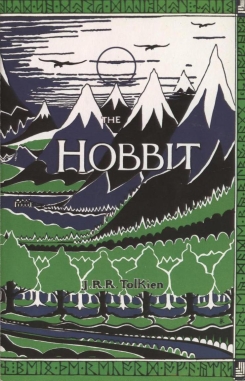
The Hobbit, or There and Back again, by J R R Tolkien 1937

It was a pleasure returning to Tolkien’s ‘The Hobbit’ after a break of several decades (plus the three Peter Jackson films of course). It’s a lovely young person’s novel – the description on the blurb of it being a children’s novel is a little imprecise for my liking, as anyone under the age of approximately 10 may not appreciate the length of the text, or some of the moments of peril and violence. To be honest, I suspect the complete absence of any female characters whatsoever might be off-putting to younger female readers as well. 

The novel famously opens with a description of the habits and domestic life of Bilbo Baggins, a hobbit with a family line inclined to most un-hobbit like adventuring. Gandalf the wizard (as opposed to all those other Gandalfs you know) uses Bilbo’s comfortable little home to host a gathering of dwarves setting out on a long-planned quest to recover their family treasure and home from the dragon, Smaug. On Gandalf’s recommendation, Bilbo is recruited as the expedition’s burglar. And so the quest begins the long journey east, past peckish trolls, to the last Homely House in Rivendell, which Tolkien does a wonderful job of making sound so alluring, across and into the Misty Mountains, where  Bilbo finds a certain ring, through Mirkwood, and on to the Lonely Mountain, their final destination.

It is an epic journey, full of wonderful adventures. Tolkien packs a lot into a short book. The final resolution is darker than one expects, as the novel grapples with the reality of the quest, its risks and danger, rather than simply using magic or another narrative trick to resolve the travellers’ problems. There is a very serious consideration of the problem of what to do when your dreams come true, how to be brave when your friends go astray, and how to honour your responsibilities to others. If that makes it sound worth it is anything but. 

The quest format is enduringly popular for good reason, and Tolkien writes with considerable economy – the events of the novel occur at a rapid pace, with little of the self indulgent diversions that marred the films. The one obvious exception to this is the fairly awful poetry that Tolkien seems unable to resist. 

The novel builds brilliantly to the climactic Battle of the Five Armies. Here younger readers’ sense of peril will be put to the test, because while the narrator takes care to reassure us of Bilbo’s eventual fate, some of his fellow adventurers are not so lucky. This is a great introduction to fantasy literature for younger readers, and as the genesis story to the much weightier ‘Lord of the Rings’ it is a good starting point for anyone thinking of pitching into the trilogy. Adult readers will enjoy the quest as well – I know I did. 

Standard
Book review

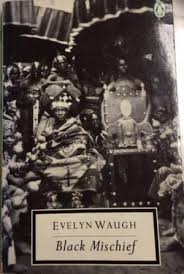
Black Mischief, by Evelyn Waugh, 1932

In many of my previous reviews I have struggled to respond to texts that either contain offensive language – that use racially insulting terms, that denigrate gay people or women, or otherwise offend my twenty-first century sensibilities. I usually try to draw a distinction between those texts that use offensive language which was in common usage in the period in which the text was written – Huckleberry Finn, for example, with its widespread use of the n-word – and texts that are more broadly offensive, that perpetuate stereotypes or go out of their way to be insulting to racial or other groups. Sometimes I find offensive novels that have not generally been considered in that category – Perfume being the obvious example, which most reviewers found harmless but which I took great exception to. 

In almost all cases however, I have been able to find redeeming features in the text. The novelist may have been reflecting outdated attitudes towards race, gender or sexuality, but they have nevertheless managed to write something worth reading. But that is mainly because I have been careful not to read those books that should be forgotten and which don’t merit a wider readership today. History has edited these novels from our bookshelves. But this is not always the case with authors who have written otherwise well thought of work, such as Evelyn Waugh’s ‘Black Mischief’. Because ‘Black Mischief‘ is an embarrassingly offensive novel. 

The events of ‘Black Mischief‘ take place mainly in the island kingdom of Azania, one of the few independent countries in Africa between the world wars. Waugh’s intention appears overt – he sets out to demonstrate that allowing African peoples to run their own countries is a ludicrous proposition that leads to profound mis-Government, chaos, and conflict. His argument is that Africans simply don’t have the intelligence, judgment or ability to run their own affairs.

Seth, emperor of Azania, inherits his role shortly after graduating from Oxford. He determines to modernise his country, but his ambitions are portrayed as utterly unrealistic – not only does he not understand what modernisation entails, but his efforts are undermined by his people, who have no interest in the modern world, and his officials, who just want to steal anything not nailed down.

Basil Seal, a feckless college friend, journeys to Azania on a whim to escape his debts in London, and is quickly appointed Minister of Modernisation. His sidekick is the Armenian businessman Yokoumian, an equally unpleasant and racist portrait. The small group of Europeans in Azania, diplomats, businessmen and missionaries, do not escape Waugh’s satire – they are all crooks and bored idiots, particularly the British consular staff headed by Sir Samson Courtenay, but there is a venom in the portraits of the Africans in the novel that is missing when the focus turns to the Europeans. 

A pageant to celebrate birth control is used as cover for the launch of a coup against Seth, with the French consul planning to install a puppet Government headed by his senile uncle Achon, who promptly dies at his coronation. In the bloodbath that follows the League of Nations steps in and claims the country as a League of Nations Mandate. The natural order with the white man running matters is restored, and Basil returns to London, where his absence has passed largely unnoticed. 

Many reviewers claim this novel is a satire. I am not sure that is right – what precisely is it satirising? Certainly not colonialism – Azania is not a colony. Modernisation? Perhaps, but it is hard to see what aspects of modernisation are problematic. Or is it modernisation in Africa? Is Waugh telling the reader that modernising Africa is pointless, because they will just use mis-use whatever modern devices or ideas we ‘give’ them (the wires used in the railway’s construction are used as jewellery, for example). The most striking example of this is the poster drawn up to advertise the benefits of birth control, showing one family wealthy and healthy with one child, and another family with many children where life is hard and poor. These posters are misunderstood by the Africans – silly people unable to understand a simple poster – and they think the single child family is the one that is being presented as the one to avoid. 

Life is cheap in Azania – people are killed casually throughout the novel – and cannibalism is widespread. There isn’t a racist stereotype untapped. There isn’t a single positive African character, not even for contrast – they are all either evil, conniving, mercenary, or murderous. Or all four. 

Waugh is not a bad writer, but I can’t help thinking that this novel should be allowed to quietly fade away. It’s not funny, the casual and incessant racism is hard to take, and the ending is callously brutal. For the first time ever I was embarrassed to be seen reading this novel (with the front cover shown above) on public transport, which probably says it all. 


Standard
Book review

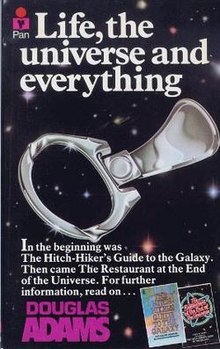
Life, the Universe, and Everything, by Douglas Adams,


The novels in the Hitchhiker series have a complex publishing history. ‘Life, the Universe and Everything’ (the answer to which is, of course, 42),  was originally an outline for a Doctor Who series, Dr Who and the Krikketmen. For some unknown reason the proposal was rejected by the BBC, and it went on to eventually become the third novel of five in the Hitchhiker trilogy. It’s never been filmed, and did not form part of the radio series, which explains why the novel had a less familiar feel than ‘Hitchhiker‘ and ‘Restaurant‘. 

When I read the first two novels each scene was like revisiting an old friend. I could see jokes coming a long way off, but they were still golden. ‘Life’, by contrast, was a lot less familiar; while I recalled the plot and the overall structure, some of the individual events were unfamiliar, and all the more enjoyable for it.

The question I can never avoid asking when reading a series is ‘When will the quality start to dip?’ When will the author start repeating themselves, or ironically referencing themselves, or even worse in a desperate attempt to avoid repetition start taking the characters into ever more unlikely situations. This last option wasn’t possible for Adams, who had already sent his characters to the restaurant at the end of the universe, and I am pleased to say that the quality of the writing, the originality of the ideas, and the jokes do not suffer by comparison with the earlier novels. Possibly the storyline is stretched a little thinly, and any peril is completely missing – Arthur and co. have been blown up and shot at so many times that we know an utterly unlikely escape route is always bound to turn up at the last minute. Plot armour in other words. But the compensation is in the high quality jokes and ideas, such as the immortal creature who decides to insult everyone in the universe, the explanation as to why the bowl of petunias thought “Not again!”, and the concept of bistromathematics.

The novel picks up where ‘Restaurant’ ends, with Arthur stranded on pre-historic Earth. Ford Prefect, his friend from Betelgeuse, arrives to take him to see the cricket at Lords. The game is interrupted, first by their arrival and then in an even more unlikely development by a squad of white robots, who steal the Ashes. On cue Slartibartfast, award-winning creator of Norwegian fjords, arrives in the starship Bistromath, and asks Ford and Arthur for help in saving the universe.

The Bistromath is more powerful than the Heart of Gold, being powered by the mathematics of Italian restaurants (this is the imagination and creativity of Douglas Adams, and if you don’t like it take a good long look at your life). As they travel, Slartibartfast uses a hologramatic film to explain that he is trying to prevent the robots from collecting the legendary Wikkit Gate, which will unlock the planet Krikket, and unleash galaxy-wide armageddon. It seems a little more plausible when Adams tells the story – not much admittedly.

Picking up Zaphod and Trillian along the way, the team fail miserably in stopping the robots collecting the various pieces of the key or unlock the time lock. Our crew instead hopelessly transport to the planet to attempt to negotiate with the Krikkit people. To their surprise, they find that the people seem to lack any desire to continue the war, and are directed to the robot and spaceship facilities in orbit about the planet. With Zaphod and Marvin’s help, the group is able to infiltrate the facilities. There are some definite Star Wars echoes here – an intrepid band of outcasts and renegades fighting to prevent the end of the world – it is a classic story I suppose. Trillian works out (the reader will have been ahead of her I think) that the Krikkiters have been manipulated into their galaxy-hatred and galaxy-destroying capability, and confronts the mastermind behind the evil plan. No, not the Sith. 

I won’t spoil the ending for you, although as Simon Brett says in the introduction to the Pan edition of the novel, “You don’t read Douglas Adams for the plots any more than you read Raymond Chandler for his”. Which might explain why with my varied reading diet of Chandler and Adams I am probably overdue something a bit more plot driven!

Origins

Standard
Book review

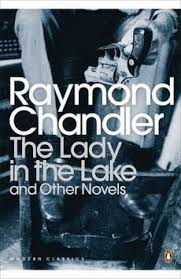
The Lady in the Lake, by Raymond Chandler, 1943

My binge reading of Chandler continues with ‘The Lady in the Lake‘, a title that does two things. It tells us to expect a body to turn up sooner or later in a lake, and hints more obliquely that there may be Arthurian elements to the narrative.

Marlowe takes a case that he would normally avoid – a MisPers (missing person). Crystal Kingsley has run out on her husband, Derace, sending him a telegram saying she was divorcing him and marrying her lover Chris Lavery. But Lavery denied all knowledge of an elopement plan when Derace met him a few days after he received his wife’s letter. Marlowe begins his investigation with a visit to Lavery in Bay City, somewhere Marlowe has had run ins with the local cops before. It’s no surprise therefore that while watching Lavery’s house, Marlowe is threatened local cop Al Degarmo, who accuses him of watching Lavery’s neighbour, Dr. Almore. Almore’s wife had died in suspicious circumstances about a year earlier. Anyone with any experience of detective fiction will jump to the conclusion that Marlowe’s missing persons case and Mrs Almore’s death will, in some way, be connected.

Lavery leads Marlowe nowhere except the run in with the local law enforcement, so he decides to drive up to the Kingsley’s holiday cabin at Little Fawn Lake, where Mrs Kingsley was staying before she went missing. Yes, that’s the lake we were waiting for. Marlowe meets the caretaker, Bill Chess, who in a highly suspicious, red lights flashing coincidence, has just been walked out on by his wife, Muriel. The scene where Marlowe and Chess chat on the boardwalk by the lake, and eventually discover the secret hidden in the water, is a masterpiece of controlled writing:

“The depths cleared again. Something moved in them that was not a board. It rose slowly, with an infinitely careless languor, a long dark twisted something that rolled lazily in the water as it rose. It broke surface casually, lightly, without haste. I saw wool, sodden and black, a leather jerkin blacker than ink, a pair of slacks. I saw shoes and something that bulged nastily between the shoes and the cuffs of the slacks. I saw a wave of dark blond hair straighten out in the water and hold still for a brief instant as if with a calculated effect, and then swirl into a tangle again.” 

Chess is arrested for his wife’s murder, although Marlowe  is sceptical. Marlowe tries not to be distracted by this discovery, although even he begins to wonder why death seems to follow him around: 

It’s only Marlowe, finding another body. He does it rather well by now. Murder-a-day Marlowe, they call him. They have the meat wagon following him around to follow up on the business he finds.

He goes back to interview Lavery again, and it is no surprise to anyone when he finds him shot in his bathroom. Without a solid lead, he picks up the Almore case, and visits Mrs Almore’s parents, who suspect their daughter was murdered. Another run-in with the local police who are trying to prevent Marlowe investigating the Almore case derails this thread of the investigation for now, but there is no time to pause for breath before he receives a call from Derace Kingsley saying that Crystal has telephoned him asking for money to help her leave town. He asks Marlowe to make the pay-off –  by now he just wants rid of his wife, even if she seems the most likely suspect for Lavery’s murder.

Marlowe is never going to give money to help a murder suspect flee the jurisdiction, but when he confronts and accuses her she pulls a gun on him. As they struggle Marlowe is sapped. Some time later he comes round:
“I smelled of gin. Not just casually, as if I had taken four or five drinks of a winter morning to get out of bed on, but as if the Pacific Ocean was pure gin and I had nosedived off the boat deck. The gin was in my hair and eyebrows, on my chin and under my chin. It was on my shirt. I smelled like dead toads.”

Crystal lies strangled to death on the bed, presumably by whoever sapped Marlowe, and with a view to framing him for the murder. Degarmo the Bay City cop, who we have learned was in love with Muriel Chess, arrests Marlowe but quickly accepts he was not responsible for Crystal’s murder. He drives him back to Little Fawn Lake to arrest Kingsley, now chief suspect. There a final confrontation ensues and all the complex threads of the mystery are drawn together in a very satisfying finale. 

I’ve raved enough in recent posts to make it unnecessary to write further about the magnificence of Chandler’s prose. His imagery in particular is to my mind some of the best in modern fiction. Can you find a better simile than this, anywhere?
“She looked playful and eager, but not quite sure of herself, like a new kitten in a house where they don’t care much about kittens.” 

His descriptive passages are vivid and his character portraits have a wonderful economy. Here’s Kingsley’s assistant for example – note how the imagery just can’t be kept out of his writing even if he wanted it to:
“She wore a steel gray business suit and under the jacket a dark blue shirt and a man’s tie of lighter shade. The edges of the folded handkerchief in the breast pocket looked sharp enough to slice bread.”

‘The Lady in the Lake’ is not one of Chandler’s most popular or well-known Marlowe novels. It should be; it is classic Chandler, in full control of his material and at the top of his game. Marlowe is cynical but not bitter, hard-boiled but still open to romance. For me Chandler transcends detective fiction, while at the same time defining it. I guess if my reviews haven’t persuaded you of this now then I probably should quit trying, but in case you are in any doubt, give him a try, you won’t regret it. 

Standard
Book review

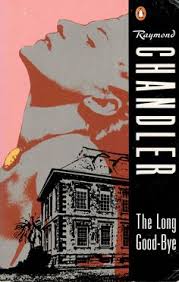
The Long Goodbye, by Raymond Chandler, 1953

I first read ‘The Long Goodbye‘ around 25 years ago, and returning to it was an absolute pleasure. It is another Marlowe novel, and is (as they all are), a gem. Some novels change over time, but Chandler’s work has a timeless quality. It doesn’t matter what is happening in the outside world, Marlowe will always be there with a smart line and a stiff drink, even if he has just discovered a body and been socked over the head.  ‘The Long Goodbye’ is late Marlowe/Chandler, with a reflective quality that shows that both men have been through a lot, and are beginning to feel their age.chandler

The plot is complex, as you would expect. Marlowe meets a drunk, Terry Lennox, outside a club. Lennox is a lush, married to a rich women who is serially unfaithful to him, and has a mysterious past, testified to by the scars down one side of his face. Marlowe and Lennox become unlikely and occasional drinking friends until Lennox shows up late one night needing a ride to the airport, no questions asked. Marlowe knows he must have very good reasons for this request, but doesn’t ask any awkward questions. He is a good enough detective to know there are only one or two reasons why someone in Lennox’s position would want to fly the country in the middle of the night. So it is no surprise when on his return from the airport, the police confirm that Mrs Lennox has been murdered. Marlowe refuses to co-operate with the police, and is slung in jail for his efforts. But his interrogation is cut short when news arrives that Lennox has committed suicide leaving a confession. Marlowe later receives a letter from Lennox containing a Madison, a $5,000 bill, and some cryptic comments that leave Marlowe with some questions about what has happened.

Chandler’s novels are often built around earlier magazine stories. Knowing this I was expecting a new storyline to be introduced at this point, and it comes when Marlowe is asked by a publisher to work out the dark secrets of one of his (the publisher’s) writers, Roger Wade. Wade is being driven to drink by whatever is troubling him, and when drunk he becomes violent, not least towards his wife. Wade has also gone missing.

Marlowe quickly tracks Wade down to a detox facility in an isolated ranch. Case solved. Inevitably that is not the end of Marlowe’s involvement with the Wades. They try to convince him to work for them as what we would now call Roger’s sober companion, but Marlowe is not interested. Meanwhile, the Lennox ‘case’ refuses to go away, even though there appears nothing left to investigate. Marlowe’s work with the Wades leads other people to conclude that he is still looking into the deaths of Mrs Lennox and her husband. This is a close-knit community where everyone knows everyone else, and there is a suggestion that Wade and Mrs Lennox were lovers . Marlowe is menaced by a mobster friend of Lennox’s, Mendy Menendez, and by Lennox’s ultra-rich father-in-law, to drop the case, even though he tells them repeatedly that he is not investigating it. Slowly, details emerge of the lives of these troubled people. Marlowe learns that Terry Lennox had lived in England, fought in the Second World War, and had been previously married.

Wade starts drinking again, and then apparently commits suicide. Marlowe is suspicious, but because he was alone with Wade at the time of his death it is he that becomes a suspect, although never seriously. In a traditional reveal scene Marlowe walks us through who really killed Mrs Lennox and Wade, and finally what really happened to Terry Lennox.

Chandler’s byzantine plots mean that even though I have read this novel before I was constantly kept guessing as to who killed whom. But as I have said before you shouldn’t read Chandler for the plots, but the wonderful prose:

When I got home I mixed a stiff one and stood by the open window in the living room and sipped it and listened to the groundswell of traffic on Laurel Canyon Boulevard and looked at the glare of the big angry city hanging over the shoulder of the hills through which the boulevard had been cut. Far off the banshee wail of police or fire sirens rose and fell, never for very long completely silent. Twenty four hours a day somebody is running, somebody else is trying to catch him. Out there in the night of a thousand crimes, people were dying, being maimed, cut by flying glass, crushed against steering wheels or under heavy tires. People were being beaten, robbed, strangled, raped, and murdered. People were hungry, sick; bored, desperate with loneliness or remorse or fear, angry, cruel, feverish, shaken by sobs. A city no worse than others, a city rich and vigorous and full of pride, a city lost and beaten and full of emptiness. It all depends on where you sit and what your own private score is. I didn’t have one. I didn’t care. I finished the drink and went to bed.” 

This is a melancholy and reflective novel in which the portraits of two serious drinkers, Wade and Lennox, are both considered self-portraits of the author.  Marlowe still takes a punch with the best of them, but it takes him just that little bit longer to come round. He is still a sucker for a pretty face, and when he takes a lover it forms part of the long goodbye of the novel’s title. I can’t rank Chandler’s novels against one another, and they are equally hard to compare to other detective fiction, such is their distinctiveness. All I can say is that if I had a desert island disc decision to make, Chandler would be very near if not at the top of my list. He is one of the language’s great stylists, and if you haven’t read him before, and aren’t offended too easily, I can’t recommend his work highly enough.

Standard
Book review

Comment: Structured or formulaic?

I have been trying to decide whether there is really a difference between a text that is highly structured, such as a sonnet for example, and a text that follows rules of composition that are formulaic. I have a suspicion that the difference may be limited: when we like the text we say it is structured, and we use the term formulaic when we want to be derogatory. However, the suspicion nags – can it really be that simple?

What set me down this track was a binge read of the Sherlock Holmes short stories. I don’t think it is controversial to say that Conan Doyle constructs most of these stories to a tight formula. The reader knows (and finds comfort from the fact) in outline what is going to happen at each stage of the story. Everything will be neatly wrapped up in a couple of thousand words. Some of these structures derive from the medium Conan Doyle was using – the magazine story – while others are self-imposed. They aren’t the rules of the genre, because Conan Doyle was pretty much inventing the genre himself. For me these stories – and there are exceptions of course – feel formulaic, as if the writer is providing the reader with what he assumed they wanted. We know that Conan Doyle eventually came to resent Holmes because of this.

But the rhyme structure of a sonnet is prescribed. The Harry Potter stories follow a rigid formula, but this doesn’t stop them being compelling. So what is the difference between adherence to form and writing within structural constraints? In a formulaic text the author is aware of the clichéd nature of the structures they are using. It is simply easier to allow the text to run along well-worn grooves. In a structured text the forms are there to guide the construction, not to govern it. The author can step outside the lines at any time. To offer some examples: Shakespeare’s most famous line – “To be or not to be, that is the question” – is an eleven syllable line in which the stresses can go almost anywhere we want them to. Anyone watching a Shakespeare play who thinks “What wonderful iambic pentameters” is really missing the point. In school we are taught that a sentence must have an object and a verb. But Charles Dickens opens ‘Bleak House’ with a one-word sentence – “London.” in which the reader is given almost completely free choice in the implied verb. Greater writers break rules. In a formulaic text the structures hold the text together, and without them it would just be a string of sentences. Conan Doyle could and did deconstruct his form – most famously when he killed off Holmes – but for too many of his stories he is on auto-pilot.

I am sure there’s more to this issue than the ground I have covered here – what do you think? I confess I have been tweaking this post for weeks trying to get the ideas straight on paper, and am close to giving up and just posting in the hope that someone might have some more insight on the issue than I have been able to muster!


Standard
Book review

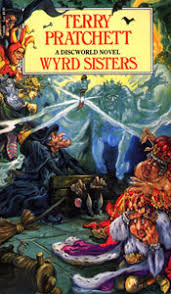
Wyrd Sisters (Discworld 6) by Terry Pratchett, 1988

‘Wyrd Sisters’ sees the return of Terry Pratchett’s magnificent three, Granny Weatherwax; Nanny Ogg, and Magrat Garlick, Discworld’s most chaotic coven. The opening of the novel is closely modelled on Pratchett’s source text, Macbeth: King Verence I of Lancre, a small mountainous kingdom high in the Ramtops, is murdered by his cousin, Duke Felmet, and the duke’s homicidal wife. So far so Shakespeare, but from this point the novel WSdeviates somewhat from its source. (For the avoidance of any doubt, this is of course a joke – Macbeth is a source for ‘Wyrd Sisters’ in the same way that Hamlet is a source for the Lion King, i.e. barely).

The king’s son and his crown are smuggled out of the castle and handed to the witches for safekeeping. They foster the child with a troupe of travelling actors, hide the crown in plain sight in a box of props, and settle back to watch destiny take its course. Their confident expectation is that the prince, Tomjon, will grow up, defeat Duke Felmet and take his rightful place as king.

However, this is Discworld, so of course things don’t work out as easily as that. Lancre is a highly magical and very slightly sentient kingdom, and is angry about the way the new King mistreats the land. Reluctantly, the coven casts a spell over the kingdom, freezing it in time for 15 years and allowing Tomjon to grow into a young man and therefore (in theory at least) able to challenge his er…second cousin (uncle would have been better) for the throne. Tomjon is also, as it happens, a highly talented actor…. Continue reading

Standard