
I first read ‘The Long Goodbye‘ around 25 years ago, and returning to it was an absolute pleasure. It is another Marlowe novel, and is (as they all are), a gem. Some novels change over time, but Chandler’s work has a timeless quality. It doesn’t matter what is happening in the outside world, Marlowe will always be there with a smart line and a stiff drink, even if he has just discovered a body and been socked over the head. ‘The Long Goodbye’ is late Marlowe/Chandler, with a reflective quality that shows that both men have been through a lot, and are beginning to feel their age.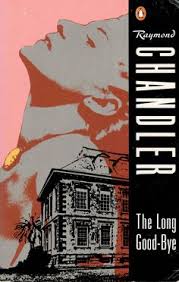
The plot is complex, as you would expect. Marlowe meets a drunk, Terry Lennox, outside a club. Lennox is a lush, married to a rich women who is serially unfaithful to him, and has a mysterious past, testified to by the scars down one side of his face. Marlowe and Lennox become unlikely and occasional drinking friends until Lennox shows up late one night needing a ride to the airport, no questions asked. Marlowe knows he must have very good reasons for this request, but doesn’t ask any awkward questions. He is a good enough detective to know there are only one or two reasons why someone in Lennox’s position would want to fly the country in the middle of the night. So it is no surprise when on his return from the airport, the police confirm that Mrs Lennox has been murdered. Marlowe refuses to co-operate with the police, and is slung in jail for his efforts. But his interrogation is cut short when news arrives that Lennox has committed suicide leaving a confession. Marlowe later receives a letter from Lennox containing a Madison, a $5,000 bill, and some cryptic comments that leave Marlowe with some questions about what has happened.
Chandler’s novels are often built around earlier magazine stories. Knowing this I was expecting a new storyline to be introduced at this point, and it comes when Marlowe is asked by a publisher to work out the dark secrets of one of his (the publisher’s) writers, Roger Wade. Wade is being driven to drink by whatever is troubling him, and when drunk he becomes violent, not least towards his wife. Wade has also gone missing.
Marlowe quickly tracks Wade down to a detox facility in an isolated ranch. Case solved. Inevitably that is not the end of Marlowe’s involvement with the Wades. They try to convince him to work for them as what we would now call Roger’s sober companion, but Marlowe is not interested. Meanwhile, the Lennox ‘case’ refuses to go away, even though there appears nothing left to investigate. Marlowe’s work with the Wades leads other people to conclude that he is still looking into the deaths of Mrs Lennox and her husband. This is a close-knit community where everyone knows everyone else, and there is a suggestion that Wade and Mrs Lennox were lovers . Marlowe is menaced by a mobster friend of Lennox’s, Mendy Menendez, and by Lennox’s ultra-rich father-in-law, to drop the case, even though he tells them repeatedly that he is not investigating it. Slowly, details emerge of the lives of these troubled people. Marlowe learns that Terry Lennox had lived in England, fought in the Second World War, and had been previously married.
Wade starts drinking again, and then apparently commits suicide. Marlowe is suspicious, but because he was alone with Wade at the time of his death it is he that becomes a suspect, although never seriously. In a traditional reveal scene Marlowe walks us through who really killed Mrs Lennox and Wade, and finally what really happened to Terry Lennox.
Chandler’s byzantine plots mean that even though I have read this novel before I was constantly kept guessing as to who killed whom. But as I have said before you shouldn’t read Chandler for the plots, but the wonderful prose:
“When I got home I mixed a stiff one and stood by the open window in the living room and sipped it and listened to the groundswell of traffic on Laurel Canyon Boulevard and looked at the glare of the big angry city hanging over the shoulder of the hills through which the boulevard had been cut. Far off the banshee wail of police or fire sirens rose and fell, never for very long completely silent. Twenty four hours a day somebody is running, somebody else is trying to catch him. Out there in the night of a thousand crimes, people were dying, being maimed, cut by flying glass, crushed against steering wheels or under heavy tires. People were being beaten, robbed, strangled, raped, and murdered. People were hungry, sick; bored, desperate with loneliness or remorse or fear, angry, cruel, feverish, shaken by sobs. A city no worse than others, a city rich and vigorous and full of pride, a city lost and beaten and full of emptiness. It all depends on where you sit and what your own private score is. I didn’t have one. I didn’t care. I finished the drink and went to bed.”
This is a melancholy and reflective novel in which the portraits of two serious drinkers, Wade and Lennox, are both considered self-portraits of the author. Marlowe still takes a punch with the best of them, but it takes him just that little bit longer to come round. He is still a sucker for a pretty face, and when he takes a lover it forms part of the long goodbye of the novel’s title. I can’t rank Chandler’s novels against one another, and they are equally hard to compare to other detective fiction, such is their distinctiveness. All I can say is that if I had a desert island disc decision to make, Chandler would be very near if not at the top of my list. He is one of the language’s great stylists, and if you haven’t read him before, and aren’t offended too easily, I can’t recommend his work highly enough.

