Book review

Harry Potter and the Half Blood Prince, 2005

Reading the Harry Potter books as they were published, with two or three year gaps between each (and with the films already being made of the earlier novels as the later novels were being published) was a great, collective experience. I can remember telling my sons on the night Deathly Hallows was published, a night of absurd media over-reaction, that they should savour the moment, because no-one was ever going to be able to read Deathly Hallows for the first time ever again – every subsequent reading of any of the novels would be in a world where the ending of the series was known.

Harry Potter and the Half-Blood Prince - Wikipedia

Speculation prior to the novel being published as to the identity of the Half Blood Prince (once the title had been confirmed, which was a media event all of its own) was rife. The revelation at the novel’s climax shows that Rowling once again set her readers a puzzle that they could not reasonably have been expected to solve – we are never told that Snape is a half blood nor that his mother’s maiden name is Prince, and while both are guessable, that’s not really the way literary puzzles work is it? Similarly futile speculation surrounded the book cover imagery when it was revealed – what are Harry and Dumbledore doing?

When chapters of the Harry Potter series break away from the concentrated focus of the central character, readers know to pay particular attention. These chapters are few and far across the seven novels – arguably there is only one other outside Half Blood Prince, the opening scenes of the Philosopher’s Stone, following Vernon Dudley to work (the opening scenes of Goblet of Fire, in which the caretaker Frank Bryce is murdered, is later shown to be Harry’s dream/vision). So the initial chapters of Half Blood Prince stand out. The first – The Other Minister – is a comic scene which could have been included in almost any one of the preceding novels. The Minister for Magic pays an impromptu visit to the British Prime Minister to brief him on the disturbing developments in the wizarding world. The second chapter is far more significant for the plot arc of the series. Narcissa Malfoy, Draco’s mother, and her sister Bellatrix Lestrange, pay a visit to Spinner’s End, the bleak Northern city which is the out of term home to Severus Snape. (As an aside, I just wanted to say that some of the casting decisions in the films were debatable, but the actor playing Bella, Helena Bonham Carter, was brilliantly cast). Despite Bellatrix’s opposition, Narcissa begs Snape to help Draco in the mysterious task he has been given by Voldemort. Snape is cross-examined by the sceptical Bellatrix, and explains his role as a double agent within Hogwarts and the Order of the Phoenix. Snape makes an Unbreakable Vow, swearing to assist Draco and if necessary complete the task he has been given should he fail. The detailed wording of this Vow was pored over by readers at the end of Half Blood Prince, trying to understand Snape’s true role in the conspiracy against Dumbledore.

Harry’s storyline in the novel opens when Dumbledore arrives at the Dursleys to escort him to the Burrow, home of the Weasley clan. On the way they take a detour to meet Horace Slughorn, a former Potions teacher, where Dumbledore not so subtly uses Harry’s notoriety to persuade Slughorn to return to Hogwarts. Dumbledore also tells Harry that this year he will be giving him private tuition. It is these ‘lessons’ (although they can only be thought of as lessons in the loosest terms) that form the spine of the novel. In them Dumbledore shows Harry a collection of memories he has collected in his research into the life and times of Tom Riddle, starting with a disturbing visit to the Gaunt family home (again notionally a non-Harry chapter, although seen by him in the Pensieve). Outside the Potterverse Dumbledore could have told Harry these anecdotes and explained their significance in an afternoon, but the demands of the narrative require them to be spread out across a whole school year (Harry recaps the scenes to Ron and Hermione fairly quickly after each ‘lesson’ without too many complications.)

There are several other threads to the novel in addition to the slow reveal of Voldemort’s plans. The discovery of an old annotated potions textbook, previously owned by ‘the Half Blood Prince’, allows Harry to excel at potions, taught this year by Slughorn, Snape having finally secured the Defence Against the Dark Arts post. His new-found brilliance at potions allows Harry to win a bottle of Felix Felicis, so called “Liquid Luck”. Another thread is Harry’s strong suspicion that Malfoy is now a death eater and is working on a task set for him by Voldemort. He trails him using the Marauders’ Map, without success. Meanwhile the romantic storylines that have been brewing throughout the series start to come to fruition, with Ron and Hermione growing closer despite Ron’s comically inept romance with Lavender Brown. Harry’s feelings for Ginny are also growing harder to deny.

Finally, the secret that Dumbledore has been edging towards all year is revealed – Voldemort has created six horcruxes, magical objects containing a portion of his soul. Only if these artefacts are destroyed will Voldemort become mortal. We later find out that Dumbledore reveals this information to Harry alone (rather than telling his trusted allies in the Order of the Phoenix) on the tenuous grounds that he wants to ensure Voldemort doesn’t realise his horcruxes are under threat and take steps to protect them. Voldemort’s vanity is his fatal flaw – instead of just using a pebble on a beach, his horcruxes are valueable, significant objects that have a connection to the founders of Hogwarts. Harry and Dumbledore apparate (alone? Why no magical escort, guards, weapons!) to a sinister seaside cave to retrieve a Horcrux. The novel’s sustained climax is well known, but I will avoid pointless spoilers – suffice to say the adventure and excitement in the novel are at a different level from Order of the Phoenix (saving its final chapters in the Department of Mysteries). Schoolwork is relegated to its correct place.

Half Blood Prince is a well constructed adventure story where dark magic takes centre stage. The central and supporting characters are all now very well established, and Rowling’s world-building begins to pay off – we really feel as if we are inhabiting a complete world. New additions to the Potterverse, such as liquid luck, horcruxes, and spells such as sectumsempra are all inspired, and the revelations about Harry and Voldemort’s past begin to throw the earlier novels in the series into a new and darker light. The pieces are now all in place for the series’ astonishing climax. Lucky readers that can now read the whole series without the suspenseful two year waits!
Standard
Book review

Harry Potter and the Order of the Phoenix, 2003

Returning to Harry Potter and the Order of the Phoenix after almost 20 years was an interesting experience. Since reading the novel when it was first published I have seen the film version several times, so it is that version that dominates my memory. Broadly speaking the film is true to the spirit of the book, and many of the cuts made to accommodate the running time are for the better.

Order of the Phoenix is in some ways misnamed (as of course are others in the series – Goblet of Fire is really not about the goblet at all, which makes one brief appearance and plays no functional role in the novel; the deathly hallows are a wild goose chase which bear little relevance to the struggle to track down the horcruxes. But I am getting ahead of myself!). It’s not really about the Order – neither Harry nor his schoolmates are members, and they are excluded from knowing much if anything about its wider membership, activities or purpose. Off-screen the order is no doubt busy recruiting and trying to disrupt the work of the Death Eaters, but we hear very little about this. Sticking firmly to Harry’s point of view, we instead focus for large parts of the novel on the fairly mundane minutiae of boarding school life – lessons and homework (incidentally, I noticed that each lesson follows the same pattern – the teacher sets a task, often by writing magically on the blackboard (no fancy whiteboards for Hogwarts!), the children then complete the task throughout the rest of the lesson either reading or practising a spell. The amount of teaching done is minimal – only Professor Binns, the ghostly History of Magic teacher, delivers lessons in the former of lectures, and these lessons are universally considered deathly dull.)

This is Harry’s year fifth year at Hogwarts in which he is due to sit his first set of exams, and for long periods this becomes a traditional school story in which the pressures of homework, avoiding fights with bullies and the first stirrings of teenage hormones combined to make Harry an extremely grumpy teenager. The point about this being a traditional boarding school story needs to be emphasised, because Rowling sticks rigidly to the conventions of a genre that many of her younger readers will be unaware of – the novels of Angela Brazil, Enid Blyton and others. You see this reflected in what Rowling doesn’t mention as much as what she does – the children never use the bathroom (despite their importance in plot terms within several of the novels) or shower at the start or end of the day; teenage romances are described very hesitantly, and while girls are allowed in the boy’s dormitories we find out in this novel that any boy trying to go up the stairs to the girls’ dorm finds the stairs transform into a slide – a little nod to the slippery-slip in the Faraway Tree?

The food served in the Great Hall is (I suspect) the diet of Rowling’s childhood – sausages and mash, liver and onions, pork chops, Yorkshire puddings and treacle tart. Not a pizza or pasta dish in sight. There’s even one incident where someone uses a dial-phone, which I am certain younger readers around the world would need to have explained to them but would look something like this. 

The opening of the novel is very similar to Deathly Hallows – Harry is collected by a group of Order of the Phoenix members who escort him on broomsticks to a safe location, in this case the Order headquarters in Grimauld Place. I always enjoyed Rowling’s ‘dad’ joke puns like this – Diagon Alley and Knockturn Alley being two other obvious examples – and Grimmauld Place is a fine addition to the Potterverse, the ancestral Black family home, haunted by the screeching portrait of Sirius’s mother and their horribly grumpy house elf, Kreacher. As in The Chamber of Secrets, Harry is accused of breaking wizarding laws by using magic while under-age – (the Ministry’s ability to detect the use of magic to a precise location, but not work out who did it, is one of those discrepancies that younger readers won’t care a damn about). This time the Ministry’s response is a lot less understanding, and the fascistic tendencies of the Wizarding World (we never hear about elections of any kind, for example) come to the fore. Harry is cleared at a full hearing of the Wizengamot, despite the obvious attempts to convict him. The Minister for Magic, Cornelius Fudge, refuses to believe Voldemort has returned to his powers, and is doing everything he can to undermine Harry and Dumbledore.

As part of this campaign Fudge appoints Dolores Umbridge to the role of teacher of Defence Against the Dark Arts. Umbridge is one of children’s literature great monsters, and I found the scenes were she tortures Harry extremely uncomfortable. Harry just accepts his ‘punishment’ in silence. I worry that this sent the wrong message to the millions of young children who saw him as a role model – children should be taught that if an adult hurts them they should tell someone in authority they trust, not just allow the abuser to continue and hurt others. It’s a rare misstep for Rowling who almost always teaches children to do the right thing in these stories. Fred and George’s resistance to Umbridge’s tyranny is one of the highlights of both the novel and the film, and shows that bullies can be stood up to.

Harry is having increasingly troubling dreams in which the connection between him and Voldemort is becoming all the more inescapable. While dreaming he sees the corridors of the Ministry of Magic through Voldemort’s eyes, and comes to realise these are not just dreams when an attack on Mr Weasley occurs in real-life as well as his dreams. Lessons with Snape in Occlumency, to try to close his mind to external intrusion, go disastrously badly, and are abandoned.

Phoenix is often described as the transition novel in the series, when Rowling stopped “writing the stories for children and start writing them for everyone, as Mark Twain did when he moved from Tom Sawyer to Huckleberry Finn and Lewis Carroll did when he moved from Alice in Wonderland to Through the Looking-Glass”. This quote is from the Stephen King review where he describes the “process — mostly subconscious — that began with volume 3 (Azkaban) and hit warp speed in volume 4 (Goblet of Fire). By the time we finish The Order of the Phoenix, with its extraordinary passages of fear and despair, the distinction between “children’s literature” and plain old “literature” has ceased to exist.”

In the same review King memorably described Order of the Phoenix as “The Catcher in the Rye, minus the dirty words and the drinking”. Certainly Harry is at his hormonally grumpiest in this novel, and that, combined with the novel’s length (it is the longest of the series, and that’s saying something) and the absence of any significant action for large parts of the school year, means it drags at some points. This is all forgotten in the novel’s extraordinary climax, in which all the elements Rowling has been putting into place during the slow build up finally pay off. The battle scenes in the Department of Mysteries, sadly truncated in the film version, end in tragedy. In many ways this has been a wasted year – the prophecy is not that important in the wizarding war, certainly not a weapon as it is described at several points, and most readers will wonder what Voldemort has been up to since coming back to life at the end of Goblet. The final scenes of the novel are anti-climatic, with a return to the Dursley’s and a conspicuous absence of any counselling for a clearly traumatised Harry and friends.

It’s important to always remember these are novels written principally for children. Rowling chose – subconsciously or otherwise – to age the novel with her readers and her characters, meaning that at moments there is a tension between her story-writing instincts – to increase the tension and horror in the novel – and the setting. Magic can always be invoked to make any problem disappear (where are the time turners when you need them!) so when magic finally proves futile, and a good shotgun or pistol would be much more effective, the suspension of disbelief comes under increasing pressure. There is much for younger (say 8-12) readers here, moments of slapstick and silliness (Flitwick is often the target of these jokes, and the novel also sees the introduction of the wonderful Luna Lovegood) but the darkness is closing in, and there is worse to come.

Standard
Book review

The Mind is Flat, by Nick Chater, 2018

The Mind is Flat, by Nick Chater, 2018

“almost everything we think we know about our own mind is a hoax, played on us by our own brains.”

The Mind is Flat is one of those disturbing books that makes you change the way you look at the world. It certainly did for me anyway. Whether that change will be permanent, or whether I will relapse into the comforting delusion of an inner life, remains to be seen.

This book asks the question you probably haven’t even asked yourself – do we as humans have a different level of consciousness from animals? (Chater doesn’t phrase it this way or even consider animals as an alternative to human consciousness, but the parallel works for me.) If you watch animals they live in the moment, responding to their environment and their needs and instincts, almost nothing more. If they want to kill something, they kill it – no hesitation or equivocation. (There might be hesitation about the best way to execute the hunt, but that’s just practicality not more ambivalence). We think of ourselves as existing on a higher plane – we have an inner life of values, thoughts, experience and principles, and respond to our world very differently. But do we? Chater’s thesis – and I have no idea to what extent this is original work or something that has been around for centuries – is that we construct our perception of the world as we go along. We have no beliefs, desires, fears, personality, or “inner life”. The brain makes everything up responding to the world as we experience it through our deeply flawed senses.

Chater focuses on sight in this book although I suspect similar analysis could be applied to our other senses, and shows how unreliable sight can be – how partial our view of the world is, how little we actually see, and how much the brain sketches in the rest of the field of vision. There are some fascinating studies referenced here (some of which quite obviously were intended for a colour version of the book, and which don’t work as well in the black and white paperback version). One is the Ninio experiment where the black dots on this image drop in and out of our sight as our eyes move across the screen or page. We can only see one or two of these at a time, even though our brain is telling us we can see the rest of the image – in reality we can’t, we are just better at filling in the grid than we are the dots. (People reading this will say “I can see all the dots”. They can’t – what is happening is that their eyes are making those micro-adjustments we make all the time but are barely aware of. 

Ninio, J. and Stevens, K. A. (2000) Variations on the Hermann grid: an extinction illusion. Perception, 29, 1209-1217

It might seem a big leap from ‘our eyes can play tricks on us’ to ‘consciousness is an illusion’, but Chater draws the lines between the two carefully and convincingly.

“The brain is such a compelling storyteller that we are fooled into thinking that it is not creating our thoughts ‘in the moment’ but fishing them from some deep inner sea of pre-formed colours, objects, memories, beliefs or preferences, of which our conscious thoughts are merely the shimmering surface. But that world is a… fiction created in the moment by our own brain. There are no pre-formed beliefs, desire, preferences, attitudes, even memories, hidden in the deep recesses of the mind. Indeed the mind has no deep recesses in which anything can hide. The mind is flat: the surface is all there is.”

This is all so profoundly counter-intuitive that the normal response is denial. ‘Your mind may be flat but mine is fully-rounded, with values, intelligence, principles and a whole lot of other stuff going on, most of which is going on in the background while I eat, sleep, walk etc’. Perhaps, but the case for this being just a story we tell ourselves to explain the world as we experience it is compelling.

Looking at the counter-argument for a bit, first we aren’t animals. We don’t just kill people when angry (not all of us anyway), steal when we want something, sleep with anyone at any time. But of course some people do. And perhaps the reason we don’t all respond that way is not because of some internal policeman, but because we have better memories than animals – we know that there are consequences from killing, stealing etc. If these consequences weren’t there, would we be so restrained? This is why we need laws, police, courts etc in the first place. Perhaps this also explains why a civilised society like Germany in the 1930’s could inflict the holocaust on the Jewish people (and the other minority groups involved) – remove the consequences and we will do pretty much anything, however barbaric and inhuman.

This theory also explains the feeling that many people have of being dead inside, meat robots, acting a part and waiting for their lives to start. We watch other people having their complex lives, their relationships and romances, adventures and achievements, and assume they are whole people rather than just acting out their parts in some bizarre version of the Truman Show.

If this is all feeling far too depressing, here’s some consolation, I hope. Firstly, we aren’t just responding to our environment moment by moment. We have instincts that dictate how we respond without even engaging our thoughts. Some of these instincts are primeval and we lose them as we grow older. Then there are the aspects of our behaviour and personality that are determined by our genes (which explains how twins separated at birth often develop along closely aligned pathways, unless of course that is an urban myth!). We still get to make choices about what we do, it’s just those are choices we make, not the person living secretly inside us. Once you accept that the mind is flat, that we don’t have a subconscious to which we can ascribe anything negative or unpleasant in our personalities, that is in a way liberating.

There are some pathways Chater could have gone down in this book, some avenues of exploration, which I wish he had. Firstly, how do people who are blind from birth and perhaps have restrictions in their other senses experience the world? How do they make things up moment to moment? Second, if we have no secret inner identity what are the implications for gender and sexuality? Perhaps even more significantly what does this mean for the study and practice of psychiatry, and even for religion – the idea that people have souls? These are deep waters I accept, and the author only had so many pages to play with, but it would have been interesting to read a discussion of these issues.

This was a challenging book that I would recommend to anyone who is interested in the mind – which is everyone surely? It may not be a comfortable read, and there were many moments where I had to stop and retrace my steps to ensure I had got what the author was trying to say (and I am not sure I succeeded at each point), but in the end it gave me a lot to think about, and some insights into many issues that I hadn’t even considered were issues before. I’d love to know what others thought about it (or think they think about it!)

Standard
Book review

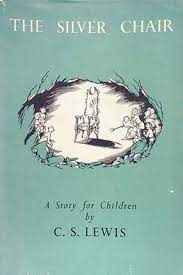
The Silver Chair by C.S. Lewis

The Silver Chair was the fourth Narnia novel to be published (and just to reiterate, this should also be the reading order – ignore any other attempts to resequence the novels), and marks the beginning of the decline in the series. But that’s not to say it is without its moments.

I particularly enjoyed the opening of the novel, flavoured as it was by nostalgia from childhood readings of the series. Eustace Scrubb, fresh from the adventures of The Voyage of the Dawn Treader, and classmate Jill Pole attend the awful ‘Experiment House’. This is a progressive school and Lewis’s conservative views on progressive education are given free rein, including his shock that there should be such a thing as a female headteacher:

“there was an inquiry into the whole thing. And in the inquiry all sorts of things about Experiment House came out, and about ten people got expelled. After that, the Head’s friends saw that the Head was no use as a Head, so they got her made an Inspector to interfere with other Heads. And when they found she wasn’t much good even at that, they got her into Parliament where she lived happily ever after.”

Before this however Experiment House is run by bullies, and while hiding from them Eustace tells Jill about his Narnian adventures. To escape from the bullies, more in hope than in expectation, they try the handle of a door in a wall which has always been previously locked. Magically it opens and leads then not into Narnia but Aslan’s Country, which towers above all other lands. Alsan appears and gives Jill a quest, to find the missing Prince Rillian of Narnia, son of King Caspian. Their quest includes a series of ‘signs’ Jill has to memorise. Things are never made easy for quest followers.

Jill and Eustace travel to Narnia by falling off a cliff, which is only slightly less unlikely than through the back of a wardrobe, blown to safety on a magical wind stream of some kind by Aslan. They arrive and Cair Paravel, and watch as an elderly Prince Caspian (as they later find him to be) sails away. Their first task was to have spoken to Caspian, so they have already failed, as they are to do throughout the story – this is a story about persevering against the odds even when you mess up.

Seventy years have passed since the events of Dawn Treader. Caspian has left Trumpkin the dwarf in charge. Jill and Eustace are given rooms in the castle, but the arrival of a long lost comrade from another world is met with a very muted underwhelmed response. This is mainly because of the uncertainty about the future of the realm – Caspian is old and may not return, and his son Prince Rilian disappeared a decade earlier while searching for the magical serpent that killed his mother.

Jill and Eustace set off on their quest to find the missing prince the following day, led by their guide, Puddleglum. Puddleglum is a gloomy marsh-wiggle, a humanoid figure of Lewis’s invention characterised by a relentless determination to see the dark side of any situation.

And you must always remember there’s one good thing about being trapped down here: it’ll save funeral expenses.

They head north to the giant-lands of Narnia. There they meet the Arthurian ‘Lady of the Green Kirtle’ accompanied by a mute knight in black armour. She directs them to Castle Harfang, the home of the “Gentle Giants”, who ‘would be glad to have them at their Autumn Feast’. Even younger readers will spot the ambiguity in that suggestion, and unsurprisingly the children are intended as the centrepiece, a delicacy, of the celebratory meal. Discovering the giants’ intentions from a cookbook in the kitchen they escape into a cave under the ruined city next to the castle, scene of the latest missed sign. Taken prisoner they are escorted deep into a world ruled by the Lady of the Green Kirtle, and are finally introduced to her attendant, a young man who explains that he is burdened by a curse. Each night he must be tied to a silver chair; if this doesn’t happen he will turn into a serpent.

The ‘mystery’ of the young man’s identity is quickly revealed, and his captors defeated. The trio with their rescued prince return to the surface and there is time for a quick traditional Narnian party, a reunion with the ailing Caspian, before goodbyes and a return to school, where the bullies are given a beating (with the help of a magically restored Caspian) and any loose ends are tied up.

While this was all good a fun in the Narnia tradition, The Silver Chair had many echoes of fan fiction. It uses all the traditional characteristics of the series – the unexpected voyage to Narnia, the quest format, the late intervention of Aslan to help resolve the struggle with a wicked witch, and most importantly of all the character forming experience for the young people involved, the 1950’s version of a gap-year – but there’s a suggestion of Lewis going through the motions, trapped by the conventions of his format. The outcome of the novel is heavily telegraphed very early on and is in no doubt at any point, so when the prince is rescued and the wicked witch dispatched it is anti-climatic (although to be fair the same could be said of the death of the White Witch in The Lion, the Witch and the Wardrobe). The Christian allegory elements of the novel are by this point in the series easily ignored – they are definitely there, with Caspian being revived by a drop of Aslan’s blood for instance – but I never found them intrusive (excepting of course the Last Battle, of which we do not speak). I wonder how children brought up in today’s world of Harry Potter and video games react to the childish joys of these trips to Narnia?

Standard
Book review

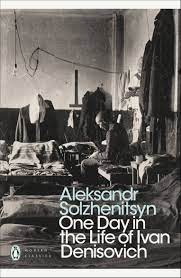
One day in the life of Ivan Denisovich, by Alexander Solzhenitsyn, 1962

After the title of each of these reviews I include the publication date, blithely suggesting that the novel appear complete and final in the year given. Clearly, that is often a simplification – the publication history of many novels is more complicated than this would suggest. The appear in instalments spread over years, are significantly revised, appear in underground magazines then remain banned for years before a final glorious emergence. One day in the life of Ivan Denisovich has a complex publication history which is an important element of the novel’s overall historical significance. Solzhenitsyn served almost ten years in a prison camp of the kind described in this novel. In 1957 he was released from the exile that followed his imprisonment and began writing One Day. In 1962 he submitted the novel to a literary magazine. He must have been aware that its content – a devastating description of life on a soviet labour camp – was going to be contentious, and that publication in the Soviet Union was improbable. Although Stalinism had officially ended with his death in 1953, the USSR remained an authoritarian society where criticism of the state was discouraged.

Instead of summarily rejecting it, the magazine’s editor submitted the manuscript to the Communist Party Central Committee for permission to publish. It ultimately reached the desk of Nikita Khrushchev who approved its publication. I can’t be certain but I think this decision was part of a conscious attempt to demonstrate that post-Stalin Russia had moved on from the labour camps and oppression of Stalinism, presenting a new face to the world. If that was the plan I think you can say it succeeded, although some critics have drawn a causal line between the book’s publication and the eventual collapse of the Soviet Union (although I have to say that feels quite a stretch to me.).

According to his dossier Shukhov was in for treason. He’d admitted it under investigation – yes, he had surrendered in order to betray his country and returned from a POW camp to carry out a mission for German intelligence. What the mission could be, neither Shukhov himself nor his interrogator could imagine. They left it at that – just “a mission”. The counter-espionage boys had beaten the hell out of him. The choice was simple enough: don’t sign and wear a wooden overcoat, or sign and live a bit longer…

Like thousands of his fellow Russian soldiers, Ivan Denisovich Shukhov has been sent to the Gulag – a prison labour camp – as ‘punishment’ for surrendering to the Germans as a prisoner of war during World War II. This was seen as a betrayal of the USSR and a lack of ideological commitment. The novel – as the title suggests – follows Ivan across the course of one typical day. He wakes feeling unwell, but is reluctant to try to get medical help – he knows this is unlikely to help. Punished for lateness he goes to work with his squad, the 104th, on a construction site. Here the winter cold freezes the mortar if it is not applied quickly enough. Shukhov is an experienced prisoner and knows all the best ways to keep warm, avoid the punishments of the guards, and find enough to eat. His focus is always on survival – he often notes other prisoners without the skills to survive the privations of the camp, forecasting that they are going to die sooner or later.

One day is one of those novels that has become an important cultural and historical artefact. It has moulded the way people think, write and speak about Soviet and other labour camps – cold, brutal and unforgiving, even if ultimately and barely survivable. It shows the extent to which literature, even novels that are simply descriptive rather than polemical, can have a significant impact on national political affairs and public opinion.

Shukhov is a consummate survivor, but his life is exhaustingly hard. The novel ends on a note of the slightest bitter-sweet hope – one day Shukhov’s sentence will end, and he will be free. Perhaps the same will happen for Russia:

“The end of an unclouded day. Almost a happy one. Just one of the 3,653 days of his sentence, from bell to bell. The extra three were for leap years.”

Standard