21st century literature, adventure story, Book review

Where my heart used to beat, by Sebastian Faulks, 2015

It wasn’t until I noticed this novel lurking in the Times’s ‘ten best-sellers in paperback’ list last week that I remembered I had read it. Such is the depth of impression it made, and I had to quickly remind myself what it was about – I had a vague memory of the war being involved – by reading some online reviews. They were not overly kind – the New York Times called it “biscuit bland” (a wonderful phrase which I will surely steal); the Washington Post an “an unmeshed assemblage of case histories”; the Irish Times a rather tedious piece of retro-sexism; the Guardian “dithery” (although the quote from this review which the publisher chooses to focus on is “combining as it does the cultural narrative of a complex century forsaken by God and certainty, a serious investigation into the vulnerability of the human mind and an old-fashioned – in the best sense – story of love and war, this is an ambitious, demanding and profoundly melancholy book”. I think “dithery” is more concise!)

Briefly, Robert Hendricks, doctor who specialises in psychiatry, aged 60ish, lives alone and clearly has had problems forming long term relationships. Out of the blue he is contacted by a stranger who knew his father in the First World War and is looking for a literary executor. Intrigued Robert travels to a small mysterious island, and begins a series of reminiscences which slowly unfold the story of his life. The text is unnecessarily complex, with tales within tales. The mysterious island turns out not to be mysterious at all, just small (large enough to have a town, and a mayor, but not large enough to appear on maps). Hendricks is an unengaging character, in his mid-sixties and seemingly irresistible to women. What is it about novels by men of a certain age where women keep throwing themselves at the central male character, stripping off at the drop of a hat and offering him no-strings sex – even the prostitute he engages in the first chapter can’t resist him, and despite his reluctance she is “intent on a repeat”. Such a nuisance when there are some more war diaries to be read.

The reviewers are universally agreed that this novel really takes flight when the inevitable sections on the second world war arrive. I can’t disagree – the portrait of the attempted break out at Anzio is well-written, but there is nothing particularly new here, and the scenes of squalor and fear fit uneasily in the romantic and literary mystery that comprises the rest of the novel, a mystery that I found dull, clumsily plotted and episodic.

“Throughout my life,” Hendricks tells us at one point, “I had thought that if I could get through this section of it, then the pattern of a destiny would reveal itself.” I know how he feels. Was this quote an example of Faulks going all-post-modern on us, anticipating the inevitable criticism of this meandering novel, or just a happy coincidence?

Just as a post-script, I did find one point of interest in the novel. It is set in the early 1980’s.Hendricks is 60ish, which means he was old enough to have fought in the second world war. It was only at that moment that I belatedly realised out that the older adults around me when I was growing up in the 70’s were of the right age to have fought in that war – and that now so many of them are gone. It is an arresting thought that 1980 was nearer in time to the end of the second world war than it is to today. Faulks chose this point in time carefully, and well.


Standard
100 Best Novels Guardian list, adventure story, Book review, Daniel Defoe, http://schemas.google.com/blogger/2008/kind#post

Robinson Crusoe by Daniel Defoe, 1719

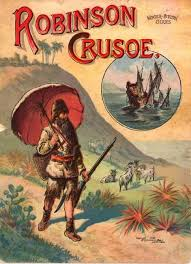
Robinson Crusoe – or, as its amazing sub-title would have it ‘The Life and Strange Surprizing Adventures of Robinson Crusoe, Of York, Mariner: Who lived Eight and Twenty Years, all alone in an un-inhabited Island on the Coast of America, near the Mouth of the Great River of Oroonoque; Having been cast on Shore by Shipwreck, wherein all the Men perished but himself. With An Account how he was at last as strangely deliver’d by Pyrates’ is quite an extraordinary book. Published in 1719 at the very dawn of the novel, it was widely taken as a true story. It was wildly popular, running through four editions in its first year of publication, and according to Wikipedia, by the end of the 19th century no book in the history of Western literature had more editions, spin-offs and translations (even into languages such as Inuktitut, Coptic and Maltese), with more than 700 such alternative versions.

When you read a classic like this you hope you are going to discover something beyond the popular culture version you have absorbed since your childhood. Some of the novels I have read recently were slightly disappointing in that regard – ‘Alice’s Adventures in Wonderland‘ for example was everything I had been led to expect. ‘Dracula‘ and ‘Frankenstein‘ were probably the most remote or adrift from their origins. ‘Robinson Crusoe’ was in many ways very familiar, but there were some things I hadn’t expected to find. For example I had no idea that Defoe wrote a sequel, ‘The Farther Adventures of Robinson Crusoe’ which I must look out/download. Because I really enjoyed this novel.

Taking the novel as an adventure story for a minute and ignoring its importance as a cultural artefact, this was fun. After running away to sea, being enslaved and then escaping, Crusoe finally makes his way to Brazil, where he settles down and becomes prosperous. Greed tempts him into a voyage, where he is shipwrecked on the aforementioned deserted island. What isn’t well known is that his voyage was to purchase slaves to work on his plantation. The attitude to slavery is interestingly frank – slavery isn’t particularly nice for the slaves, Crusoe recognises – he knows even the cannibals he meets on ‘his’ island are still people – but then Christmas isn’t nice for turkeys. It’s just a fact of the world he lives in, and the thought of doing something about it doesn’t cross his mind, in the same way as we see suffering and misery in our own world and shrug and walk on by.  

Crusoe‘ can really only be read as a story of imperialism or colonialism. He goes about mastering his environment with a dogged determination, farming, building and learning skills such as pottery and basket weaving. The animals on the island are culled in a casual a way that helps the reader understand how 17th and 18th century sailors destroyed native populations of animals such as the dodo so wantonly. He slowly comes to a religious settlement with his situation, accepting that while God may have shipwrecked him alone on the island for decades, he also provided him with an Eden-like environment in which surviving is not a struggle.

“These reflections made me very sensible of the goodness of Providence to me, and very thankful for my present condition, with all its hardships and misfortunes ; and this part also I cannot but recommend to the reflection of those who are apt, in their misery, to say, Is any affliction like mine? Let them consider how much worse the cases of some people are, and their case might have been, if Providence had thought fit.”

Provisioned from the wreck of his ship with virtually every tool, seed, animal and material he could possibly need, he is able to construct a home, a farmstead, and a fortification against dangerous creatures (of which there are none) and savages, which only appear towards the end of the novel. This is inspired by the famous and mysterious ‘footprint on the sand’ scene, mysterious because Defoe stresses several times that there is only the one footprint. Where it comes from is never resolved, but leads Crusoe to discover the cannibals that periodically visit the other side of his island for their celebration feasts. He interrupts one such party to rescue his man Friday, who becomes a faithful friend. He teaches Friday all about Christianity. This generates one wonderful scene where Friday innocently asks Crusoe some difficult theological questions (specifically, If God is all powerful, why is his struggle with the Devil so protracted?) which lead to a bit of a tumbleweed moment – Crusoe has to evade the question by pretending not to hear it!

Having been quite slow paced while Crusoe explores his world and steadily turns it into a little England, the narrative accelerates when the cannibals arrive, swiftly followed by an English ship captured by mutineers and recaptured by Crusoe, on which he returns to England to reclaim his birthright and possessions. There is time for one last chase through the woods pursued by packs of wolves, before Defoe decides to let Crusoe rest and take a breather.

The impact of Defoe on the English novel was huge. Poe obviously borrows heavily from him in ‘The Narrative of Arthur Gordon Pym of Nantucket’, as do the later Victorian adventure novelists such as Verne and Wells. You can even see traces of Crusoe in ‘Coral Island‘, and its counterpart Lord of the Flies‘. This is the earliest novel I have reviewed to date, and its surprising modernity – there was no difficulty in language or style – is a tribute to Defoe’s innovation.

Standard