21st century literature, American literature, Book review, Jonathan Safran Foer

Here I Am, by Jonathan Safran Foer, 2017

As I may have mentioned once or twice, I keep this blog as a record of what I read. If I don’t blog it’s probably because I haven’t been reading, but occasionally there are novels that really challenge my ability to say something interesting. ‘Here I Am’, Jonathan Safran Foer’s third novel, is a case in point. I read it a couple of months ago, but found it so underwhelming that when I finally found the time to write this review I had to look the title up. What is more remarkable is that it seems to have taken the author 10 years or more to write it!

‘Here I Am‘ is the story of the Blochs, a very familiar dysfunctional American family. Julia, an architect, and husband Jacob, a TV screenwriter, live in Washington DC with their three sons, Sam, Max and Benjy. Their marriage is falling apart for all the usual reasons – boredom, disrespect, mid-life crises, infidelity. An extended family provides supporting cast members including Jacob’s grandfather Isaac, planning to defer death until after Sam’s bar mitzvah; Jacob’s parents, Irv and Deborah, and others.

The Guardian’s review described “Here I Am” as

a novel of diaspora, of the elasticity of its numerous possible meanings, and of the pain caused by both the presence and the absence of the homeland it invokes. It moves from the intimate dissection of a family that has ceased to become a home for its members to the question of what Israel means to American Jews, and what they might consider to be their duty in the face of its imperilment.”

Which is a useful thematic summary, but will also give you a strong flavour of the worthiness of the novel. Worthiness can be fatal to any attempt at comedy. Because despite the big themes, this is undoubtedly intended to be an albeit dark comic novel. Divided between writing a serious novel about the experience of being a Jewish American family (already very well-explored novelistic territory) and the more comic aspects of that experience (ditto) Safran delivers neither very well.

Part of the problem is that very little happens, and it takes a long time to not happen. Minor incidents become central plot elements. Sam leaves a list of “rude” words on his desk at school then denies doing so – it is not until near the end of the novel that we find out he did write the list, as a profoundly unrealistic exercise in intellectual curiosity. Jacob “loses” the secret mobile phone on which he and a producer have exchanged explicitly sexual texts, in a pretty pathetic attempt to make himself more interesting to his wife. As mid-life crises go this is mundane stuff.

The bulk of the narrative is conveyed through the family’s conversations. The repetitive dialogues and monologues may be realistic representations of the way families talk to one another, but it felt a bit like being harangued for 500 and more pages. Realising the novel needed something by way of incident or drama, Safran Foer goes “all-in”. An apocalyptic earthquake in the Middle East strikes Israel, gifting the surrounding states an opportunity to recover lost territories/invade, depending on your perspective. A domestic chronicle suddenly becomes a diary of this catastrophe, which ends with the Israeli prime minister’s absurdly unlikely call to the men of the Jewish diaspora to return “home”. As if a country struck by an earthquake needs an influx of untrained volunteers to defend it. Jacob’s half-hearted attempt to volunteer falls flat, being turned away at the airport due to him having nothing worthwhile to contribute. As a metaphor for the turbulence in the Bloch family the earthquake and ensuing crisis is clumsy in the extreme, and as a statement on the position in the Middle East it is at best irrelevant and worst tasteless.

And if you have found the preceding paragraphs an unsatisfactory account of this novel, well you can’t say I didn’t warn you!
Standard
Book review

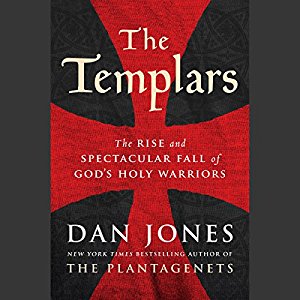
The Templars: The Rise and Spectacular Fall of God’s Holy Warriors by Dan Jones, 2017

tamplarsIt would be hard to write a boring history of the Knight’s Templars. They were a Christian military order originally founded during the early years of the Crusades to protect pilgrims travelling to Jerusalem and other holy sites in the very dangerous lands of the Middle East. The Order’s story is inextricably linked with that of the Crusades, and you accidentally learn a lot about the latter just by reading this account of the former. It is hardly surprising then that the Templars have had a strong grip on popular imagination, from the Da Vinci Code to Indiana Jones. They also had a flair for iconography and symbolism, such as the big red cross they wore on their cloaks.
Dan Jones’s “Templars” a fairly conventional chronological narrative, and after a while the procession of battles, slaughter, castles and cities captured and lost, becomes a bit of a blur. Masters of the Order come and go, opponent warlords do the same, victories and losses take their turn. This is a very Western oriented history – the infidel hordes are differentiated only by their leaders, and there is no attempt to understand why they had such apparently inexhaustible resources (clue – because this was/is their homeland) or why they were able to repeatedly defeat supposedly superior Western European armies. Jones resists the temptation to draw parallels with modern conflicts in the Middle East,  although these suggest themselves at times irresistibly.

 Authors of histories need to address the “Why am I writing this book?” question in a way fiction writers do not. Normally answers range from “I have uncovered new material” – no such claim is made here – “I have a different interpretation from previous authors” – ditto – or “this topic has not been written about recently” – another ditto. So why was this book written? Jones may have hoped for a TV adaptation from this book – the settings are very photogenic – and this may be behind his tendency to leave chapters hanging on a cliff-hanger in phrases such as “William was not quite ready to act on the evidence he was compiling. But he could and he would”; “He would never see Cyprus again”; or “This was the moment when darkness began to fall on the Templars”.

I make no claims of expertise in this field, but I got the impression that Jones has based his work primarily on the chronicles of the Templars and their opponents. I would have thought an archaeological approach might have been worth considering – what do the ruins of the temples, castles, houses and farms of the Order  tell us about their histories that the chronicles gloss over?

During my read of this text I came up with a theory about this category of book – serious but non-academic history. There’s a limit to how much information the brain can retain. This is a complex narrative spanning around two hundred years. The bibliography, glossary and appendices run to almost 100 pages. This condensation of such a vast amount of information in a non-academic work of history (I don’t mean Jones’s approach is non-academic, simply that the book is aimed at the general albeit studious reader, rather than historians or student) inevitably leads to the overwhelming weight of facts passing the reader by. It’s just not possible to retain all that information, unless you read the book as if you were going to be examined on it afterwards. So in the end you probably learn little more than if you were to read a few thousand words about the Templars on Wikipedia. I am not sure that is a problem or not – you can enjoy the book but use the internet if time is more pressing or you want to cover more ground.

Standard
Book review

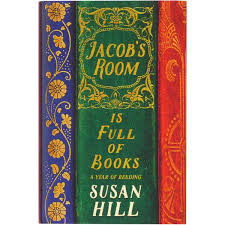
Jacob’s Room is full of books – Susan Hill, 2017

‘Jacob’s Room is full of books‘ is Susan Hill’s very readable if (I have to say) unsubstantial  follow up to ‘Howard’s End is on the Landing’. Simply, it is a reading diary, a year of reading as the subtitle puts it.  Each month Hill mentions the books she has been reading, and these booHIllks then go on to trigger what often seem quite random but nevertheless entirely natural thoughts – her personal acquaintance with the author, her impressions and judgments on their other works, what it is like to be a writer on GCSE reading lists, attending literature festivals, and so on. Interspersed with this well-informed stream of consciousness are many observations about nature, particularly birds, which if I was being cynical I would think of as padding to get the book over the 200 pages mark…

There is a structure of sorts to the book – it is divided into the twelve months of the year – but you could easily dip into it at any point and it wouldn’t make much difference. You certainly don’t end the book knowing much more about Hill or books or reading or writing than you do, say, half way, or indeed after having read ‘Howards End is on the Landing’. Which makes me wonder – is this anything other than a rather cynical cash-in, a stocking filler, something to appeal to Christmas shoppers with a reader in their lives to keep happy? I feel a bit ridiculous mentioning this, but the fact that Jacob’s Room isn’t mentioned at all in the book, other than to provide the mildly amusing title, niggled at me slightly. Because Hill’s struggles with her out-of-control personal collection of books, which she culls ruthlessly and often, but still can’t keep on top of, (“As fast as I get one out of the back door, two new ones come in through the front anyway”) was one of the more relate-able aspects of the book which I would have liked to have known more about.

The book shows signs of being a transcribed notebook – there is an immediacy to many of Hill’s observations and comments, such as those on wildlife spotted (that is seen, not spotted wildlife) or emails received – and the repetition at many points, such as her slightly contradictory accounts of being on the 2011 Booker prize jury, could have done with some friendly editing. There’s little artifice here – there must have been a temptation to edit or self censor to make the author appear a more careful and considered reader – but that doesn’t seem to have happened. I suspect I won’t be the only reader who snapped the book shut at her more outrageous criticisms of writers we have loved – Keats, for goodness sake, gets dismissed with a few words, and Jane Eyre goes proudly unread – but then cheered when she praises our favourites. I can forgive her almost everything for her comments on the brilliance of Raymond Chandler.

If I wanted to I could construct a narrative about this book being (underneath all the daily noise) about ageing. Hill is in her mid-70’s, and while full of life she still has some/much of the grumpiness of many of that age. She knows that her overstocked shelves are becoming a bit of a burden, and in trying to divest herself of them she is making tentative steps towards preparing for the later stages of her life. Whether I can convince even myself on this one is another matter.

This was the first and probably easiest/shortest of an extraordinary haul of books I accumulated over the recent festivities, which will dominate my reading across much of 2018. I’ll keep you posted.


Standard
Book review

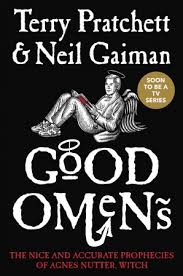
Goods Omen by Terry Pratchett and Neil Gaiman 1990

Why haven’t I read “Good Omens” before now? That’s not a rhetorical question – tell me why no-one has thrust this book into my hands and said “You love Terry Pratchett and you think Neil Gaiman is pretty good as well, so read this, now”? As you can tell I feel slightly narked at the fact that this wonderful book has not made it onto my reading list until now. Good omens

One reason might be that collaborations, especially on novels, have at best a patchy record. Name me a novel written by two people that is as good as any of the novels written by either of the co-authors? That one is a rhetorical question btw. “Good Omens” is the only co-authored novel on the BBC Big Read list of 100 best novels, if you needed any evidence on that point. But something about the way these two worked together, across different continents and time zones, just worked, producing something as good as if not better than their best solo work. It could easily have been written by Douglas Adams, and if you have been paying any attention to anything I have written in the last 5 years or so you will know that there is no higher compliment.

“Good Omens” started life as a Just William parody, and if I were to find a fault with the novel, the extended sections of the prepubescent schoolboys and schoolgirl getting up to no good in an essentially well behaved way are some of the weaker parts of the novel. But that doesn’t really matter, because the cornucopia of ideas and characters that fizz from every page of the rest of the novel more than compensate. Quite how a schoolboy story became a parable about the end of the world I am not sure, but it tells you something about Pratchett and Gaiman’s imaginations. There so much to enjoy here – utterly believable eccentric characters, such as the angel and demon working together to avoid Armageddon, Witchfinder General Shadwell and his assistant Newton Pulsifer, the witch Anathema Device (was/is there any author better at producing fantastic names for his characters than Terry Pratchett was – I give you Cut My Own Throat Dibbler in evidence), a breathless plotline that genuinely leaves it open to doubt whether the world is going to end or not, and on every page some of the best and at the same time wisest jokes you will find in any modern novel.

“It may help to understand human affairs to be clear that most of the great triumphs and tragedies of history are caused, not by people being fundamentally good or fundamentally bad, but by people being fundamentally people.”

“An Angel who did not so much Fall as Saunter Vaguely Downwards.”
“She was beautiful, but she was beautiful in the way a forest fire was beautiful: something to be admired from a distance, not up close.”
This is Pratchett at his very best, and whatever Neil Gaiman contributed to the process and outcome – the appendix at the end of this edition contains interviews with the authors that are frustratingly vague on this point, including the possibility that some of the text was written by neither of them – the combination just worked. I suspect it made Terry a better author in the long run, although I don’t think he ever wrote anything better.
Finally some good news – the novel is being adapted for television by the BBC, with two of Britain’s best actors, Michael Sheen and David Tennant, in the lead roles, and with a wonderful supporting cast. Should be (the light) fantastic.
Standard