Rotating about the Earth in their spacecraft, they are so together, and so alone, that even their thoughts, their internal mythologies, at times convene. Sometimes they dream the same, dreams of fractals and blue spheres and familiar faces engulfed in dark, and of the bright energetic black of space that slams their senses. Raw space is a panther, feral and primal; they dream it stalking through their quarters.
Orbital, which won the 2024 Booker Prize, follows a day in the lives of six astronauts in low-earth orbit on the International Space Station. Italian, Russian, British, American and Japanese astronauts spend their day in a mixture of the mundane – monitoring routine experiments on the behaviour of microbes and mice in space, documenting their bodily functions, eating, drinking, sleeping – and the extraordinary, watching the vastness of space and the earth pinwheeling round. We learn the backstory of each astronaut and how they came to be on the ISS. Simultaneously another mission takes off from earth, this time going back to the moon.
The novel is a poem to the beauty of the earth and its fragile improbability. The prose is extraordinarily lyrical – I could fill this review with examples of the author’s wonderful descriptions of earth as it passes by the space station’ s windows:
There’s the first dumbfounding view of Earth, a hunk of tourmaline, No, a cantaloupe, an eye, lilac, orange, almond, mauve, white, magenta, bruised, textured, shellacked splendour.
and
As they traverse south, the colours change, the browns lighter, the palette less sombre, a range of greens, from the dark of the mountainsides to the emerald of river plains to the teal of the sea. The rich purplish green of the vast Nile Delta. Brown becomes peach, becomes plum: Africa beneath them in its abstract batik. The Nile is a spillage of royal blue ink.
and
Down over the arrowing peninsula of Dakar, crossing the equator, and in the closing minutes of day, the lights of Brazzaville and Kinshasa on either side of the Congo River, tepid in the dusk. Blue becomes mauve becomes indigo becomes black, and night-time down southern Africa in one. Gone is the paint-splattered, ink-leached, crumpled-satin, crumbled-pastel overflowing-fruit-bowl continent of chaotic perfection, the continent of salt pans and red sedimented floodplain and the nerve networks of splaying rivers and mountains that bubble up from the plains, green and velvety like mould growth. Gone is a continent, and here is another sheer widow’s veil of starstruck night.
This is some of the finest descriptive writing I have read in a very long time and I make no apology for quoting it at such length.
Orbital is not just a prose poem on the beauty of the earth. No novel, however slight (the text is less than 140 pages long) could sustain that as its sole theme. It touches on a number of other topics. One of the astronauts is asked to provide a response to the question “With this new era of space travel, how are we writing the future of humanity?” (this is with reference to the new journey to the moon, not the low-orbit space station which is very much showing its age), and the response offered by one of his fellow astronauts is “With the gilded pens of billionaires”, which is at once beautifully lyrical and at the same time recognises the role of the mega-rich in plotting the future course of space exploration. Climate change is addressed as the astronauts watch a tornado as it cuts a devastating route across islands in the Pacific. Chie, the Japanese astronaut, finds out that her mother has died and reflects on the improbability of her birth (her mother survived the atom bombs on Japan at the end of the second world war) and her journey into space.
There are many small stories here – but I would have to accept that the absence of a larger, over-arching storyline was one I missed. Orbital has no real narrative structure, no story in the conventional sense. There is incident – when the mice being experimented on suddenly discover that the absence of gravity means they can effectively fly is a wonderful moment – but the book felt more like an extended short story rather than a novella. While the distinction between these two categories might seem slight |I do think it is significant. It meant that there were points in the book where, however wonderful the prose descriptions of the earth were, I felt that there are only so many of these that I needed.
I will definitely be looking out for more works by this author. Her description of the ‘cosmic calendar‘ concept, used to to visualise the chronology of the universe, scaling its currently understood age of nearly fourteen billion years into a single year in order to help us comprehend the vastness of its scale, was extraordinary, and worth the price of admission on its own. Although this is a familiar concept I don’t think I have ever read it described more lyrically or in fact beautifully as Harvey in this book. She is a great writer, even if here she is not such a great story-teller.
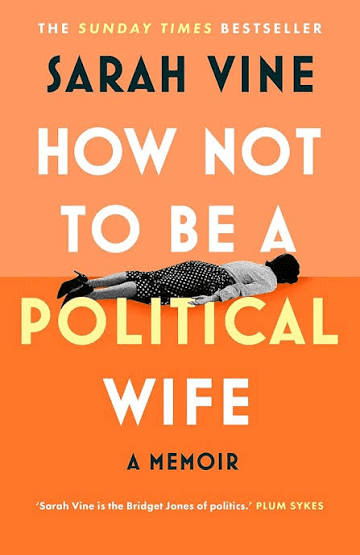
How Not to be a Political Wife by Sarah Vine, 2025
This book’s clumsy title sets the tone for what is, one can be pretty confident, going to be quite a bumpy ride. The book is categorised as a memoir, but more accurately it is a confessional of staggeringly indiscrete proportions, quite calculatedly burning lots of Ms Vine’s bridges with the Cameron vintage Conservative hierarchy. The book serves as an interesting and I suspect deliberate contrast to Sasha Swire’s much more reflective and considered Diary of an MP’s Wife which covers much of the same time period and territory.
Sarah Vine describes herself as a journalist, but more accurately she is a columnist, writing observational pieces about the world as she sees it. She is one of the genre of columnists who specialise in what is now called ‘rage-bait’ – constructing controversial ‘opinions’ and comments to order that she may or may not mean to be taken seriously, but which are going to drive traffic to her newspaper’s website, which nowadays is all that matters.
The author had a front-row seat at some of the most turbulent years of recent British politics. She worked for mainly right-wing newspapers throughout the period covered by the memoir. Her husband Michael Gove was Education Secretary, Chief Whip, and Lord Chancellor in David Cameron’s and Theresa May’s governments, and then held prominent roles in the Conservative administrations after the 2019 general election. He is now editor of the Spectator and, it goes without saying, a member of the House of Lords. In mentioning Mr Gove I am not succumbing to the sexist idea that a woman is only as important as her husband’s job. The fact is his story is an integral part of this memoir – his choices and decisions had a profound impact on the course of her life over this period and he features significantly throughout. In fact she defines herself in this narrative by contrasting what she did with what she believes was expected of her – hence the book’s title. While the introductory chapters on the author’s early life are interesting, the substance of the book is her role as Gove’s wife and partner, inside observer of the recent Conservative governments. This period can be summed up briefly – for the author it was (despite all the privilege and benefits being part of the Government involved) unremittingly awful. Everyone felt entitled to be nasty to you:
Doctors can shed what’s left of their bedside manner with you. Ordinary people no longer need have any consideration for you. Friends no longer trust you. Children are taught to despise you, not respect you. Journalists and policemen no longer need to be impartial or accurate. You have lost those human rights and protections because you are no longer human, you are a politician and you are now the legitimate prey of the only big game hunting still allowed in this country.
It wasn’t just unkind words of course – death threats followed, their children were bullied and they were ostracised from various friendship groups. None of this stopped Vine having her manufactured views on her political opponents of course. She wrote of Ed Miliband’s kitchen, for example, that there was “not much prospect of a decent meal emanating from that mean, sterile, little box.” Minor television celebrity Carol Vorderman is paid back for having the temerity to criticise the later Tory administrations: “One year we had Carol Vorderman, when she was in her pro Tory phase (as opposed to her sucking up to Labour phase): rarely have I encountered such a heavily cantilevered bosom.” Is the state of Carol Vorderman’s bosom really relevant here?
It wasn’t all bad. Vine has happy memories of weekends at Chequers with the Camerons and the rest of the Notting Hill set:
“Sam really came into her own when she threw a party, and the party she threw at Chequers for her delayed 40th, in 2014, was probably my last truly happy memory of those gilded days, and almost certainly one of the best parties I’ve ever been to. Sam had transformed the Great Hall into a rave, with glitter balls, lasers and disco lights playing over about 150 people dancing wildly to the music of DJ Sarah HB, short for Hard Bitch. Dave and Sam ruled over the dance floor, always the best dancers, doing their Ceroc double act with enviable grace. Everyone was beautiful and clever and powerful; but for once I didn’t feel like Cinders at the ball. Sam had already complimented me on my Diane von Furstenberg black wrap dress, even though it was a touch too tight around the middle – “those bosoms, Sarah!” – and I was having the time of my life, sipping mojitos and chatting to Sarah Montague in the Rose Garden.“
Vine’s main issue is a crippling instance of imposter syndrome. Her dysfunctional relationship with her bullying father (who in the book’s acknowledgements she thanks for “fucking me up so brilliantly” and who lived to see this book published) has left her with the inability to believe she deserves her place in ranks of the country’s privileged few. Money is an obsession – she objects to Gove’s sacking by Cameron as Education Secretary because of the impact it will have on their family income. Her address is not quite in the right postcode. Gove even pays to have an 0207 number (instead of 0208) – an incredibly niche but telling piece of status insecurity that today has not real equivalent.
The heart of the book is her account of the Brexit debacle. Gove promised not to campaign for Brexit, then led the campaign, expressing disbelief that the Cameron’s would see that as a betrayal, even though it destroyed his political career. (In his memoir For the Record, David Cameron directly accuses Michael Gove of disloyalty, stating, “As for Michael, one quality shone through: disloyalty. Disloyalty to me — and, later, disloyalty to Boris”). Vine is able to see that “everyone hated us” without ever really understanding why. If everyone hates you, doesn’t that suggest that you have done something to provoke that response, rather than that everyone was wrong, misjudging you, or being hateful? Gove’s decision to support the Vote Leave campaign and to go on and lead the Brexit campaign, was a turning point in the whole debate – it is arguable that without that decision Boris Johnson would not have supported leave, and potentially that the outcome of the vote would have been different. Certainly Vine’s description of the days and weeks following the Brexit vote does not read like a celebration by the winning side. The suggestion that Cameron should have stayed on as Prime Minister and worked to implement the outcome of the Brexit vote, that his refusal to take responsibility for something he had found hard against was in some way the cause of the utter shitshow that followed, is laughable. Talk about not owning your own mistakes!
Vine has a stunning lack of insight into why people hated her, why they blamed her husband for the disaster that was Brexit, why people stopped being their friends after he stabbed them in the back. She just can’t understand why anyone had a problem with her and Gove’s behaviour. It is all a mystery – which is funny because even the most obtuse reader can easily understand these things. Vine is like a flawed narrator of her own memoir, accidentally revealing insights into her personality and behaviour without having them herself. There are more accurate and more interesting histories of this period, but How Not to be a Political Wife nevertheless gives an original insight into many of the mistakes made by those involved.
Half past four on the afternoon of 8th April 1912 – the weather was mild and hyacinths bloomed in window boxes – a stranger chose to die in my arms. “Please,” I said, as he pitched forward and clutched me round the waist. We both fell to our knees. Over the road a crocodile of Girl Guides sashayed sing-song through the ornamental gates of the public gardens.
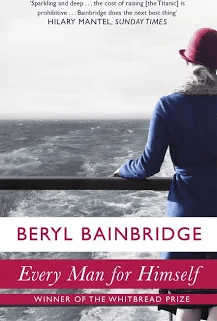
I wrote some time back about my policy of avoiding reading much, if anything, about a novel before reading the novel itself. Apart from the obvious risk of spoilers, pre-reading can influence your reaction to a book, shaping it in a certain direction. For example, if you are told a novel is ‘a work of genius’ it might encourage you to overlook any flaws you identify in it. A similar problem occurred after I read Beryl Bainbridge’s book about the Titanic disaster, Every Man for Himself, when I came across this article she wrote in the Guardian in 2009. In it she describes the process of negotiating a new contract with her publisher:
“I’d been about to seek another publisher, one who would offer me money, and told Baird-Smith that I was willing to stay with him if he granted me a three-book contract, something miraculous I’d heard of in regard to other authors. When he asked me what themes I was considering, from the top of my head I blurted out Scott going to the pole, the sinking of the Titanic and the Crimean war. Baird-Smith then offered me a substantial advance, which shook me; I wasn’t used to payments.”
Bainbridge was true to her word, writing Master Georgie about the Crimean War, The Birthday Boys about the Scott Polar expedition, and Every Man for Himself. Does it matter that Bainbridge was writing to order rather than being genuinely inspired by her subject matter? A bit, yes. Because I think it shows in the novel itself.The writing is rather ‘by the numbers’ and only sporadically shows a real interest in the subject matter. Most of the novel sees the characters in a holding pattern, running up the word count and down the clock until the iceberg strikes.
As a thought exercise, imagine you were the author in this situation, committed to writing a novel about the Titanic. How would you go about addressing the central challenge of this scenario, which is obviously the lack of any suspense about the overall ending? The first thing you would do, I would suggest, is try to make your central character or characters people the reader cares about, wanting to know whether they survive – in other words you reframe the question ‘What happens?’ to ‘What happens to X?’ This would involve giving the character a backstory and the reader a reason to care about them. The other element I think the hypothetical novel would need would be some depth – for example consideration of social issues or class. The differential in survival rates on the Titanic – 62% of first-class passengers survived, against only 24% of third class passengers (41% for second class if you were interested) – has always struck me as something worth detailed analysis. Was it because the first-class passengers were prioritised in the evacuation and in life-boat spaces, or was it more to do with where they were in the ship when the collision occurred? (To be clear, I am 100% sure that this differential has been analysed very fully by historians – I just don’t think the issues have ever been explored by novelists). And then there’s the crew, who had to supervise the evacuation and enforce the ‘women and children first’ protocol, many of whom stayed behind to carry out their duties to the last minute. The Titanic sinking has so many dramatic stories, conflicts, moments of tension and so on that it would be almost impossible to write a novel that didn’t engage the reader in the drama of the situation.
And yet….
Every Man for Himself tells the story of the sinking of the Titanic through the eyes of one of the first-class passengers, 22 year-old Morgan, part of a very wealthy banking family. Morgan is an orphan who was brought up relatives. Before boarding the ship he sees a man who has fallen onto some railings, dying in a rather clumsy piece of foreshadowing. Once onboard he spends his time socialising with the other first class passengers. He shows some interest in the construction of the ship (having worked on some aspects of its design – presumably the author providing us with a reason to care a little more about the outcome?) and finds out that it set sail with a fire in one of the coal holds not completely under control. There are also occasional mentions of warnings from other ships about icebergs ahead. But the Titanic was unsinkable, so there is nothing to worry about…. He is attracted to socialite Wallis Ellery, who flirts with him while all the time having a fling with one of the other passengers, but he recovers fairly quickly when he finds this out.
The Titanic’s evacuation order (which, from what I can tell, was a long-established protocol) was the very opposite of the novel’s title – not ‘every man for himself’ but ‘women and children first’ – an order that was largely voluntarily complied with. I think the author chose this title as a commentary on the behaviour of the first-class passengers prior to the collision, where their personal interests, well-being and finances are prioritised over everyone else. Every man for himself was the spirit of the age.
Bainbridge does her best to differentiate the large cast of characters, but at times they blurred into one another. Everyone seems to know everyone else (Morgan even knows the captain). This privileged social circle is intimate and hostile to outsiders. Morgan describes his first dinner on board thus:
Dinner that evening was a boisterous affair. Ours was a small world and between the soup and the fish we were all constantly bobbing up and down to acknowledge people we knew; but for the intermittent and minute flickerings of the electric lights we might have been dining at the Ritz in Paris. The Thayers stopped at our table, the Daniels, Mrs Snyder, the Speddens of Tuxedo Park, Colonel Gracie, jolly Mrs Hogeboom with the excessively ritual eccentric Mrs James Brown, her bridge crony from Denver, in tow. As usual, the latter was dressed inappropriately and wore a gigantic hat across whose brim languished an entire stuffed bird. Colonel Astor and his young bride passed by without a nod, leaving Ginsberg on his feet with his hand held foolishly out. He said he knew Vincent, the colonel’s older son, and had often fenced with him.
Most of these characters are not mentioned again and are just passing across the stage, mildly comically, to make the point as to how close this circle is. But it makes it hard to care about the characters who do eventually emerge from the throng. Morgan fails to make any real new associations with other passengers and neither does the reader. Second and third class passengers, and the crew, are restricted to walk on parts. So I am not sure we really care who lives and who dies when the novel reaches its inevitable climax. In other words this was a disappointing effort, going through the motions by a novelist who at her best was very much better than this.
The trouble began long before June 9, 1976, when I became aware of it, but June 9 is the day I remember. It was my twenty-sixth birthday. It was also the day I met Rufus – the day he called me to him for the first time.
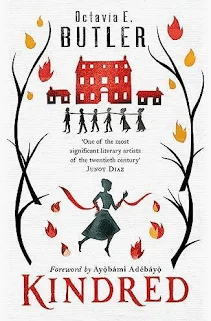
Dana and Kevin have just moved into their new apartment in Los Angeles, California. Out of nowhere, Dana starts to feel dizzy and faint, and before she knows it…
“The house, the books, everything vanished. Suddenly I was outdoors kneeling on the ground beneath trees. I was in a green place. I was at the edge of a woods. Before me a was a wide tranquil river, and near the middle of that river was a child, splashing, screaming….Drowning!”
Dana has been transported to somewhere where she is needed, where she can save the life of the drowning child, whose name we later find out is Rufus. But the boy’s parents are not grateful – far from it, they seem to think Dana is responsible for his accident – the father aims a shotgun at her and angrily confronts her. She fears for her life, and in that moment she is transported back to her apartment, where a puzzled Kevin tells her that only moments have passed.
At first the reader thinks they are in a simple time travel novel, where the principal character is summoned into another time and place to intervene in the life of someone with whom they have some kind of connection. Yes and no, because in a moment of dreadful realisation Dana finds out something terrible about the challenge fate has presented her with – the time she is travelling back to is the 1820’s, in the South of the United States of America, and Dana is black. The young boy whose life she is fated to save – she is summoned from the present every time his life is at risk – is the son of a slave-owner. He lives on a plantation. Worse, Dana has no control over when she is summoned nor when she is returned. She works out that she will return to her own time – where time passes at a completely different rate from that in the 1820’s, so several months can pass in the past but only hours in the present – when her own life is threatened. She cannot choose when to return, and putting her own life deliberately at risk seems far too dangerous.
The only positive side to this appalling situation is that, unlike the form of time travel in the Time Traveller’s Wife (for example) she is able to take objects with her into the past, anything she happens to be touching at the time she is summoned, including her partner Kevin. She quickly assembles a small bag of useful items, including a knife and some painkillers, knowing she could be whisked back to the nineteenth century at any time. I would have been tempted to take a gun, preferably a rifle, but I am probably taking the time travel conventions a little too literally! On her subsequent journey to the 1820’s Kevin goes or is taken with her, and after she saves the young man’s life once again, the plantation owner assumes Dana is Kevin’s slave. Dana, recognising names from the family tree in her bible, quickly works out that Rufus is one of her distant relatives, and that she needs to keep him alive long enough for him to father one of her ancestors. But Rufus is white, and she is not, horrifyingly suggesting that the ancestor she is waiting to arrive is the product of an abusive relationship between slave-owner and enslaved.
Novels that attempt to portray the horrors of slavery are faced with an immediate challenge – how to convey the many terrible things that happened – the brutality of every day life, the appalling treatment of the enslaved, the families torn apart by slave-owners simply for monetary gain – without looking away or in any way softening the edges of the realities of the form of chattel slavery of this period, but at the same time not making the novel impossible to read, capturing the reality of what living through this period must really have been like. To take someone from the 1970’s and transplant them into this environment is a brilliant way of making the reader imagine what being in this time must have been like – these are no longer long-dead people who it is easy to think of as statistics, but real, living family members and friends.
Butler takes one step further than just presenting afresh the trauma of slavery, by asking the question – how does one accommodate oneself to living in that situation, living as an enslaved person? Dana is trapped in the nineteenth century for long periods, too far away from the Northern states where slavery was no longer practised or widespread (slavery in the Northern states of the USA ended gradually over several decades; Vermont banned slavery in 1777 and Massachusetts in 1783; other Northern states passed gradual emancipation laws that freed existing slaves slowly, meaning complete freedom for all enslaved people in the North took until the early-to-mid 1800s – and even then ‘runaways’ were subject to the punitive conditions of the Fugitive Slaves Act). Dana is forced to come to terms with the conditions and compromises of her enslavement. Her partner Kevin is trapped in this time period for several years when she is returned to the twentieth century unexpectedly and this experience changes him as well (Dana perceives) even though he commits himself to helping runaway and escaped slaves.
Quite early on Rufus learns of Dana’s origins – he can hardly find a natural explanation for her appearing out of thin air every time his life is at risk – and has to accept the undeniable supernatural element of her existence. Dana slowly comes to an understanding with Rufus – he depends on her to save his life, therefore he must treat her with respect and care for her, protecting her from the unstable temper of his father. But time and again Rufus’s contempt for black people resurfaces – he never gets out of the habit of using the n-word for example, even though he knows he needs Dana to save his regularly threatened life (Rufus is very accident-prone!).
Kindred has an incredibly strong narrative structure. The reader (or this one at least) cares for and wants to find out what happens to Dana, Kevin and even Rufus. I understand why the author included a prologue which effectively spoils the ending of the novel for the reader – we know some important details about the outcome of the novel through this short opening chapter – but personally I don’t think it added anything and removed much of the suspense from the novel’s ending and I would have not used it had I been the author. But even though this is a very strong story, that’s not the primary reason for this being such a ‘must read’ – that derives from its unblinking portrait of the horrors of American chattel slavery.
“It was a diamond all right, shining in the grass half a dozen feet from the blue brick wall. It was small, not more than a quarter of a carat in weight, and unmounted. I put it in my pocket and began searching the lawn as closely as I could without going at it on all fours. I had covered a couple of square yards of sod when the Leggetts’ front door opened. “
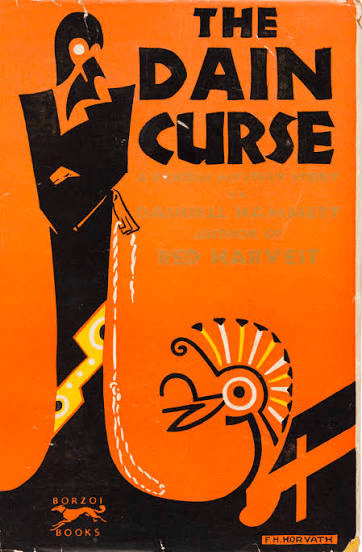
Oh dear. Having really enjoyed The Maltese Falcon and The Thin Man a lot, I decided to read some lesser known novels by Hammett, in the hope that I might, like the Continental Op in the quote above, find some diamonds in the rough. Unfortunately all I found was ‘rough’, no diamonds!
The Dain Curse is divided into three, loosely linked stories, which equate to the instalments in which the novel was first published in The Black Mask magazine. The first story opens with the Continental Op investigating a diamond robbery from Doctor Edgar Leggett. Dr Leggatt was using the diamonds to test a process of colourisation. The Op is commissioned by an insurance company to see whether the reported theft is legitimate and if possible to recover the diamonds. Dr Leggett’s wife maiden name was Dain and in the course of the investigation it emerges that their daughter Gabrielle believes there is a curse on the whole Dain family which follows them through the generations. This belief appears justified when several murders complicate what at first appears a straightforward investigation. I have to confess that even though I have only just finished reading the novel I can’t recall the precise detail of who murders who, and why, but I suspect that level of detail is not that important – this is an adventure story rather than a mystery. We know the Op is going to find out who committed the murders, all we have to do is enjoy the ride.
Diamonds recovered, the Op thinks his time with the unfortunate Gabrielle is over, but he is soon recalled to investigate a mysterious religious cult to which she has succumbed. The cult’s headquarters double as a clinic, a place of worship, and a retreat for the more vulnerable of the membership. The Op infiltrates the clinic/hostel/church none too subtly, and after the inevitable drugging, murdering and shoot-outs, manages to rescue Gabrielle. Her fiancé takes her away to marry her as quickly as possible before anything else can happen to her, but of course the curse cannot be escaped as easily as that….
The novel ends with at least ten pages of exposition, ten pages of the Op explaining what really happened. This becomes absurdly complex and convoluted and I can’t imagine many readers by this stage (or even earlier) really caring who did what to whom. The solution, including the extremely unlikely evil mastermind behind it all, is of course nonsense. If the novel itself was worth reading then the silly ending would be excusable, but sadly the characters are weak and unconvincing and the prose is flat. If you were considering reading anything by Hammett, a) despite all of the above, don’t let this put you off, and b) don’t choose this. Better still, read anything by Raymond Chandler!
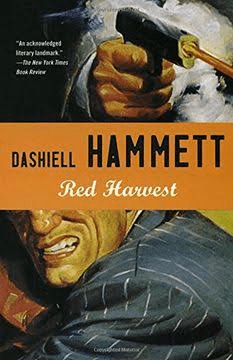
“I first heard Personville called Poisonville by a red-haired mucker named Hickey Dewey in the Big Ship in Butte. He also called his shirt a shoit. I didn’t think anything of what he had done to the city’s name. Later I heard men who could manage their r’s give it the same pronunciation. I still didn’t see anything in it but the meaningless sort of humor that used to make richardsnary the thieves’ word for dictionary. A few years later I went to Personville and learned better.”
The first person narrator of Dashiell Hammett‘s Red Harvest, known only as ‘the Continental Op’ is called to Personville (known as “Poisonville” by the locals) a Californian mining town, by newspaper publisher Donald Willsson to help fight corruption in the town. Willsson is gunned down before The Op has a chance to meet him, establishing an early pattern of violence and murder that continues throughout the novel. The ‘red harvest’ of the novel’s title refers simply to the carnage which ensues, a vicious cycle of revenge murders, which even The Op loses track of eventually.
Personville/Poisonville is run by a number of violent gangs. The police and the civic authorities – the Mayor, City Councillors, etc – are all implicated in the various criminal enterprises the gangs run, not least of which is bootlegging (prohibition was a gift to the criminal fraternity). The Op has to decide early on his investigation whether he is going to abandon things – his client is dead, after all – and head back to San Francisco, or get his hands dirty and try to break up the gangs. He chooses option two, and realises that the only way he is going to achieve this is if he plays the gangs off against one another. This is a dangerous, high stakes game, with the prospect of little reward at the end of it other than a bullet. But The Op is stubborn and not scared of a gunfight or two.
He starts by meeting the dead man’s father, Elihu Willsson, an industrialist who originally ran the whole town, but has now lost control to the gangs he brought in to help run the city. The Op identifies Donald’s murderer as someone who is not a gang member at all, but a bank clerk. This establishes another pattern – each murder is committed by someone other than the obvious suspect. But by now the war has started and the bloodshed is not going to stop. The large cast of characters passes by with blistering speed and it can be hard for the reader to keep up with who is blackmailing who, who is double-crossing who, and so on. The gangsters are particularly bloodythirsty and vengeful – after The Op organises a ‘peace conference’, ostensibly to halt the slide into all out war, if anything the pace of the killings accelerates.
The Op manipulates all of the warring parties, feeding them information, sometimes false, sometimes not, to keep the antagonism at fever pitch. The outcome is, inevitably, a blood bath, from which The Op manages somehow to escape with his life despite being in the middle of several shootouts. Soon everyone who has played a part in the criminality of the town is dead. Poisonville might revert back to illegality and war in a few years, but for now the poison has been flushed out.
Reading Red Harvest I kept being struck, time after time, how similar the novel was to those of Raymond Chandler. Chandler took the template developed by Hammett and improved it significantly, to the extent that Red Harvest at times reads like a rough draft of a Chandler novel. Individual scenes such as a trip out of town to a shack used as a safe house by one of the gangs, a drunken dream ended by waking up to find a corpse spread-eagled on the floor, the client who wants to back out of the deal but can’t – every scene and every plot device has its later parallel in Chandler. Hammett’s sparse prose style, his plot structures, stock characters and just about every other element of the novel is echoed time and again. At times the slang tips over the edge into being unintelligible. See if you can work out what this means:
“somebody dynamited the floor out of the can. I dropped through the hole with the rest of them. There was some mugs standing off the bulls. I made the back-trotters with one bunch. Then we split, and I was figuring on cutting over and making the hills.”
There is no doubt that Chandler improved on his source material – Red Harvest is repetitive, and all problems are resolved in the same violent way. The secondary characters are two-dimensional and one could be forgiven for confusing Gangster A with Gangster B, C or D. The OP has some good lines – “The chief winked at me, an athletic wink in which all his facial muscles took part” – but he’s no Philip Marlowe. To be fair, Red Harvest was Hammett’s first novel, originally published in four instalments in a pulp magazine, Black Mask, so I shouldn’t expect too much in the way of literary flair, but enough of the bones are there to show that Hammett was to go on to become a great writer.
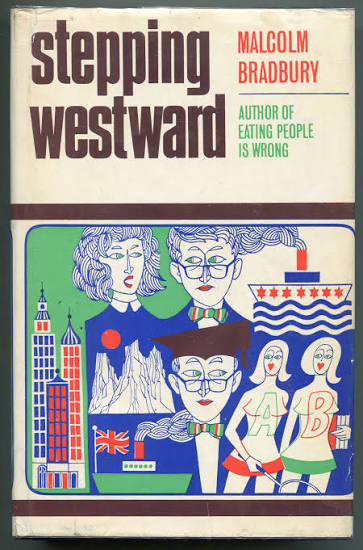
Stepping Westward is an early example of the campus novel, although for some reason Wikipedia does not include it in its list of examples of the genre. Bradbury is still a well-known author, largely on the basis of the television adaptation of The History Man but this, his second novel, has been almost forgotten – it doesn’t have its own entry in Wikipedia, has only one review on Amazon, nine other fairly desultory reviews on Goodreads and is out of print. And yet it is head and shoulders above many other examples of the genre including the novel it obviously had a significant influence on, David Lodge’s Changing Places (1975).
Bradbury took his novel’s title from the Wordsworth poem of the same name, which opens thus:
‘T would be a wildish destiny, If we, who thus together roam In a strange land, and far from home, Were in this place the guests of Chance
And it is this spirit of exploration, even wanderlust, that inspires and infuses the novel. On the Malcolm Bradbury website the author wrote (in an unpublished afterword):
Stepping Westward is my second novel. I wrote it, mostly in the United States, at the beginning of the Sixties, when I and the world were both visibly changing… It was a time when Americanization was passing through Europe like what many of the young in those days still had to take – a dose of salts. Britain was losing an Empire and gaining a washing machine, and America was where, it seemed, everything that was best came from – the best jazz, the best novels, the best ice-cream, the best cars, the best films. In fact America, the America of Arthur Miller and Marilyn Monroe, J.D. Salinger and Dave Brubeck, Jack Kerouac and Allen Ginsberg, Elvis and the Kelvinator, haunted the imaginations of the Fifties young. The old myth of European liberation in the New World never seemed stronger, and adventurous journeys to the new frontier were very much in order. So one day, when my thesis was finished, I put down my Leavis, put on my Levis, and sailed for the United States.
This is the mood that fills this novel, and I hope it seems like a joyous one.
I think it does.
James Walker lives a drab life in Nottingham with three modestly successful novels to his name. Unhappily married and with a young daughter, he takes little joy in life. He doesn’t think much of himself as a husband, father, writer or man. Largely because of lazy reviewers his work has been lumped into the category of ‘angry young man’ novels, even though he had no conception of this when writing them. Out of the blue he is offered and accepts a one-year Creative Writing Fellowship at Benedict Arnold University in the town of Party, located in the undefined West but in the shadow of the Rockies. We see this offer being made from the American perspective and know that he is part of a wider game of campus politics being played by the cynical Bernard Froelich.
Walker sails to America instead of flying, which feels anachronistic even for the 1960s. The journey drags somewhat (for the reader – Walker enjoys himself). We soon learn that Walker has no intention of remaining faithful to his wife – these are the sixties after all – as he pursues one of the American students sharing his journey, a member of an unlikely bagpipe band that has been touring Europe. Once arrived in Party he struggles to navigate the complexities of American campus life and politics. The bumbling Englishman abroad material is hardly original and much of the content here is laboured. Most of the humour derives from cliches about American hostility to the English, American food, and campus politics (including elements of lingering McCarthyism). The crunch comes when his stubborn Britishness leads him to resist signing the university’s mandatory loyalty oath. His speech to the whole university explaining his reasons for this (in a scene very reminiscent of the climax of Kingsley Amis’s Lucky Jim) makes him something of a civil rights celebrity, but also paints a target on his back.
Tempted by the improbably named Julie Snowflake, the young woman he met on the boat over, Walker travels further west during the Christmas break. At first their journey is exciting – he contemplates leaving his wife and marrying Ms Snowflake – but when he fails to act decisively during a mechanical breakdown in Mexico, he realises he is not cut out for this life. He quits his job and sails back home to England and his family.
The novel unquestionably has its issues. The portrayal of campus politics has long lost any interest and seems as dated as the ocean crossing by liner. The sexism in the novel is problematic. Walker seems obsessed with the tight fitting nature of the clothing of every single female student and whenever any woman is introduced he always notices and comments on their ‘sunburnt skin’ or their ‘finely cantilevered bosoms’. Watching students becomes a hobby:
“From their offices the members of the faculty could see the co-eds flouncing past the windows,,,On fine days they wore neat blouses and skirts, tight at the rump, or else cut-off jeans with the Greek letters of their sororities painted in white across their behinds; on wet ones they wore slickers in red and blue and yellow, or, if it was cold, quilted or fur-lined jackets with hoods. ,,, Walker spent a good deal of time peering through the fly-screens on his windows at this campus display.”
In part this is a reflection of the time – the depiction of women and casual sexism reflects the mid-1960s academic and societal landscape. Bradbury’s satirical aspirations, aimed at exposing the hypocrisies of British and American cultures, may have been laudable, but his treatment of female characters often falls into the trap he aims to critique. His fictional academia is a profoundly male-centred world – there are very few female professors or tutors. Women are marginalised as either wives, hostesses, or romantic targets. Julie Snowflake is a modern American young woman, but she serves mainly to act as Walker’s romantic interest. At times she seems his intellectual equal, challenging him, but he never treats her as such. Most other women in the novel are the faculty wives, relegated to supporting roles and judged by how well they “pour tea, manage the donors, and keep their opinions to themselves“. Bradbury is of course critiquing this treatment of women but he does nothing other than portray it – positive female role models that challenge this status quo are hard to find.
The novel ends with a whimper. It fizzles out with most of the plot lines forgotten or abandoned. Walker feels disenchanted with America and when his relationship with Julie stalls he runs away back home. The last time we see him he is climbing onto the liner back to Southampton. In a postscript the university decides to discontinue its Creative Writing fellowship and spend the money more wisely.
Despite all this, I would still encourage anyone interested in the campus novel genre to read Stepping Westward. It is a confident, thoughtful work, a product of its time, no doubt, but it has interesting things to say about the awkward relationship between the UK and America. While Walker is a frustratingly limited anti-hero, the novel deserves a wider audience and to be recognised as an important contribution to the genre.
PS. In preparing this review I looked up some information about Bradbury’s first novel, Eating People is Wrong. Lazily I did not include the words ‘Bradbury’ or ‘novel’ in my search, and the engine’s AI thought I was asking whether cannibalism was legal!
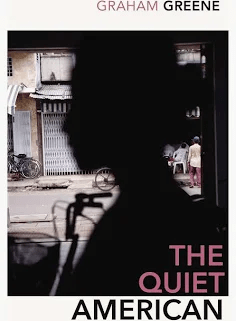
“After dinner I sat and waited for Pyle in my room over the rue Catinat; he had said “I’ll be with you at latest by ten”, and when midnight struck I couldn’t stay quiet any longer and went down into the street.”
Over the years, in recognition of his reputation as one of England’s greatest novelists, I have read several novels by Graham Greene – Our Man in Havana, Brighton Rock; The End of the Affair; The Third Man; and Dr Fischer of Geneva – with the aim of finding out for myself what entitled him to that status. All are impressive in their own way. Brighton Rock is a chilling portrait of a psychopath; The Third Man is an outstanding detective story, and so on – but none of them have struck me as being anywhere nearly as impressive (while still being very distinctively by Greene) as The Quiet American.
The short (less than 180 pages) novel is set in mid-1950’s Vietnam. At this time the origins of the Vietnam War were developing, with the French colonial rulers struggling to impose order upon a growing Communist insurgency and their American allies slowly being dragged into the conflict. The narrative contains an account of the domino theory which came to dominate American foreign policy for decades. If you are not familiar with this theory it argues that one country ‘lost’ to communism would lead to others in the region falling to communism like a row of toppling dominos.
“They want enough rice, I said. They don’t want to be shot at. They want one day to be much the same as another. They don’t want our white skins around telling them what they want.”
“If Indo-China goes…”
“I know the record. Siam goes. Malaya goes. Indonesia goes.”
Narrated in the first person by the cynical and aging English journalist Thomas Fowler, The QuietAmerican tells the story of a love triangle between Fowler, his much younger Vietnamese mistress Phuong, and a naive American ‘economic attaché’, Alden Pyle. Through this story Greene challenges the American involvement in Vietnam and eerily predicts the future course of the conflict. Greene’s was a war correspondent for The Times and Le Figaro in French Indochina 1951–1954 and the novel is clearly based on this experience, with his point of view being closely identified with his narrator, Fowler. The novel is told in flashback, with Fowler recalling his brief relationship with Pyle before the latter is murdered by insurgents.
It becomes clear very early on in the novel that Pyle is a CIA agent organising support for a local right-wing militia, seen by the American as a useful third force in opposition to the communists.
Fowler has a live-in lover, Phuong, who is only 20 years old and was previously an exotic dancer. Phuong has an ambitious sister who intend to arrange a marriage for Phuong to a Westerner. She originally thought that Fowler might marry Phuong, but he is already married. His wife back in the UK is a staunch Catholic unprepared to consider divorce, despite his record of infidelity. Pyle falls immediately in love with Phuong and asks Fowler to give her up, promising he will give her everything he, Fowler, cannot. At the same time Fowler’s editor asks him to return to England, offering him a promotion. Despite the American offering much more than Fowler can, Phuong chooses to stay with the Englishman. Pyle, always attempting to be ‘honourable’ withdraws and tries to make himself scarce. But he and Fowler are thrown together once again when they end up in a guard tower outside Saigon under attack from the insurgents. Pyle saves Fowler’s life much to his irritation. Back in Saigon, injured but recovering, Fowler lies to Phuong that his wife has agreed to a divorce. When this lie is exposed Phuong moves out an in with Pyle, realising that Fowler is never going to marry her.
The novel’s climax comes when the evidence pointing to Pyle’s involvement in a attack killing civilians becomes undeniable. Pyle attempts to justify his support for General Thé, commander of the ‘third force’ behind these attacks, explaining his theories about what is best for the Vietnamese. As a journalist, Fowler has some trusted contacts with the Viet Minh, predecesors of the Viet Cong, one of whom approach him asking for his tacit help in ending Pyle’s support for General Thé. He realises, but does not admit to himself, that this most likely means Pyle will be murdered. He goes through with the arrangement, and the result is already known. Despite his involvement, even culpability, Fowler manages to be angry at Pyle’s death, telling the American Economic Attache “They killed him because he was too innocent to live. He was young and ignorant and silly and he got involved. He had no more of a notion than any of you what the whole affair’s about, and you gave him money and York Harding’s books on the East and said “Go ahead. Win the East for Democracy”.
This was a devastating portrait of American involvement in Vietnam, extraordinarily prescient, predicting the whole course of the war. No wonder the book was seen as anti-American – it certainly isn’t sympathetic to the US. Greene obviously wrote from bitter experience. As a political statement the novel is powerful, but it succeeds on a number of other levels. The description of how women are treated in 1950’s Saigon is depressing. Phuong’s relationship with Fowler is predominantly commercial – he looks after her financially, with the implied promise of future support, and she is return allows him access to her body. She is a step above the prostitutes working the streets of Saigon or at the House of the Five Hundred Girls, shown fighting desperately for ‘business’ – but she is treated little better by the Americans. Granger, the obnoxious journalist working as part of the press corps in Vietnam, asks of Fowler’s relationship with Phuong:
“Where’d he find her? You got to be careful in this town.” He added gloomily “Thank God for penicillin”. Later he describes her as “a piece of tail”, even though it is clear that her relationship with Fowler is more than that of client and prostitute. Fowler’s narration portrays Phuong as docile and interested only in gossip about the British Royal family. He sees other Vietnamese women purely as sex objects:
“Up the street came the lovely flat figures – the white silk trousers, the long tight jackets in pink and mauve patterns slit up the thigh.”
The Quiet American is taut, precise, atmospheric, and chillingly prescient. In Fowler, Greene has created a complex, flawed, and in many ways unpleasant anti-hero with whom the reader cannot help but identify, despite his culpability in Pyle’s murder. Highly recommended.
“I have just buried my boy, my poor handsome boy of whom I was so proud, and my heart is broken. It is very hard having only one son to lose him thus, but God’s will be done. Who am I that I should complain? The great wheel of Fate rolls on like a Juggernaut, and crushes us all in turn, some soon, some late—it does not matter when, in the end, it crushes us all
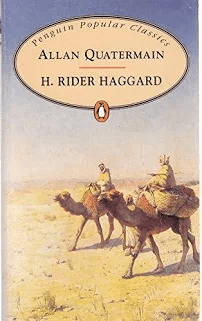
Allan Quatermain is the sequel to King Solomon’s Mines and the second novel in a series of adventures for the eponymous hero (although chronologically it is the last in the series). It sees our hero reunited with Captain Good and Sir Henry Curtis, his original travelling companions in adventure in KSM. The novel opens on the shockingly downbeat note above – Quatermain’s son Harry has just died of smallpox, contracted in a hospital where he was working as a doctor. Quatermain is understandably devastated and decides to abandon the sedentary life of a country gentleman and return to where his heart lies, Africa, in search of one last great adventure. Good and Sir Henry decide on the spot to join him, and no sooner said than done, the gang is back together again, on their way to lands unknown.
I’ve used this illustration because it was the edition I read, but there are no camels mentioned in the text so far as I can recall!
One of the many conventions of the adventure novel of the late nineteenth and early twentieth century (and still seen in films today) was that however large the continent being explored, the adventurers always almost immediately bump into someone they know. Here Quatermain and party meet Zulu chief Umslopogaas on their arrival in Africa and persuade him and his small group of soldiers to join them. Umslopogaas is an interesting portrait, the very definition of the ‘noble warrior’ trope that recurs throughout this genre. Although he is defined by racist ideas about the savagery of African tribesmen, it is not an unsympathetic portrait – in fact Umslopogaas is a hero and role model, loyal to Quatermain and fearless in battle.
Thus assembled the explorers set out from the coast of east Africa into the unknown. They have heard of a lost race of white- or light-skinned people who they decide to track down. Again Rider Haggard is relying safely on another trope of the genre, the ‘lost race’ story where explorers journey into isolated, uncharted territory and discover an undiscovered or hidden civilisation. The rumours of the lost race are always borne by someone who escapes from the lost world and survives an exhausting journey, only to expire almost as soon as his story is told. Thus:
“I was sitting on the veranda, when a poor, miserable, starved-looking man came limping up and squatted down before me. I asked him where he came from and what he wanted, and thereon he plunged into a long rambling narrative about how he belonged to a tribe far in the north, and how his tribe was destroyed by another tribe, and he with a few other survivors driven still further north past a lake named Laga. Thence, it appears, he made his way to another lake that lay up in the mountains, ‘a lake without a bottom’ he called it, and here his wife and brother died of an infectious sickness—probably smallpox—whereon the people drove him out of their villages into the wilderness, where he wandered miserably over mountains for ten days, after which he got into dense thorn forest, and was one day found there by some white men who were hunting, and who took him to a place where all the people were white and lived in stone houses…. he seems, according to his account, to have gone through sufferings and hardships innumerable, and to have lived for weeks on roots and berries, and such things as he could catch and kill. But somehow he did live, and at last by slow degrees made his way south and reached this place.”
As soon as his story is told his end is nigh:
“I told him to return on the morrow, bidding one of my headmen look after him for the night. The headman took him away, but the poor man had the itch so badly that the headman’s wife would not have him in the hut for fear of catching it, so he was given a blanket and told to sleep outside. As it happened, we had a lion hanging about here just then, and most unhappily he winded this unfortunate wanderer, and, springing on him, bit his head almost off without the people in the hut knowing anything about it, and there was an end of him and his story about the white people”.
But first they have to travel through Maasai territory. Following a violent quarrel with their bearers, the group find that are being tracked by a Maasai war party intent on punishing them. They seek sanctuary at the home of a Scottish missionary, Mr. Mackenzie, who has established a very civilised home in the deep jungle. As well as building a heavily fortified and extensive mission house, Mackenzie has tamed the jungle and established a small oasis of ‘civilisation’. It is described as being like a Garden of Eden, full of plants imported from the UK:
“We been walking up the slope of the hill, the lower portion of which was fenced off, sometimes with quince fences and sometimes with rough stone walls, into Kaffir gardens, just now full of crops of mealies, pumpkins, potatoes, etc. In the corners of these gardens were groups of neat mushroom-shaped huts, occupied by Mr Mackenzie’s mission natives, whose women and children came pouring out to meet us as we walked. Through the centre of the gardens ran the roadway up which we were walking. It was bordered on each side by a line of orange trees, which, although they had only been planted ten years, had in the lovely climate of the uplands below Mt Kenia, the base of which is about 5,000 feet above the coastline level, already grown to imposing proportions, and were positively laden with golden fruit…. What a garden it was! I have always loved a good garden, and I could have thrown up my hands for joy when I saw Mr Mackenzie’s. First there were rows upon rows of standard European fruit-trees, all grafted; for on top of this hill the climate was so temperate that nearly all the English vegetables, trees, and flowers flourished luxuriantly, even including several varieties of the apple, which, generally, runs to wood in a warm climate and obstinately refuses to fruit. Then there were strawberries and tomatoes (such tomatoes!), and melons and cucumbers, and, indeed, every sort of vegetable and fruit…. I do not think I ever saw such roses, gardenias, or camellias”.
The not-so-subtle message here is that Imperialism can tame and bring order to the wildest of environments. This little England is threatened when Mr. Mackenzie’s daughter is kidnapped by the Maasai war party who demand the life of one of the Britons as ransom. Instead they counterattack, and using their rifles and guns are able to defeat the much larger group, slaughtering every one of them and feeding them to the crocodiles. That’s the sentence for threatening a white woman. Mackenzie’s cook, Alphonse, a cowardly French cook, joins the party at this point, and for the rest of the novel fulfils a straightforward comedic role of the ‘funny foreigner’.
Following this short break they push on into the interior. Another trope is quickly upon them. The race of white-skinned people they are searching for live in an area of Africa isolated by mountains and other impenetrable geographical features, as is almost always the case. Compare for example the Lost World which is cut off from the outside world by virtue of being on a volcanic plateau, Shangri-La in a hidden Himalayan valley or Herland on another of those isolated and unscalable plateaus that litter the African landscape.
The party accidentally find their way into this region by canoeing along an underground river, through which they find the lost world of Zu-Vendis. Zu-Vendis is ruled by two queens, sisters Nyleptha and Sorais. While this society is an absolute monarchy, the peace is kept by a precarious alliance between the powerful priesthood and another group of wealthy feudal lords. The novel reaches its climax when both sisters fall in love with Curtis, and his choice of one over the other triggers a bloody civil war.
Allan Quatermain is a guilty pleasure, an unashamed adventure novel. If at times it seems a bit ‘by the numbers’ with a lot of predictable elements, this in part is because the author originally established many of the tropes he uses. I am sure that other, earlier authors wrote about lost tribes, noble savages and so on, but Rider Haggard is the founding father of the genre. He is unapologetically imperialist – or at least Quatermain is. He boasts about the vast amount of elephants he has shot without a hint of regret or remorse. To the Englishmen in this novel black lives, with a few exceptions, are disposable. All of the Wakwafi soldiers who sign on to join the party with Umslopogaas are killed off during the journey, but none are named nor mourned and their deaths are passed over casually. Even the portrait of Alphonse, intended as comical, is at this distance racist. So this is a period piece that has not aged well and I have no doubt I would never have read it if it wasn’t part of a second-hand bookshop bargain haul. But at the same time I don’t regret doing so either. In part this is because books of this genre were part of the standard reading material (of boys in particular) when I was growing up, and nostalgia is a powerful force, but also gaining a better understanding of how the world was seen by many Europeans in the late nineteenth century is a useful means to appreciate the nature of imperialism. It’s still escapism of course – while Quatermain and friends were exploring a fictional Africa of maybe a hundred years earlier, the reality of imperialism was being exposed in novels such as Conrad’s Heart of Darkness. The contrast is stark.
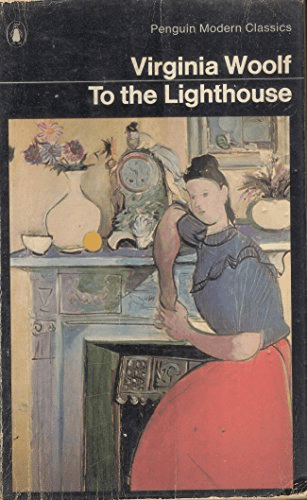
“Yes, of course, if it’s fine tomorrow,” said Mrs. Ramsay. “But you’ll have to be up with the lark,” she added.”
The narrative style of To the Lighthouse is usually described as ‘stream of consciousness’. While there is no strict definition of this term, it struck me while reading the novel that this term is not quite right. Stream of consciousness, as demonstrated by Molly Bloom at the end of Ulysses for example, is a direct representation of the thoughts of the character in the first person. (“Yes, I said yes, I will, yes” etc). Whereas To the Lighthouse has an omniscient narrator who sits on the shoulders of Woolf’s characters and transcribes their thoughts in the third person. Normally this transcription is unfiltered and may as well be in the first person, but very occasionally the narrator interprets or passes comment on the character’s thoughts and feelings. The representation of consciousness is one of the most striking features of this novel – thoughts are chaotic, easily interrupted or distracted, and sometimes include intrusive or unwelcome. But the narrator is always there, inserting a slight distance between the character and the narrative. Take for example the opening paragraph of chapter 12. The narrator is watching Mrs Ramsay and her husband, and describes what they do as well as what they think:
“She folded the green shawl about her shoulders. She took his arm. His beauty was so great, she said, beginning to speak of Kennedy the gardener, at once he was so awfully handsome, that she couldn’t dismiss him. There was a ladder against the greenhouse, and little lumps of putty stuck about, for they were beginning to mend the greenhouse. Yes, but as she strolled along with her husband, she felt that that particular source of worry had been placed. She had it on the tip of her tongue to say, as they strolled, “It’ll cost fifty pounds,” but instead, for her heart failed her about money, she talked about Jasper shooting birds, and he said, at once, soothing her instantly, that it was natural in a boy, and he trusted he would find better ways of amusing himself before long. Her husband was so sensible, so just. And so she said, “Yes; all children go through stages,” and began considering the dahlias in the big bed, and wondering what about next year’s flowers, and had he heard the children’s nickname for Charles Tansley, she asked. The atheist, they called him, the little atheist. “
It is Mrs Ramsay who thinks her husband is sensible and just, not the narrator, but the slim distance between the two perspectives is important. Crucially it allows the point of view to flit between characters, so within a few lines of this paragraph the narrative is assumed by Mr Ramsay, a much more introspective, internally focussed point of view. What the narrator does not do is step away from the characters’ thoughts and provide any exposition. We are thrown into the middle of the Ramsay family holiday without being told who the family members are, who are their guests and servants, their occupations, or indeed anything to provide us with context. Who are these people? Slowly, through the narration and the conversation the reader is able to piece together an overview of the setting. The Ramsays are a large middle-class family on holiday in the Isle of Skye in Scotland. As well as their eight children they have several house-guests and a number of domestic servants. The house is on the coast and overlooks a bay where a large lighthouse is situated. Some of the children want to take a boat-trip out to the lighthouse the following day, but it is a long and rough journey and cannot happen unless the weather is fine, which it usually isn’t. Mr. Ramsay—a professor of philosophy—harshly tells the children the trip will be impossible.
In the first, longest section of the novel, the Ramsays are hosting a diverse group of intellectuals and artists at their holiday home. The narrative focuses on a single day during which Mrs Ramsay match-makes between her guests, reads her youngest son, James, a story, flatters the ego of her grumpy husband, and floats around the house noticing things. In the evening a grand dinner is served (more on which below) and the day ends with Mr and Mrs Ramsay reading alongside one another but failing to connect or communicate. The sketch is predominantly autobiographical – Mrs Ramsay is thinly-disguised a portrait of Woolf’s mother who died when Woolf was only 11, and was obviously deeply missed. To the Lighthouse is in many ways Woolf’s way of exorcising her grief at the loss of her mother.
The second, much shorter section of the novel, “Time Passes” was described by Woolf as a corridor between the The Window, set before the first World War, and The Lighthouse, the third section of the novel set some ten years later. The holiday home is viewed through the eyes of the domestic servant employed by the family to act as a caretaker for the house, and when they eventually decide to come back to renovate and clean it. Time Passes is a quite literal description of what happens. In the intervening decade Mrs Ramsay and two of her children die, and the house deteriorates badly in apparent sympathy with the family:
For now had come that moment, that hesitation when dawn trembles and night pauses, when if a feather alight in the scale it will be weighed down. One feather, and the house, sinking, falling, would have turned and pitched downwards to the depths of darkness. In the ruined room, picnickers would have lit their kettles; lovers sought shelter there, lying on the bare boards; and the shepherd stored his dinner on the bricks, and the tramp slept with his coat round him to ward off the cold. Then the roof would have fallen; briars and hemlocks would have blotted out path, step and window; would have grown, unequally but lustily over the mound, until some trespasser, losing his way, could have told only by a red-hot poker among the nettles, or a scrap of china in the hemlock, that here once some one had lived; there had been a house.
Here the abandoned home symbolises the state of the nation, damaged to the point of destruction by World War I. In casual, almost brutal parenthesis, the deaths of Mrs Ramsay and two of her children are announced. Alongside so much death in the Great War, in which almost no town, village or family was untouched, these announcements act as reminders of the everyday losses that the country suffered.
[A shell exploded. Twenty or thirty young men were blown up in France, among them Andrew Ramsay, whose death, mercifully, was instantaneous.]
In the final section of the novel, some of the surviving family members and a few former guests return to the reopened summer home. A grieving Mr Ramsay insists that the family must finally complete the long-delayed boat trip to the lighthouse and forces his now-teenage children, James and Cam, to join him. The teenagers deeply resent their father’s tyrannical, mourning behaviour and form a silent pact of resistance against him. The trip to the lighthouse is both an attempt to recover the lost pre-War days which in hindsight seemed so peaceful and to reconnect with his children, who as moody teenagers no longer respect their mourning father. Much of this section of the novel is told from the perspective of Lily Briscoe, one of the original house guests, a painter who sets up her easel in the exact spot she did a decade earlier. Remembering her earlier visit she also mourns for Mrs Ramsay. The novel ends as the fishing boat reaches the lighthouse and they disembark. The lighthouse is a multi-faceted symbol that works in a number of ways during the course of the novel, but here for me represents death or the end of life’s journey.
I wanted to take a closer look at some of the minor characters in To the Lighthouse, more specifically the domestic servants. The cook, Muriel, is first mentioned in chapter 10. Mrs Ramsay is wondering whether some of her house guests have returned from their walk, so she asks one of her children (Cam) to “ask Mildred if Andrew, Miss Doyle, and Mr. Rayley have come back?” She wonders “What message would Cam give the cook?” which tells us, indirectly that Muriel is not a family member or guest but a member of staff, and specifically the cook. Cam returns to tell her “that there was an old woman in the kitchen with very red cheeks, drinking soup out of a basin” whose message is that “”No, they haven’t, and I’ve told Ellen to clear away tea.” Ellen is another servant who is part of the support team that the household relies on but takes for granted. Chapter 10 ends with Mrs Ramsay finishing her reading of a story to James, and “In a moment he would ask her, “Are we going to the Lighthouse?” And she would have to say, “No: not tomorrow; your father says not.” Happily, Mildred came in to fetch them, and the bustle distracted them. But he kept looking back over his shoulder as Mildred carried him out, and she was certain that he was thinking, we are not going to the Lighthouse tomorrow; and she thought, he will remember that all his life.” James is six at this point, a bit old for being carried out by an old woman I would have thought, but this does suggest that Mildred is not just a cook but has child-caring responsibilities as well.
Mildred is next referred to during dinner preparations, where the main dish, a boeuf en daube, is described as “Mildred’s masterpiece”. When this dish is finally served (and there is strong suggestion that the cook has exaggerated its complexity to Mrs Ramsay – it is just a slow cooked stew) Mrs Ramsay accepts her guests praise for the dish without acknowledging Mildred’s hard work:
“an exquisite scent of olives and oil and juice rose from the great brown dish as Marthe (another anonymous servant), with a little flourish, took the cover off. The cook had spent three days over that dish. And she must take great care, Mrs. Ramsay thought, diving into the soft mass, to choose a specially tender piece for William Bankes. And she peered into the dish, with its shiny walls and its confusion of savoury brown and yellow meats and its bay leaves and its wine, and thought, This will celebrate the occasion–a curious sense rising in her, at once freakish and tender, of celebrating a festival, as if two emotions were called up in her, one profound–for what could be more serious than the love of man for woman, what more commanding, more impressive, bearing in its bosom the seeds of death; at the same time these lovers, these people entering into illusion glittering eyed, must be danced round with mockery, decorated with garlands.
“It is a triumph,” said Mr. Bankes, laying his knife down for a moment. He had eaten attentively. It was rich; it was tender. It was perfectly cooked. How did she manage these things in the depths of the country? he asked her. She was a wonderful woman. All his love, all his reverence, had returned; and she knew it.“It is a French recipe of my grandmother’s,” said Mrs. Ramsay, speaking with a ring of great pleasure in her voice.“
Later, after dinner, Mrs Ramsay wanders ethereally away from her guests to go and check on the children.
“She turned the handle, firmly, lest it should squeak, and went in, pursing her lips slightly, as if to remind herself that she must not speak aloud. But directly she came in she saw, with annoyance, that the precaution was not needed. The children were not asleep. It was most annoying. Mildred should be more careful. There was James wide awake and Cam sitting bolt upright, and Mildred out of bed in her bare feet, and it was almost eleven and they were all talking. What was the matter? It was that horrid skull again. She had told Mildred to move it, but Mildred, of course, had forgotten, and now there was Cam wide awake, and James wide awake quarreling when they ought to have been asleep hours ago. What had possessed Edward to send them this horrid skull? She had been so foolish as to let them nail it up there. It was nailed fast, Mildred said, and Cam couldn’t go to sleep with it in the room, and James screamed if she touched it.”
Cam is the youngest Ramsay daughter, at seven only a year older than her brother James. In this home (at least) they share a bedroom. Mrs Ramsay is annoyed with Mildred “out of bed and in her bare feet” because the children are not asleep. So as well as being the family cook, we can infer that Mildred is directly responsible for putting the children to bed. I doubt she sleeps in the same room as them, so the fact she is ‘out of bed’ suggests she has heard the children arguing and has got up to try and calm them down, when Mrs Ramsay walks in and blames her for the children’s misbehaviour and arguing. This reveals a contemptuous attitude towards a senior member of staff, which is compounded by the comment that Mildred “of course” had forgotten to move the skull. The ‘of course’ suggests Mrs Ramsay expects to be disappointed by her servants, as if Mildred hasn’t been busy cooking a stew for three days! Later in this paragraph Mildred explains that the skull is nailed fast, making it clear that she had not forgotten about it all, just that she was unable to move it. Of course, no apology is even considered. Servants are there to do as they are told.
The domestic female staff of the Ramsay household are ignored, neglected, taken for granted, disrespected, and under-valued. So what we have to try and work out is whether this is a subtly drawn portrait by Woolf of entitled middle-class people treating their servants – their employees – with a lack of respect, or whether this is a reflection of the way Woolf herself took her family servants for granted. It is a difficult call to make – we have to read the text closely to work out who the servants are (as opposed to the eight children and the various house guests) and Mrs Ramsay’s inner monologue doesn’t really help us. But there is another portrait of a servant in the novel that throws light on this issue. In Time Passes, we are introduced to Mrs McNab. Although she is the family’s housekeeper, she does not merit a mention in The Window. The portrait of her in Time Passes is largely unsympathetic. She walks with a lurch, rolling like a ship at sea. The narrator doesn’t explain why she walks this way, but it could have been caused by rickets, a common condition for working people at the time (particularly Hebridean people with limit access to some foodstuffs) caused by a calcium deficiency. What Woolf’s narrator is noticing is that old servants walk in a ‘funny’ way without considering why. She also ‘leers’ instead of looking directly at things, which we are told is because she is ‘witless’. And as working class people often do (when written by middle-class authors) she sings to herself:
“As she lurched (for she rolled like a ship at sea) and leered (for her eyes fell on nothing directly, but with a sidelong glance that deprecated the scorn and anger of the world–she was witless, she knew it), as she clutched the banisters and hauled herself upstairs and rolled from room to room, she sang.,,, a sound issued from her lips–something that had been gay twenty years before on the stage perhaps, had been hummed and danced to, but now, coming from the toothless, bonneted, care-taking woman, was robbed of meaning, was like the voice of witlessness, humour, persistency itself, trodden down but springing up again, so that as she lurched, dusting, wiping, she seemed to say how it was one long sorrow and trouble, how it was getting up and going to bed again, and bringing things out and putting them away again.”
Not satisfied with patronising and caricaturing this hard-working housekeeper, Woolf continue to denigrate her. She is “bowed down … with weariness…. creaking and groaning on her knees”. Her “sidelong leer which slipped and turned aside even from her own face, and her own sorrows, stood and gaped in the glass, aimlessly smiling”. The narrator attempts to capture Mrs McNab’s thoughts, but for once the attempt falls flat:
“Visions of joy there must have been at the wash-tub, say with her children (yet two had been base-born and one had deserted her), at the public-house, drinking; turning over scraps in her drawers. Some cleavage of the dark there must have been, some channel in the depths of obscurity through which light enough issued to twist her face grinning in the glass and make her, turning to her job again, mumble out the old music hall song….Mrs. McNab continued to drink and gossip as before.”
Even the washer-woman, the narrator speculates, must have some fond memories of her children, even though two of them were illegitimate. A kind interpretation would be that Woolf is here acknowledging that even working class woman, condemned to a life of drudgery and child-bearing, have an internal life, hopes and dreams – but I am not convinced, and that final dismissive summary – “Mrs McNab continued to drink and gossip as before” – makes me wonder whether Woolf really thought of her servants as authentic, valuable human beings. There is evidence to suggest her relationships with her own servants were troubled – see Alison Light’s account in Mrs Woolf and the Servants for example.
I appreciate this aspect of the novel is simply one part and should not be given overdue emphasis. It certainly didn’t spoil the novel for me. But equally I did not want to ignore it, when the more obvious aspects of the novel – the Modernist exploration of consciousness, the complex narrative point of view, and the abundant use of symbolism – have been so thoroughly explored elsewhere. To be fair to Woolf she does not ignore her servant characters completely, as was often the case in earlier novels (see this post for more on the invisibility of servants in nineteenth century novels), they are given names and thoughts, but they are marginalised and disrespected, which is not much better.


 The Reading Bug