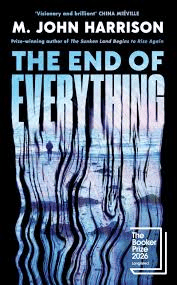
For years Phillip Tennent lived at the end of the sea, where artefacts were washed up every day. Scavengers, professional and otherwise, came and went. Turnover was higher than you’d expect given the relaxed lifestyle, the constant good weather, the ease with which some sort of existence could be pursued.
The End of Everything defies categorisation. The term ‘dystopian fiction’ helps a little – the novel is set in an indeterminate future where society as we know it has largely broken down, although there is still some form of social order. It could also be categorised as science fiction, as the world is now occupied by an alien race known as the iGhetti who seem to have come to an accommodation with humanity, and co-exist alongside them – or, it is unclear, they might be destroying the world very slowly. There are also ‘bad patches’ – areas in the countryside where the normal rules of time and space have ceased to exist, and weird things happen. It’s best not to get caught in a bad patch – you might not be able to get out. ‘Speculative fiction’ is just too broad a genre to be of any help here. In the end the label that helped me come to terms with this novel the most was new weird fiction, a term that Harrison himself coined.
The search for a genre label might appear to be an attempt to put Harrison’s text into a framework that limits it, ties it down, but The End of Everything easily sidesteps any such attempt. It is unlike anything I have read before, and was consciously unsettling and disturbing. The narrative, such as it is, follows a beachcomber named Phillip who finds an ‘artefact’, something other-worldly left behind or created by the aliens. This artefact is never directly described, but it is alive, or has features that mimic life – it grows and adapts and can even be eaten, but is hard if not impossible to kill. It appears to be able to adapt to its environment and develop in ways that mimic the things around it – in this case Philip. Philip takes the artefact to his 70-year-old aunt Marnie, an artist suffering from early-stage Alzheimer’s disease. defends her townhouse and starts her own journey from gallery to gallery. Phillip decides to dispose of the artefact, and heads away from the coast. Following a ‘dispute’ with her neighbours, Marnie embarks on her own nomadic journey up the coast.
The disturbing scene which describes this dispute appears early on in the novel and firmly establishes the tone. I would not read this if you are in any way squeamish. Marnie lives in a ramshackle house. One day a fourteen year old boy climbs into the extension of her house and, finding her sleeping in the room below, urinates on her.
“He turned to run away and put his foot through the extension roof. Totten plaster pattered down inside. His left leg dangled into the room beneath, scrabbling for purchase. He began to call out in a high voice. “I have you now, you little bastard” Marnie told him. She wiped herself off and went inside, where she rummaged about in the kitchen until she found a metre or two of old electrical flex. This she fastened round the boy’s ankle, anchoring the other end to the heaviest object she could find, which happened to be the bed, to limit the movement of the leg. Once she was satisfied, she went outside again and pulled herself up on the edge of the extension roof until she could look at him.
“How do you feel about this now?” she said. The boy was in half-sitting half-kneeling position, his visible leg quivering with the strain of supporting him…. Marty went back inside. After some consideration, she grasped the tethered leg in both hands and hung from it. “No one in the street likes you”, she shouted. “Do you hear?” Then she found a knife in a cupboard, cut into the boys femoral artery and stepped quickly away from the spray of blood. She stood there for a moment watching the leg flail and spurt…. She watched for a minute or two as the boy lost energy, then turned away and leaned on the balcony rail, looking up and down the row at the overgrown gardens…. She went to talk to the boy’s father, who lived a couple of doors down. They sorted things out between them, and the father sent someone to lever his dead son out of her extension roof…..
After breakfast the boy’s father called, with delegation comprised of half a dozen other people who lived along the street. “Some of us feel you went too far”, he said, implying perhaps that he didn’t. ….The general feeling, the father said, the feeling of everyone there, was that Marnie should leave. “I can see I can see why you might say that” she said, although she couldn’t. ” I’ve lived here longer than any of you, but I can see why you might say that.”
I’ve quoted this awful, upsetting scene at considerable length (even though I have edited it down substantially, shown by the ellipses) because it is such a striking, unsettling episode. Killing a young boy (turns out he was actually 12, not 14 as Marnie believes) is done so casually, and with so few consequences, as if she has committed some minor social faux pas, rather than murder. Marnie is asked, politely, with typical British understatement, to move on, but other than that she is free to go. We are not in a typical dystopian world where life is cheap because of the breakdown of social order – instead this is a world where killing people casually, almost disinterestedly, is accepted, not normal, but not distressing either. This is not the only casual killing in the novel – Marnie has a gun, and uses it when she feels the need – but it is the one that stands out the most, coming early in the novel and setting the tone for what is to come. The reader has no frame of reference to respond to this incident – this is unlike any other dystopia, any end of the world written about before. Obviously the author’s intention is to unsettled the reader, to remove any solid ground from under them. Mission accomplished.
The rest of the novel follows this template. You never quite know what is happening. There is a narrative structure, of sorts, but it is not that important. Neither are the principal characters. People are introduced, things happen, nothing really makes much sense.
I turned to the internet for help in framing my reactions to the novel, and come across this review by sci-fi blogger At Boundary’s Edge. The blogger observes in one very telling sentence that “Harrison isn’t telling us a story. He’s selling us an experience.” This makes a lot of sense. Don’t read the novel to find out ‘what happens’ or to enjoy the story, because there really isn’t much of one. Instead, immerse yourself in the experience of reading a M John Harrison novel, like taking a drug that you aren’t sure how you are going to react, whether the experience is going to be a good one or not, but it is definitely going to be an experience. Another reviewer over on Goodreads wrote: “There’s using confusion and warped perception as a literary tool, and then there’s this. As soon as it started approaching interesting concepts, it swiftly turned away to then prattle on about nothing of substance… It shouldn’t be this much of a slog to get through a 200 page book.” And there we have it. Because I did find it hard to make my way to the end of The End of Everything. There was no-one to care about, no plot to resolve or end, even the mildly interesting puzzle of what the artefact might be or become is left unclear – and I was left feeling a little embarrassed at my need for clarity or resolution. Alongside the weirdness there is plenty of lyrical descriptive writing suggesting Harrison is a skilled and capable writer, but this is definitely a case where for me the strangeness went that little bit too far. The Booker Prize panel obviously disagreed, long-listing this novel for the 2026 award, but I would be shocked if it makes it any further in the process.
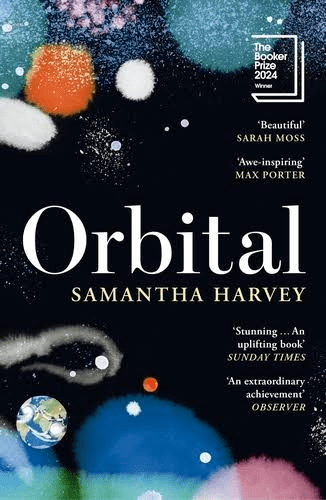
Rotating about the Earth in their spacecraft, they are so together, and so alone, that even their thoughts, their internal mythologies, at times convene. Sometimes they dream the same, dreams of fractals and blue spheres and familiar faces engulfed in dark, and of the bright energetic black of space that slams their senses. Raw space is a panther, feral and primal; they dream it stalking through their quarters.
Orbital, which won the 2024 Booker Prize, follows a day in the lives of six astronauts in low-earth orbit on the International Space Station. Italian, Russian, British, American and Japanese astronauts spend their day in a mixture of the mundane – monitoring routine experiments on the behaviour of microbes and mice in space, documenting their bodily functions, eating, drinking, sleeping – and the extraordinary, watching the vastness of space and the earth pinwheeling round. We learn the backstory of each astronaut and how they came to be on the ISS. Simultaneously another mission takes off from earth, this time going back to the moon.
The novel is a poem to the beauty of the earth and its fragile improbability. The prose is extraordinarily lyrical – I could fill this review with examples of the author’s wonderful descriptions of earth as it passes by the space station’ s windows:
There’s the first dumbfounding view of Earth, a hunk of tourmaline, No, a cantaloupe, an eye, lilac, orange, almond, mauve, white, magenta, bruised, textured, shellacked splendour.
and
As they traverse south, the colours change, the browns lighter, the palette less sombre, a range of greens, from the dark of the mountainsides to the emerald of river plains to the teal of the sea. The rich purplish green of the vast Nile Delta. Brown becomes peach, becomes plum: Africa beneath them in its abstract batik. The Nile is a spillage of royal blue ink.
and
Down over the arrowing peninsula of Dakar, crossing the equator, and in the closing minutes of day, the lights of Brazzaville and Kinshasa on either side of the Congo River, tepid in the dusk. Blue becomes mauve becomes indigo becomes black, and night-time down southern Africa in one. Gone is the paint-splattered, ink-leached, crumpled-satin, crumbled-pastel overflowing-fruit-bowl continent of chaotic perfection, the continent of salt pans and red sedimented floodplain and the nerve networks of splaying rivers and mountains that bubble up from the plains, green and velvety like mould growth. Gone is a continent, and here is another sheer widow’s veil of starstruck night.
This is some of the finest descriptive writing I have read in a very long time and I make no apology for quoting it at such length.
Orbital is not just a prose poem on the beauty of the earth. No novel, however slight (the text is less than 140 pages long) could sustain that as its sole theme. It touches on a number of other topics. One of the astronauts is asked to provide a response to the question “With this new era of space travel, how are we writing the future of humanity?” (this is with reference to the new journey to the moon, not the low-orbit space station which is very much showing its age), and the response offered by one of his fellow astronauts is “With the gilded pens of billionaires”, which is at once beautifully lyrical and at the same time recognises the role of the mega-rich in plotting the future course of space exploration. Climate change is addressed as the astronauts watch a tornado as it cuts a devastating route across islands in the Pacific. Chie, the Japanese astronaut, finds out that her mother has died and reflects on the improbability of her birth (her mother survived the atom bombs on Japan at the end of the second world war) and her journey into space.
There are many small stories here – but I would have to accept that the absence of a larger, over-arching storyline was one I missed. Orbital has no real narrative structure, no story in the conventional sense. There is incident – when the mice being experimented on suddenly discover that the absence of gravity means they can effectively fly is a wonderful moment – but the book felt more like an extended short story rather than a novella. While the distinction between these two categories might seem slight |I do think it is significant. It meant that there were points in the book where, however wonderful the prose descriptions of the earth were, I felt that there are only so many of these that I needed.
I will definitely be looking out for more works by this author. Her description of the ‘cosmic calendar‘ concept, used to to visualise the chronology of the universe, scaling its currently understood age of nearly fourteen billion years into a single year in order to help us comprehend the vastness of its scale, was extraordinary, and worth the price of admission on its own. Although this is a familiar concept I don’t think I have ever read it described more lyrically or in fact beautifully as Harvey in this book. She is a great writer, even if here she is not such a great story-teller.
“When he’s fifteen, he and his mother move to a new town and he starts at a new school. It’s not an easy age to do that – the social order of the school is already well established and he has some difficulty making friends.”
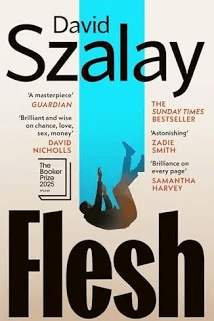
In eight discontinuous chapters, David Szalay tells the story of Istvan, whose surname is never mentioned to preserve his ‘everyman’ status. The novel opens with 15-year-old István living with his single mother (his father is also never mentioned, but his absence from Istvan’s life casts a long shadow. This is a novel about fatherhood among other more prominent themes.) Isolated at school, he begins a sexual relationship with an older, married neighbour. Told from Istvan’s perspective this affair is not perceived as abusive, but he is clearly groomed and the reader can infer how damaging it is. He repeatedly describes the neighbour as ‘old’ and ‘ugly’ and focuses on the flaws in her less-than perfect body. Eventually a violent confrontation with her husband results in his accidental death; István is held responsible (rightly so) and is sent to juvenile detention. As with many critical episodes in his life, this period of detention is skipped over in the narrative, and the next chapter opens with István about to be discharged from five years’ service in the army. He has served in Kuwait and the Iraq War, but we only learn this after the event as we are told about his discharge and attempt to return to civilian society. Another end of chapter time jump sees him moving to London to work as a bouncer at a nightclub. From there he is hired as a chauffeur and bodyguard for a wealthy businessman and he soon begins an affair with the businessman’s wife, Helen.
Helen’s husband has a recurrence of cancer and despite the best treatment money can buy, he dies. Another time jumps sees Istvan and Helen married, Helen pregnant, and her teenage son Thomas bitterly resenting Istvan’s very existence. All of the businessman’s estate has been left to Thomas, held in trust until he turns 25. Helen and Istvan dip into this money (with the connivance of a dodgy lawyer) to fund property development schemes. I am going to stop this plot summary at this point because there some significant spoilers ahead, if I haven’t given too many already. Suffice to say there are some significant challenges ahead for Istvan.
It’s quite some time since I read a book where I was so conscious of the author, sitting behind a screen, tapping out scenes and challenging the reader to find them banal, improbable or unconvincing. His central character – virtually every scene is recounted through Istvan’s eyes, to the extent that the small number of scenes not told from his perspective stand out starkly – finds it very difficult to access or articulate his feelings. To demonstrate this Szalay gives us literally dozens of scenes where Istvan replies in monosyllables to anyone attempting to get him to communicate on anything other than the most basic level. In conversation he either replies any time he is addressed with “I don’t know”, “Yeah” or by repeating the question:
“It’s Istvan right?”
“Yeah”
“Where are you from?”
“Hungary”
“What’s that like?
Istvan isn’t sure what to say. He says what he tends to say when people ask that question.
“It’s okay”
“You go back much?”
“Sometimes”
“Visit family?”
“Yeah”
“You must miss it”
“Yeah, sometimes”
And so on, relentlessly, daring the reader to find this banal. Even scenes of conflict, danger or excitement are described in the same, monosyllabic unengaged tone, demonstrating no awareness of the questioner’s interest in what is being discussed. Szalay has made a brave, radical choice – to take an exciting life and focus on the moments in-between the incident and drama, so all we see are the moments of reflection; and then to create a character almost completely unable to reflect on what has happened to him with any degree of insight or coherence. Istvan’s inability to talk about the events of his life quickly becomes a burden to the reader. We get it, he is inarticulate, the point is really flogged to death. I could have done with fewer of these extended conversations where nothing is said – I doubt if I was the only reader who was tempted to let their eyes slide over a chunk of dull, phatic dialogue to the next paragraph.
Reflecting on this choice while announcing the novel’s Booker Prize 2025 award, the chair of judges, Roddy Doyle explained:
“At the end of the novel, we don’t know what the protagonist, István, looks like but this never feels like a lack; quite the opposite. Somehow, it’s the absence of words – or the absence of István’s words – that allow us to know István. Early in the book, we know that he cries because the person he’s with tells him not to; later in life, we know he’s balding because he envies another man’s hair; we know he grieves because, for several pages, there are no words at all.I don’t think I’ve read a novel that uses the white space on the page so well. It’s as if the author is inviting the reader to fill the space, to observe – almost to create – the character with him. The writing is spare and that is its great strength. Every word matters; the spaces between the words matter.
If Szalay had chosen to write the scenes between the chapters, telling us directly about the moments that shape Istvan’s life, rather than letting most of it happen ‘off screen’, this would have been a very different novel, far more conventional, less challenging, but I suspect more enjoyable. But while interesting things happen to Istvan, I am not sure he is an interesting character. It will be clear by now that I am ambivalent about Flesh: you have got to admire the author’s audacity and technical skill, and I found the novel an extremely easy, two-day read, but the nagging doubt remains that at the heart of the novel there is a vacancy, a gap. Istvan drifts through life without forming any serious relationships – he is almost surprised when he realises at one point very late in the day that he actually likes his wife – and has nothing of interest to say. Perhaps Szalay was telling us that we are all, like Istvan, just flesh?