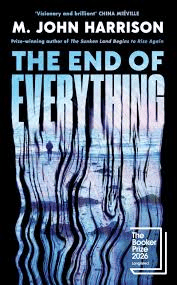
For years Phillip Tennent lived at the end of the sea, where artefacts were washed up every day. Scavengers, professional and otherwise, came and went. Turnover was higher than you’d expect given the relaxed lifestyle, the constant good weather, the ease with which some sort of existence could be pursued.
The End of Everything defies categorisation. The term ‘dystopian fiction’ helps a little – the novel is set in an indeterminate future where society as we know it has largely broken down, although there is still some form of social order. It could also be categorised as science fiction, as the world is now occupied by an alien race known as the iGhetti who seem to have come to an accommodation with humanity, and co-exist alongside them – or, it is unclear, they might be destroying the world very slowly. There are also ‘bad patches’ – areas in the countryside where the normal rules of time and space have ceased to exist, and weird things happen. It’s best not to get caught in a bad patch – you might not be able to get out. ‘Speculative fiction’ is just too broad a genre to be of any help here. In the end the label that helped me come to terms with this novel the most was new weird fiction, a term that Harrison himself coined.
The search for a genre label might appear to be an attempt to put Harrison’s text into a framework that limits it, ties it down, but The End of Everything easily sidesteps any such attempt. It is unlike anything I have read before, and was consciously unsettling and disturbing. The narrative, such as it is, follows a beachcomber named Phillip who finds an ‘artefact’, something other-worldly left behind or created by the aliens. This artefact is never directly described, but it is alive, or has features that mimic life – it grows and adapts and can even be eaten, but is hard if not impossible to kill. It appears to be able to adapt to its environment and develop in ways that mimic the things around it – in this case Philip. Philip takes the artefact to his 70-year-old aunt Marnie, an artist suffering from early-stage Alzheimer’s disease. defends her townhouse and starts her own journey from gallery to gallery. Phillip decides to dispose of the artefact, and heads away from the coast. Following a ‘dispute’ with her neighbours, Marnie embarks on her own nomadic journey up the coast.
The disturbing scene which describes this dispute appears early on in the novel and firmly establishes the tone. I would not read this if you are in any way squeamish. Marnie lives in a ramshackle house. One day a fourteen year old boy climbs into the extension of her house and, finding her sleeping in the room below, urinates on her.
“He turned to run away and put his foot through the extension roof. Totten plaster pattered down inside. His left leg dangled into the room beneath, scrabbling for purchase. He began to call out in a high voice. “I have you now, you little bastard” Marnie told him. She wiped herself off and went inside, where she rummaged about in the kitchen until she found a metre or two of old electrical flex. This she fastened round the boy’s ankle, anchoring the other end to the heaviest object she could find, which happened to be the bed, to limit the movement of the leg. Once she was satisfied, she went outside again and pulled herself up on the edge of the extension roof until she could look at him.
“How do you feel about this now?” she said. The boy was in half-sitting half-kneeling position, his visible leg quivering with the strain of supporting him…. Marty went back inside. After some consideration, she grasped the tethered leg in both hands and hung from it. “No one in the street likes you”, she shouted. “Do you hear?” Then she found a knife in a cupboard, cut into the boys femoral artery and stepped quickly away from the spray of blood. She stood there for a moment watching the leg flail and spurt…. She watched for a minute or two as the boy lost energy, then turned away and leaned on the balcony rail, looking up and down the row at the overgrown gardens…. She went to talk to the boy’s father, who lived a couple of doors down. They sorted things out between them, and the father sent someone to lever his dead son out of her extension roof…..
After breakfast the boy’s father called, with delegation comprised of half a dozen other people who lived along the street. “Some of us feel you went too far”, he said, implying perhaps that he didn’t. ….The general feeling, the father said, the feeling of everyone there, was that Marnie should leave. “I can see I can see why you might say that” she said, although she couldn’t. ” I’ve lived here longer than any of you, but I can see why you might say that.”
I’ve quoted this awful, upsetting scene at considerable length (even though I have edited it down substantially, shown by the ellipses) because it is such a striking, unsettling episode. Killing a young boy (turns out he was actually 12, not 14 as Marnie believes) is done so casually, and with so few consequences, as if she has committed some minor social faux pas, rather than murder. Marnie is asked, politely, with typical British understatement, to move on, but other than that she is free to go. We are not in a typical dystopian world where life is cheap because of the breakdown of social order – instead this is a world where killing people casually, almost disinterestedly, is accepted, not normal, but not distressing either. This is not the only casual killing in the novel – Marnie has a gun, and uses it when she feels the need – but it is the one that stands out the most, coming early in the novel and setting the tone for what is to come. The reader has no frame of reference to respond to this incident – this is unlike any other dystopia, any end of the world written about before. Obviously the author’s intention is to unsettled the reader, to remove any solid ground from under them. Mission accomplished.
The rest of the novel follows this template. You never quite know what is happening. There is a narrative structure, of sorts, but it is not that important. Neither are the principal characters. People are introduced, things happen, nothing really makes much sense.
I turned to the internet for help in framing my reactions to the novel, and come across this review by sci-fi blogger At Boundary’s Edge. The blogger observes in one very telling sentence that “Harrison isn’t telling us a story. He’s selling us an experience.” This makes a lot of sense. Don’t read the novel to find out ‘what happens’ or to enjoy the story, because there really isn’t much of one. Instead, immerse yourself in the experience of reading a M John Harrison novel, like taking a drug that you aren’t sure how you are going to react, whether the experience is going to be a good one or not, but it is definitely going to be an experience. Another reviewer over on Goodreads wrote: “There’s using confusion and warped perception as a literary tool, and then there’s this. As soon as it started approaching interesting concepts, it swiftly turned away to then prattle on about nothing of substance… It shouldn’t be this much of a slog to get through a 200 page book.” And there we have it. Because I did find it hard to make my way to the end of The End of Everything. There was no-one to care about, no plot to resolve or end, even the mildly interesting puzzle of what the artefact might be or become is left unclear – and I was left feeling a little embarrassed at my need for clarity or resolution. Alongside the weirdness there is plenty of lyrical descriptive writing suggesting Harrison is a skilled and capable writer, but this is definitely a case where for me the strangeness went that little bit too far. The Booker Prize panel obviously disagreed, long-listing this novel for the 2026 award, but I would be shocked if it makes it any further in the process.
The second novel in the series, Gormenghast picks up where Titus Groan left off, returning to the castle where the new earl, 77th of his line, grows up in his vast crumbling demesne into a life governed by strict and stifling ritual. Peake reintroduces his cast of extraordinary characters in a leisurely manner – he is in no rush to get the action underway. Titus, who had just turned one when the first novel ended, has to grow up before he can confront the demons that threaten him.
The florid language that characterised Titus Groan also returns, not least in the descriptions of the castle itself:
Withdrawn and ruinous it broods in umbra: the immemorial masonry: the towers, the tracks. Is all corroding? No. Through an avenue of spires a zephyr floats; a bird whistles; a freshet bears away from a choked river.
Readers will either luxuriate in prose like this, or be irritated by it. I don’t think one can have Gormenghast the adventure story without Gormenghast the prose poem, and I am very glad we have both.
Once the scene is set, and the characters are re-introduced, Peake can spend time on showing Titus’s childhood. He is wonderful at capturing the joy as well as the boredom of infancy: in a phrase that has stayed with me since reading it some 40 or more years ago, Titus is wading through his childhood.
Or to put it another way
Drear ritual turned its wheel. The ferment of the heart, within these walls, was mocked by every length of sleeping shadow. The passions, no greater than candle flames, flickered in Time’s yawn, for Gormenghast, huge and adumbrate, out-crumbles all. The summer was heavy with a kind of soft grey-blue weight in the sky – yet not in the sky, for it was as if there were no sky, but only air, an impalpable grey-blue substance, drugged with the weight of its own heat and hue.
Titus begins to chafe at the crippling conventions of castle life and the impositions of the daily rituals he has to undertake. I always read these rituals as Peake’s commentary on the meaningless conventions we surround ourselves with in life. Yes, this novel is thought provoking as well.
Sooner or later an Earl needs to go to school, and here Peake introduces new characters to his cast: the Professors. Professor Bellgrove is elevated to the headmastership following a fatal and grotesque accident which disposes of his predecessor. The other teachers are, as one by now expects, a collection of grotesques, not one of whom should be within a mile of a classroom. Peake is in no hurry with the adventure element of his tale, and introduces a new element to his narrative – romance, albeit a comedy romance between lovers who are getting on in years. The angular spinster Irma Prunesquallor, sister of the castle’s doctor, decides to get married, and throws a party to help her secure a groom from among the eligible teachers of the castle. Bellgrove rises to the occasion and begins to pay her court:
“His staff had shaken hands with her as though a woman was merely another kind of man. Fools! The seeds of Eve were in this radiant creature. The lullabyes of half a million years throbbed in her throat. Had they no sense of wonder, no reverence, no pride?”
I have an immense fondness for the chapters featuring the professors – they add little if anything to the plot, but they flesh out the world of Gormenghast wonderfully.
Meanwhile Steerpike, now assistant to the Master of Ritual, Barquentine, watches and waits for his opportunity. He decides that Barquentine stands in his way of advancement and has to be disposed of. However the plan doesn’t go smoothly – Barquentine puts up an unexpectedly fierce fight. Steerpike is severely injured, suffering extensive burns and almost drowning. As he lies recovering his delirious mutterings give rise to concerns in Dr Prunesquallor’s mind that he was involved in the mysterious disappearance and presumed deaths of Titus’s aunts, the twin sisters Ladies Cora and Clarice. Steerpike is now under suspicion, and from this point the novel races to a tragic and bitter conclusion in a chase scene that repays any and all the patience the reader has invested up to this point. An epic manhunt through the rapidly flooding castle ends with Titus having to make the most difficult decision of his young life.
I’ve praised Peake’s use of language, his character creation, his descriptive powers, but really at the heart of this novel is an adventure story. It takes a while to get there but the payoff at the end is extraordinarily exciting.
God I loved this book and its sequels. They enchanted me in a way that very few other books have done in my lifetime – possibly only teenagers can really feel this way about novels. Decades on I can look at them a bit more dispassionately and see their (very minor) flaws, but they remain high on my top ten list, and will always do so. It’s not going to be easy explaining this obsession. You either love these books (or at least the first two, the third is more complicated as I will explain in a bit) or you don’t – indifference is rare.
Peake was a writer of extraordinary flair and confidence. This is how he opens Titus Groan:
Gormenghast, that is, the main massing of the original stone, taken by itself would have displayed a certain ponderous architectural quality were it possible to have ignored the circumfusion of those mean dwellings that swarmed like an epidemic around its outer walls. They sprawled over the sloping arch, each one half way over its neighbour until, held back by the castle ramparts, the innermost of these hovels laid hold on the great walls, clamping themselves thereto like limpets to a rock. These dwellings, by ancient law, were granted this chill intimacy with the stronghold that loomed above them. Over their irregular roofs would fall throughout the seasons, the shadows of time-eaten buttresses, of broken and lofty turrets, and, most enormous of all, the shadow of the Tower of Flints. This tower, patched unevenly with black ivy, arose like a mutilated finger from among the fists of knuckled masonry and pointed blasphemously at heaven. At night the owls made of it an echoing throat; by day it stood voiceless and cast its long shadow.
I wonder at the assurance and skill of an author who can open with a parenthesis like that. This is our introduction to the huge castle of Gormenghast, a “vast landscape of crumbling towers and ivy-filled quadrangles” that has for centuries been the hereditary residence of the Groan family. I have only limited evidence for this but I am personally convinced that as Peake wrote the novels the castle grew in his imagination, starting from a modest, realistic setting and with it finally ending larger than a city. Titus Groan, the first of the series (not strictly a trilogy as it was not conceived as such, more a 3 book series) opens in an extraordinarily cinematic way – taking the reader from the outside of the castle where the Bright Carvers reside to the Hall of Bright Carvings, through corridors and passageways into the heart of the castle, focussing down to a small eye-hole in a painting through which we see the novel’s newly born hero, Titus, heir to the crumbling towers of Gormenghast.
Slowly Peake introduces the cast of his drama. Lord Sepulchrave, seventy-sixth Earl of Groan, a melancholy man, a prisoner of the rituals that govern life in the castle.
Sepulchrave, 76th Earl to the house of Gormenghast and lord of those tracts of country that stretch on every hand, in the North to the wastelands, in the south to the grey salt marshes, in the East to the quicksands and the tideless sea, and in the West to knuckles of endless rock.
His wife Countess Gertrude shuts herself away with her birds and her multitude of white cats. Their daughter is 15-year-old Fuchsia.
a girl of about fifteen with long, rather wild black hair. She was gauche in movement and in a sense, ugly of face, but with how small a twist might she not suddenly have become beautiful. Her sullen mouth was full and rich – her eyes smouldered.”
Fuchsia is a typical teenager, moody, self-absorbed and selfish. Sequestered in the south wing of the castle are Sepulchrave’s identical twin sisters Cora and Clarice:
dressed in purple, with gold buckles at their throats by way of brooches, and another gold buckle each at the end of hatpins which they wore through their grey hair in order apparently to match their brooches. Their faces, identical to the point of indecency, were quite expressionless, as though they were the preliminary lay-outs for faces and were waiting for sentience to be injected.
Both suffered from ill-defined fits in their youth which left them with limited mobility and even less intelligence. They crave power and blame Gertrude for robbing them of their rightful place in the castle’s heirarchy.
This is the ruling Groan family. Their lives are supported by numerous servants. These include Mr Flay, Lord Sepulchrave’s personal assistant, who is obsessively dedicated to his master. Swelter, the castle’s enormously fat chef, is Flay’s arch-nemesis:
Swelter, as soon as he saw who it was, stopped dead, and across his face little billows of flesh ran swiftly here and there until, as though they had determined to adhere to the same impulse, they swept up into both oceans of soft cheek, leaving between them a vacuum, a gaping segment like a slice cut from a melon. It was horrible. It was as though nature had lost control. As though the smile, as a concept, as a manifestation of pleasure, had been a mistake, for here on the face of Swelter the idea had been abused.”
Nanny Slagg is the down-trodden Groan family carer, looking after Fuchsia and now Titus. Doctor Prunesquallor is the castle’s physician. Rottcodd cares for the Bright Carvings. Sourdust is the Master of Ritual.
Into this arcane, decaying, isolated world, comes Steerpike, a young kitchen boy who could give Machiavelli a run for his money, Rescued by Flay from the kitchen, mainly to irritate Swelter, Steerpike immediately starts scheming his rise to power. This is as much his story as Titus’s. Steerpike is the worm in the apple of Gormenghast, who slowly comes to corrupt the whole body-politic of the castle.
In some ways the castle itself is almost a character in the novel. Peake is endlessly fascinated by its eccentric architectural detail:
Most of these buildings had about them the rough-hewn and oppressive weight of masonry that characterized the main volume of Gormenghast, although they varied considerably in every other way, one having at its summit an enormous stone carving of a lion’s head which held between its jaws the limp corpse of a man on whose body was chiseled the words: “he was an enemy of Groan’; alongside this structure was a rectangular area of some length entirely filled with pillars set so closely together that it was difficult for a man to squeeze between them.
Some readers have struggled to allocate Titus Groan and its sequel to a particular genre. While often described as fantasy, there are no witches, dragons or magical spells here, nothing supernatural or other-worldly at all. We perhaps cannot tell where or when Gormenghast is, but the people who live there obey strictly the internal rules of the narrative. It is best read as a gothic adventure story, a romance. Yes it is peopled by grotesques who you are unlikely to meet in everyday – but you might. There are stranger people out there. Not that long ago the Guardian carried an article comparing the novel to its near contemporary The Lord of the Rings, trying to understand why it was not as well known or loved as Tolkien’s trilogy. This was surely a category error – one work is a quest trilogy peopled by dragons, dwarves, wizards and elves; in Titus we remain rooted in Gormenghast, and the only menacing creatures hiding in the shadows are the men and women of the castle.
Readers may struggle with Peake’s florid language. Without question some passages are over-written. The novel also has probably the slowest start of any classic – it takes an age to reach Titus’s birth and Steerpike’s escape from the kitchen. All I can say is that once you get past this point the pace picks up and the narrative is gripping across the two main novels. Steerpike is a compelling character – while he is clearly monstrous, we cannot help but sympathise with him for at least some of his journey.
Titus Groan and its sequels are wonderful, life-changing, superb novels. Peake creates memorable characters you come to genuinely care about, and who will stay with you. There is a Shakespearean quality to the tragedy that unfolds in this novel and its sequel, a tragedy compounded in a remarkable way by the turn of events in Peake’s own life that are reflected in the third and final novel in the series. They may not be universally popular – some readers may find it hard to find a hero to identify with, and the language over-indulgent – but I love them.
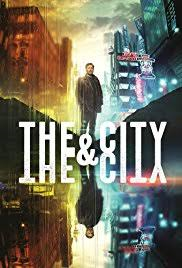
When reading this review, if you do, please remember my policy on spoilers – which is that I will probably use them. I don’t do so deliberately, I just find it hard to write comprehensively about something I have read without writing about the things that other readers might consider spoilers (bearing in mind of course that there is no universally agreed definition of what constitutes a spoiler in the first place). ‘The City and the City‘ is particularly difficult to review without reference to the central concept. If you avoid blurbs, plot summaries, reviews, tv adaptations etc, and read this novel without any preconceptions (I would agree by the way that a ‘pure’ approach to reading any novel is impossible – the reader will be influenced by their knowledge of the author, the cover illustration, etc) you become slowly aware that there is something unusual about the setting.
The central concept in this otherwise orthodox police procedural novel is extraordinary. Inspector Borlú, of the Extreme Crime Squad in the central European country of Besźel, investigates the murder of a foreign student. The victim was involved in debates about the complex relationship between Besźel and its neighbour and rival Ul Qoma. From early on there are some unusual aspects of Borlu’s narration. He talks about ‘unseeing’ a passerby, with no explanation of what this means. Borlu is Beszel born and bred, so his instincts as a native are deeply ingrained – he sees nothing out of the ordinary in what follows. Slowly, the true nature of Beszel and Ul Qoma’s unique relationship is revealed. The cities occupy the same geographical space, but preserve their separation through rigid adherence to ‘unseeing’ – being aware of but refusing to acknowledge the existence of the other – its buildings, vehicles, citizens and so on. This practice is enforced by a sinister entity known as Breach. Separation is assisted by differences between the city and the city – clothing, architecture, even gait. Residents are taught from childhood to recognise things belonging to the other city without actually seeing them. Ignoring the separation, even by accident, is called “breaching” – a serious and swiftly punished crime.
I suspect Meiville drew inspiration for this separate but the same concept from the situation in the former Yugoslavia in the 1980s and 90s, where neighbouring countries fought bitterly over small areas of land. This separation could have arisen from this kind of conflict, although we are told it dates to before recorded European history. Inevitably there are many complications to this way of life. The cities have areas where ownership is unclear, and where people of both cities walk and drive alongside one another. The only way one can legally pass from one city to another is through border control – even though such journeys involve returning to the same physical space one has just left.
Meiville’s construction of this world is thorough – he thinks through all the practical aspects (what if there is a traffic collision between cars from the different cities?) – this is not just a whimsical concept but a fact of everyday life for the citizens of the two cities, which make investigation of cross-border crime a logistical and conceptual nightmare.
Within this world, the murder investigation unfolds, and it is not a criticism to say that in this respect the novel is a traditional police procedural. Suspects are interviewed, other crimes are discovered, hidden forces interfere with the investigation, all in a routine manner. This is not of course a simple murder, even if where it was committed had been a less complex environment. A conventional buddy relationship develops between Borlu and his Ul Qoma partner, and Borlu’s sidekick does what every good sidekick does, providing back-up and insight without stealing the limelight.
In crossing genre boundaries, any author runs the risk of pleasing fans of neither original genre. Meiville does what he can to mitigate this risk, but his weird fiction fans are the most likely to have been disappointed – other than the setting or context, this is a very recognisable world. I really enjoyed it, and while I recognise it is probably not typical of Meiville’s work, I will be interested to see to what extent that is true, or whether my fairly uninformed impressions of this author are correct.



 universally agreed definition of what constitutes a spoiler in the first place). ‘The City and the City‘ is particularly difficult to review without reference to the central concept. If you avoid blurbs, plot summaries, reviews, tv adaptations etc, and read this novel without any preconceptions (I would agree by the way that a ‘pure’ approach to reading any novel is impossible – the reader will be influenced by their knowledge of the author, the cover illustration, etc) you become slowly aware that there is something unusual about the setting.
