At Swim-Two-Birds, Book review, Irish literature, Lost literature, The Third Policeman

The Third Policeman, by Flann O’Brien, 1940

“Is it about a bicycle?”

This wonderful novel has an interesting history. Written between 1939 and 1940, immediately after At Swim-Two-Birds, it was declined by O’Brien’s (English) publisher, Longmans, who said that “we realise the author’s ability but think that he should become less fantastic, and in this new novel he is more so.” Instead of trying to find an alternative publisher, O’Brien literally shelved the manuscript, and later claimed to have lost it. The book remained unpublished until his death in 1966, and was eventually printed unrevised  the following year. ‘The Third Policeman‘ was hugely ahead of its time, and it is sad to think O’Brien did not see it published, or come to influence a major American television series, in his lifetime.

I don’t agree with Longmans’ reader – ‘The Third Policeman is in many ways a straightforward narrative, and certainly more accessible than ‘At Swim’. The storyline is simple: the central character commits a murder; much later, he returns to collect the victim’s cash box. When he does so, just as he reaches for the box, “something happened. It was as if the daylight had changed with unnatural suddenness, as if the temperature of the evening had altered greatly in an instant or as if the air had become twice as rare or twice as dense as it had been in the winking of an eye; perhaps all of these and other things happened together for all my senses were bewildered all at once and could give me no explanation”.

From this point the naturalistic description ends, and the narrator enters an increasingly disturbing and surreal world, in which the laws of nature are left behind. The murder victim reappears and tells the narrator about a nearby police station. On the way he meets a one-legged man who threatens to kill him.. The police station is even more disturbing: “it looked as if it were painted like an advertisement on a board on the roadside and indeed very poorly painted. It looked completely false and unconvincing.” The narrator is not deterred by this breaking down of reality. Inside the station, the two policeman he meets are utterly obsessed with bicycles, and anything to do with bicycles – it is only later that we come to realise that this is because they are, at least in part, bicycles themselves. This is a result of “atomic theory”: –

“People who spent most of their natural lives riding iron bicycles over the rocky roadsteads of this parish get their personalities mixed up with the personalities of their bicycle as a result of the interchanging of the atoms of each of them and you would be surprised at the number of people in these parts who are nearly half people and half bicycles…when a man lets things go so far that he is more than half a bicycle, you will not see him so much because he spends a lot of his time leaning with one elbow on walls or standing propped by one foot at kerb stones.”

Another of the great joys of the novel are the footnotes concerning the narrator’s obsessive interest in the great scientist and philosopher, de Selby. In a style reminiscent of Kinbote in Nabokov’s ‘Pale Fire‘,  de Selby develops a character and story line all of his own in these footnotes, at times threatening to overwhelm the primary narrative. The narrator treats de Selby with huge seriousness and respect, but he is clearly deranged – he comes up with some wonderfully bizarre theories, such as the sausage shaped nature of the earth, and undeterred attempts to prove his theories with unhinged experiments, such as his attempts to dilute water, or see himself in the past by an increasingly distant series of mirrors, which he explains thus:

“If a man stands before a mirror and sees in it his reflection, what he sees is not a true reproduction of himself but a picture of himself when he was a younger man”. 

After a series of increasingly strange adventures, the narrator finally returns to his house where he is told the cash box full of untold treasure awaits him, only to discover the disturbing explanation for the increasingly bizarre, unreal, and fragmented nature of his world.

The Third Policeman‘ is a brilliant delight, chock full of wit and ideas. The plot twist at the end – and for once I won’t spoil it for you, despite my rigorous policy on this issue – can be seen coming a long way off, not least by anyone who watched the last series of ‘Lost’ (which apparently derived its central idea from this novel) – but that doesn’t spoil it in the least. If you are trying to choose between ‘At Swim‘ and this novel, choose ‘The Third Policeman’ – it is lighter, more accessible, simply easier to follow. You will find yourself quoting the kaleidoscope of ideas O’Brien scatters around for a long time to come.
Standard
100 Best Novels Guardian list, 20th century Literature, At Swim-Two-Birds, Book review, Flann O'Brien, Irish literature

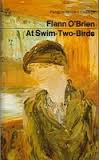
At Swim-Two-Birds, by Flann O’Brien – 1939

At Swim-Two-Birds‘ is quite unlike any other novel I have ever read. On the whole that is a good thing, but it also means that it can be a challenging, almost impossible read. Let’s start with a plot summary, which I have borrowed direct from Wikipedia:

At Swim-Two-Birds presents itself as a first-person story by an unnamed Irish student of literature. The student sets three apparently quite separate stories in motion. The first concerns the Pooka MacPhellimey, “a member of the devil class”. The second is about a young man named John Furriskey, who turns out to be a fictional character created by another of the student’s creations, Dermot Trellis, a cynical writer of Westerns. The third consists of the student’s adaptations of Irish legends, mostly concerning Finn Mac Cool and Mad King Sweeney.

In the autobiographical frame story, the student recounts details of his life. He lives with his uncle, who works as a clerk in the Guinness Brewery in Dublin. The uncle is a complacent and self-consciously respectable bachelor who suspects that the student does very little studying. This seems to be the case, as by his own account the student spends more time drinking stout with his college friends, lying in bed and working on his book, than he does going to class.

The stories that the student is writing become intertwined with each other. John Furriskey befriends two of Trellis’s other characters, Lamont and Shanahan. They become resentful of Trellis’s control over their destinies, and manage to drug him so that he will spend more time asleep, giving them the freedom to lead quiet domestic lives rather than be ruled by the lurid plots of his novels. Meanwhile, Trellis creates Sheila Lamont (Antony Lamont’s sister) in order that Furriskey might seduce and betray her, but “blinded by her beauty” Trellis assaults her himself. Sheila gives birth to a child named Orlick, who is born as a polite and articulate young man with a gift for writing fiction. The entire group of Trellis’s characters, by now including Finn, Sweeney, the urbane Pooka and an invisible and quarrelsome Good Fairy , convenes in Trellis’s Red Swan Hotel where they devise a way to overthrow their author. Encouraged by the others, Orlick starts writing a novel about his father in which Trellis is tried by his own creations, found guilty and viciously tortured. Just as Orlick’s novel is about to climax with Trellis’ death, the college student passes his exams and At Swim-Two-Birds ends.

The reason why I have exceptionally quoted this plot summary at such length is to give you some idea of the labyrinthine complexity of the plot. I struggled with following the action of the narrative until I came across this summary (after extensive research, of course) and used it as a crib sheet to help me follow things. I have no idea what this says about me as a reader, but I recommend it as an approach for anyone else who struggles as I did. Of course the other point that jumps off the page from this precis is the bizarre, post-modernist nature of the text. Characters writing their own endings and launching attacks on their authors is something no-one (that I know of) had done before O’Brien, certainly not in novel format, and it still remains outside the normal realms of fiction, belonging more to comedy or comic books.

The third reason why the novel presents challenges to the reader brought up on traditional narrative is the innovative use of found texts. I’ve not been able to establish precisely which parts of the novel were copied from other texts in ‘At Swim-Two-Birds’, other than the letter from a tipster recommending a sure fire winner, but I suspect the section providing random ‘useful’ facts during Trellis’s trial, the summary of the events of the poem ‘The Shipwreck’ (pages 201-211) and the long list of ‘flowers and plants rarely mentioned in ordinary conversation’ on page 192 are examples. The latter two instances are dropped into the text almost entirely at random with little or no contextual reason for their use. The use of complex Irish names and place names added yet another layer of difficulty for this reader, and if you think I am exaggerating the point, try this:

“Sweet to me your voice, said Caolcrodha Mac Morna, brother to sweet-worded sweet-toothed Goll from Sliabh Riabhach and Brosnacha Bladhma, relate then the attributes that are to Finn’s people.”

Most of the humour in the novel derives from O’Brien’s surreal approach to his subject matter, such as it is. The closest thing I can compare it to is listening to a drunk telling you a long and unstructured story, where no-one behaves rationally, and where he keeps forgetting what he was telling you. Occasionally glimmers of sense can be perceived, but this never lasts long and we are soon back in old Ireland, with the Pooka speculating on whether his wife is a kangaroo, or whether the invisible fairy in his pocket is planning to set it on fire.

This certainly all adds up to an unusual, even unique novel.

Standard