In 1629 the Dutch East Indian merchantman, Batavia, foundered on a reef, Houtman’s Abrolhos, off the coast of West Australia. Most of the crew and passengers survived the wreck, and escaped onto the bare coral atolls that offered them little shelter and no fresh water. The captain set off in a longboat to find help, leaving as senior officer the under-merchant, Jeronimus Cornelisz. At this point the narrative takes a horrific turn. Rather than protecting the survivors left in his care, Cornelisz sets about dividing any possible opposition, then systematically massacring the remaining men, women and children.
Dash’s exploration of this massacre rejects the idea that this was a battle for survival in which the weak were killed (several of the earliest killings were of the sick) to preserve resources for the strong. Despite this being a very bleak atoll, rainwater meant survivors had plenty to drink and food was available from sea-birds, sea-lions, and fish. Once the taboo against killing had been breached, it became a perverse part of life on the atoll, and ultimately there were few survivors outside the gang that formed around Cornelisz. Dash looks for an explanation for this brutal behaviour, and comes up with a surprising and I have to say unconvincing rationalisation in the personal history of the protagonist. Cornelisz had a troubled family life and a failed apothecary business back in Holland. While living in Amsterdam he appears to have come under the influence of allegedly heretical ideas (hence the title) that may have made him believe that he was incapable of sin.
Why isn’t this explanation plausible? There is nothing in the religious beliefs that Cornelisz was on the fringes of which justified mass slaughter of civilians. In any event he was the ring leader of the killings, but far from the only person involved – others followed his lead with enthusiasm. The other principal reason I have for rejecting this hypothesis is that it lets everyone off the hook – if Cornelisz was some messianic leader Charles Manson-like figure who persuaded members of his crew to become bloodthirsty killers through the powers of his oratory, they cannot be held accountable for their part in the murders.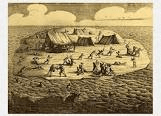
There is a much more obvious explanation closer to home. When the longboat left to find rescue, Cornelisz was left in charge. His first killings were extra-judicial – of people charged with stealing some of the groups very limited resources, and were according to the laws of the sea entirely legitimate. The rules of the East Indian Company, and long distance voyages more generally, were utterly brutal. Dash describes in detail the various punishments available at sea for minor infringements of on board rules, many of which would have been fatal. Life was cheap in these voyages, where the survival rate was often 50% or less of those starting out from Holland. It is hardly surprising in these circumstances that the gang that coalesced around Cornelisz were relaxed about killing weaker survivors, and once that taboo had been broken went on to kill with impunity. They knew that if caught they would be executed in the most brutal fashion imaginable (the descriptions of executions are some the hardest to stomach scenes in a book full of brutality) so had nothing to lose. They didn’t need any distant religious justification for their actions.
Dash’s research is extraordinarily detailed, and there is much to learn here about religious heresies of the 17th Century, seafaring in the early years of European colonisation of and trading with the far East, (including the first tentative exploration of the North-West of Australia, years before Captain Cook), and the history of the Dutch East India Company. Those months if not years in the archives needed some payback, so the sensationalism of the book’s title and blurb are understandable, if clearly wrong. I’ve already outlined why I think attributing the killings to Cornelisz’s heretical beliefs is unnecessary; I am also not convinced that this counts as a mutiny. He was in charge, so I don’t think this was in any way “an open rebellion against the proper authorities, especially by soldiers or sailors against their officers” whatever had been planned before the shipwreck. And finally I don’t think there is any justification for calling this the bloodiest mutiny in history – sadly there are many other examples of bloodier instances of rebellion against the ‘proper’ authorities.
The horrors of the survivors ends in a surprising fashion. A small group sent to die on a nearby atoll go on to discover a water supply, and find out that their scrap of reef is actually much more hospitable than that of the main, murderous group. This breakaway group represents a threat to the ‘mutineers’ – if a ship returns to pick up the survivors then the killers plan to take it over and turn to a life of pirating. No one can be allowed to survive to spoil this plan. But a series of attacks on this group are foiled, and finally interrupted by the return of the captain with a rescue party. The ‘mutineers’ are arrested, tried, and quickly and bloodily executed, and the small group of survivors complete their journey to Java.
In a short concluding chapter, presented as a return to more serious history after the vivid recreation of the horrors of the atoll, Dash outlines recent archaeological research on the atoll, the uncovering of skeletal remains, the identification of the islands that were the scene of the killings, and a reconstruction of the Batavia.
The breadth of Dash’s research is stunning, so it’s a pity that I have a couple of further quibbles. First, the narrative can be hard to follow, with such a large cast of characters each with multiple different names, which Dash seems to use at random. This can make the early sections of the book back in Holland in particular hard to work through. Second, the claim that every word of the book is historical fact is hyperbole – Dash imaginatively recreates the scene of the shipwreck, describing it from the point of view of someone present at the time, and in doing so bring it to life. But there’s little point in pretending that these descriptions do not require at least an element of imagination. Overall these reservations didn’t spoil my enjoyment of the book – although enjoyment seems a strange way of describing reading about such horrific scenes. Fortunately Dash is not in any way gratuitous about these scenes and shows respect to the victims.