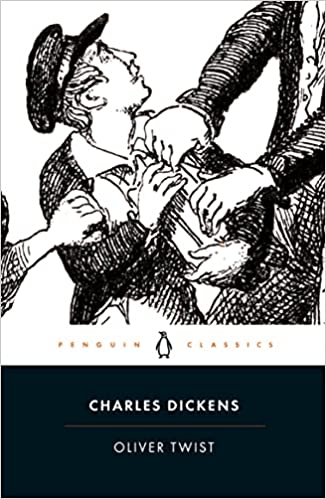
Last year I came across a category of novels I hadn’t previously heard of – the charmingly named ‘silver-fork‘ novel. Everyday is a learning day as they say, so I was pleased to further expand my knowledge of obscure literary categories when as part of my background reading into Oliver Twist I came across another category – The Newgate Novel.
Newgate novels are an early example of what we know think of as true crime fiction. They were also known as Old Bailey novels and had their heyday in the UK in the 1820s to 1840s. Newgate was London’s principal prison for centuries, and the courtrooms built on the side of the prison slowly expanded into a complex that eventually became (and is today) the Old Bailey, London’s central criminal court. The stories of the criminals tried there were told in The Newgate Calendar, The Malefactors’ Bloody Register. Originally a monthly bulletin of executions, produced by the prison administration, the calendar’s title and content was copied by other publishers.
Newgate novels were widely seen as glamorising the lives of the criminals and were therefore as well as being hugely popular were also controversial, in that they made heroes of murderers. That still happens to this day of course – criminal behaviour is romanticised by the passage of time, and the horror of murders such as the Jack the Ripper crimes can one day be treated as light entertainment or a merchandising opportunity. very few of the Newgate Novels remain in publication to this day, although that it hardly surprising – they never pretended to be anything other than popular entertainment.
I think Oliver Twist has a strong case for not being classified as a Newgate novel. Firstly there’s no indication that it drew its inspiration from a real or reported case. Secondly the principal character is not a criminal but a victim, albeit one that is drawn into the ambit of the criminal fraternity. Finally the glamorisation of the criminals portrayed in the novel is largely missing – Sikes is a monster, Fagin not much better, and the only characters with any redeeming features are Charlie Bates, who turns in Sikes and eventually abandons a life of crime, and the Artful Dodger, who it is easy to forget is only thirteen, a pickpocket rather than a house-breaker or fence, and is clearly highly intelligent.
This year’s Dickens was an easy choice. Oliver Twist is the last of the major Dickens novel I had to (re)read, and it is such a familiar cultural artefact! The musical Oliver! is an important part of that feeling of course, and a comparison between the plot choices in the novel and the musical is illuminating. The characters Dickens created in this novel – Fagin, Sikes, the Artful Dodger and Oliver himself – are remarkably vivid and enduring.
I’ve written before about Dickens’s consistency as a novelist. It’s hard to believe that Oliver Twist was arguably his first ‘proper’ novel. The Pickwick Papers is now seen and published as a novel but at the time it was
written it was conceived and constructed as a very loose series of stories with no serious intention of publishing it as a single book. Oliver may have had a similar origin – it was published in instalments, as all Dickens’ s novels were, and there is every reason to believe that Dickens constructed all but the broadest elements of the plot as he went along, rather than having a master plan – but the final product is far more cohesive and carefully structured. It has a beginning a middle and an end, and a plot running through it joining all the parts, even if the plot is the weakest part of the whole. The publication history of Oliver is actually even more complex than I have suggested, because about two-thirds of the way of it being published in instalments Dickens fell out with the publisher and had it published in novel form as well. So the text was available as a novel before the instalments were all published.
Anyway, to the novel itself. Critics have long argued (see Orwell’s wonderful essay on Dickens for example) that Dickens’s experience of being taken out of school and sent to work in a factory at an early age was so traumatic an experience that it threw a shadow over most of his writing. Certainly there are echoes here of this experience – Oliver is left an orphan from birth and suffers at the hands of an uncaring welfare system. He survives, somehow, where many do not and is sent to work at a very early age as an undertaker’s assistant. He is bullied remorselessly in this post and to avoid having to return to the workhouse runs away to London. Here he is quickly picked up by the Artful Dodger (and the lesser remembered Charley Bates) and taken back to Fagin’s hideout, where he is trained to be a pickpocket. It is important to note that as soon as he realises what is happening – and it takes quite some time, because he is very naïve – Oliver refuses to consider any criminality at all. This is important for Dickens – he wants to keep Oliver’s conscience clear, and avoid any suggestion that criminality is an inevitable consequence of poverty. Oliver is nevertheless arrested on suspicion of picking the pocket of an elderly gentleman who is buying some books. This it turns out is Mr Brownlow, a kindly gentleman who takes Oliver in from the street and nurses him back to good health. The kindly old gentleman who helps out unfortunate children is one of those literary stereotypes that seems to have been around forever, but I am not sure there are many examples before Dickens.
Of course there are good archetypes and bad, and Fagin, consistently referred to as ‘the Jew’ in most editions (although some are sanitised) is a chilling portrait of the racist, anti-Semitic image that was largely accepted in Victorian England. When we first meet Fagin he is described as a “very old shrivelled Jew, whose villainous-looking and repulsive face was obscured by a quantity of matted red hair”. There’s no escaping the poisonous nature of this caricature, and the only thing that can be said in Dickens’s defence is that when subsequently challenged on the portrait he made attempts to apologies by writing more positive Jewish characters in his later novels. While Fagin’s Jewishness is portrayed as the source of all his character flaws, he remains a fascinating portrait of evil. The gang of child thieves shown in the stage and film musical and still consistently referred to in reference works, don’t appear in the novel – it’s just Charley Bates and the Artful Dodger, which hints at various other associates currently spending time at His Majesty’s pleasure, or even having previously paid the ultimate price. Dickens is very clear that criminality is a highly dangerous, unattractive, and not very well rewarded career choice.
Nancy is another fascinating character. Dickens never uses the word prostitute to describe her, nor any other of a thousand synonyms, but he may as well because there is no doubt whatsoever of her profession. Her’s is a sympathetic, almost affectionate portrait, and her murder is one of the most dramatic and traumatic scenes Dickens ever wrote, terrible in its domesticity and mundaneness, tragic in Nancy’s refusal to take the escape offered her time and again, and chilling in its description first by an omniscient narrator:
“It was a ghastly figure to look upon. The murderer staggering backward to the wall, and shutting out the sight with his hand, seized a heavy club and struck her down.”
then once the murder is committed, the perspective switches to Bill’s:
Once he threw a rug over it; but it was worse to fancy the eyes, and imagine them moving towards him, than to see them glaring upward, as if watching the reflection of the pool of gore that quivered and danced in the sunlight on the ceiling. He had plucked it off again. And there was the body—mere flesh and blood, no more—but such flesh, and so much blood! He struck a light, kindled a fire, and thrust the club into it. There was hair upon the end, which blazed and shrunk into a light cinder, and, caught by the air, whirled up the chimney. Even that frightened him, sturdy as he was;
Notice that Nancy’s body becomes ‘it’, not ‘her’.
The only criminal character who Dickens seems unconcerned to paint as having a bad character and to be destined for the gallows or worse is the Artful Dodger. While his associate Charley Bates is so appalled by Nancy’s murder that he ‘shops’ Sikes and eventually gives up crime entirely, we last see Jack Dawkins controlling the courtroom where he is being committed (some have claimed Dodger is sentenced to transcription to Australia, but this was not at all clear in the Penguin Classics edition I read – possibly Dickens tidied things up in later editions. Dodger’s refusal to be cowed by the criminal justice system is quite magnificent:
‘No,’ replied the Dodger, ‘not here, for this ain’t the shop for justice: besides which, my attorney is a-breakfasting this morning with the Wice President of the House of Commons; but I shall have something to say elsewhere, and so will he, and so will a wery numerous and ‘spectable circle of acquaintance as’ll make them beaks wish they’d never been born, or that they’d got their footmen to hang ‘em up to their own hat-pegs, afore they let ‘em come out this morning to try it on upon me. I’ll—’
‘There! He’s fully committed!’ interposed the clerk. ‘Take him away.’ ‘Come on,’ said the jailer.
‘Oh ah! I’ll come on,’ replied the Dodger, brushing his hat with the palm of his hand. ‘Ah! (to the Bench) it’s no use your looking frightened; I won’t show you no mercy, not a ha’porth of it. You’ll pay for this, my fine fellers. I wouldn’t be you for something! I wouldn’t go free, now, if you was to fall down on your knees and ask me. Here, carry me off to prison! Take me away!’ With these last words, the Dodger suffered himself to be led off by the collar; threatening, till he got into the yard, to make a parliamentary business of it; and then grinning in the officer’s face, with great glee and self-approval.
(I think this is clear – Dodger is ‘fully committed’ i.e. sent for trial, not sentenced (the clerk couldn’t sentence him anyway), and after this point we do not hear from Dodger again – he is conspicuously absent from the author’s final ‘what happened next to everyone’ chapter.
It has to be said that the novel’s plot is repetitive and dull. Oliver is first kidnapped by Fagin, innocently involved in an attempted crime by two of Fagin’s associates (Charley Bates and the Artful Dodger, who both run away) rescued by kind Mr Brownlow and nursed back to health. Then the whole cycle starts again. He is (re)kidnapped by Bill and Nancy, innocently involved in the attempted burglary and rescued again by the intended victims, Mrs Maylie and her ward, Rose while his erstwhile criminal associates, Bill Sikes and Toby Crackit, run away. Each rescue is followed by a long period of recuperation and lots of Victorian charity and kindliness. Each intended victim is remarkably closely connected to Oliver’s and at the time totally unknown real family. And each time Oliver is suspected of involvement in the crime but protected by his kindly saviours. All the while ‘Monks’ lurks in the background of the plot with obvious sinister intent, although I suspect almost all readers will not care in the slightest what he is up to. All but the broadest detail of the secret inheritances, half brothers, lockets and nonsense used to tie things up and rescue Oliver from poverty and worse the curse of being working class is eminently forgettable, and it is hardly surprising that this was all excised from the musical adaptation without any impact of the story’s impact. But none of that really matters, because we still have a host of vivid characters and wonderful, haunting writing in chapters such as ‘Fagin’s Last Night‘ to savour and remember.