Book review, First World War, H H Munro, invasion literature, Saki, When William Came

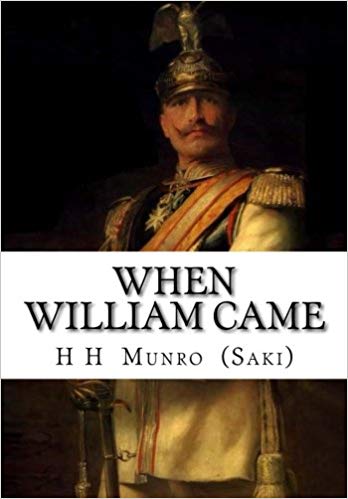
When William Came, by H H Munro (Saki) 1913

More invasion literature, this time a long short story or novella by a writer more traditionally associated with humour, albeit of the more biting kind. I originally read ‘When William Came‘ many years ago, and it is one of those stories that sticks in your head, particularly the final vivid image of resistance and rebellion. when william came
Let me explain. In the years running up to the First World War, there was a common understanding that a global conflict was coming. Initially this was a speculative idea – “what if there is a global war?” –  but after much repetition it become more a question of “When there is a global war…” This idea in other words became part of the political and cultural landscape, accepted as a truism. Novels were written about how the conflict might start and pan out, and a particular focus was on the UK’s lack of preparation. There was also a fashion for novels that saw the country quickly defeated by a technologically and militarily superior alien force (‘War of the Worlds’ for example) with the bulldog spirit emerging at the end to fight back. Other perspectives focussed on the precise nature of our enemies’ preparations – see ‘The Riddle of the Sands’ by Erskine Childers for example.

‘When William Came’ (William, in this context, being Kaiser Wilhelm) opens with the return to the UK of Murray Yeovil, a wandering aristocratic Englishman. He has been very unwell on his travels, and thus isolated from the catastrophic news from home. This provides an opening for a recount of the story of the UK’s recent conquest. A swift and decisive land invasion and an equally destructive naval battle, in which the dispersed British fleet was destroyed by superior German technology, followed by the flight of the royal family and much of the upper classes to imperial India, left the UK defeated and conquered. A few months has passed, and London is slowly accommodating the German victors. Society is divided between those prepared to put up with the demands made by the Germans – new street signs, higher taxes, new currency, German culture, etc – and those who either retreat to the country or emigrate.

Resistance has not entirely faded from the conquered British spirit, and there are several discussions about how the UK could throw off the German oppressor, possibly using the forces of the Empire. These are given short shrift – the German stranglehold on the UK is overwhelming and any resistance by Australia or Canada for example would see their swift defeat in turn. Munro is arguing that there will be no second chances – defeat is the end of the Empire. Yeovil despairs at the decadence of British society that has led to this situation – the novel is a thinly disguised plea for rearmament and the introduction of national service.

Anti-semitism is a feature of far too many novels of this period, and Saki’s portrait of Jewish characters and society in this novel is hard to stomach at times. He goes far beyond the casual anti-semitism of everyday Edwardian language and perpetuates many of the classic anti-semitic tropes that were widely accepted at the time but no less distressing and damaging for all that. I still haven’t worked out whether this damages the novel overall for me sufficiently to detract from the value of Munro’s writing – it is not an integral part of the novel, but it is sufficiently pervasive to be pretty damaging, not something that can be skipped over as ‘just the way people spoke back then’. This is also not a question of Munro giving anti-semitic ideas to a character as part of their portrayal – this is a much more didactic novel than that. I am not a proponent of censorship of novels featuring language or ideas we no longer find acceptable, but there are some novels that should be left to gather dust.

Which is a pity, because ‘When William Came’ is otherwise a powerful portrait of a conquered and cowed Britain, emasculated by defeat. (Yeovil’s wife openly flirts with other men in front of her husband, who seems untroubled by her disloyalty.) The closing scene in which the youth of the country defy the invaders has been criticised (on Goodreads) as being ridiculous or anti-climatic, but I found it powerful and vivid. The fact that Munro went on to die in the imminent Great War gives the novel a greater poignancy.

This is undoubtedly a literary curiosity, and unrepresentative of Saki’s oeuvre, his waspish short stories. It is I think an important representative of the invasion literature genre – one that accepts war as inevitable, and expresses fear for Britain’s preparedness. It is however unlike many other examples in that the war is not described, and avoids any reference to the physical destruction many other novels anticipate (London seems barely touched). I can’t honestly recommend it unless you have a particular interest in these topics and a strong stomach for anti-Semitism.
Standard
100 Best Novels Guardian list, 20th century Literature, Book review, First World War, Ford Madox Ford, The Good Soldier

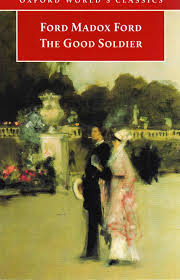
The Good Soldier by Ford Madox Ford, 1915

This novel has an utterly misleading title. Ford claimed ‘The Good Soldier’ was his publisher’s idea, as an alternative to ‘The Saddest Story’, which may not have caught the public mood, but the commercial appeal of a novel published in 1915 about a ‘good soldier’ must have been hard to resist. Why not go the whole distance and call it “Brits beat the Hun”? It would have had as much relevance.

My main reaction while reading, and on completing, this novel, was one of irritation. The fallible narrator may have been innovative for its time (was it really?) and the fractured timescale may even have seemed daring, but 100 years on these features cannot disguise the novel’s many weaknesses. The characters are spoilt, deluded, and ignorant, yet we are invited to admire them despite their manifold flaws. The narrative lacks pace and interest, and the language plods.

To take a step back, this novel tells the “saddest story” of two couples who meet on vacation in Germany. The Dowell’s are wealthy Americans on what develops into a long-extended honeymoon – having married without her parent’s permission, Florence develops a spontaneous heart condition as soon as she boards her transAtlantic liner, a condition that conveniently means she is unable ot consumate her marriage without the exercise putting her life at risk. Her husband, our narrator, relates this all with a straight face, seemingly unaware that he has been duped. They meet the soldier of the title, Edward Ashburnham, and his wife Leonara. Edward’s occupation is incidental of the events of the novel; he seems to have one of those Army positions that involve minimal amounts of soldiering. He is wealthy, but profilgate, a drinker, gambler, and womaniser. His wife detests him, but is forbidden by her Catholic faith from divorcing him, so instead devotes herself to torturing him. Deeply unhappy, Edward and Florence eventually separately kill themselves. The narrator insists to the bitter end that Edward is a good man, but the evidence to the contrary is overwhelming.

This novel is about these two unhappy marriages. At the heart of their unhappiness is, inevitably, sex. Ford is unable to address this issue directly, so he employs a wide range of euphemisms to hint at the issue:

“It was the ship’s doctor who discreetly suggested to me that I had better refrain from manifestations of affection. (83)

“I must never enter her room without knocking, or her poor little heart might flutter away to its doom” (84)

“It will give you some idea of the extraordinary naiveté of Edward Ashburnham that, at the time of his marriage and for perhaps a couple of years after, he did not really know how children are produced” (136)

“he passed the night in her bed”. (147)

“From the moment of his unfaithfulness….she never acted the part of wife to Edward.” (163)

“Watching Edward more intently and with more straining of ears that that which a cat bestows upon a bird overhead, she was aware of the progress of his passion….She was aware of it from the way in which his eyes returned to doors and gateways; she knew from his tranquilities when he had received satisfactions.” (163)
I particularly like the last of these – note the plural ‘satisfactions’.  Our narrator seems unperturbed by his wife’s machinations to avoid sex with him, hinting that this is because he may discover that she is not a virgin, and later in the novel accepts her infidelity without complaint. He is a deeply unappealing character, and is rewarded at the end of the novel with another ‘partner’ he is unable to sleep with.
‘The Good Soldier is in many ways a transitional novel, bridging the gap between the Victorian novels where sex was never mentioned, and anticipating Lawrence and the other authors who finally shrug off this constraint. He is also a modernist in his style. He adopts a very conversational style, attempting to mimic the way Dowling may have written a personal narrative were he to have existed. He anticipates any criticism of this style by explaining it thus:
“I have, I am aware, told this story in a very rambling way, so that it may be difficult for anyone to find their path through what may be sort of a maze. …I console myself with thinking that this is a real story, and that, after all, real stories are probably told best in the way a person would tell hem. They will then seem most real” (167). Apart from being rambling, Ford obviously also though that repetition was key to this conversational style. (If he is right, conversations with him would have been pretty dull!) Time and again Dowling repeats himself without variation, as for example here:
“I should marry Nancy if her reason were ever sufficiently restored to let her appreciate the meaning of the Anglican marriage service. But it is probable that her reason will never be sufficiently restored to let her appreciate the meaning of the Anglican marriage service” (212). The difference between bad writing, and deliberately bad writing to convey character is of course important, but over the course of a whole novel the point is lost. The novel also uses the technique of telling the reader the eventual fate of the characters early on, rather than leading up to this, a technique which strangely seemed quite new when Muriel Spark used it in the “Prime of Miss Jean Brodie” fifty years later, but which here simply seems confused.
One last thought: there’s very little humour in this novel, but one line did stand out, when the narrator comments on Edward’s soldiering:
“Edward ought, I suppose, to have gone to the Transvaal. It would have done him a great deal of good to get killed”. (156/7)


Standard
100 Best Novels Guardian list, 20th century Literature, Book review, First World War, John Buchan, Spy stories, The 39 Steps

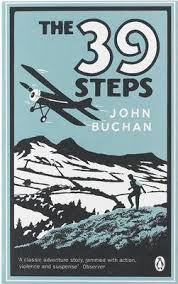
The Thirty-Nine Steps by John Buchan, 1915

This is the novel for which the phrase “what a load of old tosh!” was invented. Buchan, in a short introduction, described it as coming from a genre “which we know as the ‘shocker’ – the romance where the incidents defy the probabilities, and march just inside the borders of the possible”. This is a thinly veiled attempt to pre-empt some of the more obvious criticisms of the utter implausibility of his story. Although having been told that the story will be wildly implausible doesn’t make the plot much easier to swallow.

Positives about the novel are elusive. If the plot is ludicrous, the characterisation is not much better. The descriptive writing, which some reviewers and readers enjoy, left me cold. And the politics of the novel are appalling – a point to which I will return. However, “The 39 Steps” is an important part of the “German spies in the UK” genre, which before the war was used to bolster the re-armament position, and which after the start of the war were all part of the literary attempt to portray the Germans as cunning and dastardly, but beatable, with the right amount of pluck and stiff upper lip. Hannay, the lead character, is thinly drawn – he is a Scottish ex-patriot used to hunting on the veldt, and finds the confines of London life boring and stifling. He treats the improbable events he finds himself engulfed in as an adventure – it would be no surprise to any reader to hear that this novel was first published as a weekly serial in Blackwood’s magazine, which not many years earlier had published Conrad’s “Heart of Darkness”.

Through a series of increasingly outlandish plot twists, none of which are particularly inventive or entertaining, Hannay finds himself forming a thin blue line between the Great British Empire and the Hun. He slips through the fingers of his pursuers in a way that is so predictable as to deprive the novel of any suspense whatsoever, and the bad guys are eventually bested through a combination of Hannay’s intelligent deductions, clues left by his accomplice, and some good old British spunk. It almost defies parody. The novel is barely 100 pages long, and speeds along at a good pace, so if you have a couple hours spare I suppose there are worse ways of wasting them.

But be prepared for some really unpleasant racism and anti-Semitism, particularly the latter. This is more than simply the prevailing casual racism of the British upper classes of the early 20th century. Jewish conspiracy theories are referred to explicitly, and shown to be genuine. These ideas have no meaningful part whatsoever in the plot, other than to provide the vague suggestion that the plot underfoot is more than a simple case of one nation against another (the gang trying to steal British military secrets calls itself the “Black Stone” – amazingly the Black Stone have a secret base in the Scottish Highlands, right in the path of Hannay’s attempt to lay low). This all leaves a bad taste. It’s not thought through in any coherent way, and while done in an apparently off-hand way, without any apparent spite, represents more that the simple racist assumptions and language that were current at this time – they give a platform and credence to anti-Semitic ideologies that were to prove so poisonous only 20 years later.

Standard
Book review, First World War, History

Mud, Blood, and Poppycock by Gordon Corrigan

I am going to assume that Gordon Corrigan is a nice man. In this 2003 Cassell edition of Mud, Blood, and Poppycock he shares with us that he is married and a church-goer, so this is a reasonable assumption. I genuinely do not want to spend ages telling you why this book is terrible – it’s not a particularly good use of your time or mine. I know I have said this before, but it is not really the purpose of this blog to self censor and only write nice, glowing reviews of wonderful books. So in the unlikely event that this spoils a nice person’s day then I am genuinely sorry, but this was one of the weakest, worst written history books I have read in a very long time.

It is not without its redeeming features – there are several passages of mildly interesting, if unoriginal, description of the structure of the British Army in 1914-18. I also learnt something I hadn’t known before about the role of horses in the war. If the author had just exercised some self control this would have been such a better book. I suspect he knows that, and decided to include the offending content, which I am getting to, to boost sales.
Just to be completely clear, revisionist history is a good thing. It is absolutely right that the assumptions we make about what we think we know about the past are challenged in the light of new evidence as it emerges. Lazy stereotypes need to be confronted, even when on examination they turn out to be broadly correct. So I have no problem that Corrigan decides that everything ever written about the Great War is wrong, that it was not a bloodbath, that life in the trenches was usually jolly good fun, and that we beat the Boche through force of character and a jolly good British stiff upper lip. Although of course this is parody, Corrigan really does write like this. The British Army was and is the best in the world, and anyone who suggests otherwise is unpatriotic. Oh, and by the way, Blackadder 4 wasn’t historically accurate.

The technique here is simple and very badly done.
Step 1 – make a general observation, unsupported by any reference or evidence whatsoever, about the popular perception of the Great War – for example that the trenches were full of very large rats.
Step 2 – claim with little or no evidence to the contrary that they weren’t
Step 3 – claim that there may in fact have been some true in the popular perception after all – but argue that the rabbits were larger in the French trenches, that the Tommies enjoyed the company of the rats, and who minds the odd rat anyway other than lefty pinkoes?

Just to emphasise – this is Corrigan’s approach, chapter after chapter, not a parody. Take one example. In chapter 3 he says that “The perception of soldering in the Great War is of a young patriot enlisting in 1914 to do his bit…Arriving at one of the Channel Ports he marches to all the way up to the front, singing “Tipperary” and smoking his pipe.” (Page 74).

I am not aware of anyone every suggesting that soldiers marched all the way from the Channel Ports to the front line. Nor apparently is Corrigan, because this perception is not evidenced in any way. Nevertheless, having set up this straw man, he points out that trains, motor vehicles, mules and horses were all in abundance in 1914 Belgium. Point made, straw man demolished. Yet a sense of honesty compels him to admit only a few lines later that “The pre-war army was …well accustomed to marching. The reservists were not so lucky. Reservists sitting by the side of the road, boots off, and feet bleeding were a common sight (75). Again, no authority is provided, but it is hardly surprising if the common perception of soldiers having to march an unreasonably long way grew up if this was a common sight on the roadsides of Northern France and Belgium.
There is an opportunity here for some serious historical investigation to be done. The Army stands accused of not looking after its solders very well, of making them march long distances in uncomfortable footwear, and of not providing enough motor and equine transport. So is that true? What does the evidence say? What did other armies do with regard to moving their troops about, in the circumstances where transport was limited and the need to move troops around urgent? Was transport taken seriously as a military discipline? I don’t know, but neither, apparently, does the author.

The First World War was a terrible, shocking bloodbath. Hundreds of thousands of men marched to their deaths in circumstances that remain distressing to this day. I have written elsewhere about the “thankful villages” – Corrigan references these as evidence that not every community lost someone during the war, missing the point that so very few did so. In denying the enormity of the shock of the war – there was no lost generation, not that many people died compared to other conflicts, that the only people with a problem were poets “who wrote for money” (!!!! – the monsters) – he insults the memory of those that fought and died, and denies them a voice. There are so many powerful records – diaries, letters, etc. – of the time telling us what the war was like, but Corrigan ignores these voices and relies on distorted statistics and a relentless refusal to accept that any concern about the war and its conduct could possibly be wrong.

Finally, Corrigan is at pains to let the reader know he is a retired soldier. If the numerous reminders of this are not sufficient, he uses playground language – “wedding tackle”, “willy”, and “dirty water” – at times in a way that is utterly inappropriate in a serious work of historical inquiry. But perhaps that is the point.

 
Standard
Book review, First World War, History, The Live and Let Live system, Tony Ashworth, Trench Warfare 1914-1918

Trench Warfare 1914-1918 – The Live and Live System, by Tony Ashworth

I do read some interesting books don’t I? This is one of the Pan Military History series, originally published in 1980 (that date is important by the way, and I will come back to it) and was a bit dry to be honest. It’s more of a reference book than a page-turner. Which was a pity, because the author has identified something really interesting about military conflict, and the First World War in particular, and that is the tendency of combatants to impose some control on their environment, even in the midst of the bloodiest, nastiest conflict imaginable, by refusing to kill their enemies. Ashworth calls this the live and let live system, whereby troops in the trenches would come to informal understandings with those facing them that they would leave one another alone in certain circumstances, at particular times, days, and for particular purposes. This understanding found its most vivid expression in the extraordinary Christmas truces of 1914, when trench warfare was still a relatively new experience, and when the bloody battles of Ypres, Passchendaele, the Somme etc. had entrenched (if you will forgive the pun) bitterness against the enemy.

For me, this was a bit of a light bulb moment. I knew of course that soldiers in the trenches were not constantly fighting, and that there was evidence from other conflicts, touched on at the end of this book, that a surprisingly large proportion of soldiers would avoid killing one another when they could. But the nature of trench warfare, when troops were in close proximity – certainly in hearing range in many cases – to their enemy for long periods of time – meant that they would slowly begin to recognise their opponents as people rather than abstract entities. Once that happen – these are people that eat, sing, hate the rain, etc., like us – then killing them becomes harder. Peace kept breaking out despite all the efforts of the war machine to stop it. In 1917 there were extensive mutinies in the French army across the whole of their front – mutinies which the Germans opposing them at the time were blithely unaware of. As the author points out, this was no doubt because these fronts were largely applying the live and let live principle at the time – if you don’t attack me I won’t attack you.
The context of the war is important here, and it is something Ashworth doesn’t really mention. The belief that a continental war was coming had been around for decades, fuelling spending on the Royal Navy for example, but in many scenarios the Germans, with our shared Royal family, were on the same side as the UK. France was to many our traditional enemy; we had never fought the Germans in a war, whereas we had hardly stopped fighting the French over centuries. So there was no inherent hostility towards the Germans. The media tried to stoke it up of course, and atrocity stories played a part, but the evidence presented in this book suggests that many soldiers in the trenches were quite happy to consider not killing Germans if the reciprocal could be ensured. When higher commands ordered activity, Ashworth argues and demonstrates that firing to miss was common-place.
I have mentioned one omission from this study, the context of the war, but there are a couple of other factors which are not given any focus. I think the conflict in the trenches was – to an extent – seasonal. The weather dictated the extent and nature of the conflict, and this is supported by the casualty figures I have seen elsewhere. Ashworth identifies many different features which meant “live and let live” was more or less likely to occur, but doesn’t mention these practical considerations of weather and season. A minor point I suppose.
I also mentioned earlier that this book was published in 1980, 35 years ago. The relevance of this is that the author was able to interview and correspond with survivors of the Great War, an opportunity that would not exist today. I wonder if he realised at the time how precious this opportunity was. Diaries, letters and journal can tell us a lot, but I don’t think they could ever be a substitute for the oral history of survivors.
Standard