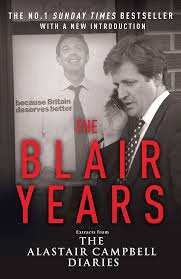
The Blair Years, by Alastair Campbell, 2007
I don’t think there is any question that Alastair Campbell’s obituary when it comes to be written will focus on the events of the last few weeks of this diary. For any readers for whom this is history rather than current affairs, a short summary: Alastair Campbell was Tony Blair’s press spokesman from shortly after Blair became leader of the Labour Party through the first two New Labour governments. He developed a fearsome reputation as a defender of the Government. The verb ‘to spin’ might have existed before Campbell and New Labour, but it came into common currency during those years. To give you some idea of Campbell’s reputation, all you need to know is that the character Malcolm Tucker from The Thick of It was based upon him.
After 9/11 America, led by George W Bush, was determined to depose Saddam Hussein. The premise for this attack was that Iraq possessed weapons of mass destruction (WMDs), or the capability to develop such weapons. Tony Blair was unshakeable in his support for Bush and the issue became a deep dividing line within British politics. To support the case for war a file of intelligence briefings (a dossier) was produced, purporting to demonstrate that Hussein had WMDs. A BBC report claimed that Campbell had interfered with the drafting of the report and ‘sexed’ it up, over-stating the strength of the evidence. Dr David Kelly, a government scientist who had allegedly leaked information on the dossier to the BBC ended up taking his own life. A judicial inquiry into these events, the Hutton inquiry exonerated Campbell but the accusation has stuck, primarily because it seems the sort of thing that Campbell would have done.
Campbell has spent more than twenty years trying to rebuild his reputation, but I suspect he will always be haunted by this accusation. The Blair Years is the first of what is by now a series of eight volumes of his extremely detailed diaries – over 750 pages covering 1994-2003, around a sixth of the total words written contemporaneously. The obvious question is to what extent these diaries have been edited or selected to present a positive view of Campbell and his role in New Labour, and specifically to exonerate him from the WMD accusations? It would be astonishing if not almost impossible to edit down that volume of writing without any element of spin. Choices must have been made, inevitably with the intention of presenting Campbell and Blair in the most positive light. Even if Campbell wasn’t such a notorious exponent of the art of spin, some recasting of events must have happened. I am possibly being naïve but I choose to think that this is a reasonably honest version of events. Campbell saw himself as a leading figure in the Blair administrations, more a chief of staff than a press officer. He was at the heart of the New Labour project, even if on some issues he found his personal views to the left of Blair. An early instance of this is when he tries and fails to persuade Blair not to send his children to a grant-maintained school, which went on to be a bit of a PR disaster for him.
Most of the time there is little effort made to provide context to the events being described – footnotes are few and far between – so the reader either needs to be familiar with the events or spend a fair amount of time flicking back and forth to Wikipedia. The overall effect is of a real-time account of several significant moments in recent British history, such as the death of Princess Diana, the foot and mouth crisis, and the British reaction to 9/11 leading through to the Gulf War. Throughout, Campbell’s portrait of Blair is consistent: he was a reforming Prime Minister often out of step with his party but driven by faith in the rightness of his own views, determined to reform institutions (such as the House of Lords) and with a broad interest in social justice. Campbell himself is by contrast more a traditional party man. The cast of supporting characters is large. John Prescott comes across as a surprisingly likeable ally, while Campbell makes little attempt to disguise his contempt for others such as Clare Short. The effect of some parts of the diaries is to confirm public perception of Labour figures – Peter Mandelson is undoubtedly Machiavellian, Gordon Brown is prone to outbursts of anger, and so on – there aren’t many revelations about politicians secret lives. Perhaps this is because so many other memoirs have been published. What was at the time an insight into what really happened – such as the story of Robin Cook breaking up with his wife on the way to the airport because a tabloid was about to expose his affair (a story sometimes presented as Campbell instructing Cook to divorce his wife) are now well known and all these diaries do is confirm them.
Campbell isn’t over-burdened by humility. Early on he becomes excruciatingly convinced Princess Diana is attracted to him. The Secretary General of NATO is quoted as saying in the context of the conflict in Kosovo “If you can, send me your man Campbell, that would be best“. He becomes good friends with Bill Clinton and George W Bush. I suppose everyone is the hero of their own stories.
While some of the narrative feels like ancient history, other sections bear strikingly similarities to the political situation today – a reforming Labour Government with a large majority after a long period of Conservative rule; a hostile media; cynical anti-politics agenda being pursued by the right-wing; Europe as always a divisive issue. Even electoral reform and changes to the House of Lords are back on the agenda. So these diaries should probably be studied by the new Labour Government. If they were to do so what lessons would they derive?
First, the Conservatives must not be under-estimated. They will be back, and the time to cement Labour’s position as the party of Government is now, not in five years time. The next Conservative Prime Minister may not yet be an MP (Cameron was not an MP when Blair was elected; Starmer was not an MP when Cameron was elected) but they aren’t one of Europe’s oldest political parties for nothing.
Second the media will be unrelentingly hostile and the Government needs to decide what it is going to do about that. What we mean by the media has obviously changed since 1997 with the advent of Facebook etc, but the right-wing tabloids are still stubbornly there and will not miss a chance to undermine the Government.
Thirdly major crises seem almost unavoidable. Whether it is the death of Princess Di, foot and mouth disease, the oil delivery drivers strike (first term) or 9/11 and the Gulf War (second term) and the global economic crisis (third term) there are going to be testing times ahead.
Is the portrait of Campbell that emerges from these diaries accurate? For example is his reputation for quite aggressive ferocity justified? I wanted to quote at length a description Campbell gives of a shouting match between himself and Gordon Brown, Chancellor of the Exchequer (page 528) during the 2001 general election campaign. Brown had long been concerned about the negative impact of briefings by Peter Mandelson, who had been sacked twice from Cabinet positions:
“I went over to see GB in his office….and he was banging away at his computer. He had a pile of papers to the right and on the top had written 75 pence and below it, in large black letters, ‘who will silence Mandelson?’ ….
I tried to make a joke of it, but he was having none of it, went on a great tirade, said we were letting him destroy the campaign, undermine him, be ill-disciplined, on and on he went and eventually I lost it, said PM was nothing to do with me and I did not like the implications that I could be held responsible one way or the other for what he was or was not up to. “Well it has to stop” he said. “Telling me it has to stop suggests that in some way I might be responsible, and I fucking resent that….(continues at some length) I was suddenly conscious that I was jabbing my finger at him, and thought it better to leave.”
This is extraordinarily unprofessional conduct, but it seems there were no consequences for Campbell for swearing and shouting at the second most senior member of the Government. The word suddenly is revealing here – if the description can be taken at face value, he seems genuinely not to have realised he was shouting and being aggressive towards Brown for most of the exchange. If he treated the Chancellor of the Exchequer like this, what was he like with junior members of staff and journalists? Of course we don’t need to ask because there are multiple accounts of his behaviour. So yes, he was aggressive and either didn’t know or care that people were often genuinely scared of him.
Just one other thing I noticed: the back cover of the paperback edition includes the following quote from Matthew Parris, the Times columnist and former Conservative MP
“A brilliant, absorbing account….These diaries….will be gasped at, and relied upon, for decades to come. Buy them; they will suck you in”.
I was surprised to read this endorsement when Mr Parris himself appears only once in these diaries (page 308) as “The little shit Parris“.
One wonders what qualifications were hidden by the ellipses?