Book review

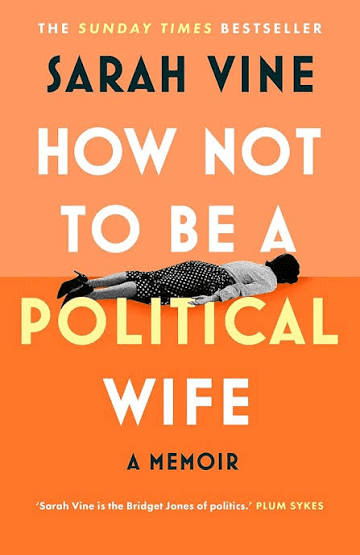
How Not to be a Political Wife by Sarah Vine, 2025

This book’s clumsy title sets the tone for what is, one can be pretty confident, going to be quite a bumpy ride. The book is categorised as a memoir, but more accurately it is a confessional of staggeringly indiscrete proportions, quite calculatedly burning lots of Ms Vine’s bridges with the Cameron vintage Conservative hierarchy. The book serves as an interesting and I suspect deliberate contrast to Sasha Swire’s much more reflective and considered Diary of an MP’s Wife which covers much of the same time period and territory.
Sarah Vine describes herself as a journalist, but more accurately she is a columnist, writing observational pieces about the world as she sees it. She is one of the genre of columnists who specialise in what is now called ‘rage-bait’ – constructing controversial ‘opinions’ and comments to order that she may or may not mean to be taken seriously, but which are going to drive traffic to her newspaper’s website, which nowadays is all that matters.

The author had a front-row seat at some of the most turbulent years of recent British politics. She worked for mainly right-wing newspapers throughout the period covered by the memoir. Her husband Michael Gove was Education Secretary, Chief Whip, and Lord Chancellor in David Cameron’s and Theresa May’s governments, and then held prominent roles in the Conservative administrations after the 2019 general election. He is now editor of the Spectator and, it goes without saying, a member of the House of Lords. In mentioning Mr Gove I am not succumbing to the sexist idea that a woman is only as important as her husband’s job. The fact is his story is an integral part of this memoir – his choices and decisions had a profound impact on the course of her life over this period and he features significantly throughout. In fact she defines herself in this narrative by contrasting what she did with what she believes was expected of her – hence the book’s title. While the introductory chapters on the author’s early life are interesting, the substance of the book is her role as Gove’s wife and partner, inside observer of the recent Conservative governments. This period can be summed up briefly – for the author it was (despite all the privilege and benefits being part of the Government involved) unremittingly awful. Everyone felt entitled to be nasty to you:

Doctors can shed what’s left of their bedside manner with you. Ordinary people no longer need have any consideration for you. Friends no longer trust you. Children are taught to despise you, not respect you. Journalists and policemen no longer need to be impartial or accurate. You have lost those human rights and protections because you are no longer human, you are a politician and you are now the legitimate prey of the only big game hunting still allowed in this country.

It wasn’t just unkind words of course – death threats followed, their children were bullied and they were ostracised from various friendship groups. None of this stopped Vine having her manufactured views on her political opponents of course. She wrote of Ed Miliband’s kitchen, for example, that there was “not much prospect of a decent meal emanating from that mean, sterile, little box.” Minor television celebrity Carol Vorderman is paid back for having the temerity to criticise the later Tory administrations: “One year we had Carol Vorderman, when she was in her pro Tory phase (as opposed to her sucking up to Labour phase): rarely have I encountered such a heavily cantilevered bosom.” Is the state of Carol Vorderman’s bosom really relevant here?

It wasn’t all bad. Vine has happy memories of weekends at Chequers with the Camerons and the rest of the Notting Hill set:

Sam really came into her own when she threw a party, and the party she threw at Chequers for her delayed 40th, in 2014, was probably my last truly happy memory of those gilded days, and almost certainly one of the best parties I’ve ever been to. Sam had transformed the Great Hall into a rave, with glitter balls, lasers and disco lights playing over about 150 people dancing wildly to the music of DJ Sarah HB, short for Hard Bitch. Dave and Sam ruled over the dance floor, always the best dancers, doing their Ceroc double act with enviable grace. Everyone was beautiful and clever and powerful; but for once I didn’t feel like Cinders at the ball. Sam had already complimented me on my Diane von Furstenberg black wrap dress, even though it was a touch too tight around the middle – “those bosoms, Sarah!” – and I was having the time of my life, sipping mojitos and chatting to Sarah Montague in the Rose Garden.

Vine’s main issue is a crippling instance of imposter syndrome. Her dysfunctional relationship with her bullying father (who in the book’s acknowledgements she thanks for “fucking me up so brilliantly” and who lived to see this book published) has left her with the inability to believe she deserves her place in ranks of the country’s privileged few. Money is an obsession – she objects to Gove’s sacking by Cameron as Education Secretary because of the impact it will have on their family income. Her address is not quite in the right postcode. Gove even pays to have an 0207 number (instead of 0208) – an incredibly niche but telling piece of status insecurity that today has not real equivalent.

The heart of the book is her account of the Brexit debacle. Gove promised not to campaign for Brexit, then led the campaign, expressing disbelief that the Cameron’s would see that as a betrayal, even though it destroyed his political career. (In his memoir For the Record, David Cameron directly accuses Michael Gove of disloyalty, stating, “As for Michael, one quality shone through: disloyalty. Disloyalty to me — and, later, disloyalty to Boris”). Vine is able to see that “everyone hated us” without ever really understanding why. If everyone hates you, doesn’t that suggest that you have done something to provoke that response, rather than that everyone was wrong, misjudging you, or being hateful? Gove’s decision to support the Vote Leave campaign and to go on and lead the Brexit campaign, was a turning point in the whole debate – it is arguable that without that decision Boris Johnson would not have supported leave, and potentially that the outcome of the vote would have been different. Certainly Vine’s description of the days and weeks following the Brexit vote does not read like a celebration by the winning side. The suggestion that Cameron should have stayed on as Prime Minister and worked to implement the outcome of the Brexit vote, that his refusal to take responsibility for something he had found hard against was in some way the cause of the utter shitshow that followed, is laughable. Talk about not owning your own mistakes!

Vine has a stunning lack of insight into why people hated her, why they blamed her husband for the disaster that was Brexit, why people stopped being their friends after he stabbed them in the back. She just can’t understand why anyone had a problem with her and Gove’s behaviour. It is all a mystery – which is funny because even the most obtuse reader can easily understand these things. Vine is like a flawed narrator of her own memoir, accidentally revealing insights into her personality and behaviour without having them herself. There are more accurate and more interesting histories of this period, but How Not to be a Political Wife nevertheless gives an original insight into many of the mistakes made by those involved.
How Not to be a Political Wife by Sarah Vine, 2025

Aside
Book review

J by Howard Jacobson, 2014

J, shortlisted for the 2014 Booker Prize, is set in a dystopian(ish) future after a catastrophic event known only as ‘WHAT HAPPENED, IF IT HAPPENED’. Later in the novel different variants of this expression are used, such as WHAT HAPPENED (that is, without the qualifier) indicating the speaker’s distance from the orthodox view of this event. Precisely what ‘the event’ was is never made explicit, but enough is revealed towards the end of the novel to suggest that it was a mass killing of a minority in society in which ordinary citizens participated. Several decades have passed since this event, but society is still haunted by it, seeking ways of restoring balance to an increasingly violent and disordered world.

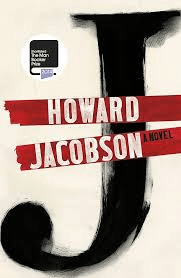
The central narrative of J is on the surface a traditional romance. Kevern, a woodworker, and Ailinn, an artist, begin a rather sweet love affair. Kevern is socially isolated and finds it hard to make friendships. He is rather neurotic and exhibits symptoms of obsessive compulsive disorder – for example he repeatedly returns to his front door to make sure it is locked and that his hallway is arranged as he needs it to be. The reader comes to realise that he has been taught to do this by his parents as a way of ensuring that he can tell if his house has been broken into. In other words it is a security measure, although precisely who or what he needs to be worried about is initially unclear. Kevern was also taught by his father to place two fingers over his lips when using any word beginning with the letter J. This we can conclude was a way of training his son never to acknowledge his Jewish identity – the words Jew and Jewish are never used in the novel and illustrate how Jewishness has been effectively extinguished by WHAT HAPPENED. The letter J becomes in the novel a symbol of the near complete erasure of Jewish people in this society and also points to the hidden identity of any Jewish survivors. The novel’s true title is actually the letter “J” with two lines struck through it – this double-crossed “J” (see above) evokes the anti-Semitic trope of the “double-crossing Jew,” serving as a visual reminder of the deep-seated prejudice that exists even in a society that claims to have addressed this prejudice. Ironically the government has since WHAT HAPPENED forced all citizens to take Jewish-sounding surnames in a twisted attempt to illustrate that anti-Semitism no longer exists. But this attempt to rewrite history and deny the existence of anti-Semitism is not working – society remains violent and troubled. We eventually come to realise that Kevern and Ailinn’s relationship has been engineered as a social experiment to see if the reintroduction of Jews to society may help rebuild society by providing a scapegoat for society’s ills. When they find this out the impact on them is devastating.

Jews are not the only people who have seen their identity reduced to simplified markers in this society: “A compliant society meant that every section of it consented with gratitude – the gratitude of the providentially spared – to the principle of group aptitude. People of Afro-Caribbean origin were suited by temperament and physique to entertainment and athletics, and so they sang and sprinted. People originally from the Indian subcontinent, electronically gifted as though by nature, undertook to ensure no family was without a functioning utility phone. What was left of the Polish community plumbed, what was left of the Greek smashed plates.

The publisher of compared the novel to the dystopias written by Orwell and Huxley. So far there is no evidence that the comparison has stood the test of time – for example J has an average score on Goodreads of just under 3 (on a scale of 1-5). I understand the reservations many reviewers have expressed about J on this site and elsewhere. Jacobson really makes the reader work hard – the point of view narration from members of a society where forgetting WHAT HAPPENED is a national preoccupation means we are only given glimpses of the past and have to piece things together slowly. (The ending of the novel is also unforgivably bad, but we shouldn’t define a novel just by how it ends). This is a thought-provoking novel that I suspect will be read in years to come when other Booker prize shortlisted novels have long been forgotten. It is hard for me as a non-Jewish person to fully appreciate the issues Jacobson discusses, but I believe that this portrait of being Jewish in a society in which the whole concept of Judaism has been effectively eradicated will resonate with many Jewish people.

J by Howard Jacobson, 2014

Aside
Book review

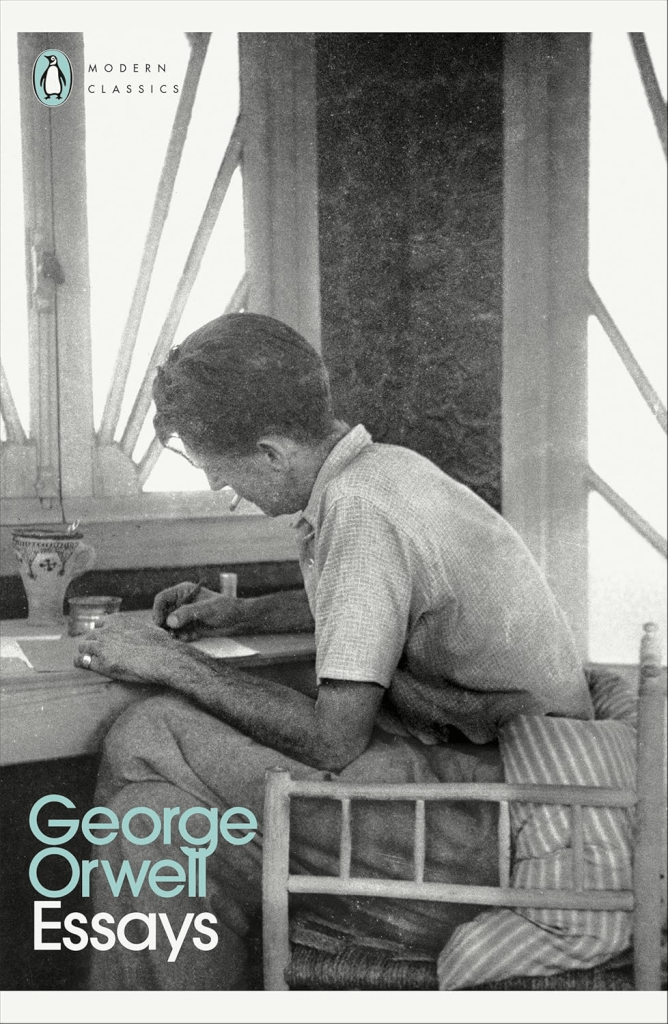
Essays by George Orwell

My deep dive into Orwell continues with the Penguin Modern Classics collection of his essays, edited by Bernard Crick, one of Orwell’s earlier biographers.

In the extremely unlikely event that someone asked me to edit a collection of the great man’s essays, the first task I would set myself would be to understand what is an essay? Which of the many articles Orwell wrote would qualify for inclusion, and which would be excluded? There is a simple textbook definition of the term ‘essay’, ‘a short piece of writing on a particular subject’ but that isn’t particularly helpful – a letter of complaint to the council would fit that bill. He published different collections during his lifetime, and since then they have been republished in multiple different formats. Some collections of Orwell’s essays have over 240 items (for example the Everyman’s Library Contemporary Classics edition – to get to this high a number they must have included the weekly columns that Orwell wrote for Tribune from 1943 to 1947). This Penguin Modern Classics edition has 41 essays, which tallies with the count in Orwell’s bibliography on Wikipedia.

The next thing I would do is try to decide how to group the essays? Would I present them chronologically? That would have the benefit of showing Orwell’s progression as a writer, although some of the essays were published long after they were written, such as his account of his days at his prep school, St Cyprians, Such, Such Were the Joys, which was considered so libellous that publication had to wait until the 1950’s when everyone mentioned was safely dead. I think I would instead group the essays thematically. Memoirs such as A Hanging, Shooting an Elephant, Marrakesh, Bookshop Memories and so on would form one category. Another would be literary analysis – Dickens, Kipling, Cervantes, etc. A third would be popular culture including Boy’s Weeklies and The Art of Donald McGill – and finally a politics section.

When Orwell initially wrote these essays they were published in a wide variety of magazines including: Tribune (which is still in print) where he was literary editor after he left the BBC, Horizon, a magazine edited by his old schoolfriend Cyril Connolly, the Evening Standard, for years the principal London evening paper, as well as a number of more obscure and short-lived publications, such as Polemic, which only managed eight issues and Gangrel which only ran to four, but published his seminal essay “Why I Write”. It is fairly obvious from this wide spread of magazines and papers that Orwell wasn’t enormously fussy (or couldn’t afford to be fussy) about where his work was published – although of course he would have had red lines in terms of pro-Communist and pro-fascist publications.

The reason why I have made this point at such length is that I have no idea why this collection was printed in this particular order. It’s not chronological, thematic, alphabetical, or any other structure or design that I can discern. Perhaps I am missing something but the random nature of the collection, if intentional, did not work at all. The changes in tone from whimsical to academically serious were often jarring. The editing of the text did not help either because the date of publication of each essay was only included as an endnote. The date of publication matters – something written in 1942 about what the world might look like after the end of the war lands completely differently from the same topic written in 1946. But you have to check the end of the essay to find this out, even though it is information needed up front. Crick’s introduction to the selection is also really rather strange. At times it seems that he doesn’t particularly like Orwell’s work. At one point he comes close to calling Orwell dishonest, claiming “One can tell lies or spin stories in monosyllables and simple sentences.” and later “Orwell himself seemed to believe that it is more difficult to lie in monosyllables than in polysyllables, but like many people he confused meaning with truth”. This is leading up to his suggestion that A Hanging and Shooting an Elephant are stories rather than essays, and therefore do not belong in this collection. Which begs the simple question, if Crick did not think these are essays, why include them?

Which is all a pity, because the essays themselves are (of course) outstanding. I have some personal favourites. The Burma essays, A Hanging (1931) and Shooting an Elephant (1936), are comparatively early but exceptional, very concise masterpieces that speak to the human condition and the impact of imperialism. In many ways they would be more impressive if they were entirely fictional. The Art of Donald McGill introduced me to the idea that popular culture (in this case, comedic holiday postcards) can be looked at seriously and tell us something about society. His essay Boys’ Weeklies had the same impact (criminally, this edition does not include the response to Orwell’s theory that the author of the Greyfriars stories must be a collective identity, which explained why the stories themselves were so heavily stylised; Frank Richards’ reply to Orwell can be found here, and it is a serious oversight that it was not included in this collection.) Orwell the man always shines through in his work but never more so when he is writing about the simple but very English pleasures of life such as what makes a great pub, how to make a cup of tea (neither of which are included in this collection) or his thoughts on the common toad. And of course Orwell’s political insight and perspective are a guide to both the politics of the period but more importantly provide us with tools to navigate our own troubled times.

This isn’t a book to be read from beginning to end straight through (although you could) but rather it is to be dipped into and referred back to as occasion demands.

Essays, by George Orwell

Aside
Book review

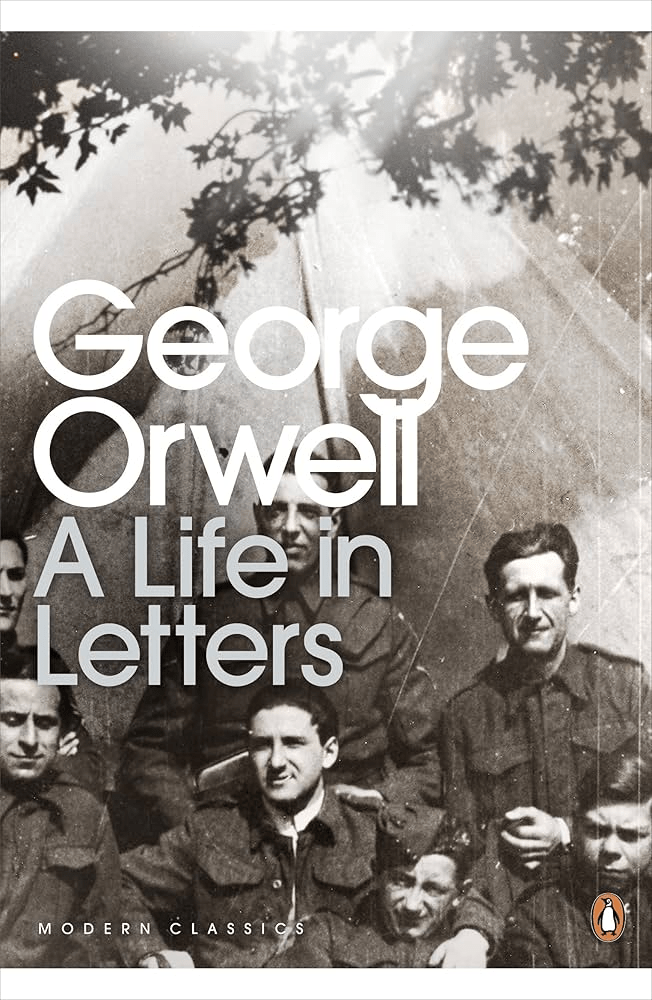
George Orwell, A Life in Letters, edited by Peter Davison, 2010

A Life in Letters is a fascinating collection that took me an inordinately long time to read, simply because of the multiple ‘side quests’ it sent me on. A great example of this is Orwell’s exchange with Anne Popham (pages 293, 307 & 321). Anne was Orwell’s downstairs neighbour in Canonbury Square, and one of the many young women that Orwell propositioned after his wife’s death. (“I wonder if you were angry or surprised when I sort of made advances to you that night before you went away“) According to Anne there was nothing ‘sort of’ about it. In an interview in the Guardian on her 100th birthday she recalled the incident as follows:

“In his flat there was a table, the baby, and its nurse. We had strong Indian tea, with brown bread and treacle. After tea, he told the nurse to take the baby away, and then he said, ‘Come and sit on the bed’. So I went and sat on the bed in the corner, and he came and sat beside me.” She laughs in disbelief at the memory. “In no time at all, his arms were round me, and he was kissing me. I was shocked. I said, ‘What are you up to ?’ and I pushed him away. Later on, I decided this must be how Old Etonians got on with girls, as if no one could resist them. He said, ‘I’m sorry’ and asked about my work, and I said, ‘I’m governing Germany’.”

Anne had an extraordinary life (the interview in the Guardian linked above is a good start) of which the encounter with Orwell played a minor part, but it does tell us a lot about his state of mind following the death of his wife the previous year. It is in this exchange (Orwell’s letter 18th April 1946) in which he makes the claim that “What I am really asking you is whether you would like to be the widow of a literary man?” One can never be completely certain of the extent to which this is being said seriously or is simply a ‘line’, but I am reasonably sure that Orwell himself would not have been able to answer that honestly either – he knew his health was poor and he was looking for a mother for Richard, his adopted son, but at the same time he was making plans for the future and did not have a terminal diagnosis. As a sexually frustrated bachelor in his early forties he would hardly be the first man to chance his arm with a young women with a tragic sob story, on the basis that sooner or later he might be lucky. It is in this same letter that Orwell claims that he did not suffer from jealousy: “I don’t much care who sleeps with whom. It seems to me what matters is being faithful in an emotional and intellectual sense. I was sometimes unfaithful to Eileen and I also treated her very badly, and I think she treated me badly too at times.”

This collection would make a superb companion text to any biography of Orwell. It can be read on its own of course, but combining it with a biography would work really well, with Orwell’s own words accompanying narrative about the events of his life. It would reveal his tendency to downplay things in a very British stiff-upper-lip way, such as his health problems, his distress at the death of his wife (“I don’t know whether you will have heard from anyone else the very bad news. Eileen is dead” opens a letter to Lydia Jackson, one of Eileen’s close friends, dated 1 April 1945, Eileen having died two days earlier. This isn’t Orwell being uncaring or brutal, it is him trying to cope with his grief and carry on doing the right thing.) and his pride in the success of his later books.

Another thing that shines out of the pages of this collection is Orwell’s entirely unsentimental love of the countryside. Very few personal letters go by without lines on the progress of his garden, how many pounds of potatoes have been harvested, how many eggs the hens have laid, and so on. This was more than a hobby, it was a part of his life and he clearly found the loss of gardening when he was laid up in various hospitals and sanitoriums (or away in Spain or Morocco) highly frustrating. It does make me think that the short period he was on Jura, enjoying living off the land, was one of the happiest of his life, even though it was tinged with sadness as he was having to make this home without Eileen, who seemed to have shared his dream of escape to the Hebrides.

Over half of the letters in this collection date from 1945 or later, that is to say the last five full years of his life (he died in January 1950). In part this must be a reflection of the fact that by 1945 Orwell was increasingly well known, so recipients of his letters were much more likely to have kept them. He may have also kept copies himself, certainly of business letters. I don’t have access to the 20-volume Complete Orwell that Davison edited, so I can’t be sure, but this edition doesn’t contain any letters from Orwell’s five years in Burma, which suggests either that he didn’t send any, which is profoundly unlikely, that none of the letters from that time have been found, (quite possible) or that none of them have anything particularly interesting to say. Whatever the reason it does mean that this aspect of his life is unrecorded in this collection, which is a gap. If I am being pedantic I would also say that this collection contained just a few too many letters from Orwell to his literary agent arranging details of publication, distribution, translation and so on – this aspect of his life as an author could have been illustrated just as clearly with fewer examples. But the scholarship of this collection is formidable, with detailed and clear footnotes to every letter, an extensive set of biographical notes of the main recipients of Orwell’s letters, every typo that was Orwell’s not the editor’s marked clearly and of course a detailed index. Even though I have read all the biographies of Orwell I still learnt a lot about his life and work from this collection. Just to offer one example, I previously thought of Jura as a remote and wild place, which it was, but assumed it was madness to decamp there with Orwell’s health so precarious and it being so hard to reach. But he only summered there, spending winters in the Canonbury Square flat in London that he retained the tenancy of (often letting others stay there) and the island had a mild climate. It also seems they ate better there than on the still rationed mainland, with access to fish, lobsters and crabs from the sea, rabbits and venison from the land, eggs and meat from the chickens they kept, and vegetables from the garden. It was also easier to keep warm on Jura compared to London, because there was plenty of natural fuel – peat and wood – available, compared to the capital where everything was scarce and rationed. It does seem rather idyllic and it is not surprising they had so many visitors, at one stage having to set up a tent in the garden to accommodate the overflow.

Davison enriches this collection enormously by interspersing letters from Orwell with those from others such as his childhood sweetheart Jacintha Buddicom. Most revealing are those from Eileen to her friend Norah. These letters are full of impish humour and provocation and were the basis of the 2023 book Wifedom. The author of Wifedom took everything Eileen says in these letters as gospel, when it is plain as anything that she is invariably joking, usually by way of comic exaggeration. Letters between Eileen and Orwell are few and far between. Obviously that is because husband and wife tend not need to write to another. Eileen’s last unsent letter to her husband (29/3/45) is heartbreakingly sad. She was a much more interesting and lively correspondent than Orwell, and the fact that her letters are often interrupted and written over several days, if not longer (instead of throwing away a mislaid draft she would resume writing with an apology for the delay) adds to their charm. The exercise of compiling a complete edition of Orwell’s letters is one that may never end – very recently more letters were discovered by relatives of his correspondents. Last year Darcy Moore, a great Orwell scholar, discovered another lost letter from 1942. I doubt it will be the last.

Sadly the editor of this collection, Peter Davison, who was also the editor of the twenty volume complete Orwell, died in 2022 – I do hope that the Orwell Society or his literary agents appoint someone to continue Davison’s work. The Society has introduced a Peter Davison award for Orwell scholarship, which I suppose goes some way towards this aim. While mentioning the Orwell Society I should also recommend this excellent review of the Collected Letters on their site.

The final year of Orwell’s life was spent a sanatorium and then a hospital where he seemed to have received little by way of actual medical treatment, spending the time just resting, surrounded by growing piles of books. Resting for Orwell still meant undertaking a lot of correspondence, as well as a little journalism and book reviewing. He obviously knew he was very seriously ill but at the same time held out hope for a recovery that might give him a few more years. He had lots of visitors, many of them members literary aristocracy and was clearly much loved – many people expressed concern for his health and the need to ‘do something’ to save him. Forty-six is a ridiculously early age to die, especially for a writer who in Animal Farm and 1984 had fully discovered their own voice. These two novels alone have sold over forty-one million copies. This achievement is not the end of the story. Earlier this month I was watching the television show Countdown. Someone used the word “unperson” without reference to Orwell even though he coined the word in 1984. This to me just emphasises (albeit in a very minor, incidental way), the extent to which Orwell’s thoughts and ideas have permeated Western culture and language; they are just now part of the way we think rather than something that needs to be referenced or explained. Sales of 1984 spike every time world events seem particularly Orwellian such as when Trump’s press spokesperson coined the phrase ‘alternative facts‘. That more than anything else was his contribution.

George Orwell, A Life in Letters, edited by Peter Davison, 2010

Aside
Book review

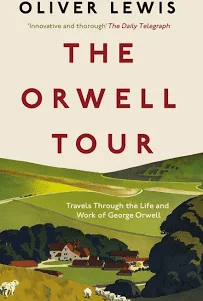
The Orwell Tour, by Oliver Lewis, 2023

I must admit I am a little jealous of Oliver Lewis. I have pointed out in previous reviews of Orwell biographies that he was relentlessly nomadic, never living in the same place for more than a handful of years. I’ve also been to several of the places he lived – Marrakesh, Southwold, Paris, London, and nearby Wallington in Hertfordshire – but with the exception of the last location I have never made the effort to seek out the blue plaques recording where Orwell lived, however briefly. (Wallington is an exception to that rule, because apart from the Stores, Orwell’s house there, and the prototypes of Manor Farm, there is very little in the village at all). Lewis had the inspired idea of visiting as many of Orwell’s homes as possible, with the thought that they might individually or collectively tell us something about the man, his background, influences and experiences. I wish I had had the same idea.

Knowing where to draw the line in terms of the places Orwell ‘lived’ is not always straightforward. For example, did he ever live in Stockton-on-Tees? We know his wife Eileen’s family owned a house there and she and Richard (their adopted son) decamped there after they were bombed out of their London flat. But did Orwell visit or stay for any length of time? There are so far as I am aware no letters from him to anyone carrying this address. D J Taylor, author of one of the best biographies of Orwell, (Orwell, the New Life) says (page 432)

The first of the V1 flying bombs, known as ‘doodlebugs’, had been launched across the channel on 13 June, a week after the Normandy landings. On 28 June one of them fell on Mortimer Crescent; no one was hurt, but the house was uninhabitable and would remain so for some time. Orwell and Eileen’s whereabouts for the next few months are far from certain. One temporary landlady may have been Inez Holden, at her new flat in George Street, Marylebone, although a note in Inez’s diary records their going to stay with the Dakins in Bristol. If so, this could only have been a short-term arrangement as Orwell was needed three days a week at Tribune. Eileen and Richard certainly spent some time at Greystone, the O’Shaughnessy family home twenty-five miles south of Newcastle, and there were short visits to Wallington…but the likelihood is that Orwell himself joined the vast floating population of displaced wartime Londoners with no fixed abode, moving on from one spare room or camp bed to another as the opportunity arose”.

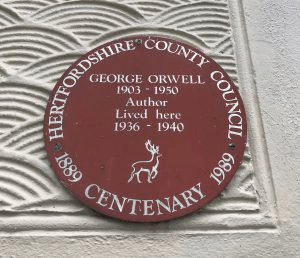
I have quoted this at length to illustrate the point that the question of where Orwell ‘lived’ is often far from straightforward and until such times as letters from or to Orwell, or any other evidence emerges, will remain unclear. There is a similar issue with Orwell’s residence at the Stores in Wallington. He held the lease to this cottage from 1936 to 1947, but the plaque on the wall states he lived there from 1936 to 1940. Even during that period he spent six months in Spain, as recorded in Homage to Catalonia, six far less interesting months in a sanatorium in Kent and a further six months recuperating in Marrakesh. After 1940 he lived in various addresses in London and in 1946 he moved to Jura. The Stores were (from what I can tell) sub-let at various points, but the record also indicates he and Eileen, occasionally joined by friends, would spend some weekends at Wallington during the war. Does this mean he lived there then? (If so, the plaque would be far more complicated!) Probably not, but again the point is that the question of where this ultra-nomad lived at any one time is not straightforward, and eventually requires us to make judgment calls about these issues.

There are a few omissions from what is otherwise a comprehensive review of the many places Orwell lived. He attended Wellington College for a single term before going to Eton. St Cyprian’s School in Eastbourne, East Sussex where Orwell went to prep school for five years as a boarder, is mentioned but not visited, possibly because the building in which it was housed has since burned down, so there would be little to see. Having said that these were key formative years for Orwell, recorded in his essay Such, Such Were the Joys (which is a grimly ironic quote from Blake). Freys College, where he taught for a term in 1933, is also mentioned but not visited. Orwell seems to have spent quite a lot of time at his wife’s brother’s family home in Greenwich, which might have been worth visiting, and was certainly close enough. Any attempt to visit every location ever associated with Orwell is probably futile, but these all seemed easy enough locations to tick off and may have been worthwhile additions to this account.

There are a few errors here as well which are less forgivable. The chapter on the Blair’s early years back in the UK after India is entitled Henley-on-Thames, Berkshire, whereas Henley-on-Thames is in Oxfordshire, as the text makes clear. The error is important because it makes more sense of Orwell’s decision to be buried in Sutton Courtenay, Oxfordshire – otherwise he had no particular association with this County, rather than it being the place of his early childhood. The description of Southwold as being “a small port clinging to the extremity of the East Anglian coastline” is technically correct, but misleading. Southwold is predominantly a Suffolk seaside town, pier and all, and the fact that as with all ports and seaside towns it is on the coast means the description of it ‘clinging’ to the coastline (rather than sloping gently down to the sea) is redundant.

I don’t think there is any doubt that we can learn more about an author by visiting the places where they lived. Orwell’s lack of interest in home comforts is summed-up vividly by the dilapidated cottage in Wallington, even if over the years it has been vastly improved, not least by the addition of a thatched roof and indoor plumbing and heating. Manor Farm just a short walk away conjures up images of the revolutionary animals of Animal Farm. I am sure the conditions in Burma could tell us a lot about Orwell’s time in the military police there. The wildness of Jura doesn’t seem to have changed a great deal since his time there in the 1940’s – anyone seeking out that remoteness and isolation must have wanted to escape something and will have paid little regard once again to the lack of home comforts.

Lewis makes some small but fascinating discoveries in the course of his journey: gravestones from the Limouzin family, Orwell’s mother’s side of the family, are found in a half-abandoned church in Burma; his measurements can still be seen in his tailor’s records in Southwold from when he ordered a suit almost 100 years ago; his name is still to be found in the visitors book in his neighbour’s house on Jura. Orwell left footprints everywhere, but at the same time he is elusive – famously, there is no known recording of his voice, which is extraordinary given that he worked in broadcasting for two years in the the 1940’s – and there are many small mysteries about his life which researchers are diligently chipping away at.

Lewis makes it clear in his introduction that this is not another biography, of which there are plenty, but it is not simply a travelogue either. It is a different way of looking at a remarkable life, and therefore a valuable contribution to the growing scholarship about the great man.

The Orwell Tour, by Oliver Lewis, 2023

Aside
Book review

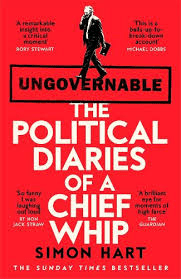
Ungovernable: The Political Diaries of a Chief Whip by Simon Hart, 2025

Simon Hart was a relatively minor figure in the appalling melodrama that was the 2019-2024 Conservative Government – he was Secretary of State for Wales for a couple of years, a post of minimal significance since devolution, but came with a place at the Cabinet table, and then Chief Whip for the duration of the Sunak Government (2022-24). He now sits in the House of Lords, despite having consistently poured scorn on the aspirations of his fellow MPs for the same privilege. Nevertheless, he undoubtedly had an insider’s perspective (the proverbial ‘front row seat’) on the chaos that engulfed the Tories during the 2019-24 Parliament and his heavily redacted diaries of that period give enough juicy details to keep the pages turning, even if the ‘real’ story remains elusive.

A feature of most political diaries is the temptation to remove references that make the author look like he or she had no idea what was going on, but at the same time to also leave sufficient minor ‘gaffes’ to make the account convincing. What do I mean by that? Well, if these diaries were to include glowing predictions of how wonderful Liz Truss’s premiership was going to be, Hart would lose any credibility as an observer of the political scene. On the other hand if every prediction proves unerringly accurate then the reader would be sceptical as to their authenticity. So when Hart says of Rishi Sunak in June 2022, “He is compelling and will be a contender for PM one day“, his editor would have been keen to keep this prediction in the final edit despite the fact that Sunak was to become Prime Minister only four months later – ‘one day’ being a stark understatement. In other words Hart was wrong, but in a mildly entertaining way rather than totally misjudging the situation. It was for the purposes of this category of memoir the ‘right’ kind of mistake. Most of his political predictions that survive the edit are reasonably accurate – for example as the process to replace Johnson as Prime Minister gets underway Hart pondered “I dread to think what a Truss Government would look like, or if it will even last”.

Looking back now over the 2019-2024 Government it really is quite breath-taking how bad it was. The rot started at the top of course and Hart is a frank observer of Johnson’s flaws as well as his abilities. Knowing how things ended we can see how entirely unsuited he was to senior office, even if that wasn’t glaringly obvious much earlier, but Hart, like the rest of the Conservative Party, was swept away by his Etonian bluster. He finds his performances in Parliament ‘brilliant’ and is charmed by his Woosterish schtick. Hart’s decision to join the eventual flood of Ministerial resignations which swept Johnson from office comes late and is done with much regret rather than in recognition of the Prime Minister’s arrogance and incompetence. His subsequent appointment as Sunak’s Chief Whip was intended to introduce some stability to the political process, but on every other page there is scandal, from the infamous ‘tractor porn‘ incident to a succession of entries about serious sex offences (allegedly and in some cases actually) committed by MPs, special advisors (SpAds) and others. 

Hart himself emerges as an affable, hard-drinking One Nation Tory, a remainer who was often out of his depth, like so many of his colleagues. If you want to know why the Tories went from a comfortable 80+ majority in the December 2019 General Election to an ignominious wipe-out five years later, there is plenty here both between the lines and directly from Hart himself. A good example of his lack of understanding as to just how existentially serious the crisis the party was facing comes in his entry for Friday 17 December 2021

“The North Shropshire by election goes against us and in favour of the Lib Dems with a 5000 majority. It’s the first time this seat has ever been held by a non-Conservative. This is manageable but serious and should probably be reversed at a General Election, but it has opened up the whole question of whether the BoJo electoral ‘magic’ has lost some of its potency.”

Is some ways it this is the most egregious of all Hart’s political miscalculations. In the 2019 General Election Owen Paterson won this seat for the Conservatives with a majority of over 20,000 (the chaos over Paterson’s breach of Parliamentary standards and the Government’s blatant attempt to subvert Parliamentary processes to avoid him having to face the consequences of his actions is a whole other story – readers of Hart’s account will need to turn to Wikipedia for the detail). The Lib Dems had come third in this seat in 2019 with fewer than half the votes of the Labour candidate, then leapfrogging Labour to beat the Tories comfortably at the by-election. At the 2024 General Election the Lib Dem incumbent increased her majority to over 15,0000, making North Shropshire a relatively safe LD seat. The arrogant assumption that the by-election result was simply a protest vote rather than part of a generational movement away from life-long Conservative hegemony reveals how little Hart understood what was really going on as the Johnson administration slowly but inevitably imploded.

Although the 2019-24 government was obviously deeply flawed and chaotic, it would be wrong to overlook the two significant external events that would have been challenging for the most competent of administrations – the Covid pandemic and the war in Ukraine. Both had dramatic impacts on the economy which we will be paying for for years to come. Boris Johnson was totally unsuited to running the serious type of Government required to manage the UK’s response to the pandemic (for example his early demonstration of his incompetence and bravado by ignoring medical advice and continuing to shake people’s hands) but it would have been difficult for any government. None of which justifies the casual indifference to economic stability demonstrated by Liz Truss and Kwasi Kwarteng of course.

Does Ungovernable tell us anything we didn’t already know? The detail of the collapse of the various administrations is already in the public domain. Central characters including Johnson have already published their memoirs and accounts of the period. Frustratingly, the really juicy gossip that Hart was privy to – the drunken calls from MPs in the middle of the night, one claiming to be stuck in a Bayswater brothel with a woman he thought was a KGB agent, or the reports of orgies and someone going to a party in a Jimmy Savile costume and having sex with a blow-up doll – is all sadly but inevitably anonymised. Anyone who starts this book with a positive opinion of politicians, as hard working and basically decent, will find themselves closing the pages at the end wondering just how wrong one can be!

Ungovernable: The Political Diaries of a Chief Whip by Simon Hart, 2025

Aside
Book review

The Blair Years (2) by Alastair Campbell, 2007

There were a few additional observations I wanted to add to my earlier review of Campbell’s fascinating diaries of the years he spent as Tony Blair’s press secretary, from 1994-2003.

One of the contentious policies the Starmer Government has been pursuing since the 2024 General Election is the levying VAT on the fees paid for private education. Campbell always was to the left of Blair on educational issues, advising him against sending his kids to the grant-maintained Oratory school, and he is a strong supporter of the current Government’s plans. This policy idea was originally floated in the early years of Blair’s leadership prior to him becoming Prime Minister – and when it came up he killed the idea stone dead without any debate. He considered it a tax on education and could not understand why any Government would even consider the idea. To him it was unthinkable. I mention this point simply to underline the fact that while the Starmer Government is obviously very far to the right of the policy positions taken during the Corbyn years, there remains some important differences between its policies and those of New Labour. Blair would never have countenanced something as radical as VAT on school fees – Starmer is pushing ahead with the idea despite a lot of well-resourced opposition and limited evidence that the policy is causing the party some electoral damage. In other words he is probably doing it because he believes it is the right thing to do, not simply because it is politically expedient.

The second point that I originally overlooked is an exchange Campbell shares (page 101) between himself and Mo Mowlam, at the time a shadow minister for Northern Ireland, who was to go on to play a key role in the Good Friday Agreement. At the time the Labour Party, still in opposition, was rocked by Harriet Harman’s controversial decision to send her children to grammar school. Campbell’s role as always was to ensure all Labour MPs stayed on-message and defended the party line, whatever their personal feelings on the issue. He recounts his version of events:

“We were still struggling to get anyone to defend her (Harman) on TV, but eventually I persuaded Mo to do it, only half jokingly saying that if she didn’t I’d reveal her stepchildren were at a public school.”

This is horrendous. A Shadow Minister is forced to go on television to defend a position she doesn’t agree with because otherwise a party official will expose damaging information about her family to the media. This isn’t a half-joke, it’s blackmail. The fact that Campbell thought it acceptable to include in this book – presumably to show how far he was prepared to go to support Blair – is appalling, and makes one wonder what dark arts and deviousness were left out.

Finally, during the 2024 general election campaign it was hard to find a single commentator not referring to Labour’s ‘ming vase’ campaign strategy. The phrase was used so relentlessly that it almost lost all meaning, so I was struck by the fact that the phrase is first recorded in these diaries. It isn’t just an echo of the New Labour strategy, it is the New Labour strategy.

“TB told me about his last dinner with Roy Jenkins at Derry’s….” I see you Tony, as someone carrying an exquisite, beautiful. hand-painted vase over a slippery floor and as you proceed across the floor, vase in hand, you can see your destination and you can see the likes of Harriet Harman and Clare Short lunging towards you, and you don’t know whether to run or tiptoe”.

In this original version of the strategy, it’s not the leadership who are going to drop the vase – instead they might have it struck from their hand by outspoken or clumsy Shadow Ministers or party spokespersons. So the strategy is not simply one of taking no risks, but also of shackling any Shadow Ministers seen as likely to say something out of turn. Roy Jenkins was a progressive Labour Cabinet Minister in the sixties and seventies, but had done his best to destroy the party in the eighties by setting up the SDP (which was to eventually merge with the Liberal Party to form the Liberal Democrats). You can interpret the fact that Blair adopted him as one of his senior (albeit unofficial) advisors as either evidence of Blair’s willingness to think outside the box and break rules, or of his innate conservatism.

The diaries were a mine of interesting insights such as this into both the Blair years themselves and their reflection in what might one day be called the Starmer years. Or maybe not.

The Blair Years (2) by Alastair Campbell, 2007

Aside
Book review

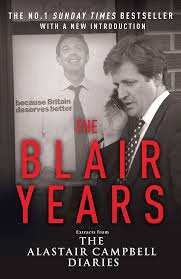
The Blair Years, by Alastair Campbell, 2007

I don’t think there is any question that Alastair Campbell’s obituary when it comes to be written will focus on the events of the last few weeks of this diary. For any readers for whom this is history rather than current affairs, a short summary: Alastair Campbell was Tony Blair’s press spokesman from shortly after Blair became leader of the Labour Party through the first two New Labour governments. He developed a fearsome reputation as a defender of the Government. The verb ‘to spin’ might have existed before Campbell and New Labour, but it came into common currency during those years. To give you some idea of Campbell’s reputation, all you need to know is that the character Malcolm Tucker from The Thick of It was based upon him.

After 9/11 America, led by George W Bush, was determined to depose Saddam Hussein. The premise for this attack was that Iraq possessed weapons of mass destruction (WMDs), or the capability to develop such weapons. Tony Blair was unshakeable in his support for Bush and the issue became a deep dividing line within British politics. To support the case for war a file of intelligence briefings (a dossier) was produced, purporting to demonstrate that Hussein had WMDs. A BBC report claimed that Campbell had interfered with the drafting of the report and ‘sexed’ it up, over-stating the strength of the evidence. Dr David Kelly, a government scientist who had allegedly leaked information on the dossier to the BBC ended up taking his own life. A judicial inquiry into these events, the Hutton inquiry exonerated Campbell but the accusation has stuck, primarily because it seems the sort of thing that Campbell would have done.

Campbell has spent more than twenty years trying to rebuild his reputation, but I suspect he will always be haunted by this accusation. The Blair Years is the first of what is by now a series of eight volumes of his extremely detailed diaries – over 750 pages covering 1994-2003, around a sixth of the total words written contemporaneously. The obvious question is to what extent these diaries have been edited or selected to present a positive view of Campbell and his role in New Labour, and specifically to exonerate him from the WMD accusations? It would be astonishing if not almost impossible to edit down that volume of writing without any element of spin. Choices must have been made, inevitably with the intention of presenting Campbell and Blair in the most positive light. Even if Campbell wasn’t such a notorious exponent of the art of spin, some recasting of events must have happened. I am possibly being naïve but I choose to think that this is a reasonably honest version of events. Campbell saw himself as a leading figure in the Blair administrations, more a chief of staff than a press officer. He was at the heart of the New Labour project, even if on some issues he found his personal views to the left of Blair. An early instance of this is when he tries and fails to persuade Blair not to send his children to a grant-maintained school, which went on to be a bit of a PR disaster for him.

Most of the time there is little effort made to provide context to the events being described – footnotes are few and far between – so the reader either needs to be familiar with the events or spend a fair amount of time flicking back and forth to Wikipedia. The overall effect is of a real-time account of several significant moments in recent British history, such as the death of Princess Diana, the foot and mouth crisis, and the British reaction to 9/11 leading through to the Gulf War. Throughout, Campbell’s portrait of Blair is consistent: he was a reforming Prime Minister often out of step with his party but driven by faith in the rightness of his own views, determined to reform institutions (such as the House of Lords) and with a broad interest in social justice. Campbell himself is by contrast more a traditional party man. The cast of supporting characters is large. John Prescott comes across as a surprisingly likeable ally, while Campbell makes little attempt to disguise his contempt for others such as Clare Short. The effect of some parts of the diaries is to confirm public perception of Labour figures – Peter Mandelson is undoubtedly Machiavellian, Gordon Brown is prone to outbursts of anger, and so on – there aren’t many revelations about politicians secret lives. Perhaps this is because so many other memoirs have been published. What was at the time an insight into what really happened – such as the story of Robin Cook breaking up with his wife on the way to the airport because a tabloid was about to expose his affair (a story sometimes presented as Campbell instructing Cook to divorce his wife) are now well known and all these diaries do is confirm them.

Campbell isn’t over-burdened by humility. Early on he becomes excruciatingly convinced Princess Diana is attracted to him. The Secretary General of NATO is quoted as saying in the context of the conflict in Kosovo “If you can, send me your man Campbell, that would be best“. He becomes good friends with Bill Clinton and George W Bush. I suppose everyone is the hero of their own stories.

While some of the narrative feels like ancient history, other sections bear strikingly similarities to the political situation today – a reforming Labour Government with a large majority after a long period of Conservative rule; a hostile media; cynical anti-politics agenda being pursued by the right-wing; Europe as always a divisive issue. Even electoral reform and changes to the House of Lords are back on the agenda. So these diaries should probably be studied by the new Labour Government. If they were to do so what lessons would they derive?

First, the Conservatives must not be under-estimated. They will be back, and the time to cement Labour’s position as the party of Government is now, not in five years time. The next Conservative Prime Minister may not yet be an MP (Cameron was not an MP when Blair was elected; Starmer was not an MP when Cameron was elected) but they aren’t one of Europe’s oldest political parties for nothing.

Second the media will be unrelentingly hostile and the Government needs to decide what it is going to do about that. What we mean by the media has obviously changed since 1997 with the advent of Facebook etc, but the right-wing tabloids are still stubbornly there and will not miss a chance to undermine the Government.

Thirdly major crises seem almost unavoidable. Whether it is the death of Princess Di, foot and mouth disease, the oil delivery drivers strike (first term) or 9/11 and the Gulf War (second term) and the global economic crisis (third term) there are going to be testing times ahead.

Is the portrait of Campbell that emerges from these diaries accurate? For example is his reputation for quite aggressive ferocity justified? I wanted to quote at length a description Campbell gives of a shouting match between himself and Gordon Brown, Chancellor of the Exchequer (page 528) during the 2001 general election campaign. Brown had long been concerned about the negative impact of briefings by Peter Mandelson, who had been sacked twice from Cabinet positions:

“I went over to see GB in his office….and he was banging away at his computer. He had a pile of papers to the right and on the top had written 75 pence and below it, in large black letters, ‘who will silence Mandelson?’ ….

I tried to make a joke of it, but he was having none of it, went on a great tirade, said we were letting him destroy the campaign, undermine him, be ill-disciplined, on and on he went and eventually I lost it, said PM was nothing to do with me and I did not like the implications that I could be held responsible one way or the other for what he was or was not up to. “Well it has to stop” he said. “Telling me it has to stop suggests that in some way I might be responsible, and I fucking resent that….(continues at some length) I was suddenly conscious that I was jabbing my finger at him, and thought it better to leave.”

This is extraordinarily unprofessional conduct, but it seems there were no consequences for Campbell for swearing and shouting at the second most senior member of the Government. The word suddenly is revealing here – if the description can be taken at face value, he seems genuinely not to have realised he was shouting and being aggressive towards Brown for most of the exchange. If he treated the Chancellor of the Exchequer like this, what was he like with junior members of staff and journalists? Of course we don’t need to ask because there are multiple accounts of his behaviour. So yes, he was aggressive and either didn’t know or care that people were often genuinely scared of him.

Just one other thing I noticed: the back cover of the paperback edition includes the following quote from Matthew Parris, the Times columnist and former Conservative MP

“A brilliant, absorbing account….These diaries….will be gasped at, and relied upon, for decades to come. Buy them; they will suck you in”.

I was surprised to read this endorsement when Mr Parris himself appears only once in these diaries (page 308) as “The little shit Parris“.

One wonders what qualifications were hidden by the ellipses?

The Blair Years, by Alastair Campbell, 2007

Aside
Book review

Why Orwell Matters by Christopher Hitchens, 2002

This extended essay on the continuing significance of Orwell as a writer and thinker is a tour de force of analytical writing by the late, great, Christopher Hitchens. Orwell has been seconded to a wide range of causes over the years, by cold warriors, reactionaries and revolutionaries, but I don’t think anyone has written as clearly nor as intelligently about his work as Hitchens does here.

There’s an immense but loosely worn scholarliness about this analysis. Hitchens has not only read and remembered virtually everything Orwell ever wrote, (and in case I haven’t mentioned it before that was an enormous, prodigious amount), but he seems also to have read everything written about Orwell. What is wonderful is that this isn’t an account bogged down in footnotes and irrelevant detail. Heavyweight critics of Orwell from left and right are batted away with ease. If I found some of the debates about Orwell’s legacy hard to follow at points, due to the arcane academic language used by some critics, (in complete contrast to Orwell’s one writing of course) I nevertheless felt in safe hands in Hitchens company.

A lesser critic would have been tempted to call this text ‘Why Orwell was Right’ but Hitchens is a far subtler writer than that. He appreciates that the idea of Orwell having a fixed set of ideas that never changed throughout his life and which can be tested by later critics as either correct or otherwise is facile – Orwell changed his mind constantly, as any human being will, particularly as he lived through the political turbulence of the 1930’s and 40’s. Orwell was at heart a journalist, and he frequently opened his articles with provocative statements intended to engage the reader rather than as statement of positions he genuinely felt. Orwell’s early anti-Semitism and later attempts to address the issue within himself is charted fairly here, as is his more troubling and apparently life-long homophobia. Orwell the flawed but ultimately heroic author and man emerges more clearly from these pages than from most of his biographies.

Hitchens is very good on Orwell’s novels, and their relationship to the rest of his work. The earlier works before Animal Farm are considered fairly but also I think accurately as a minor contribution to his work. He describes (page 186) Coming Up for Air, A Clergyman’s Daughter, Keep the Aspidistra Flying and Burmese Days wonderfully thus: “These four pre-war efforts constitute a sort of amateur throat clearing” which is exactly how I have always thought of them – like an orchestra warming up discordantly before the symphony begins. Hitchens writes of Orwell’s final masterpiece (page 190) 1984It is the first and only time that his efforts as a novelist rise to the level of his essays”. That might be , in fact almost certainly is, hyperbole, and is totally unfair with regard to Animal Farm, but the essays are much under-appreciated, beyond one or two pieces such as Shooting an Elephant and A Hanging which are still taught in schools.

Despite this very positive reaction I still found something to disagree with on almost every page. That’s going to happen with polemical writing and is part of the fun! Some points of fact were I think missed (for example Hitchens claims Orwell was right to deduce (in his essay, Boys’ Weeklies, published on Horizon) that the Greyfriars/Billy Bunter stories were written by more than one person, whereas Frank Richards’s wonderful response to Orwell’s essay is rightly cherished and to my knowledge never disproven) but equally Hitchens invites disagreement and I suspect would have relished it. Perhaps he was not being deliberately controversial, but it is clear he never backed down from a fight either.

For Orwell enthusiasts this is a must-read. For anyone looking for an introduction to Orwell this might be quite advanced – it assumes a fairly extensive knowledge of Orwell’s life and works – but there are many far worse places to start.

Why Orwell Matters by Christopher Hitchens, 2002

Aside
Book review

How They Broke Britain, by James O’Brien, 2023

How They Broke Britain comprises ten essays on familiar characters from early twenty-first century British politics, constructed round the framing device that all of those portrayed have contributed to the degradation of political life in the UK. Some are very well known – it is surprising that O’Brien found anything new to say about Rupert Murdoch for instance – others much less so, for example the recently ennobled Matthew Elliott.

Very little of what O’Brien writes will be new to anyone who has been paying attention to the news over the last thirteen years. That’s not to say it is not convenient to have so much detail collected together in this way – in some respects this will probably work better as a reference book than as an attempt to change anyone’s mind. Conservative supporters will either not read this in the first place, or will do so with the specific intention of finding flaws and weaknesses. The Telegraph review, for example, described it as a ‘wild polemic’, both weak and childish, and hilariously finds fault that O’Brien has not correctly understood the hierarchy of the English aristocracy (“He’s wrong: the rank below an earl is viscount.”)

O’Brien’s style invites disagreement, so here goes. Firstly, the breaking of Britain (and it is really difficult to argue with the proposition that the country has been deeply wounded in recent years) is not the result of the behaviours and characters of ten or so individuals. There are systemic, structural flaws in the way our nation is constructed and organised, and basing his analysis on the ten people in question means O’Brien doesn’t really have to address those structural issues. In fact there’s no real attempt at all to understand or identify what’s gone wrong other than through the characters of the people portrayed. But without an understanding of these issues then any attempt to address them is doomed – there’s every chance we will end up with another set of chancers and crooks running our country and its institutions, even if we were to clear out the existing cabal.

Second, keeping a modern political commentary up to date is admittedly really difficult, because O’Brien is charting something that is happening right now. There’s never a right time to end the analysis, never a point at which he or any other commentator can say (along with Andrew Lincoln) “enough”. This was really driven home to me when I read that Matthew Elliot, Chief Executive of the TaxPayers Alliance and latterly the Vote Leave campaign, the subject of chapter three of this book, has been nominated for a life peerage by Liz Truss in her ‘I’m no longer Prime Minister’ honours list.

Third, O’Brien argues that the bad behaviour he records, the lying, bullying, abuse of power, is all the more egregious because by and large the people doing it got away with it unpunished. This is clearly wrong. Boris Johnson and Liz Truss were both hounded from office and Johnson had to resign from Parliament when found guilty of breach of parliamentary procedure by the Privileges Committee. Johnson was also fined by the police over Partygate, as was Rishi Sunak (who doesn’t, yet, merit his own chapter, although I suspect later editions may remedy that omission). Johnson may have behaved as if he was above the rules that the rest of us had to comply with and some of his more egregious behaviour may have still to be addressed (by, for example, the Covid enquiry), but the idea he got away with everything without consequence is demonstrably incorrect. Jeremy Corbyn is a surprise inclusion in the text, perhaps thrown in for ‘balance’, but more likely because O’Brien holds him personally accountable for the Brexit referendum outcome. Corbyn never really came close to power during his five years as leader of the Labour Party, and now sits as a independent backbencher having been thrown out of the Parliamentary Labour Party – again hardly the best example of someone getting away with bad behaviour.

This is not a book for reading at one sitting. Take it a chapter at a time and allow yourself plenty of breaks to absorb the detail and for your blood pressure to reset. The piling on of fact upon fact in intense detail can at times be hard to absorb and at moments almost becomes incoherent. The overall effect can feel like being shouted at by someone almost desperate to convey their point but struggling to overcome the weight of detail and present compelling evidence and argument. History won’t be kind to Liz Truss, Boris Johnson, Dominic Cummings and Nigel Farage, all of them currently a long way from the levers of power and likely to stay that way (even though Rishi Sunak was reportedly flirting with the idea of returning Dominic Cummings to Number 10 to run the election campaign, a truly bizarre idea if ever there was one), and history may use How They Broke Britain as a reference work when judgment is being passed and obituaries are written. Until then I would recommend this book to anyone looking to get their heads around how this country has so badly lost its way, even if it won’t really help in finding any answers on how we find out way out of this mess.

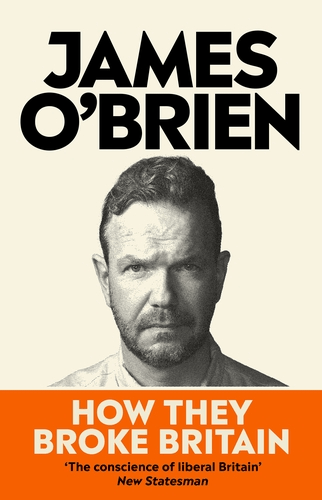
It’s worth noting that the hardback version of this book uses a large picture of O’Brien on its front cover, and a supportive quote about the author rather than the book (“The conscience of Liberal Britain” – the New Statesman). It wouldn’t have been difficult to have come up with a cover that used mugshots of the ten people featured in ‘Usual Suspects’ style (just for example – the kind of thing Private Eye front covers do so well). This approach exposes O’Brien to criticisms that this is just an ego trip, preaching from a public pulpit while unprepared to accept the same level of challenge in return, other than to rage bait callers to his LBC show. But the ‘O’Brien brand’ sells well, and How they Broke Britain will have sold by the lorry load over Christmas.

How They Broke Britain, by James O’Brien, 2023

Aside