Book review

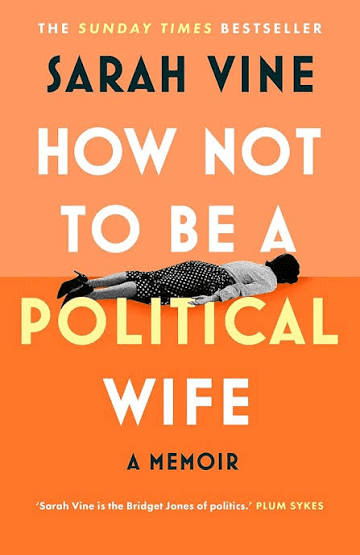
How Not to be a Political Wife by Sarah Vine, 2025

This book’s clumsy title sets the tone for what is, one can be pretty confident, going to be quite a bumpy ride. The book is categorised as a memoir, but more accurately it is a confessional of staggeringly indiscrete proportions, quite calculatedly burning lots of Ms Vine’s bridges with the Cameron vintage Conservative hierarchy. The book serves as an interesting and I suspect deliberate contrast to Sasha Swire’s much more reflective and considered Diary of an MP’s Wife which covers much of the same time period and territory.
Sarah Vine describes herself as a journalist, but more accurately she is a columnist, writing observational pieces about the world as she sees it. She is one of the genre of columnists who specialise in what is now called ‘rage-bait’ – constructing controversial ‘opinions’ and comments to order that she may or may not mean to be taken seriously, but which are going to drive traffic to her newspaper’s website, which nowadays is all that matters.

The author had a front-row seat at some of the most turbulent years of recent British politics. She worked for mainly right-wing newspapers throughout the period covered by the memoir. Her husband Michael Gove was Education Secretary, Chief Whip, and Lord Chancellor in David Cameron’s and Theresa May’s governments, and then held prominent roles in the Conservative administrations after the 2019 general election. He is now editor of the Spectator and, it goes without saying, a member of the House of Lords. In mentioning Mr Gove I am not succumbing to the sexist idea that a woman is only as important as her husband’s job. The fact is his story is an integral part of this memoir – his choices and decisions had a profound impact on the course of her life over this period and he features significantly throughout. In fact she defines herself in this narrative by contrasting what she did with what she believes was expected of her – hence the book’s title. While the introductory chapters on the author’s early life are interesting, the substance of the book is her role as Gove’s wife and partner, inside observer of the recent Conservative governments. This period can be summed up briefly – for the author it was (despite all the privilege and benefits being part of the Government involved) unremittingly awful. Everyone felt entitled to be nasty to you:

Doctors can shed what’s left of their bedside manner with you. Ordinary people no longer need have any consideration for you. Friends no longer trust you. Children are taught to despise you, not respect you. Journalists and policemen no longer need to be impartial or accurate. You have lost those human rights and protections because you are no longer human, you are a politician and you are now the legitimate prey of the only big game hunting still allowed in this country.

It wasn’t just unkind words of course – death threats followed, their children were bullied and they were ostracised from various friendship groups. None of this stopped Vine having her manufactured views on her political opponents of course. She wrote of Ed Miliband’s kitchen, for example, that there was “not much prospect of a decent meal emanating from that mean, sterile, little box.” Minor television celebrity Carol Vorderman is paid back for having the temerity to criticise the later Tory administrations: “One year we had Carol Vorderman, when she was in her pro Tory phase (as opposed to her sucking up to Labour phase): rarely have I encountered such a heavily cantilevered bosom.” Is the state of Carol Vorderman’s bosom really relevant here?

It wasn’t all bad. Vine has happy memories of weekends at Chequers with the Camerons and the rest of the Notting Hill set:

Sam really came into her own when she threw a party, and the party she threw at Chequers for her delayed 40th, in 2014, was probably my last truly happy memory of those gilded days, and almost certainly one of the best parties I’ve ever been to. Sam had transformed the Great Hall into a rave, with glitter balls, lasers and disco lights playing over about 150 people dancing wildly to the music of DJ Sarah HB, short for Hard Bitch. Dave and Sam ruled over the dance floor, always the best dancers, doing their Ceroc double act with enviable grace. Everyone was beautiful and clever and powerful; but for once I didn’t feel like Cinders at the ball. Sam had already complimented me on my Diane von Furstenberg black wrap dress, even though it was a touch too tight around the middle – “those bosoms, Sarah!” – and I was having the time of my life, sipping mojitos and chatting to Sarah Montague in the Rose Garden.

Vine’s main issue is a crippling instance of imposter syndrome. Her dysfunctional relationship with her bullying father (who in the book’s acknowledgements she thanks for “fucking me up so brilliantly” and who lived to see this book published) has left her with the inability to believe she deserves her place in ranks of the country’s privileged few. Money is an obsession – she objects to Gove’s sacking by Cameron as Education Secretary because of the impact it will have on their family income. Her address is not quite in the right postcode. Gove even pays to have an 0207 number (instead of 0208) – an incredibly niche but telling piece of status insecurity that today has not real equivalent.

The heart of the book is her account of the Brexit debacle. Gove promised not to campaign for Brexit, then led the campaign, expressing disbelief that the Cameron’s would see that as a betrayal, even though it destroyed his political career. (In his memoir For the Record, David Cameron directly accuses Michael Gove of disloyalty, stating, “As for Michael, one quality shone through: disloyalty. Disloyalty to me — and, later, disloyalty to Boris”). Vine is able to see that “everyone hated us” without ever really understanding why. If everyone hates you, doesn’t that suggest that you have done something to provoke that response, rather than that everyone was wrong, misjudging you, or being hateful? Gove’s decision to support the Vote Leave campaign and to go on and lead the Brexit campaign, was a turning point in the whole debate – it is arguable that without that decision Boris Johnson would not have supported leave, and potentially that the outcome of the vote would have been different. Certainly Vine’s description of the days and weeks following the Brexit vote does not read like a celebration by the winning side. The suggestion that Cameron should have stayed on as Prime Minister and worked to implement the outcome of the Brexit vote, that his refusal to take responsibility for something he had found hard against was in some way the cause of the utter shitshow that followed, is laughable. Talk about not owning your own mistakes!

Vine has a stunning lack of insight into why people hated her, why they blamed her husband for the disaster that was Brexit, why people stopped being their friends after he stabbed them in the back. She just can’t understand why anyone had a problem with her and Gove’s behaviour. It is all a mystery – which is funny because even the most obtuse reader can easily understand these things. Vine is like a flawed narrator of her own memoir, accidentally revealing insights into her personality and behaviour without having them herself. There are more accurate and more interesting histories of this period, but How Not to be a Political Wife nevertheless gives an original insight into many of the mistakes made by those involved.
How Not to be a Political Wife by Sarah Vine, 2025

Aside
Book review

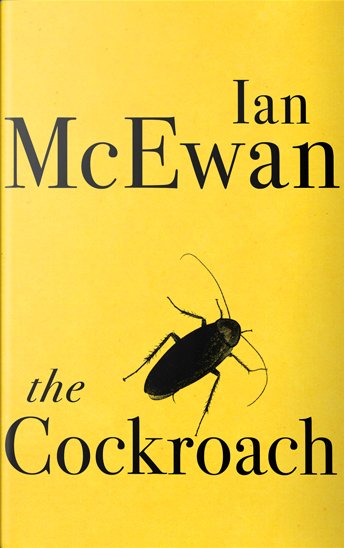
The Cockroach, by Ian McEwan, 2019

The Cockroach runs to less than 100 pages, and was obviously written quickly, in a state of intense anger. It takes as a starting point Franz Kafka’s Metamorphosis and cleverly turns it on its head – a cockroach is turned into a human being. At first he finds the cockroachclumsy nature of the body he has acquired, with its floppy limbs and internal skeleton hard to cope with. In his mouth “a slab of slippery meat lay squat and wet”. Because he no longer has compound eyes, everything appears “oppressively colourful”. His head is large, and his eyes can move. His skeleton is covered in flesh. Slowly it is revealed that this isn’t any random human that he has been turned into, but the Prime Minister, Jim Sams, who bears a profoundly close similarity to the man who is at the time of writing, but hopefully not much longer, the Prime Minister of the United Kingdom.

Kafka is fairly quickly left behind, as the new Prime Minister launches a plan to implement an economic policy so insane that only a thinly disguised President Trump can support it. The UK is driven through the looking glass into a world in which up is down, lies are truth, Parliament is the enemy of democracy, and the constitution is there to be ignored. McEwan’s solution to how Brexit could be forced through Parliament even though the Government doesn’t have a majority was inspired. For months we were told that Johnson and Cummings had a cunning plan which only four or five people had been told about, but that would see Brexit delivered on 31st October. That was all horseshit, but McEwan could have worked it for them it he had been so inclined. I bet they are kicking themselves! Job done, the cockroaches return to their previous form, but not before one is trodden on, thereby providing a tasty snack for his partners in crime.

Reviewers have consistently compared this novella to the work of Jonathan Swift, which is extraordinarily high praise indeed. Swift’s work often seems driven by anger, and here McEwan rages at the stupidity of Brexit (without mentioning it) as a massive act of national self harm which can only be rationally explained by metaphor. There are of course many economic and political explanations for the forces that led to the Brexit vote (and Trump’s election) but you won’t find any analysis of those forces here. Instead this is a cathartic rage against the forces of darkness threatening our country, forces that don’t read novels and don’t really care for reading anything else much either.

McEwan’s website helpfully summarises his motivations in The Cockroach, although we could probably have worked these out for ourselves – nevertheless the clarity is useful:

As the nation tears itself apart, constitutional norms are set aside, parliament is closed down so that the government cannot be challenged at a crucial time and ministers lie about it shamelessly in the old Soviet style, and when many Brexiters in high places seem to crave the economic catastrophe of a no deal, and English national extremists are attacking the police in Parliament Square, a writer is bound to ask what he or she can do. There’s only one answer: write. The Cockroach is a political satire in an old tradition. Mockery might be a therapeutic response, though it’s hardly a solution. But a reckless, self-harming, ugly and alien spirit has entered the minds of certain politicians and newspaper proprietors. They lie to their supporters. They express contempt for judges and the rule and norms of law. They seem to want to achieve their ends by means of chaos. What’s got into them? A cockroach or two, I suspect.

Reviewers struggled to appreciate this novel, despite it being a very simple parable and despite McEwan’s even simpler translation above. The New Statesman’s judgment was that:

“If the book cannot be considered any kind of addition to the oeuvre, it is at the very least a coda to more substantive ventures, and another clue in the ongoing quest to understand what really matters to McEwan”

This misses the point spectacularly. Literature is not a guessing game where the novelist,  slowly reveals text by text clues to “what matters” to him or her. If you manage to read The Cockroach without working out within a few pages that McEwan is angry as hell with the state of the United Kingdom in 2019 then all the clues in the world aren’t going to help you divine what matters to him. 

The Guardian had reservations about McEwan’s use of cockroaches as an image for the Cabinet:

“Comparing one’s political opponents to cockroaches is a toxic metaphor with a nasty political history and it is hard to read McEwan’s novella without a degree of discomfort.”

The Spectator, formerly edited by the Cockroach in chief himself, had similar reservations:

“For many of us, it will never be at all OK to describe democratically elected politicians as ‘cockroaches’. It was the word by which the génocidaires in Rwanda called their adherents to action”

This is the same Spectator that ran an article in 2015 headed “She’s wrong but Katie Hopkins has a right to call migrants cockroaches”. Satire may be on the critical list, but irony is not dead!

Standard
Book review

Patronising Bastards, by Quentin Letts, 2017

Quentin Letts is a sketchwriter for the Daily Mail, a UK newspaper characterised by two predominant emotions- fear and hatred.  (The Mail is frightened of, and therefore hates, difference and change. It hates foreigners, the EU, the BBC, socialists, liberals, remainers, health and safety, and political correctness. It loathes Jeremy Corbyn. So it is hardly surprising that this rambling collection of short essays is dominated by hatred of the above.

Letts had a modest amount of success with an earlier book, 50 People Who Buggered Up Britain, and this is just more of the same – a series of sketches loosely connected by the theme of people whom Letts finds patronising, although ‘people I disagree with” would be a more accurate summary. His targets range far and wide, and there is a random feel to attacks that span Nicholas Serota, Bob Shennan, an obscure radio programmer who had the temerity to move one of Letts’ favourite programmes, Richard Branson, Ian McEwan, Sandi Toksvig and Sir Ivan Rogers. No, I hadn’t hear of him either.

It is entirely understandable that Letts would use hyperbole as his go-to technique. Part of the problem with this book as he really doesn’t have any other way of approaching his subjects – the people he writes about are all mean patronising bastards, and there’s little if any light and shade in his portraits.

Personal insults abound. Obama is described as “feted mainly for being black” which is openly racist as far as I am concerned, Camila Batmanghelidjh is described as “that” (ditto, and sexist for good measure), Dame Judi Murray is a “great cow walrus“, and so on. Dame Vivienne Westwood must really have upset Letts at some point, because he is appalled when she revealed that she went commando to Buckingham Palace one time, saying “Sorry about the swarm of bluebottles, your Maj“. Yes, that’s right isn’t it Quentin, women’s genitals attract flies don’t they? Elsewhere she is “gurning termagant“. He describes Sandi Toksvig and “Sir Sandi” and Gary Lineker as “Dame Gary”. See what he did there – deliberately confused their gender to make fun of them. Hold my sides.

One of the persistent characteristics of Brexiteers is their tendency to portray themselves as outsiders, anti-establishment figures campaigning for the little man. Letts doesn’t really fit that bill (neither does Nigel Farage of course). He has written for The Daily Telegraph, Daily Mail, Mail on Sunday, and The Times, amongst others. He was educated at Haileybury and Imperial Service College, Bellarmine College, Kentucky (now Bellarmine University), Trinity College, Dublin, and then studied Medieval and Renaissance Literature (1982–86) at Jesus College, Cambridge, taking a Diploma in Classical Archaeology. Quite the outsider!

Given all this it was a bit disturbing when I found myself agreeing with one of Letts’ observations on the cultural significance of Church of England hymns. It wasn’t a particularly political point, but he writes well on the importance of hymns in our cultural history and collective experience. The essay itself is spoiled by the tantrum that someone had the temerity to move his favourite programme – an arguable decision perhaps, but a long leap from patronising bastardy.

It’s always good to read books and writers you disagree with, I would be the first to accept that. As a left-leaning, remain-voting, blog-writing southerner I need to better understand why people voted remain, (although I still struggle to improve on Stewart Lee’s take on the situation. I can’t link it here because it is nsfw but google it). Did I come through the ordeal of reading Patronising Bastards with a better understanding of that perspective? Sadly no, because the level of personal abuse clouded almost any effort at constructing a coherent argument. Which was a pity, because 17.2m people can’t all be racists?

Standard