Book review

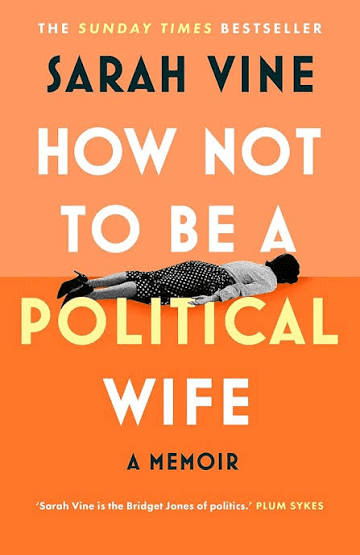
How Not to be a Political Wife by Sarah Vine, 2025

This book’s clumsy title sets the tone for what is, one can be pretty confident, going to be quite a bumpy ride. The book is categorised as a memoir, but more accurately it is a confessional of staggeringly indiscrete proportions, quite calculatedly burning lots of Ms Vine’s bridges with the Cameron vintage Conservative hierarchy. The book serves as an interesting and I suspect deliberate contrast to Sasha Swire’s much more reflective and considered Diary of an MP’s Wife which covers much of the same time period and territory.
Sarah Vine describes herself as a journalist, but more accurately she is a columnist, writing observational pieces about the world as she sees it. She is one of the genre of columnists who specialise in what is now called ‘rage-bait’ – constructing controversial ‘opinions’ and comments to order that she may or may not mean to be taken seriously, but which are going to drive traffic to her newspaper’s website, which nowadays is all that matters.

The author had a front-row seat at some of the most turbulent years of recent British politics. She worked for mainly right-wing newspapers throughout the period covered by the memoir. Her husband Michael Gove was Education Secretary, Chief Whip, and Lord Chancellor in David Cameron’s and Theresa May’s governments, and then held prominent roles in the Conservative administrations after the 2019 general election. He is now editor of the Spectator and, it goes without saying, a member of the House of Lords. In mentioning Mr Gove I am not succumbing to the sexist idea that a woman is only as important as her husband’s job. The fact is his story is an integral part of this memoir – his choices and decisions had a profound impact on the course of her life over this period and he features significantly throughout. In fact she defines herself in this narrative by contrasting what she did with what she believes was expected of her – hence the book’s title. While the introductory chapters on the author’s early life are interesting, the substance of the book is her role as Gove’s wife and partner, inside observer of the recent Conservative governments. This period can be summed up briefly – for the author it was (despite all the privilege and benefits being part of the Government involved) unremittingly awful. Everyone felt entitled to be nasty to you:

Doctors can shed what’s left of their bedside manner with you. Ordinary people no longer need have any consideration for you. Friends no longer trust you. Children are taught to despise you, not respect you. Journalists and policemen no longer need to be impartial or accurate. You have lost those human rights and protections because you are no longer human, you are a politician and you are now the legitimate prey of the only big game hunting still allowed in this country.

It wasn’t just unkind words of course – death threats followed, their children were bullied and they were ostracised from various friendship groups. None of this stopped Vine having her manufactured views on her political opponents of course. She wrote of Ed Miliband’s kitchen, for example, that there was “not much prospect of a decent meal emanating from that mean, sterile, little box.” Minor television celebrity Carol Vorderman is paid back for having the temerity to criticise the later Tory administrations: “One year we had Carol Vorderman, when she was in her pro Tory phase (as opposed to her sucking up to Labour phase): rarely have I encountered such a heavily cantilevered bosom.” Is the state of Carol Vorderman’s bosom really relevant here?

It wasn’t all bad. Vine has happy memories of weekends at Chequers with the Camerons and the rest of the Notting Hill set:

Sam really came into her own when she threw a party, and the party she threw at Chequers for her delayed 40th, in 2014, was probably my last truly happy memory of those gilded days, and almost certainly one of the best parties I’ve ever been to. Sam had transformed the Great Hall into a rave, with glitter balls, lasers and disco lights playing over about 150 people dancing wildly to the music of DJ Sarah HB, short for Hard Bitch. Dave and Sam ruled over the dance floor, always the best dancers, doing their Ceroc double act with enviable grace. Everyone was beautiful and clever and powerful; but for once I didn’t feel like Cinders at the ball. Sam had already complimented me on my Diane von Furstenberg black wrap dress, even though it was a touch too tight around the middle – “those bosoms, Sarah!” – and I was having the time of my life, sipping mojitos and chatting to Sarah Montague in the Rose Garden.

Vine’s main issue is a crippling instance of imposter syndrome. Her dysfunctional relationship with her bullying father (who in the book’s acknowledgements she thanks for “fucking me up so brilliantly” and who lived to see this book published) has left her with the inability to believe she deserves her place in ranks of the country’s privileged few. Money is an obsession – she objects to Gove’s sacking by Cameron as Education Secretary because of the impact it will have on their family income. Her address is not quite in the right postcode. Gove even pays to have an 0207 number (instead of 0208) – an incredibly niche but telling piece of status insecurity that today has not real equivalent.

The heart of the book is her account of the Brexit debacle. Gove promised not to campaign for Brexit, then led the campaign, expressing disbelief that the Cameron’s would see that as a betrayal, even though it destroyed his political career. (In his memoir For the Record, David Cameron directly accuses Michael Gove of disloyalty, stating, “As for Michael, one quality shone through: disloyalty. Disloyalty to me — and, later, disloyalty to Boris”). Vine is able to see that “everyone hated us” without ever really understanding why. If everyone hates you, doesn’t that suggest that you have done something to provoke that response, rather than that everyone was wrong, misjudging you, or being hateful? Gove’s decision to support the Vote Leave campaign and to go on and lead the Brexit campaign, was a turning point in the whole debate – it is arguable that without that decision Boris Johnson would not have supported leave, and potentially that the outcome of the vote would have been different. Certainly Vine’s description of the days and weeks following the Brexit vote does not read like a celebration by the winning side. The suggestion that Cameron should have stayed on as Prime Minister and worked to implement the outcome of the Brexit vote, that his refusal to take responsibility for something he had found hard against was in some way the cause of the utter shitshow that followed, is laughable. Talk about not owning your own mistakes!

Vine has a stunning lack of insight into why people hated her, why they blamed her husband for the disaster that was Brexit, why people stopped being their friends after he stabbed them in the back. She just can’t understand why anyone had a problem with her and Gove’s behaviour. It is all a mystery – which is funny because even the most obtuse reader can easily understand these things. Vine is like a flawed narrator of her own memoir, accidentally revealing insights into her personality and behaviour without having them herself. There are more accurate and more interesting histories of this period, but How Not to be a Political Wife nevertheless gives an original insight into many of the mistakes made by those involved.
How Not to be a Political Wife by Sarah Vine, 2025

Aside
Book review

A Life of Sorts, by Graham Greene, 1971

This autobiography focuses on Greene’s early life, the years up to the point he married, by which point he had published his three novels. The memoir ends in 1932 when he achieved his first major success as a novelist with Stamboul Train. Most of A Life of Sorts focusses on his in some ways idyllic Edwardian childhood, growing up the son of a headmaster and one of six children in leafy Berkhamstead. This was a life of considerable privilege – at one point Greene reels off a list of servants (although his family were perceived as the poor relations compared to another clan of Greene’s living at the nearby hall). They even had an orchid house! This start in life gave Greene a privileged education, psychotherapy in Harley Street when he threatened to run away from school, private tutors and entrance to Oxford without any of the nonsense about qualifications or suitability (he twice failed to win a scholarship but ‘we still lived in a world of influential friends,’ and the history tutor at Balliol who admitted him was ‘an old pupil and disciple of my father’s’).

At times the narrative is reduced to a simple list of Greene’s likes and dislikes: his childhood hobbies, the qualities most admired in men, favourite pastimes and favourite holiday resorts are all described in detail, without telling us much about the author other than he seemed to have lived an life of luxury. His enormous family are sketched with vivid pen-portraits of the principal characters and Greene takes the opportunity to name-drop the many distinguished and famous people that were a part of or acquainted with his extended family. Like many Edwardians of the upper-middle class Greene could trace his family money back to the Caribbean sugar plantations, which were run on slave labour for centuries. His paternal great-grandfather, Benjamin Greene, was a prominent West India merchant who owned extensive plantations in the Caribbean and held hundreds of enslaved people. He passionately opposed the abolition of slavery in the 1830s and later received substantial government compensation when it was outlawed. Greene never acknowledges the source of this blood money.

Boarding school, even though it was in the same village as his family home, was a dreadful and traumatising experience for Greene. He writes of the indignities and filth of this deeply unhappy period in his life which haunted him into adulthood. The psychological distress is vivid to him forty years later and an obvious trigger for several clumsy suicide attempts. His life of advantage continued after university (where he describes being drunk from morning to night – great training for his chosen career in journalism). A job as a subeditor on the Times falls into his lap with minimum effort. His novels are published without the years of rejection faced by many writers, although Greene is dismissive of the literary merit of his early work.

As well as descriptions of Greene’s childhood, this account contains some ‘teasers’ – glimpses of his future career in espionage. There are some significant omissions from this account as well. His wife is mentioned in passing of the “by this time I had decided to get married” variety. Equally his conversion to Catholicism, which was to play such a significant part in his adult life, is presented almost as administrative decision rather than anything to do with his faith: “I cannot be bothered to remember—I accept. With the approach of death I care less and less about religious truth. One hasn’t long to wait for revelation or darkness.” Despite this Greene still manages to mention a conversation about the supposedly heretical nature of his books with a very tolerant Pope.

I wouldn’t call it a matter of policy, but generally I tend to avoid reading autobiographies. They rarely give a fair portrait of the author, who inevitably presents a partial or distorted view of their life, not necessarily in an attempt to deceive (although that definitely happens) but because they don’t have the necessary distance or perspective. Biographies often give a very different account of the events recorded in autobiographies. To give one obvious example, in this first volume of Greene’s memoirs, his experience of playing Russian roulette features prominently. Greene describes these attempts in detail, suggesting they derived from an attempt to relieve his existential boredom with life: “I remember an extraordinary sense of jubilation, as if carnival lights had been switched on in a dark drab street. My heart knocked in its cage, and life contained an infinite number of possibilities.” But his most recent biographer, Richard Greene (apparently no relation) concluded that “There is no evidence, apart from Graham’s word, that he ever tried to kill himself by playing Russian roulette…it was merely part of Graham’s self-created daredevil myth. His brother, with whom he shared a bedroom, said the revolver had no bullets. Most likely, Graham played the potentially fatal game with blanks or empty chambers.” In other words Greene invented these events, probably as part of the self-mythologising that we all do to a greater or lesser extent. I am sure he genuinely believed that these things happened – his accounts suggests no doubt or ambiguity when it comes to this part of his childhood, although other memories are qualified or even in some cases directly contradicted when he quotes, in footnotes, the clearer memories of others. But it seems equally certain that his memories of these incidents were wrong. Their inclusion in this memoir gives us an insight into how Greene perceived himself – even in his sixties he still nursed his self-image as a wounded survivor.

A Life of Sorts, by Graham Greene, 1971

Aside
Book review

Please Mr Postman, by Alan Johnson, 2014

Please, Mister Postman is the sequel to Johnson’s This Boy, the highly praised account of his childhood in the slums of 1950s West London. This Boy (2013) won the Royal Society of Literature Ondaatje Prize (2014) and the Orwell Prize. Please Mr Postman was possibly an attempt to cash in on the unexpected success of the first volume of his memoirs – certainly it appeared very quickly thereafter. It covers what he obviously saw as the second phase of his life, from the early start of his first marriage, aged 18, to its end (the marriage that is, not his life) in his mid-30s.

Reading Please, Mr Postman (the title is obviously a reference to Johnson’s occupation, but also a clever nod to the music of the time, which provides a backdrop to all his work and leisure) you get very few hints that Johnson was going to go on and become a Labour MP and eventually Home Secretary. His involvement with the local Labour Party is limited – his focus is more on a slow but steadily increasing commitment to the Postman’s Union, which was to become the UCW (Union of Communication Workers). This was good old-fashioned 1970’s closed shop trade unionism, where if someone broke a strike they were ostracised by their workmates indefinitely. I now know far more about the detail of postal work and the agreements of the time between management and unions governing all aspects of working life than I ever thought I would need. Johnson is rightly proud of his working class roots, but there is little to suggest that he has the political appetite or ability for Westminster. The political events of the day are mentioned, but mainly in passing as a backdrop to the more pressing detail of the latest change to postal delivery processes or the management of his sorting office.

While he devotes many pages to the detail of these issues and to anecdotes about his family, neighbours, friends and colleagues, all the time I got the impression that the real Alan Johnson was hiding in plain sight. We really get to know little about Johnson the man. At the end of the book he describes a distressing conversation with his wife when they agree to separate and divorce. This comes out of the blue – prior tot his there is no suggestion their marriage was in trouble, or the large amounts of time he was spending away on union business was causing them problems. The incident is used to close the book and bring down the curtain on this phase of his life, but is dealt with hurriedly in a few paragraphs – his discomfort at even sharing this level of detail is obvious.

For a brief period Johnson was a significant figure in the Labour Party. Ed Miliband appointed him as Shadow Chancellor of the Exchequer, a post he stood down from when his unsuitability and lack of appetite for the role became unavoidable. He came within a whisker of being elected Deputy Leader of the party, and was spoken of more than once as a candidate for the top job itself, although he quickly graduated to the role of senior statesman . All this is almost possible to imagine when reading about his inability at DIY, local elections in the postal workers union, or his nervousness when speaking at CWU conference. As with most memoirs he paints himself as usually being on the right side of most moments of history but at the same time is very understated and self-deprecatory.

Johnson’s authenticity, his working class roots and trade union activism were always his defining qualities. He makes the most of them here, although this is not a miserabilist memoir. Warned on arriving in Slough that the Britwell estate he was moving into was dangerous, Johnson and family instead experienced it as a welcoming community. His family grows as the seventies progress, and while they are never prosperous things slowly get a little easier, and one or two upgrades occur along the way – he moves from a borrowed bike, to a moped, a Post Office van, and finally a family car. His gratitude for the experience of social housing was obviously formative but it doesn’t prevent him from supporting the Thatcherite policy of selling council houses. Nevertheless his background is a world away from the affluent middle-class life of many New Labour MPs, and it gave him an authenticity when talking about welfare or housing that for others was purely theoretical. Little wonder he stood out – in 2010 a parliamentary report found that the number of former manual workers serving as MPs had fallen from 16% in 1979 to just 4% in 2010. Half of Labour’s candidates in marginal seats in the 2015 election were political insiders such as former special advisers or thinktank workers. The Conservatives had only two former manual workers as MPs post-2010; the Liberal Democrats had one. Johnson’s years as a postie were to prove invaluable in defining him as a Labour politician with first-hand experience of the issues he campaigned on.

Johnson is largely out of politics now, and seems happier for it. He stood down from Parliament in 2017, apparently disenchanted with the direction the Labour Party was taking under Jeremy Corbyn. His most recent career move saw him appear on The Masked Singer – I’d guess it will be Strictly next!

Standard