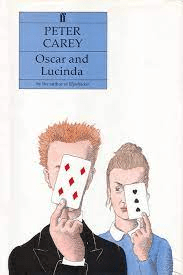
Peter Carey’s 1988 Booker-prize winning Oscar and Lucinda tells the parallel stories of its eponymous characters: Oscar Hopkins, a disgraced clergyman, and Lucinda Leplastrier, owner of a glass factory. The novel is narrated by one of the Oscar’s descendants several generations later, who is always keen to point out the role random chance seems to have in determining their fate. Although they eventually meet on board a ship headed to Australia, for a large part of the novel their stories are separate.
Oscar is raised in remote Cornwall by his father who is a preacher in the Plymouth Brethren, a harshly non-conformist group which believes in the literal truth of the bible.
He (Oscar) comes to believe that God wants him to convert to Anglicanism, despite his father’s conviction that this means he is going to hell. But his conversion is also, incidentally, a means for him escape from rural Cornwall and achieve an education. At Oxford while training to become a priest Oscar discovers gambling, a sin he is never subsequently able to escape from. Whilst at university Oscar is a social outcast. His poverty marks him out, as does his other-worldly appearance and his complete lack of social skills. By chance he meets a fellow student, Wardley-Fish (a larger than life character I wish we had seen more of) who introduces him to the joys of gambling. At first his horse-racing winnings provide him with the funds to stay at Oxford, but his gambling – even on the Sabbath – eventually gets him into trouble, to the extent that the church authorities decide to exile him to Australia.
Lucinda’s story is also dominated by her fascination (or perhaps it is an addiction?) with gambling. She is orphaned when she is a young woman. She inherits the large farm in Australia her parents bought following a move from the UK. Not really knowing what to do with either her inheritance nor the rest of her life she spontaneously decides to buy a glassworks. Making a success of the business isn’t easy – the fiercely misogynistic glassblowers don’t even allow her to enter her own factory. At a loose end, Lucinda falls into the wrong crowd, and begins gambling on cards. A trip to London isn’t the way of rebooting her life she is looking for, but on the way back she meets Oscar.
Oscar’s terror of the sea – and large bodies of water more generally – means he is unable to socialise or move freely around the liner taking them to Australia. Nevertheless they bond over their mutual hobby, and Lucinda eventually invites Oscar to stay with her in Sydney. Their friendship develops and society is scandalised when they live together seemingly as man and wife, although in fact entirely innocently. Their relationship falters as Oscar is convinced Lucinda is in love with Reverend Hassett, a glass expert she consulted on the acquisition of her factory.
The finale of the novel involves a dangerous and improbable bet – Lucinda challenges Oscar to deliver a glass church to Reverend Hassett in his new living in Boat Harbour. Yes, a glass church. If that were not improbable enough, instead of taking the church by sea, Oscar’s fear of water means he has to travel overland, through largely uncharted territory. This fanciful expedition inevitably extracts a high price from them all.
Oscar and Lucinda could have been the great Australian novel. Carey is recorded as having said of his writing “My fictional project has always been the invention or discovery of my own country“. The colonisation of the continent by the British and others, and the impact this had on the indigenous peoples, is a theme which ripples through this novel, but always as the background to the lives of the central characters rather than ever being foregrounded as an issue. In the novel’s opening introductory chapter the narrator tells the reader a little about the area where he grew up, including the following:
“I learned long ago to distrust local history. Darkwood, for instance, they will tell you at the Historical Society, is called Darkwood because of the darkness of the foliage, but it was not so long ago you could hear people call it Darkies’ Point, and not so long before that when Horace Clark’s grandfather went up there with his mates – all the old families should record this when they are arguing about who controls the shire – and pushed an entire tribe of aboriginal men and women and children off the edge.”
This shocking massacre is part of settler history, and no worthy of further exploration. While other writers might think this story worth telling, in this novel it is just window-dressing, local ‘colour’. Oscar and Lucinda are both European settlers, as is almost everyone else they meet or mix with, while the indigenous Australians are virtually voiceless. Towards the end of the novel there are some brief exceptions to this rule – Kumbaingiri Billy, for example, a friend of the narrator’s father, is introduced as the source of the story of the glass church – but overwhelmingly this novel is about the experience of colonial Australia, in which European settlers struggle to come to terms with the challenges of the new world. That settler experience is only part of the story of Australia. Australia wasn’t invented or discovered by Europeans – I am pretty sure it was there all along and had been inhabited by people for thousands of years. While Carey doesn’t ignore that fact he really doesn’t address it at any length either. It is only recently, in A Long Way from Home for example, that Carey has finally started to address face-on what he has called “the fundamental, bloody circumstance of my country”. In the promotional interviews for that novel Carey said that “You can’t be a white Australian writer and spend your whole life ignoring the greatest, most important aspect of our history, and that is that we – I – have been the beneficiaries of a genocide.” The fact is he managed to do just that in this novel. I know it might seem strange to critique the novel Carey hasn’t written, and I understand his reasons for not feeling qualified to write about the aboriginal experience, but I can’t help feeling it was a huge missed opportunity.