I reviewed 35 books in 2024, which is about average for me in a typical year, but a little disappointing nonetheless. One book every ten days, read and reviewed, doesn’t sound too bad, and that does include Dombey and Son – but almost all the other books were either average length or shorter. Definitely a ‘must try harder’ year. Likes and views were slightly down on 2023, but still better than any other year. My five most popular posts were my reviews of Bob Mortimer’s underwhelming The Satsuma Complex, Richard Osman’s The Last Devil to Die, fourth in the Thursday Murder Club series, Ben Okri’s The Famished Road, and Graham Greene’s The Third Man. The other post in my top five is one in which I discuss Clothing in Jane Eyre, which was posted back in 2016 and which is by some considerable distance my most visited post of all time. I can just about understand why the Mortimer and Osman reviews are popular – these were both huge sellers from the end of 2023 – but the persistent popularity of the other posts are baffling. Not that I am complaining!
My reading in the first quarter of the year is as always going to be focussed on the outstanding selection of books received as presents, including new novels by the aforementioned Mortimer and Osman, as well as a book I am very much looking forward to, the latest Jasper Fforde novel. My 2025 Dickens is going to be his last completed novel, Our Mutual Friend. Beyond that I do not have any specific reading targets, but I would like to improve on this year’s total if possible. While I have abandoned my attempt to read all the Booker Prize winning novels – I was left with a small residue which I simply didn’t like the look of – I will be catching up on one or two of the more recent winners this year. Above all I will be trying to recapture the reading bug, that love of reading that is such a blessing and which gives this blog its corny name.
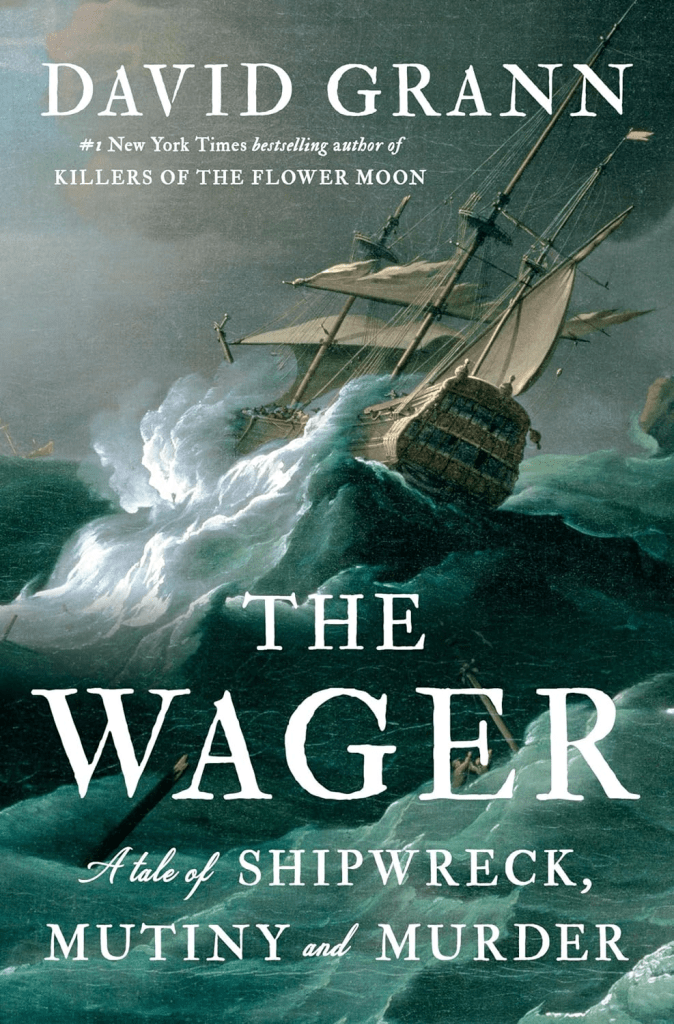
The Wager: a Tale of Shipwreck, Mutiny, and Murder by David Grann, 2023
The Wager is everywhere at the moment. After President Obama listed it as one of his books of the year in 2023 it topped The New York Times best-seller list and stayed in the top ten for six months. The film rights were snapped up by Martin Scorsese and Leonardo di Caprio. It featured in many best books of 2023 lists: as usual I am coming very late to the party. Accordingly my expectations were sky-high and predictably I was a little disappointed – if it hadn’t had this much hype I would have been able to read and appreciate the book on its own terms. Oh well.
The book’s blurb and description on Amazon give this summary (I’ve tried to edit it because it is quite long, but in the end I decided to keep it full-length because the detail actually matters):
“On January 28, 1742, a ramshackle vessel of patched-together wood and cloth washed up on the coast of Brazil. Inside were thirty emaciated men, barely alive, and they had an extraordinary tale to tell. They were survivors of His Majesty’s Ship the Wager, a British vessel that had left England in 1740 on a secret mission during an imperial war with Spain. While the Wager had been chasing a Spanish treasure-filled galleon known as “the prize of all the oceans,” it had wrecked on a desolate island off the coast of Patagonia. The men, after being marooned for months and facing starvation, built the flimsy craft and sailed for more than a hundred days, traversing nearly 3,000 miles of storm-wracked seas. They were greeted as heroes.
But then … six months later, another, even more decrepit craft landed on the coast of Chile. This boat contained just three castaways, and they told a very different story. The thirty sailors who landed in Brazil were not heroes – they were mutineers. The first group responded with countercharges of their own, of a tyrannical and murderous senior officer and his henchmen. It became clear that while stranded on the island the crew had fallen into anarchy, with warring factions fighting for dominion over the barren wilderness. As accusations of treachery and murder flew, the Admiralty convened a court martial to determine who was telling the truth. The stakes were life-and-death–for whomever the court found guilty could hang.“
To be fair, this is not just the publisher’s summary – in the book’s opening chapter this version of what it to come is largely the same: this is a story of a shipwreck that leads to mutiny, murder, and finally a form of retribution for the survivors. Except it is not.
For a start there was no real mutiny – no-one was tried for this incredibly serious charge. If the Admiralty had thought there was any risk of this offence being condoned they would have seen to it that people hanged, just in case anyone thought mutiny was acceptable in any circumstances. They took law and order extremely seriously. There was no question a dispute amongst the survivors about how to reach civilisation once the Wager had been shipwrecked on an isolated (but not completely deserted) island. The bulk of the survivors ignored the captain’s wishes to sail north to Chile and instead headed off in the opposite direction – but the Admiralty did not think this constituted mutiny. If the breakaway group had really thought they were committing mutiny they would almost certainly have destroyed the many paper records that they carried with them back to England and for that matter they would have avoided handing themselves in to the authorities by travelling back to England in the first place.
For an event that happened on the other side of the world almost three hundred years ago, there is a remarkable amount of documentary evidence about the wreck of the Wager and the subsequent ordeal of its crew. Many of the survivors wrote extensively about their adventures – the account by the leader of the expedition of which the Wager was a part, George Anson, is still in print – and in addition many of the contemporaneous records including log books and diaries survived and are available to historians (to be completely fair to Grann whether he is an academic historian or not (not) I nevertheless include him in this category; his account is very well researched and evidenced. It’s just not a new or untold story).
There was no trial, no-one was found innocent or guilty, and no-one was hanged. There was an investigation with a very limited scope, but that quickly found that no further action was required. This is all a bit of a damp squib after the long build-up in which the reader is explicitly lead to believe that a trial would decide who was telling the truth about the shipwreck. In fact the introduction suggests this is the whole point of the narrative. Surprisingly there were no significant differences between the survivors as to what happened; broadly speaking their accounts agreed, not least because of the extent of the written record. Whether the actions of the protagonists were justified was disputed, but what they actually did or did not do was not disputed.
So this is not the book we are led to believe it is going to be. It is instead a dramatic but as far as possible accurate retelling the story of the Wager. Much of the book is dedicated to the preparation for setting sail and then the journey to South America and beyond, the challenges of assembling a crew and then the privations once on board and under sail. The Wager was part of a wider expedition which in turn was part of the English campaign against the Spanish that in this period. usually described as the War of Jenkins’ Ear. The shipwreck and the appalling conditions on the island that the survivors experienced (although ironically the diet of scavenged seaweed and sea celery help cure the ravages of scurvy all the men had faced) are brought to life and it is from this point, almost three-quarters of the way through the book, that the ‘slow-motion mutiny’ (as Wikipedia describes it) unfurls.
The Wager has some striking similarities with Batavia’s Graveyard, Mike Dash’s 2002 account of a shipwreck some 100 years earlier, in which the survivors faced a life and death struggle for survival, order quickly broke down and brutality engulfed the survivors. The crew of the Wager behaved in a relatively civilised fashion compared to their East Indian counterparts from the Batavia. To be fair their island was better equipped – they even had friendly natives on hand to bring them food (although the quickly scared them off with their behaviour). If you are looking for books with a similar theme and structure to The Wager, Batavia’s Graveyard is highly recommended.
When a book doesn’t live up to the hype it can be disappointing, but judged on its own merits The Wager was an enthralling read. The book’s epilogue, telling the story of the rest of the fleet which was slowly destroyed, leaving just one surviving ship, which in a ferocious sea battle captured a Spanish treasure ship and made its way home from halfway around the world , is told almost as an afterthought, but it is hard to resist the thought that this was the more compelling adventure.
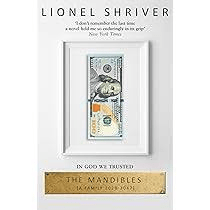
It’s been a very long time – I am struggling to remember the last time it happened – since a book has haunted me in the way that Lionel Shriver’s The Mandibles did. By ‘haunted’ I don’t mean scared (although there is plenty that is scary here), but that the characters and their situation stayed with me when I was not reading the book. The feelings of nervousness and anxiety that it engendered hung over me, so that when I wasn’t thinking about the book I was feeling it. I wasn’t quite stock-piling toilet paper and checking my bank account every five minutes, but it was not far off!
For context, The Mandibles is set in the USA in 2029. The American economy is in the midst of an economic crisis of the kind it narrowly dodged in 2008. Unemployment and inflation soar, law and order begins to break down, and America reneges on its international debts. We experience this crisis through the eyes of an extended middle class American family, the Mandibles. Yes this is a strange name, and no I don’t know if it has any particular significance (it’s possible that the fact it is the only mobile bone in the human body is a reference to the family’s ability to be agile and keep one step ahead of the crisis, but that’s really stretching things!).
In 2029, America has already changed dramatically from the relatively stable economy and political landscape of the year of publication, 2016. In the real world of spring 2016, Trump had already announced his run for the White House and the UK’s Brexit referendum was looming, but it was hard to anticipate the political turmoil that was to follow months after this novel was published, let alone the lockdown and pandemic four years later. In Shriver’s 2029 America is already significantly diminished. Previously the country had temporarily lost access to the internet and as a result all financial transactions now take place either on paper or in hard cash. China is suspected as being behind the cyber-attack, as part of its wider ambitions to replace America and the dominant superpower. Things however are slowly beginning to return to normal when the crash hits. A new international reserve currency, the bancor, (which in real life had been proposed by Keynes in the 1930’s and remains an idea some economists support – for example it was called for as recently as 2009 by the Governor of the Bank of China) collapses the American economy. This is not just a depression or a recession but far worse – money loses most of its value, millions lose their jobs, savings are wiped out and prices go through the roof. The US Government’s disastrous response is to ban American’s from owning bancors (thereby closing down almost all international trade) and sequesters all gold owned by people and business.
Prior to the crash the four generations of the Mandible family are relatively well off and live in expectation of an inheritance from their very wealthy patriarch. His savings and investments are completely wiped out. One son-in-law is an economist who is sacked from his professorship, but who right until the end of the book continues to argue that the crash was avoidable and that he was right while everyone else was wrong. This satirical teasing of economists who are unable to understand the economy or predict its behaviour is one of the gentler aspects of the novel. As the crisis deepens the family move in together and adjust to their straitened circumstances, showering only once a week, stockpiling supplies, and generally having a miserable time. While the adults are to a greater or lesser extent in denial about how bad things are going to get, one of the younger family members, Willing, is the calm centre of both the family and the novel. Willing is able to tell that things are going to get a lot worse and plans accordingly, learning practical skills such as how to pick locks and developing a plan for the family that could see them escaping from the city and to safety.
Three quarters of the way through the novel, with the family homeless and at crisis point, the story jumps forward fifteen years. I can’t lie, I found that decision irritating. It seemed as if the novelist got tired of charting their struggles with the breakdown of society and hit the fast forward button. It might have been because this is quite familiar territory – dystopias in which society collapses aren’t exactly uncommon. The final quarter of the book acts almost like a postscript. Most of the characters have adapted and survived and society is slowly being rebuilt. The United States government has become extremely authoritarian, with everyone being compulsorily ‘chipped’ like pets. A small separatist enclave has been built in Nevada and the remaining family members, lead once again by Willing, set off to see if this new land of the free can be sustained.
The financial crisis of 2008 and the world’s subsequent turmoil have only served to underscore what I think most of us already knew – that civilisation is only skin deep. The American journalist Alfred Henry Louis put it like this back in 1896:
Those of us who are well fed, well garmented and well ordered, ought not to forget that necessity makes frequently the root of crime. It is well for us to recollect that even in our own law-abiding, not to say virtuous cases, the only barrier between us and anarchy is the last nine meals we’ve had. It may be taken as axiomatic that a starving man is never a good citizen.
While the novel’s portrait of society’s collapse is chillingly believable, The Mandibles is a strangely optimistic dystopia. Shriver said of the novel that “My reading on what happened in 2008 is that we dodged a bullet. I feel as if that bullet is still whizzing around the planet” which is almost completely unarguable. Next time we might not be so lucky. But terrible though the collapse of the American economy may be, the rest of the world is surprisingly immune to its effects – the bancor is not just an attack on the dollar but it is also an insurance policy. Mexico becomes an economic super-power and has to build a wall to prevent American refugees from escaping into the country. As satire that might feel a bit obvious, but the main impact on America is a sense of humiliation rather than anything more punitive. The key point is that the country recovers from near-total collapse, the economy starts to rebuild, and as authoritarian dystopian Governments go this one is relatively benign.
I enjoyed The Mandibles. Shriver is an interesting, iconoclastic writer and I will look out for more opportunities to read her work.
Invisible Man appears on many lists of the best novels of the twentieth century. It is a powerful and often disturbing account which challenges many of the conventional ideas of the form and structure of the novel.
It opens with the narrator, an unnamed black man, living in an underground room lit by hundreds of electric lights powered by electricity stolen from the city’s grid. He tells his story in flashback, attempting to explain why he feels socially and sometimes literally invisible.
“I am an invisible man. No, I am not a spook like those who haunted Edgar Allan Poe; nor am I one of your Hollywood-movie ectoplasms. I am a man of substance, of flesh and bone, fiber and liquids — and I might even be said to possess a mind. I am invisible, understand, simply because people refuse to see me. Like the bodiless heads you see sometimes in circus sideshows, it is as though I have been surrounded by mirrors of hard, distorting glass. When they approach me they see only my surroundings, themselves, or figments of their imagination — indeed, everything and anything except me.”
Born in the American South, he lives in a highly segregated society, in which black people live in fear and subjugation. He intends to escape the poverty which defines black lives in this community and wins a scholarship to an all-black college. Integrated education in the South at this time was unheard of. He works to support himself by taking a chauffeuring job. One day, while chauffeuring Mr. Norton, a trustee of the college, he makes a series of disastrous decisions. Norton, a white man, is curious about the lives of local black people. The narrator takes him to the old slave-quarters near the college campus. The fact that there even are old slave quarters still standing shows that slavery is still part of people’s lives, despite it formally ending almost a century beforehand. Here Mr Norton meets Jim Trueblood, a notorious local figure who has got both his wife and his daughter pregnant ‘in his sleep’. This is an uncomfortable portrait of black poverty in which people live little better than slaves and ignore social conventions regarding incest. Norton is appalled and asks to be taken somewhere for a stiff drink. Inexplicably the narrator takes him to a local brothel, where a riot breaks out caused by a surreal day-outing of patients from a nearby mental hospital. (There is an echo of this scene in One Flew Over the Cuckoos Nest, where the patients are taken out for the day, with similarly disastrous consequences).
The narrator is summarily expelled from college. He sees it as an unfair punishment but his principal is appalled that he has exposed the dark side of black people’s lives behind the civilised facade of the campus. The narrator travels to New York and finds work in a paint factory. More chaos ensues – he is a magnet for trouble and has no control over his life. He unwittingly causes an explosion at the factory, is hospitalised and given electric shock treatment. He escapes the hospital and stumbles into the next, decisive phase of his life. Happening across the eviction of an elderly black couple he makes an impassioned speech in their support, accidentally inciting the crowd to attack the bailiffs and triggering yet another riot. His oratorical skills are recognised by a group known as “the Brotherhood” which appears to be a black nationalist movement. He signs up and quickly becomes one of the group’s keynote speakers. Internal politics eventually turns this sour, and he becomes disillusioned with the group. Its message of gradual change and co-operation with whites is challenged from the left by more radical voices, led by a figure known as Ras the Exhorter. The novel reaches its climax with the narrator getting caught up in a race riot in Harlem. He narrowly escapes being lynched by supporters of Ras the Exhorter who perceive him as a traitor to his race.
Invisible Man is vivid, impressionistic, and unconventional. Superficially it follows a traditional narrative structure but the narrator’s adventures and mishaps are chaotic and often appear random. It charts a very specific time in Black American history at the birth of the Civil Rights movement, when many of the debates about how best to combat segregation and oppression were at their fiercest. It’s not a comfortable read but it is an important, unique book.