
The Mandibles by Lionel Shriver, 2016
It’s been a very long time – I am struggling to remember the last time it happened – since a book has haunted me in the way that Lionel Shriver’s The Mandibles did. By ‘haunted’ I don’t mean scared (although there is plenty that is scary here), but that the characters and their situation stayed with me when I was not reading the book. The feelings of nervousness and anxiety that it engendered hung over me, so that when I wasn’t thinking about the book I was feeling it. I wasn’t quite stock-piling toilet paper and checking my bank account every five minutes, but it was not far off!
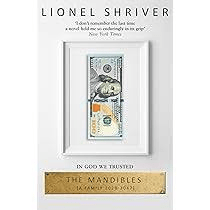
For context, The Mandibles is set in the USA in 2029. The American economy is in the midst of an economic crisis of the kind it narrowly dodged in 2008. Unemployment and inflation soar, law and order begins to break down, and America reneges on its international debts. We experience this crisis through the eyes of an extended middle class American family, the Mandibles. Yes this is a strange name, and no I don’t know if it has any particular significance (it’s possible that the fact it is the only mobile bone in the human body is a reference to the family’s ability to be agile and keep one step ahead of the crisis, but that’s really stretching things!).
In 2029, America has already changed dramatically from the relatively stable economy and political landscape of the year of publication, 2016. In the real world of spring 2016, Trump had already announced his run for the White House and the UK’s Brexit referendum was looming, but it was hard to anticipate the political turmoil that was to follow months after this novel was published, let alone the lockdown and pandemic four years later. In Shriver’s 2029 America is already significantly diminished. Previously the country had temporarily lost access to the internet and as a result all financial transactions now take place either on paper or in hard cash. China is suspected as being behind the cyber-attack, as part of its wider ambitions to replace America and the dominant superpower. Things however are slowly beginning to return to normal when the crash hits. A new international reserve currency, the bancor, (which in real life had been proposed by Keynes in the 1930’s and remains an idea some economists support – for example it was called for as recently as 2009 by the Governor of the Bank of China) collapses the American economy. This is not just a depression or a recession but far worse – money loses most of its value, millions lose their jobs, savings are wiped out and prices go through the roof. The US Government’s disastrous response is to ban American’s from owning bancors (thereby closing down almost all international trade) and sequesters all gold owned by people and business.
Prior to the crash the four generations of the Mandible family are relatively well off and live in expectation of an inheritance from their very wealthy patriarch. His savings and investments are completely wiped out. One son-in-law is an economist who is sacked from his professorship, but who right until the end of the book continues to argue that the crash was avoidable and that he was right while everyone else was wrong. This satirical teasing of economists who are unable to understand the economy or predict its behaviour is one of the gentler aspects of the novel. As the crisis deepens the family move in together and adjust to their straitened circumstances, showering only once a week, stockpiling supplies, and generally having a miserable time. While the adults are to a greater or lesser extent in denial about how bad things are going to get, one of the younger family members, Willing, is the calm centre of both the family and the novel. Willing is able to tell that things are going to get a lot worse and plans accordingly, learning practical skills such as how to pick locks and developing a plan for the family that could see them escaping from the city and to safety.
Three quarters of the way through the novel, with the family homeless and at crisis point, the story jumps forward fifteen years. I can’t lie, I found that decision irritating. It seemed as if the novelist got tired of charting their struggles with the breakdown of society and hit the fast forward button. It might have been because this is quite familiar territory – dystopias in which society collapses aren’t exactly uncommon. The final quarter of the book acts almost like a postscript. Most of the characters have adapted and survived and society is slowly being rebuilt. The United States government has become extremely authoritarian, with everyone being compulsorily ‘chipped’ like pets. A small separatist enclave has been built in Nevada and the remaining family members, lead once again by Willing, set off to see if this new land of the free can be sustained.
The financial crisis of 2008 and the world’s subsequent turmoil have only served to underscore what I think most of us already knew – that civilisation is only skin deep. The American journalist Alfred Henry Louis put it like this back in 1896:
Those of us who are well fed, well garmented and well ordered, ought not to forget that necessity makes frequently the root of crime. It is well for us to recollect that even in our own law-abiding, not to say virtuous cases, the only barrier between us and anarchy is the last nine meals we’ve had. It may be taken as axiomatic that a starving man is never a good citizen.
While the novel’s portrait of society’s collapse is chillingly believable, The Mandibles is a strangely optimistic dystopia. Shriver said of the novel that “My reading on what happened in 2008 is that we dodged a bullet. I feel as if that bullet is still whizzing around the planet” which is almost completely unarguable. Next time we might not be so lucky. But terrible though the collapse of the American economy may be, the rest of the world is surprisingly immune to its effects – the bancor is not just an attack on the dollar but it is also an insurance policy. Mexico becomes an economic super-power and has to build a wall to prevent American refugees from escaping into the country. As satire that might feel a bit obvious, but the main impact on America is a sense of humiliation rather than anything more punitive. The key point is that the country recovers from near-total collapse, the economy starts to rebuild, and as authoritarian dystopian Governments go this one is relatively benign.
I enjoyed The Mandibles. Shriver is an interesting, iconoclastic writer and I will look out for more opportunities to read her work.

