Book review

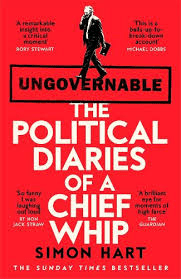
Ungovernable: The Political Diaries of a Chief Whip by Simon Hart, 2025

Simon Hart was a relatively minor figure in the appalling melodrama that was the 2019-2024 Conservative Government – he was Secretary of State for Wales for a couple of years, a post of minimal significance since devolution, but came with a place at the Cabinet table, and then Chief Whip for the duration of the Sunak Government (2022-24). He now sits in the House of Lords, despite having consistently poured scorn on the aspirations of his fellow MPs for the same privilege. Nevertheless, he undoubtedly had an insider’s perspective (the proverbial ‘front row seat’) on the chaos that engulfed the Tories during the 2019-24 Parliament and his heavily redacted diaries of that period give enough juicy details to keep the pages turning, even if the ‘real’ story remains elusive.
A feature of most political diaries is the temptation to remove references that make the author look like he or she had no idea what was going on, but at the same time to also leave sufficient minor ‘gaffes’ to make the account convincing. What do I mean by that? Well, if these diaries were to include glowing predictions of how wonderful Liz Truss’s premiership was going to be, Hart would lose any credibility as an observer of the political scene. On the other hand if every prediction proves unerringly accurate then the reader would be sceptical as to their authenticity. So when Hart says of Rishi Sunak in June 2022, “He is compelling and will be a contender for PM one day“, his editor would have been keen to keep this prediction in the final edit despite the fact that Sunak was to become Prime Minister only four months later – ‘one day’ being a stark understatement. In other words Hart was wrong, but in a mildly entertaining way rather than totally misjudging the situation. It was for the purposes of this category of memoir the ‘right’ kind of mistake. Most of his political predictions that survive the edit are reasonably accurate – for example as the process to replace Johnson as Prime Minister gets underway Hart pondered “I dread to think what a Truss Government would look like, or if it will even last”.

Looking back now over the 2019-2024 Government it really is quite breath-taking how bad it was. The rot started at the top of course and Hart is a frank observer of Johnson’s flaws as well as his abilities. Knowing how things ended we can see how entirely unsuited he was to senior office, even if that wasn’t glaringly obvious much earlier, but Hart, like the rest of the Conservative Party, was swept away by his Etonian bluster. He finds his performances in Parliament ‘brilliant’ and is charmed by his Woosterish schtick. Hart’s decision to join the eventual flood of Ministerial resignations which swept Johnson from office comes late and is done with much regret rather than in recognition of the Prime Minister’s arrogance and incompetence. His subsequent appointment as Sunak’s Chief Whip was intended to introduce some stability to the political process, but on every other page there is scandal, from the infamous ‘tractor porn‘ incident to a succession of entries about serious sex offences (allegedly and in some cases actually) committed by MPs, special advisors (SpAds) and others. 

Hart himself emerges as an affable, hard-drinking One Nation Tory, a remainer who was often out of his depth, like so many of his colleagues. If you want to know why the Tories went from a comfortable 80+ majority in the December 2019 General Election to an ignominious wipe-out five years later, there is plenty here both between the lines and directly from Hart himself. A good example of his lack of understanding as to just how existentially serious the crisis the party was facing comes in his entry for Friday 17 December 2021

“The North Shropshire by election goes against us and in favour of the Lib Dems with a 5000 majority. It’s the first time this seat has ever been held by a non-Conservative. This is manageable but serious and should probably be reversed at a General Election, but it has opened up the whole question of whether the BoJo electoral ‘magic’ has lost some of its potency.”

Is some ways it this is the most egregious of all Hart’s political miscalculations. In the 2019 General Election Owen Paterson won this seat for the Conservatives with a majority of over 20,000 (the chaos over Paterson’s breach of Parliamentary standards and the Government’s blatant attempt to subvert Parliamentary processes to avoid him having to face the consequences of his actions is a whole other story – readers of Hart’s account will need to turn to Wikipedia for the detail). The Lib Dems had come third in this seat in 2019 with fewer than half the votes of the Labour candidate, then leapfrogging Labour to beat the Tories comfortably at the by-election. At the 2024 General Election the Lib Dem incumbent increased her majority to over 15,0000, making North Shropshire a relatively safe LD seat. The arrogant assumption that the by-election result was simply a protest vote rather than part of a generational movement away from life-long Conservative hegemony reveals how little Hart understood what was really going on as the Johnson administration slowly but inevitably imploded.

Although the 2019-24 government was obviously deeply flawed and chaotic, it would be wrong to overlook the two significant external events that would have been challenging for the most competent of administrations – the Covid pandemic and the war in Ukraine. Both had dramatic impacts on the economy which we will be paying for for years to come. Boris Johnson was totally unsuited to running the serious type of Government required to manage the UK’s response to the pandemic (for example his early demonstration of his incompetence and bravado by ignoring medical advice and continuing to shake people’s hands) but it would have been difficult for any government. None of which justifies the casual indifference to economic stability demonstrated by Liz Truss and Kwasi Kwarteng of course.

Does Ungovernable tell us anything we didn’t already know? The detail of the collapse of the various administrations is already in the public domain. Central characters including Johnson have already published their memoirs and accounts of the period. Frustratingly, the really juicy gossip that Hart was privy to – the drunken calls from MPs in the middle of the night, one claiming to be stuck in a Bayswater brothel with a woman he thought was a KGB agent, or the reports of orgies and someone going to a party in a Jimmy Savile costume and having sex with a blow-up doll – is all sadly but inevitably anonymised. Anyone who starts this book with a positive opinion of politicians, as hard working and basically decent, will find themselves closing the pages at the end wondering just how wrong one can be!
Ungovernable: The Political Diaries of a Chief Whip by Simon Hart, 2025

Aside
Book review

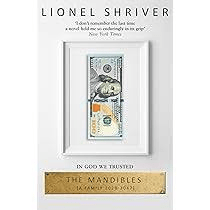
The Mandibles by Lionel Shriver, 2016

It’s been a very long time – I am struggling to remember the last time it happened – since a book has haunted me in the way that Lionel Shriver’s The Mandibles did. By ‘haunted’ I don’t mean scared (although there is plenty that is scary here), but that the characters and their situation stayed with me when I was not reading the book. The feelings of nervousness and anxiety that it engendered hung over me, so that when I wasn’t thinking about the book I was feeling it. I wasn’t quite stock-piling toilet paper and checking my bank account every five minutes, but it was not far off!

For context, The Mandibles is set in the USA in 2029. The American economy is in the midst of an economic crisis of the kind it narrowly dodged in 2008. Unemployment and inflation soar, law and order begins to break down, and America reneges on its international debts. We experience this crisis through the eyes of an extended middle class American family, the Mandibles. Yes this is a strange name, and no I don’t know if it has any particular significance (it’s possible that the fact it is the only mobile bone in the human body is a reference to the family’s ability to be agile and keep one step ahead of the crisis, but that’s really stretching things!).

In 2029, America has already changed dramatically from the relatively stable economy and political landscape of the year of publication, 2016. In the real world of spring 2016, Trump had already announced his run for the White House and the UK’s Brexit referendum was looming, but it was hard to anticipate the political turmoil that was to follow months after this novel was published, let alone the lockdown and pandemic four years later. In Shriver’s 2029 America is already significantly diminished. Previously the country had temporarily lost access to the internet and as a result all financial transactions now take place either on paper or in hard cash. China is suspected as being behind the cyber-attack, as part of its wider ambitions to replace America and the dominant superpower. Things however are slowly beginning to return to normal when the crash hits. A new international reserve currency, the bancor, (which in real life had been proposed by Keynes in the 1930’s and remains an idea some economists support – for example it was called for as recently as 2009 by the Governor of the Bank of China) collapses the American economy. This is not just a depression or a recession but far worse – money loses most of its value, millions lose their jobs, savings are wiped out and prices go through the roof. The US Government’s disastrous response is to ban American’s from owning bancors (thereby closing down almost all international trade) and sequesters all gold owned by people and business.

Prior to the crash the four generations of the Mandible family are relatively well off and live in expectation of an inheritance from their very wealthy patriarch. His savings and investments are completely wiped out. One son-in-law is an economist who is sacked from his professorship, but who right until the end of the book continues to argue that the crash was avoidable and that he was right while everyone else was wrong. This satirical teasing of economists who are unable to understand the economy or predict its behaviour is one of the gentler aspects of the novel. As the crisis deepens the family move in together and adjust to their straitened circumstances, showering only once a week, stockpiling supplies, and generally having a miserable time. While the adults are to a greater or lesser extent in denial about how bad things are going to get, one of the younger family members, Willing, is the calm centre of both the family and the novel. Willing is able to tell that things are going to get a lot worse and plans accordingly, learning practical skills such as how to pick locks and developing a plan for the family that could see them escaping from the city and to safety.

Three quarters of the way through the novel, with the family homeless and at crisis point, the story jumps forward fifteen years. I can’t lie, I found that decision irritating. It seemed as if the novelist got tired of charting their struggles with the breakdown of society and hit the fast forward button. It might have been because this is quite familiar territory – dystopias in which society collapses aren’t exactly uncommon. The final quarter of the book acts almost like a postscript. Most of the characters have adapted and survived and society is slowly being rebuilt. The United States government has become extremely authoritarian, with everyone being compulsorily ‘chipped’ like pets. A small separatist enclave has been built in Nevada and the remaining family members, lead once again by Willing, set off to see if this new land of the free can be sustained.

The financial crisis of 2008 and the world’s subsequent turmoil have only served to underscore what I think most of us already knew – that civilisation is only skin deep. The American journalist  Alfred Henry Louis put it like this back in 1896:

Those of us who are well fed, well garmented and well ordered, ought not to forget that necessity makes frequently the root of crime. It is well for us to recollect that even in our own law-abiding, not to say virtuous cases, the only barrier between us and anarchy is the last nine meals we’ve had. It may be taken as axiomatic that a starving man is never a good citizen.

While the novel’s portrait of society’s collapse is chillingly believable, The Mandibles is a strangely optimistic dystopia. Shriver said of the novel that “My reading on what happened in 2008 is that we dodged a bullet. I feel as if that bullet is still whizzing around the planet” which is almost completely unarguable. Next time we might not be so lucky. But terrible though the collapse of the American economy may be, the rest of the world is surprisingly immune to its effects – the bancor is not just an attack on the dollar but it is also an insurance policy. Mexico becomes an economic super-power and has to build a wall to prevent American refugees from escaping into the country. As satire that might feel a bit obvious, but the main impact on America is a sense of humiliation rather than anything more punitive. The key point is that the country recovers from near-total collapse, the economy starts to rebuild, and as authoritarian dystopian Governments go this one is relatively benign.

I enjoyed The Mandibles. Shriver is an interesting, iconoclastic writer and I will look out for more opportunities to read her work.

The Mandibles by Lionel Shriver, 2016

Aside
Book review

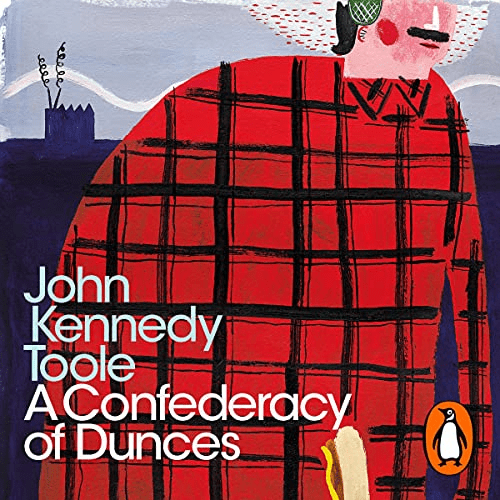
A Confederacy of Dunces, by John Kennedy Toole, 1980

I had come across A Confederacy of Dunces on various lists of ‘best’ novels without having any preconceived idea what it was about. I’m still not entirely sure to be honest. The novel follows the adventures of Ignatius J. Reilly, an obese and extraordinarily self-centred young man living with his mother is early-1960s New Orleans.

Ignatius is a “slob extraordinary, a mad Oliver Hardy, a fat Don Quixote, a perverse Thomas Aquinas rolled into one—who is in violent revolt against the entire modern age, lying in his flannel nightshirt, in a back bedroom on Constantinople Street in New Orleans, who between gigantic seizures of flatulence and eructations is filling dozens of Big Chief tablets with invective.”

He returned from college several years previously and since then done little other than bicker with his mother and her friends and neighbours. He writes in his journal, eats and masturbates. He considers himself a medievalist, although there’s little sign of him ever doing any reading on the topic.

One afternoon while shopping in town Ignatius is approached by a police officer and asked for identification, on the grounds he appears a suspicious character. Ignatius over-reacts to this request, inevitably, appealing to a gathering crowd for assistance and loudly denouncing the officer and all police. An elderly man’s attempts to help goes badly wrong when he accuses the officer of being a communist, and he is arrested, allowing Ignatius to escape with his mother into a nearby bar.

Mrs. Reilly proceeds to get drunk and on the way home she crashes her car. The bill for the accident is over a thousand dollars, and to pay the costs of the accident Mrs O’Reilly is finally pushed into forcing her son out to work. Ignatius is profoundly unsuited to any sort of responsible employment. He first finds a job in an office where the throws away all the filing he is given to do, conspires to undermine his supervisor and employer, and then writes a libellous letter in the name of his employer to a supplier. He is a nightmare of an employee:

“I have taken to arriving at the office one hour later than I am expected. Therefore, I am far more rested and refreshed when I do arrive, and I avoid that bleak first hour of the working day during which my still sluggish senses and body make every chore a penance. I find that in arriving later, the work which I do perform is of a much higher quality.”

Brief spells of ‘work’ are interrupted by regular visits to the movies, where he spends all his time berating the performances and productions:

“Filth!’ Ignatious shouted, spewing wet popcorn over rows. ‘How dare she pretend to be a virgin. Look at her degenerate face. Rape her!”

Finally dismissed from his office job, long beyond the point at which any employer would have tolerated his behaviour, Ignatius then becomes a hot dog vendor, eating many times more than he sells. The novel ends on an optimistic note with Ignatius finally breaking free from his inertia, heading off on an adventure with a college friend. The likelihood of this all ending badly and Ignatius returning home to complain for years about the discomfort or indignity of some minor aspect of his journey is high, but the reader wishes him well.

A Confederacy is one of that small group of novels where the history of its publication is as well known as the story itself. In brief, Toole killed himself before it was published, and there is reason to believe that his suicide was at least in part associated with the manuscript’s rejection by multiple publishers. It was only through the subsequent persistence of his mother that finally saw the novel published. The plot of the novel is little more than a framework for the portrait of the monstrous narcissist that is Ignatius. So you either enjoy spending time with this deeply unpleasant, but admittedly comical character, or you don’t. He is frankly an idiot, a giant toddler unable to foresee the obvious consequences of his actions, ever confident that any problem put in his way can be overcome by shouting at anyone who objects to his behaviour. Mostly this works because of his indulgent mother and employers desperate for help. The more his offences are indulged, the more he offends. I found this mildly amusing, but it quickly gets tired. The portrait of New Orleans that provides a backdrop to Ignatius’s tantrums is not one that the city should be particularly proud of, despite which a statue of Ignatius has been erected there. The author is not really interested in the city, its culture and history, and I got the impression that the novel really could have been set anywhere.

The novel has a cast of supporting characters all of whom revolve around Ignatius. The portrait of Jones, the black janitor for the “Night of Joy” who holds on to his below-minimum wage job to avoid being arrested for vagrancy tiptoed very close to racism – Jones narrates his thoughts in a stream of consciousness creole that according to some reviews captures wonderfully the authentic voice of New Orleans, or alternatively is a crude parody of the way black people speak and think:

“Look at that. She think I got siphlus and TB and a hard-on and I gonna cut her up with a razor and lif her purse. Ooo-wee.”

I’ll say this for A Confederacy – there really isn’t any other text in modern literature that does what Toole tries to do. That’s probably for a good reason – it remains a one-off, a stand alone that no-one has tried to emulate. I am still trying to decide whether I actually enjoyed the novel or not – while on the one hand I appreciate the uncompromising nature of the portrait of Ignatius, on the other he is a profoundly unpleasant person. Toole brings him vividly to life, no question, but was the effort worth it? Is this the work of genius that Toole’s suicide seems to suggest it ought to be? No, sadly not. You have to wonder what Toole would have written if he had allowed himself the chance.

A Confederacy of Dunces, by John Kennedy Toole, 1980

Aside