
A Confederacy of Dunces, by John Kennedy Toole, 1980
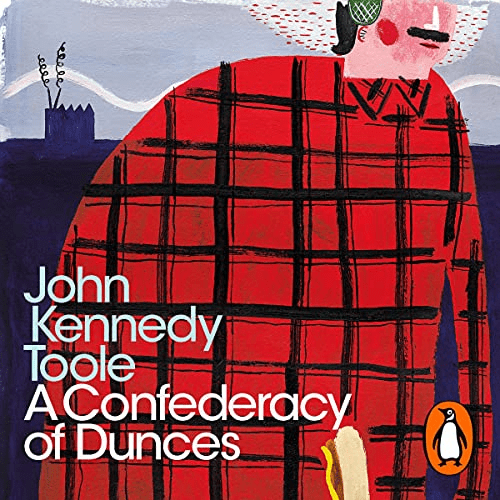
I had come across A Confederacy of Dunces on various lists of ‘best’ novels without having any preconceived idea what it was about. I’m still not entirely sure to be honest. The novel follows the adventures of Ignatius J. Reilly, an obese and extraordinarily self-centred young man living with his mother is early-1960s New Orleans.
Ignatius is a “slob extraordinary, a mad Oliver Hardy, a fat Don Quixote, a perverse Thomas Aquinas rolled into one—who is in violent revolt against the entire modern age, lying in his flannel nightshirt, in a back bedroom on Constantinople Street in New Orleans, who between gigantic seizures of flatulence and eructations is filling dozens of Big Chief tablets with invective.”
He returned from college several years previously and since then done little other than bicker with his mother and her friends and neighbours. He writes in his journal, eats and masturbates. He considers himself a medievalist, although there’s little sign of him ever doing any reading on the topic.
One afternoon while shopping in town Ignatius is approached by a police officer and asked for identification, on the grounds he appears a suspicious character. Ignatius over-reacts to this request, inevitably, appealing to a gathering crowd for assistance and loudly denouncing the officer and all police. An elderly man’s attempts to help goes badly wrong when he accuses the officer of being a communist, and he is arrested, allowing Ignatius to escape with his mother into a nearby bar.
Mrs. Reilly proceeds to get drunk and on the way home she crashes her car. The bill for the accident is over a thousand dollars, and to pay the costs of the accident Mrs O’Reilly is finally pushed into forcing her son out to work. Ignatius is profoundly unsuited to any sort of responsible employment. He first finds a job in an office where the throws away all the filing he is given to do, conspires to undermine his supervisor and employer, and then writes a libellous letter in the name of his employer to a supplier. He is a nightmare of an employee:
“I have taken to arriving at the office one hour later than I am expected. Therefore, I am far more rested and refreshed when I do arrive, and I avoid that bleak first hour of the working day during which my still sluggish senses and body make every chore a penance. I find that in arriving later, the work which I do perform is of a much higher quality.”
Brief spells of ‘work’ are interrupted by regular visits to the movies, where he spends all his time berating the performances and productions:
“Filth!’ Ignatious shouted, spewing wet popcorn over rows. ‘How dare she pretend to be a virgin. Look at her degenerate face. Rape her!”
Finally dismissed from his office job, long beyond the point at which any employer would have tolerated his behaviour, Ignatius then becomes a hot dog vendor, eating many times more than he sells. The novel ends on an optimistic note with Ignatius finally breaking free from his inertia, heading off on an adventure with a college friend. The likelihood of this all ending badly and Ignatius returning home to complain for years about the discomfort or indignity of some minor aspect of his journey is high, but the reader wishes him well.
A Confederacy is one of that small group of novels where the history of its publication is as well known as the story itself. In brief, Toole killed himself before it was published, and there is reason to believe that his suicide was at least in part associated with the manuscript’s rejection by multiple publishers. It was only through the subsequent persistence of his mother that finally saw the novel published. The plot of the novel is little more than a framework for the portrait of the monstrous narcissist that is Ignatius. So you either enjoy spending time with this deeply unpleasant, but admittedly comical character, or you don’t. He is frankly an idiot, a giant toddler unable to foresee the obvious consequences of his actions, ever confident that any problem put in his way can be overcome by shouting at anyone who objects to his behaviour. Mostly this works because of his indulgent mother and employers desperate for help. The more his offences are indulged, the more he offends. I found this mildly amusing, but it quickly gets tired. The portrait of New Orleans that provides a backdrop to Ignatius’s tantrums is not one that the city should be particularly proud of, despite which a statue of Ignatius has been erected there. The author is not really interested in the city, its culture and history, and I got the impression that the novel really could have been set anywhere.
The novel has a cast of supporting characters all of whom revolve around Ignatius. The portrait of Jones, the black janitor for the “Night of Joy” who holds on to his below-minimum wage job to avoid being arrested for vagrancy tiptoed very close to racism – Jones narrates his thoughts in a stream of consciousness creole that according to some reviews captures wonderfully the authentic voice of New Orleans, or alternatively is a crude parody of the way black people speak and think:
“Look at that. She think I got siphlus and TB and a hard-on and I gonna cut her up with a razor and lif her purse. Ooo-wee.”
I’ll say this for A Confederacy – there really isn’t any other text in modern literature that does what Toole tries to do. That’s probably for a good reason – it remains a one-off, a stand alone that no-one has tried to emulate. I am still trying to decide whether I actually enjoyed the novel or not – while on the one hand I appreciate the uncompromising nature of the portrait of Ignatius, on the other he is a profoundly unpleasant person. Toole brings him vividly to life, no question, but was the effort worth it? Is this the work of genius that Toole’s suicide seems to suggest it ought to be? No, sadly not. You have to wonder what Toole would have written if he had allowed himself the chance.


I think you’re pretty fair to this novel, which is very much of its time and has an awful lot of non-PC moments… but it’s one that cracks me up with laughter every time I come back to it, especially the character of Jones. Toole did write another novel, The Neon Bible, which I read once and haven’t been back to, so can tell you nothing about it.
LikeLiked by 1 person