Book review

Comments – sticks and stones

I got my first nasty comment yesterday. Having been blogging for several years now I Trollhave previously always welcomed comments. The vast majority have been positive, but even when people have disagreed with my view, they have done so politely. I have tried to adopt the same approach when commenting on other people’s blogs, because, you know, I am a human being not a troll. But my 2013 review of Patrick Suskind’s ‘Perfume‘ really upset one person, because they decided to leave a comment calling me an “miserable trout”!

Anyone not familiar with idiomatic British English may not recognise this phrase. It’s a remarkably mild insult, meaning roughly an unattractive and bad-tempered old woman. I’ll leave it for others to decide on the attractiveness or otherwise of my appearance, although what that has to do with Patrick Suskind’s novel escapes me for the moment. Bad-tempered I will accept in the context of the review – ‘Perfume’ is an appalling novel, and I stand by that judgment of several years ago when I first reviewed the novel – and yes, it put me in a bad mood. More, it upset me. If the descriptions of young women being murdered for sadistic pleasure which form the heart of the novel don’t upset you, perhaps it’s not me with the problem. But it’s the casual assumption that I am a woman that niggled at me – as if only women can call out misogyny when they see it. I thought we as a society or civilisation had outgrown that lazy idea?

For the avoidance of any doubt, I still love getting comments. It’s really one of the things that keeps me blogging and reading blogs, getting to share my ideas about books with other people and discuss them. Of course we will have disagreements. I would love to know in what way this commenter disagreed with me – what is it about Suskind’s portrayal of the mass murder of young women and the commoditisation of their bodies that appealed to him/her? But (s)he chose not to share that information, which was a pity.

Standard
Book review, John Green, Turtles all the way down, Young adult

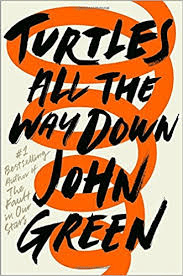
Turtles All the Way Down – John Green, 2017

Should one use the same criteria when judging young adult novels as one does when assessing full-grown adult fiction? I ask because if one were to do so, ‘Turtles’ would probably suffer by comparison, when judged on its own merits as a thoughtful novel for young adults, it is a success.
Turtles

The central character of John Green’s ‘Turtles All The Way Down’ (loving that title), Aza Holmes (‘Holmesy’) suffers from Obsessive Compulsive Disorder (OCD). This makes her extremely anxious, and she self harms as part of her control rituals, opening a wound on her hand, then being terrified it will become infected. As her condition deteriorates she takes to drinking hand sanitizer, in a deluded attempt to purge her body of infection. (NB Do not do this!). She is also haunted by thoughts that she is a fictional creation (which of course she is, although Green does nothing with this paradox). Most of the time she remains in control of her obsessive behaviour, although her internal monologue tells us that she is tortured by harmful thoughts. Despite her condition Aza is in many ways a typical, relatable American teenager – she drives to school in her beloved truck Harold, eats pizza with friends, and watches television with her mum. Green doesn’t spell it out in so many words, but we are invited to conclude that Aza’s OCD was triggered following the sudden death of her father from a heart attack when she was seven.

A fledgling romance with a neighbour whose incredibly rich father has gone missing triggers a more serious episode, and she is eventually hospitalised. The parallels with the loss of her own father are quietly underlined, and form the basis of her relapse. She eventually recovers sufficiently to overcome her anxiety and in a strange conclusion to the novel attends an art exhibition in a sewer, where she comes close to solving the mystery of the missing billionaire. I probably shouldn’t focus on this detail, but I doubt whether many OCD suffers would be prepared to go into a sewer for any price, let alone wander around in the dark in one. This ending to the novel was for me its weakest part, and fails on any level, providing an unsatisfactory ending to the ‘mystery’ element of the novel, which had a lot of potential but which Green seemed to lose interest in.

What elements do you look for in an adult novel that we can forgive being missing from a YA novel? Characterisation? Obviously not, we need the characters to be fully fledged and believable. Green does reasonably well here – some of his characters are generic, off-the shelf quirky teenagers distinguishing themselves from one another by their choice of hair style or interest in music. I quite liked Daisy, the inevitable reliable best friend, but Davis, the missing billionaire’s son, who provides the only significant romantic interest in the novel, isn’t well developed – in fact his brother Noah, who is mourning the loss of his father, but hides his grief and distress in video games, was more believable. There’s a whole missing novel there in fact – the two brothers waiting for their father to return, unable to draw any solace from their preposterous riches.

Plot? The story line in ‘Turtles’ goes missing quite early on, and never resurfaces until the hurried and unconvincing conclusion. Green starts out writing a conventional if slightly Scooby Dooish mystery, but this element fizzles out early on, and the focus shifts instead to Aza’s illness and its impact on her life.

Quality of writing. Green does a good job, so far as I can tell, in representing the voice and thoughts of a teenage OCD sufferer. His writing is straightforward and extremely easy to read – this is the kind of novel that you can polish off in a few hours easily. There are no rhetorical flourishes or difficult passages.

Originality. It would be being harsh to say Green was on auto-pilot here, but there is a very familiar clichéd feel to this novel. Angsty teenagers have mild romantic entanglements to the backdrop of a high-school experience, something easy for US teenagers to identify with from real-life, (and other readers from anyone who has watched US television) the kind of high school where you pull up in front of the school and there is always a parking space waiting; where lessons take a few minutes and time is mainly spent being cool in the cafeteria, and pupils quote Shakespeare to one another in their texts. It was as believable as Buffy the Vampire Slayer, but a bit less glamorous.

Ultimately, the answer to my opening question is a clear no. This isn’t a book that adults will be able to take much from, but younger readers (I really wouldn’t get hung up on the YA label; I would have thought pre-teens could enjoy this as well. There are some adult themes such as references to dick pics, but that is about as strong as it gets) will find it an interesting and comforting read – or in the words of the Guardian’s reviewer “It will resonate with, and comfort, anxious young minds everywhere” , which I think is spot on.

P.S. What a disappointing book cover by the way – we get it that depression is like a spiral (not that that image is in any way helpful or clear) but the missed opportunity for pictures of some turtles will hopefully be rectified in the paperback!!

Standard
Book review

Mistakes Were Made (but Not by Me): Why We Justify Foolish Beliefs, Bad Decisions and Hurtful Acts by Carol Tavris and Elliot Aronson

When I use the term “challenging” to describe a book, this is usually a euphemism for “hard to read” – either because it is badly written, or just long-winded. ‘Moby Dick’ is a challenging novel, for example. So are ‘Ulysses’ and ‘Middlemarch’, and any other number of Victorian blockbusters (I know Ulysses isn’t Victorian!)  But I found ‘Mistakes Were Made’ challenging in a very different way – it challenged some of my deeply held beliefs. Which was unusual and very refreshing. I didn’t agree with everything the authors wrote or argued, but being shown a different perspective has to be a good thing.

‘Mistakes were made, but not by me’ is a book of popular (i.e accessible, rather than academic or textbook) psychology, exploring the concept of cognitive dissonance, the mental discomfort (psychological stress) experienced by us all when we simultaneously hold contradictory beliefs, ideas, or values. Cognitive dissonance is a consequence of a person performing an action that contradicts personal beliefs, ideals, and values; and also occurs when confronted with new information that contradicts said beliefs, ideals, and values. So for example you believe the NHS I being under-funded, but when you look the statistics up you find that investment is going up above the rate of inflation. Instead of saying, how interesting, you tart to look for other statistics that will undermine this, and tell you what you really want to hear – that relative to other countries funding is down for example. This is an entirely natural response. When we experience CD we all have the impulse to minimise the uncomfortable feeling by refusing to accept the new information (“fake news”). On social media we are much more likely to be believe (and retweet or share) a post that endorses our ideas than one that challenges them. This is the reason for the so-called echo chamber phenomenon.

The authors go on to examine how cognitive dissonance causes mistakes to be made – we find it hard to accept our initial thoughts or conclusions are wrong, and seek out any number of ways to defend ourselves against the discomfort this causes, to the extent of denying or ignoring hard facts against us.

While this is a very accessible, readable account, the 40 pages of footnotes are clear evidence that this is also well-researched. Most of the examples are drawn from the United States, but that’s fine – the authors are American and write about the area they know best.

So why did I find it challenging? At the heart of the issue is the compelling section of the book about repressed memory. This really got me thinking, and reading other sources. I had accepted for a long time, without really thinking about it very much, that the repressed memory was a real thing. It’s a Freudian concept, and there is evidence (not discussed here) that the idea was not previously thought of before Freud. The authors make the familiar point that for most trauma, the challenge is forgetting the pain and distress, rather than remembering it. They also highlight research that shows how easy it is to implant false memories of childhood trauma – the so-called ‘Lost in the Mall’ experiment, where adults were easily persuaded that they had a childhood experience if being lost in a shopping centre, when they hadn’t.

So why am I still resisting the idea that repressed memory doesn’t exist? I think there are three main reasons: first, it sounds plausible. That’s obviously a cognitive dissonance coping strategy – ignore the evidence, and rather than presenting counter evidence just say that your original ideas are valid because they just are. Second, I think I have read about examples of repressed memory – but have I? Or were these fictional representations, in films or books? I have a sneaking suspicion they might have been. Lastly, while the concept of repressed memory is less widely supported than twenty years ago or so, the fact remains that large numbers of psychiatrists and psychologists still accept the concept. So I think the jury is still out, but the authors don’t have any doubts. They don’t hedge their position by referring to the evidence that suppressed memories exist – they would argue there is none. There’s obviously a baby/bathwater risk here – if all recovered repressed memories of childhood trauma or abuse are implanted or otherwise false, there is a risk that people take the wrong next step of concluding that all memories of such abuse are equally open to question or challenge? These are deep waters, and I still don’t know what I think about them – I certainly haven’t accepted the authors’ position unsceptically – but I am sure you can see why I found the book so thought-provoking.

If you are interested in how memory works, enjoy having your preconceptions challenged, and don’t mind revisiting some familiar psychological experiments, then ‘Mistakes Were Made (but not by me)’ is recommended. We can all benefit from acknowledging that we are as vulnerable to mis-remembering or making mistakes – we alone are unlikely to be infallible, while all around are prone to error – and that challenging our preconceptions (“I think I can remember that, but I might be wrong”) is a healthy reflex.

Standard