The Wager: a Tale of Shipwreck, Mutiny, and Murder by David Grann, 2023
The Wager is everywhere at the moment. After President Obama listed it as one of his books of the year in 2023 it topped The New York Times best-seller list and stayed in the top ten for six months. The film rights were snapped up by Martin Scorsese and Leonardo di Caprio. It featured in many best books of 2023 lists: as usual I am coming very late to the party. Accordingly my expectations were sky-high and predictably I was a little disappointed – if it hadn’t had this much hype I would have been able to read and appreciate the book on its own terms. Oh well.
The book’s blurb and description on Amazon give this summary (I’ve tried to edit it because it is quite long, but in the end I decided to keep it full-length because the detail actually matters):
“On January 28, 1742, a ramshackle vessel of patched-together wood and cloth washed up on the coast of Brazil. Inside were thirty emaciated men, barely alive, and they had an extraordinary tale to tell. They were survivors of His Majesty’s Ship the Wager, a British vessel that had left England in 1740 on a secret mission during an imperial war with Spain. While the Wager had been chasing a Spanish treasure-filled galleon known as “the prize of all the oceans,” it had wrecked on a desolate island off the coast of Patagonia. The men, after being marooned for months and facing starvation, built the flimsy craft and sailed for more than a hundred days, traversing nearly 3,000 miles of storm-wracked seas. They were greeted as heroes.
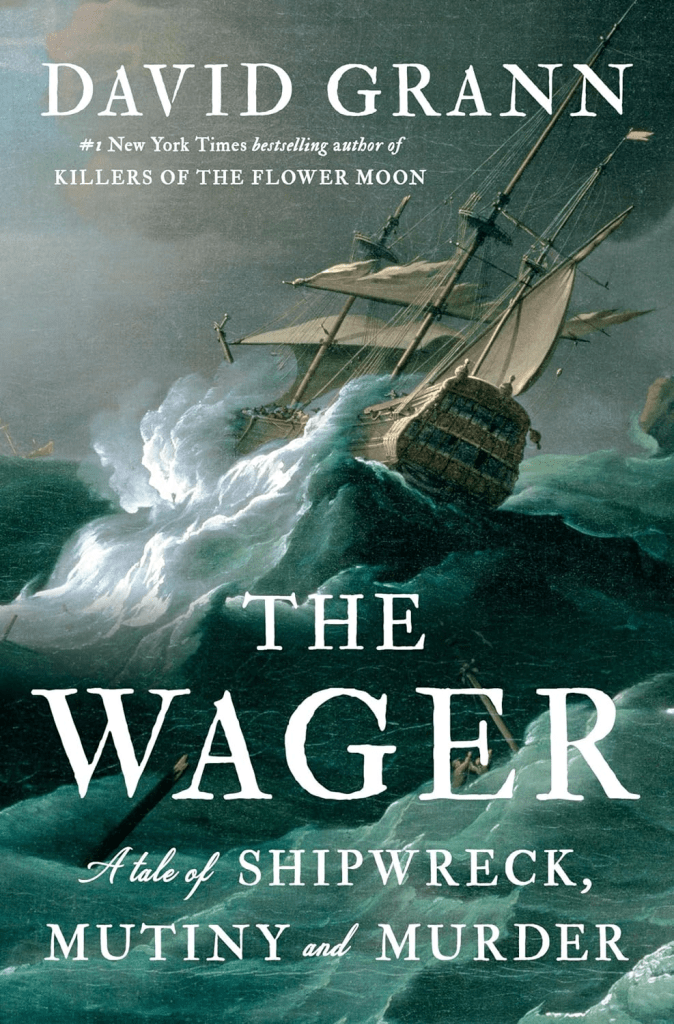
But then … six months later, another, even more decrepit craft landed on the coast of Chile. This boat contained just three castaways, and they told a very different story. The thirty sailors who landed in Brazil were not heroes – they were mutineers. The first group responded with countercharges of their own, of a tyrannical and murderous senior officer and his henchmen. It became clear that while stranded on the island the crew had fallen into anarchy, with warring factions fighting for dominion over the barren wilderness. As accusations of treachery and murder flew, the Admiralty convened a court martial to determine who was telling the truth. The stakes were life-and-death–for whomever the court found guilty could hang.“
To be fair, this is not just the publisher’s summary – in the book’s opening chapter this version of what it to come is largely the same: this is a story of a shipwreck that leads to mutiny, murder, and finally a form of retribution for the survivors. Except it is not.
For a start there was no real mutiny – no-one was tried for this incredibly serious charge. If the Admiralty had thought there was any risk of this offence being condoned they would have seen to it that people hanged, just in case anyone thought mutiny was acceptable in any circumstances. They took law and order extremely seriously. There was no question a dispute amongst the survivors about how to reach civilisation once the Wager had been shipwrecked on an isolated (but not completely deserted) island. The bulk of the survivors ignored the captain’s wishes to sail north to Chile and instead headed off in the opposite direction – but the Admiralty did not think this constituted mutiny. If the breakaway group had really thought they were committing mutiny they would almost certainly have destroyed the many paper records that they carried with them back to England and for that matter they would have avoided handing themselves in to the authorities by travelling back to England in the first place.
For an event that happened on the other side of the world almost three hundred years ago, there is a remarkable amount of documentary evidence about the wreck of the Wager and the subsequent ordeal of its crew. Many of the survivors wrote extensively about their adventures – the account by the leader of the expedition of which the Wager was a part, George Anson, is still in print – and in addition many of the contemporaneous records including log books and diaries survived and are available to historians (to be completely fair to Grann whether he is an academic historian or not (not) I nevertheless include him in this category; his account is very well researched and evidenced. It’s just not a new or untold story).
There was no trial, no-one was found innocent or guilty, and no-one was hanged. There was an investigation with a very limited scope, but that quickly found that no further action was required. This is all a bit of a damp squib after the long build-up in which the reader is explicitly lead to believe that a trial would decide who was telling the truth about the shipwreck. In fact the introduction suggests this is the whole point of the narrative. Surprisingly there were no significant differences between the survivors as to what happened; broadly speaking their accounts agreed, not least because of the extent of the written record. Whether the actions of the protagonists were justified was disputed, but what they actually did or did not do was not disputed.
So this is not the book we are led to believe it is going to be. It is instead a dramatic but as far as possible accurate retelling the story of the Wager. Much of the book is dedicated to the preparation for setting sail and then the journey to South America and beyond, the challenges of assembling a crew and then the privations once on board and under sail. The Wager was part of a wider expedition which in turn was part of the English campaign against the Spanish that in this period. usually described as the War of Jenkins’ Ear. The shipwreck and the appalling conditions on the island that the survivors experienced (although ironically the diet of scavenged seaweed and sea celery help cure the ravages of scurvy all the men had faced) are brought to life and it is from this point, almost three-quarters of the way through the book, that the ‘slow-motion mutiny’ (as Wikipedia describes it) unfurls.
The Wager has some striking similarities with Batavia’s Graveyard, Mike Dash’s 2002 account of a shipwreck some 100 years earlier, in which the survivors faced a life and death struggle for survival, order quickly broke down and brutality engulfed the survivors. The crew of the Wager behaved in a relatively civilised fashion compared to their East Indian counterparts from the Batavia. To be fair their island was better equipped – they even had friendly natives on hand to bring them food (although the quickly scared them off with their behaviour). If you are looking for books with a similar theme and structure to The Wager, Batavia’s Graveyard is highly recommended.
When a book doesn’t live up to the hype it can be disappointing, but judged on its own merits The Wager was an enthralling read. The book’s epilogue, telling the story of the rest of the fleet which was slowly destroyed, leaving just one surviving ship, which in a ferocious sea battle captured a Spanish treasure ship and made its way home from halfway around the world , is told almost as an afterthought, but it is hard to resist the thought that this was the more compelling adventure.
 ‘The Influential Mind will make you gasp with surprise – and laugh with recognition. Many of our most cherished beliefs about how to influence others turn out to be wrong; Sharot sets them right. Packed with practical insights, this profound book will change your life. An instant classic’ Cass R. Sunstein, bestselling co-author of Nudge