Book review, Death, Discworld, fantasy, Mort, science fiction', Terry Pratchett

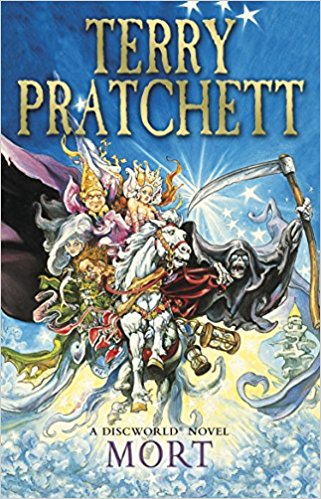
Mort, (Discworld 4) by Terry Pratchett, 1987

If you are still counting, ‘Mort’ is the fourth novel in the Discworld series. It is also the first novel in the series where Death is a central character – some people read the books thematically like that (i.e Death 1, 2 etc.).

Anyway, experiencing the need to get out a bit more and live, Death takes an apprentice, Mortimer, aka Mort (see what he did there?) to help with the harvesting of souls. And mucking out Binky’s stable. There is also the nod and a wink promise in the unwritten job description of taking over the family business when Death finally retires, however unlikely that sounds. (If that is the bit that sounds unlikely, whereas Death taking an apprentice you are OK with, then I would question your grip on reality!mort)
One of the things readers of the Discworld novels know is that Sir Terry was a bit of a philosopher. He had important insights into the way the world works, and shared them with us through the medium of humour. ‘Mort’ includes plenty of examples of this, because there are few more serious or profound issues to meditate on than death itself (or indeed, Death himself). Death doesn’t kill people, he is just there when they die, and eases their passage into the beyond. People react to Death’s arrival in a range of ways, from anger to annoyance, surprise, resignation, and occasionally with a welcome.  Sir Terry’s insights range across all of life’s big issues, and most of the small ones – this sentence jumped out at me for example:

People don’t alter history any more than birds alter the sky, they just make brief patterns in it”.

Which is a bit wonderful don’t you think?

A quick plot synopsis for those of you who expect that kind of thing in a book review. Once his initial stable cleaning duties have been completed, Mort gets to accompany Death on ‘the duties’. In Sto Lat King Olerve is due to be assassinated, but in the course of their otherwise successful visit Mort falls heavily for the King’s daughter, Keli. Later on a unscheduled half day off Mort tries to return to Sto Lat to find out whether the princess really saw him, in the course of which he meets Igneous Cutwell, a young wizard, whom he hopes can help explain his developing tendency to manifest magical powers such as walking through walls. We can tell that Mort is becoming like his master, but he remains blithely unaware of it, for now.

Death then decides that Mort is ready to perform the Duty on his own, and sends him to collect three lives. Goodie Hamstring, a witch from Lancre is very understanding about his inexperience, as is Abbot Lobsang, from the Listening Monks who is destined to be perpetually reincarnated. As soul collections go these are ideal learning deaths. But the training wheels come off with a big when Mort finds out that the third death is to be that of Princess Keli, due to be assassinated on the orders of her uncle.  Mort can’t bring himself to do it, thus creating a rift in reality that is going to cause some serious issues when time catches up with it.

Keli, suffering a temporal anomaly in which everyone thinks she is dead, appoints Cutwell as Royal Recogniser. In a badly timed move, Death decides to take some more time off, leaving Mort in charge. He tries drinking, gambling, partying and fishing before finally taking a job as a short order chef in Ankh-Morpork. Mort tries to keep the show on the road, but in doing so he slowly becomes more and more like Death, including the capitalised speech. Reality is beginning to assert itself now, for example by changing a pub sign from The Quene’s Head to The Duke’s Head. Finally, after the intervention of a very ancient wizard, (and a brief reappearance by Rincewind) Death discovers Mort’s mistake, and in a climatic scene they duel as the old reality closes in on the Princess.

Pratchett’s “and they all lived happily ever after” endings can sometimes feel a bit forced, but the resolution to this clash is well managed, and well, they all live happily ever after. If Death can’t adjust reality just a tweak to make matters right, then who can? The old universe (in which the Princess dies) becomes a wedding present which will expand into another universe once the current one dies. Which I thought was rather neat.

P.S. You will recall, because I have written about it before, that the way Sir Terry chose to notify people of his death in 2015 was the extraordinary tweet “AT LAST, SIR TERRY, WE MUST WALK TOGETHER”. Of the thousands of comments this tweet received, one of the earliest was by an account in the name of the ‘Death of Rats’ (aka The Grim Squeaker) which went “Squeak, squeak, squeak”. For reasons known only to themselves, Microsoft offers the option to “translate this tweet” – sadly the link doesn’t work. But I think we know what he was trying to say.
Standard
Book review, Discworld, Equal rites, fantasy, science fiction', Terry Pratchett

Equal Rites, (Discworld 3) by Terry Pratchett, 1987

Equal Rites’ is the third novel in the Discworld series. This is the novel where Pratchett really hits his stride. ‘The Colour of Magic’ and ‘The Light Fantastic’ are good, of course, but by comparison they felt a little childish when I was rereading them recently (see the reviews earlier in July). Some of the jokes in particular are quite crude, and the plotting is simplistic if not awkward – magic is used as the ultimate get out of jail card. Pratchett dips his toe in the waters of social issues, but quickly reverts to the frothy irreverent humour that is the trademark of these books.

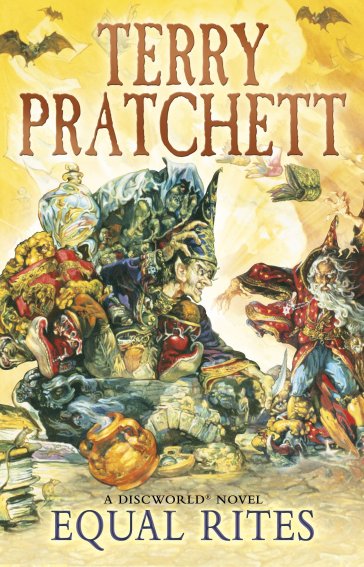
Equal rites.jpg

‘Equal Rites’ is different in kind. It introduces the extraordinary, imperious Granny Weatherwax -‘I’m not a lady, I’m a witch’. This is going to sound like hyperbole, but if Terry Pratchett had not written about any other character his place in the pantheon of great writers would have been secured by his portrait of Granny Weatherwax. She is funny and kind and clever and wise and respected and seems almost a real person.

Granny Weatherwax was a witch. That was quite acceptable in the Ramtops, and no one had a bad word to say about witches. At least, not if he wanted to wake up in the morning the same shape as he went to bed.”

I also love her stubbornness:

She was also, by the standards of other people, lost. She would not see it like that. She knew where she was, it was just that everywhere else didn’t.”

Pratchett’s theory of magic – that a large part of it is in the head of the person on whom the magic is being performed – ‘headology’ – is cleverer than any system of runes mana or potions you find in other fantasy series.

“I saved a man’s life once,” said Granny. “Special medicine, twice a day. Boiled water with a bit of berry juice in it. Told him I’d bought it from the dwarves. That’s the biggest part of doct’rin, really. Most people’ll get over most things if they put their minds to it, you just have to give them an interest.”

The central question posed in ‘Equal Rites’ is why can’t a woman be a wizard? Eskarina Smith is accidentally given a wizard’s staff, and despite all efforts to the contrary is destined to be a powerful magical person – be that a witch, wizard, warlock, sourcerer, thaumaturge or otherwise. She is apprenticed to Granny Weatherwax, who soon realises the girl’s potential, and they set off on a classic road trip to try to gain access to Discworld’s only college for wizards, the Unseen University. Her application to join the university is dismissed out of hand, and a passionate battle for equal rights ensues, with only one winner ever being likely.

Given that female wizards are unheard of in Discworld, Granny has to get a bit creative, so Esk enters the university as a servant. She is reunited there with Simon, an apprentice encountered earlier on the route to Ankh-Morpork. Simon is, like Esk, a naturally talented wizard, but he loses control of his magic and accidentally opens a rift to the Dungeon Dimensions. As you can probably guess this is not a good thing. With the help of Granny Weatherwax, Archchancellor Cutangle, and Esk’s staff, Simon and Esk manage to defeat the demons and escape back to Discworld.

The ending of the novel is one of its weaker features – there is never any real sense of peril or doubt that Esk and Simon will escape unharmed from the Dungeon Dimensions – but who reads Pratchett novels for their plot? it was great to read what is in effect Granny’s origin story. I am really enjoying my rediscovery of early Discworld, watching it emerge and expand before my eyes. The next novel in the series, Mort, takes us to Death’s own domain – I can’t wait!

Standard
Book review, Terry Pratchett, The Light Fantastic

The Light Fantastic, (Discworld 2) by Terry Pratchett, 1986

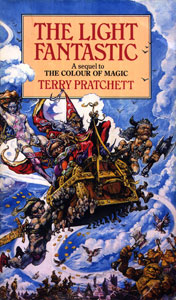
TLF_cover

‘The Light Fantastic’ concludes the adventures of Rincewind, the failed wizard, and Twoflower, the curious tourist from the Agatean Empire, who were left at the end of ‘The Colour of Magic’ falling in some style off the edge of the world (the world being, of course, disc-shaped, said disc being on the back of four giant elephants who in turn are perching on the shell of the Great A’Tuin, a celestial turtle). Hope you got that.

Reading back over my review of ‘The Colour of Magic’ I think on reflection I may have not clearly conveyed my awe at the wonder that was Terry Pratchett. He was a creative and comic genius, and my admiration of his body of work is tinged with sadness that he will no longer be adding to it. As comic writers go I would put him almost on a par with Douglas Adams – I can think of no higher praise.

Of course this isn’t just a fan-blog, these are intended as above all things honest reviews, so there’s no point in self-censoring observations that are less than adulatory – what would be the point? But there’s equally no point in just listing the minor flaws in a novel, and ignoring the gems. So if I got the balance wrong with ‘The Colour..’ then apologies, not least to TP. Continue reading

Standard
Book review, Discworld, humour, Terry Pratchett, The Colour of Magic

The Colour of Magic (Discworld 1) by Terry Pratchett, 1983

Colour of magic

So this is where it all began. I returned to the original Discworld novel as a change of pace from Dickens and with one question at the front of my mind – would it stand the test of time? How well would it have aged, and how fully formed was Pratchett’s early vision of Discworld? Would the detail and complexity all be there, or would, as I assumed, the detail have developed and accrued over time, book by book? Which is a lot more than one question of course.

Remarkably the Discworld universe is almost completely fully developed in this first portrait. The cosmology or Astrozoology – with the Great A’tuin and his accompanying elephants – is all there, and Pratchett had obviously given a lot of thought to the practicalities of a flat world with its hub and the Rim. Ankh-Morpork is complete in virtually every detail (quote) with the pre-Sam Vimes Watch, the Patrician (not yet identified as Vetenari) and the Thieves and Assassins’ Guilds. The Unseen University with its complex hierarchy of wizards and ArchWizards is there, as is magic as a practical working concept. I really enjoyed the way Pratchett plays with the idea of science being a modern equivalent of magic – not a new idea of course, but one he has fun with, for example when Rincewind is trying to work out how Twoflower’s camera works.

“This is all wrong. When Twoflower said they’d got a better kind of magic in the Empire I thought – I thought…

The imp looked at him expectantly. Rincewind cursed to himself. “Well if you must know, I thought he didn’t mean magic. Not as such”

“What else is there, then?”

Rincewind began to feel really wretched. “I don’t know” he said. “A better way of doing things, I suppose. Something with a bit of sense in it. Harnessing – harnessing the lightening, or something”.

‘The Colour of Magic’ also features two of Pratchett’s most-loved ‘characters’ – Twoflower’s sapient pearwood Luggage, and Death. The Luggage is an indefatigable multi-legged terminator, while Death already speaks in his distinctive capitalised tone, and already has his habit of appearing when least expected, such as here when the landlord of the Broken Drum is trying to set fire to his cellar to claim on his recently agreed inn-sewer-ants polly sea:

“At the top of the cellar steps Broadman knelt down and fumbled in his tinderbox. It turned out to be damp.
‘I’ll kill that bloody cat,’ he muttered, and groped for the spare box that was normally on the ledge by the door. It was missing. Broadman said a bad word. A lighted taper appeared in mid-air, right beside him.
HERE, TAKE THIS.
‘Thanks,’ said Broadman.
DON’T MENTION IT.”

The other thing that struck me, and which may be controversial, is that over time Pratchett became a much better and funnier writer. That’s not to say ‘The Colour of Magic’ isn’t funny – it is – but I think his comic style matured and improved. His love of groanworthy puns is already evident here, but some of the jokes go beyond being bad dad jokes, and are just plain bad, for example:

“My name is immaterial,’ she said.
That’s a pretty name,’ said Rincewind”

There is a thin dividing line between using clever references to other writers and genres, and just being derivative. Pratchett tiptoes close to the line sometimes in this novel, and in particular I have always thought that his debt to Fritz Lieber, author of the Fafhrd and the Gray Mouser series has been acknowledged but never fully appreciated. In later novels there is a lot more Pratchett and far fewer borrowings – references of course, but done in a way in which the original source is acknowledged without being simply reproduced.

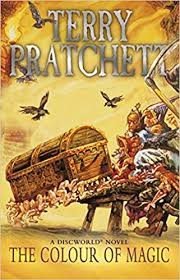
Almost lastly, a bit of a moan about this edition. It is the Corgi edition shown above, with the original Josh Kirby illustration (which I always felt were a bit over the top tbh), published this year with a mention of Pratchett’s death in the frontispiece. The blurb includes a quote from the independent calling Pratchett “one of the funniest English authors alive”. Was this just a case of laziness by the publishers not bothering to update their copy, or just a bad joke?

Finally, a quiz question for you, which should be easy given the subject of this blog entry – who are Berilia, Tubul, Great T’Phon and Jerakeen?

Standard
Terry Pratchett

Comment: Missing Terry Pratchett

It is rare that going into a bookshop saddens me, but it did so last week. Going into any half decent bookshop in December any time in the last 20 years or more inevitably meant encountering a large pile of the latest hardback DiscWorld novel – the easiest item on my Christmas list. But this year it was missing, a big gap – no more Librarian, no more Sam Vimes, the world’s best policeman (someone should do a spin-off series featuring Sam, solving crime in Ank-Morpork, with the aid of his raggle taggle army of recruits), no more Veterinari, no more Granny Weatherwax or Ogg. Really sad.

Standard
21st century literature, Book review, Terry Pratchett, The Shepherd's Crown

The Shepherd’s Crown (Discworld 41), Terry Pratchett. 2015

Sadly, ‘The Shepherd’s Crown’ will be the last Discworld novel*. I had in my head drafted a response to the critics who claimed that the impact of Terry’s illness can be traced in the overall quality of this novel. The problem with that way of reading the novel is that once you start to look for such connections you inevitably find them. But why stop there – can you find the pages in Great Expectations where Dickens had a heavy cold in 1861 (yes, I had to look that up), or the chapters in Mrs Dalloway where Virginia Woolf was feeling particularly depressed that day. The book is what it is. However, in a well meaning but ultimately unhelpful postscript to this edition, Rob Wilkins, Terry’s assistant, wrote “The Shepherd’s Crown has a beginning, a middle and an end, and all the bits inbetween. Terry wrote all of those. But even so, it was, still, not quite as finished as he would have liked when he died. If Terry had lived longer, he would almost certainly have written more of this book”. Once you know that, you can’t un-know it, and it influences the way you read the novel. You start to look for weaker passages of descriptive writing, jokes that fall slightly flatter than usual, plot lines that dwindle away. The fact that every Discworld novel has similar features seems irrelevant. It devalues what would otherwise have been a marvellous addition to the series – and which I stubbornly think it still is.
The Tiffany Aching series of Discworld novels was always positioned as Young Adult fiction. I am not sure whether if you didn’t know that, it would affect your overall enjoyment of the novel. This series is slightly less complex than the usual DW affair, and the level of menace toned down. But not much – this novel still has some seriously nasty elves who torture babies and dismember cuddly bunnies. These scenes are balanced by the way the elves are easily dispatched by Tiffany and her ragtag army of old men in sheds, part-time witches, and the glorious Mac Nac Feegles.
I’ve made no effort to avoid spoilers in this blog thus far, but I am going to make an exception here. One of Discworld’s best loved characters dies in the opening chapters of ‘The Shepherd’s Crown’, and if you don’t want to know who it is, look away now.

—————————————————————————————–

One of the reviews I read online in preparing this blog entry very insightfully observed that in describing Granny Weatherwax’s death, Pratchett was teaching us how to mourn. How right that is. These scenes are some of the best in the whole canon. Granny had fought Death tooth and nail at other points in the series, but here she accepts her fate with calm fortitude. The characters who survive her mourn her and then carry on doing the work that is in front of them, as we should.
Other things that are wonderful about this novel and the overall series:
1.     The highbrow jokes. Pratchett throws in casually some “English” jokes that might elude international readers. There is an extended reference to ‘Dad’s Army’, and at another point to Monty Python’s ‘Lumberjack’ sketch. Quotes from and allusions to Shakespeare echo throughout the series, and I even spotted a reference to Keats – one character’s reference to someone looking with “wild surmise” which is a quote from the sonnet “On First Looking into Chapman’s Homer”.
2.  Atypically for this genre, Discworld has many well developed female characters. Almost all of them are stronger in their own ways than the menfolk, and all are completely believable and convincing. They are flawed and often full of self doubt, which makes them all the more convincing.
3.     There’s a lack of sentimentality about the novels. People die, back guys do bad things, and while good always triumphs there is a price. ‘The Night Watch’ is a wonderful example of this.
4.     The novels fizz with ideas, some silly, some magnificent. In ‘The Shepherd’s Crown’ the world is changing, seeing the beginning of the Railway Age, and with it the beginning of the end of the world of magic. What better time and place for Terry to take his bow.
*Except of course it won’t be. The Discworld is far too vibrant not to survive the death of its author, and it will continue in fanfiction, incomplete work finished by others, and other work licensed by his estate and publishers.
Standard
21st century literature, Book review, Stephen Baxter, Terry Pratchett, The Long War

The Long War by Terry Pratchett and Stephen Baxter

This is the inevitable sequel to the Long Earth, which I reviewed last year.

In case you have forgotten, in the first novel a multiverse of parallel earths – the Long Earth – is discovered, along with the ability for humans to travel quickly and simply along a sequential series of earths. Its not quite clear how people “step”, nor why a process in Book 1 which is restricted to the movement of a small amount of material can now in Book 2 be accomplished at speed in great airships.

The novel charts a series of voyages across the Long Earth in search of various goals. And there’s the first of many issues – the different journeys recorded here are not clearly linked. The narrative switches between them at frequent intervals but the process of drawing them together, both thematically and in terms of their eventual outcomes, is pretty tortuous. The novel also struggles to find a theme – is it the relationship between humans and the other sentient species it discovers? (Strangely man has never evolved other than on Datum (the original earth) even though the novel is insistent that each earth is very similar to its neighbour save for small deviations, which over time lead to more significant changes (e.g. sentient dogs).) Or is it a rerun of the colonisation of North America, where the settlers gradually asserted their independence from the tax levying home country? Other weighty themes, on mortality and the uniqueness of the self are introduced but not pursued with any determination. The Long War promised in the title, a war across the parallel universes between man and trolls or settlers and state fizzles out with a shot being fired, thereby acting as a neat metaphor for the novel itself.

When you think of a typical terry Pratchett novel what do you envisage? A well developed, in fact a probably very cleverly thought out, plot, inventiveness in language, ideas, characters and plot development, well written fun to read prose, and above all else, wit. Witty turns of phrase, characters, plots. Characters that having been developed over several novels have come to have a life of their own, be it Sam Vimes, Granny Weatherwax, or Lord Veterinari, all the way through to the minor characters such as Cut-Me-Own-Throat Dibbler. None of which can be found here. No humour, no wit, no inventiveness, just more and more “stepping” and minor variations on the world before.

Clearly there is very little Pratchett here, or at least I hope so, and his name has been leased to build sales. Cynical but understandable. What worries me most is how many more volumes of this endlessly recyclable stuff is stored away for future publications, eventually becoming “based on an idea by”. The Tolkien estate is still generating apparently new content under the JRR brand decades after his death, so I can only assume the same will happen here. Which is a pity, a real pity.

Standard
21st century literature, science fiction', Terry Pratchett, The Long Earth

The Long Earth by Terry Pratchett and Stephen Baxter

Occasionally a new series is announced on television. The director is someone well known, the lead actors are famous, the production has obviously (from the trailers) had a lot of money spent on it. So you tune in with high expectations…. but end up a bit underwhelmed – the whole is less than the sum of the parts. Somewhere the story has been lost.

The premise of the novel is simple but well realised. The idea of multiple parallel universes has been around for a long time, but Pratchett/Baxter’s idea is to ask – “What if we could travel easily to and from these worlds?” This is the “Long Earth” of the title. The challenge these writers faced was to take this idea and overlay it with a story, without letting the conceit overwhelm the narrative. Broadly speaking I don’t think they achieved this. They explore a lot of the issues that the Long Earth presents – how would migration to these new worlds affect the old earth, what about those who are unable to travel, (stepping), what would the new worlds be like – almost like an intellectual exercise. New species and civilisations are discovered, but the heart of the novel is a journey to the far reaches of the Long Earth to discover a new form of intelligent life, that may or may not represent a threat to the rest of civilisation.

There are a huge number of threads left hanging at the end of the novel – the mysterious Black corporation, for example, is mentioned in passing as some kind of global MegaCorp, but this goes nowhere. Joshua the main character is built up as a messiah-like figure and there are references to “the Silence” that aren’t properly explored or explained. Equally there is little of the typical Pratchett whimsy – the organic matter that drives the stepping devices is a potato (why?), and we are told about but do not meet a religious cult that believes all of existence is a practical joke. There are also some obvious traces of Pratchett in the character of Lobsang, a hyper-intelligent robot that passes the Turing test and claims to be the reincarnated spirit of a Tibetan priest. But the lightness of touch which usually characterises Pratchett’s writing is largely missing. In its stead are long passages describing the journey West through the long earth. (Incidentally, the journey West is a deliberate and explicit echo of the journey across the Wild West of the USA, without the red indians/native americans.

Pratchett started a story based on the idea of the Long Earth and stepping between worlds, in the 1980’s, and abandoned it, presumably because he wasn’t able to craft a story out of it. DiscWorld might have got in the way a bit as well. Bringing in a sci-fi writer (Baxter is often described as a “hard sci-fi” writer – I can only guess this means he doesn’t normally include any fantasy element in his work) to help finish the work was misconceived – Pratchett already had the sci-fi component of his story, what he needed was a strong plot to bring to life the world he had created.

Despite a literal big bang, the book actually ends with a bit of a whimper, and it is made obvious that we are being invited to participate in a series of novels – the Long Earth perhaps becoming the new DiscWorld, with characters such as the police officer we meet but who has very little to do in this novel becoming more central, having their own plot lines, etc. If that inference is correct it is a fine ambition, and I am sure I will keep reading – for now.

Standard