
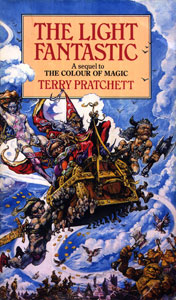
‘The Light Fantastic’ concludes the adventures of Rincewind, the failed wizard, and Twoflower, the curious tourist from the Agatean Empire, who were left at the end of ‘The Colour of Magic’ falling in some style off the edge of the world (the world being, of course, disc-shaped, said disc being on the back of four giant elephants who in turn are perching on the shell of the Great A’Tuin, a celestial turtle). Hope you got that.
Reading back over my review of ‘The Colour of Magic’ I think on reflection I may have not clearly conveyed my awe at the wonder that was Terry Pratchett. He was a creative and comic genius, and my admiration of his body of work is tinged with sadness that he will no longer be adding to it. As comic writers go I would put him almost on a par with Douglas Adams – I can think of no higher praise.
Of course this isn’t just a fan-blog, these are intended as above all things honest reviews, so there’s no point in self-censoring observations that are less than adulatory – what would be the point? But there’s equally no point in just listing the minor flaws in a novel, and ignoring the gems. So if I got the balance wrong with ‘The Colour..’ then apologies, not least to TP.
Surprisingly, Rincewind and Twoflower do not plummet to their icy deaths – they are saved by the Octavo, one of the most powerful books of magic in the Discworld, which in a pretty shameless plot device ‘adjusts reality’ to prevent the loss of one of its spells living inside Rincewind’s head, sending them to the charmingly named Forest of Skund. In a parallel storyline the senior wizards of the Unseen University try to find out what is going on by summoning Death, who warns them of the impending destruction of Discworld. Discworld fans will notice that as part of their clumsy investigations into the Octavo, this happens:
“A thick column of spitting light sprang up from the book, hit the ceiling in a splash of flame, and disappeared….The room had been part of the library until the magic had drifted through, violently reassembling the possibility particles in its path…several of the wizards later swore that the small sad orang outang sitting in the middle of it all looked very much like the head librarian”.
Yes indeed, here we have the origin story of how the Unseen University’s head librarian become a monkey sorry ape, and decided to stay that way.
Rincewind and Twoflower’s misadventures continue. With the aid of an ageing hero Cohen the Barbarian they rescue a young woman named Bethan, who forms an unconventional relationship with Cohen, which gives us one of the dodgiest jokes in the whole of the Discworld series, and possibly in the 20th century. I am not going to set it out here in full, but it ends with the punchline “We’ll just have to hope she’s shtrong enough”. Later the quip “Grinning like a necrophiliac in a morgue” from elsewhere in the novel runs it close in terms of tastelessness. Pratchett thankfully toned down the bad taste jokes and the buxom warrior-maidens running around with little to protect their modesty than a leather thong later in the series. ‘The Light Fantastic’ contains plenty of other groanworthy jokes, including this special:
“…All the shops have been smashed open. There was a whole bunch of people across the street helping themselves to musical instruments, can you believe that?”
“Yeah,” said Rincewind. “…Luters, I expect
Ultimately, Rincewind reads all eight of the Octavo’s spells aloud. This causes the moons of the red star to crack open and reveal tiny world-turtles that follow their A’Tuin on a course away from the star. The apocalypse is thus neatly and rather sweetly avoided, Twoflower decides to return home, observing that until you go home you haven’t really been anywhere, and leaves the Luggage with Rincewind as a parting gift.
When the early Discworld novels were published I read them with a degree of guilt. They were my guilty pleasures that I would put away in the presence of other adults. Not only did they have no pretensions to being anything other than a bit of fun, there were cheap jokes, stock characters, clichéd situations, and simple plot resolutions . There was just a lot of messing about. Cohen the Barbarian? Please! It wasn’t until some time well into the series that they began to develop a depth (not god forbid seriousness) and a more lyrical quality to go with the silly jokes and the one liners. The light social commentary became more thoughtful, having a purpose of its own rather than just being an excuse for some humour. Most of all his characters became real, flawed, complex and fully-rounded. We wouldn’t have ‘Going Postal’ or ‘The Night Watch’ without ‘The Colour of Magic’ and ‘The Light Fantastic’, but I am really glad we have.
P.S. Just one last point. If you look very closely at the cover illustration, still used for the Corgi editions, you will see the illustrator has shown Twoflower with four eyes. This refers back to a reference in (I think) ‘The Colour of Magic’ where someone describes him as having four-eyes, a fairly obvious reference to him wearing glasses. I suspect this mistake, which it must surely be, was identified early on, but they kept it in because they found it funny.
 The Reading Bug