The novels in the Hitchhiker series have a complex publishing history. ‘Life, the Universe and Everything’ (the answer to which is, of course, 42), was originally an outline for a Doctor Who series, Dr Who and the Krikketmen. For some unknown reason the proposal was rejected by the BBC, and it went on to eventually become the third novel of five in the Hitchhiker trilogy. It’s never been filmed, and did not form part of the radio series, which explains why the novel had a less familiar feel than ‘Hitchhiker‘ and ‘Restaurant‘.
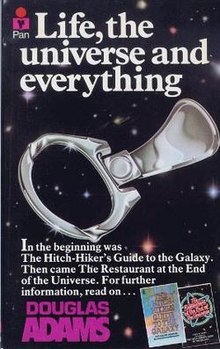
When I read the first two novels each scene was like revisiting an old friend. I could see jokes coming a long way off, but they were still golden. ‘Life’, by contrast, was a lot less familiar; while I recalled the plot and the overall structure, some of the individual events were unfamiliar, and all the more enjoyable for it.
The question I can never avoid asking when reading a series is ‘When will the quality start to dip?’ When will the author start repeating themselves, or ironically referencing themselves, or even worse in a desperate attempt to avoid repetition start taking the characters into ever more unlikely situations. This last option wasn’t possible for Adams, who had already sent his characters to the restaurant at the end of the universe, and I am pleased to say that the quality of the writing, the originality of the ideas, and the jokes do not suffer by comparison with the earlier novels. Possibly the storyline is stretched a little thinly, and any peril is completely missing – Arthur and co. have been blown up and shot at so many times that we know an utterly unlikely escape route is always bound to turn up at the last minute. Plot armour in other words. But the compensation is in the high quality jokes and ideas, such as the immortal creature who decides to insult everyone in the universe, the explanation as to why the bowl of petunias thought “Not again!”, and the concept of bistromathematics.
The novel picks up where ‘Restaurant’ ends, with Arthur stranded on pre-historic Earth. Ford Prefect, his friend from Betelgeuse, arrives to take him to see the cricket at Lords. The game is interrupted, first by their arrival and then in an even more unlikely development by a squad of white robots, who steal the Ashes. On cue Slartibartfast, award-winning creator of Norwegian fjords, arrives in the starship Bistromath, and asks Ford and Arthur for help in saving the universe.
The Bistromath is more powerful than the Heart of Gold, being powered by the mathematics of Italian restaurants (this is the imagination and creativity of Douglas Adams, and if you don’t like it take a good long look at your life). As they travel, Slartibartfast uses a hologramatic film to explain that he is trying to prevent the robots from collecting the legendary Wikkit Gate, which will unlock the planet Krikket, and unleash galaxy-wide armageddon. It seems a little more plausible when Adams tells the story – not much admittedly.
Picking up Zaphod and Trillian along the way, the team fail miserably in stopping the robots collecting the various pieces of the key or unlock the time lock. Our crew instead hopelessly transport to the planet to attempt to negotiate with the Krikkit people. To their surprise, they find that the people seem to lack any desire to continue the war, and are directed to the robot and spaceship facilities in orbit about the planet. With Zaphod and Marvin’s help, the group is able to infiltrate the facilities. There are some definite Star Wars echoes here – an intrepid band of outcasts and renegades fighting to prevent the end of the world – it is a classic story I suppose. Trillian works out (the reader will have been ahead of her I think) that the Krikkiters have been manipulated into their galaxy-hatred and galaxy-destroying capability, and confronts the mastermind behind the evil plan. No, not the Sith.
I won’t spoil the ending for you, although as Simon Brett says in the introduction to the Pan edition of the novel, “You don’t read Douglas Adams for the plots any more than you read Raymond Chandler for his”. Which might explain why with my varied reading diet of Chandler and Adams I am probably overdue something a bit more plot driven!
 )
)