Book review

Mostly Harmless, by Douglas Adams, 1992

There’s an obvious, I might even say lazy, reading of Mostly Harmless that goes something like this:

It is well known that Adams struggled with writing these novels. His lack of interest in the process is apparent in the steady decline in quality across the series, ending with this novel in which the plot is confused, the multiverse theory is wheeled out several times to explain away any inconvenient plot holes, and the ending is the author slamming the door on any further possible sequels. (In fact this novel was published posthumously, so that wasn’t really an issue as it turned out!) The dark and frankly depressing tone of the novel is largely a feature of Adams’s melancholy mood during the time he wrote it.

And of course much of that is true. The question is not whether this is a fair summary of the novel but whether there is something more interesting to be said about it?

Mostly Harmless, the fifth book in the “increasingly inaccurately named Hitchhikers’ Trilogy” derives its title from a joke earlier in the series, when Arthur Dent discovers that the entry for Earth in The Hitchhiker’s Guide to the Galaxy representing 15 years’ worth of research by Ford Prefect, consists of the word “Harmless”, which is later updated toMostly harmless”.

Arthur Dent, the one constant throughout the series, loses the love of his life, his girlfriend Fenchurch, when she disappears into an alternative time stream during a hyperspace jump. An understandably depressed Arthur wanders the galaxy, eventually ending up stranded in yet another lonely planet, where he decides to become a sandwich maker, as one does. In a parallel storyline, Ford steals a new and as yet-unpublished version of the Hitchhiker’s Guide as an act of rebellion against the guide’s new owners. In a third strand Tricia MacMillan is tortured by the thought of what her life might have turned out to be if she had left with the alien she once met at a party who invited her to travel the galaxy with him. Finally a Trillian from a separate timeline conceives a child, Random Dent, using donated sperm from Arthur.

Now if you step back a minute there’s no doubt that this as a plot outline shows some promise. Admittedly there is a considerable amount of repetition from previous novels – being stranded on a lonely planet is pretty much where we started after all (with Ford on earth). The satire is a bit heavy-handed, and the multiverse idea isn’t exactly original. But it’s a good start nonetheless. Tricia/Trillian finally gets some serious page time being more than just arm-candy for Zaphod, and the idea of the unintended consequences of over-enthusiastic sperm-donation coming back to haunt the donor is worth pursuing. So I think what I am trying to argue is that there is a good novel here struggling to get out, but not quite making it. The re-imagining of the guide as a sinister force that can navigate through time and space, inhabiting all possible universes at the same time, takes the quite benign original concept of the guide – not much more than a book after all – and turns it into a destroyer of worlds. The ending, with Ford laughing wildly at the absurdity of the universe, and Arthur finally experiencing a “tremendous feeling of peace”, feels like an entirely fitting way of Adams’s saying goodbye to his characters. 


Mostly harmless is undeniably bleak at times. Its plotlines are often left dangling – I would really like to know what happened to Fenchurch, Zaphod and Trillian for example. But (and I am very conscious I have written this many times before, of other writers and possibly of Adams as well) a badly constructed, bleak, and confused novel by Douglas Adams is still a thing of great joy. With more time this might have been a fitting finale to the series.
 

Standard
Book review

So long, and thanks for all the fish, by Douglas Adams, 1984

It will not take most readers long to work out that So Long and Thanks for All the Fish, the fourth book in the Hitchhiker’s Guide to the Galaxy trilogy, is a very different type of novel from its predecessors. These were all (more or less) novelisations of other iterations of the story, mainly the radio series in which Hitchhiker first appeared. Fast paced and fizzing with ideas, these earlier novels can be consumed in one sitting. So long, on the other hand, is a much more reflexive novel. Adams tries to capture some of the spirit of Hitchhiker etc, but eventually settles down to a much more traditional, earth -bound romance. 

At the end of Book 3 in the series, Life, the Universe and Everything, Arthur Dent, Adams’s eternal everyman, and his alien friend Ford Prefect were stranded on earth millenia before the present day. Things have now obviously moved on, because Arthur and Ford are no longer together. This is really Arthur’s novel, and Ford fades into the background playing only a minor role towards the end.  Having hitchhiked across the galaxy, Arthur is dropped back on Earth, even though the planet was. as you will recall, destroyed by the Vogons to make way for a hyper-space bypass. Arthur is surprisingly calm about this, and continues to do what he knows best – hitchhike, restlessly trying to understand what has happened to restore the earth, and where all the dolphins have gone? He has a hunch the two things are connected.

On his travels he catches a lift with a man named Russell and his sister Fenchurch. Fenchurch is withdrawn and uncommunicative, and Russell hints that she is mentally unwell. It slowly becomes clear that Fenchurch’s condition is connected to the demolition of the Earth and its subsequent reappearance, which the rest of the population avoids thinking about by claiming it was mass hysteria. Arthur is fascinated by Fenchurch, partly because he is strongly attracted to her, but also because he suspects that she is one of very few people left on earth who might be able to understand what he has experienced.

As the novel unfolds their paths keep crossing and uncrossing. Arthur finds Fenchurch hitchhiking, gives her a lift, but on parting manages to lose her phone number. He then miraculously rediscovers her by searching for the cave he lived in on prehistoric Earth – her flat is on the same spot on this quasi-Earth. There is something strange about Fenchurch, and it is only when Arthur finally works it out that they are able to properly connect with one another. It transpires that Fenchurch was the woman mentioned in passing in the opening chapter of the previous novel who, moments before the earth’s demolition, had stumbled across the answer to life, the universe and everything. Someone who in the previous novel was just a throw-away gag becomes here a central character. The destruction of the earth had interrupted her epiphany, and Fenchurch is now left with a nagging sensation that a tantalising breakthrough is just out of reach – and the thought is making her ill.

Eventually, they are reunited with Ford Prefect, and they set off once again across the universe to visit the planet where God’s Final Message to His Creation is written, in the hope that it might give them some peace. On the way they encounter Marvin, the paranoid android, still as misanthropic as ever, but now some 37 times older than the known age of the universe and on his last circuits.

Neil Gaiman’s introduction reveals some of the pain Adams went through in composing So Long, but if you didn’t know it would probably still be apparent. At one point for example he retells in detail an urban legend (the one about the man sitting opposite you in a cafe who helps himself to your biscuits). It’s exquisitely told, but it’s padding nonetheless. (There was a point to this story, but it has temporarily escaped the chronicler’s mind.) Gaiman reveals that Adams’ editor moved in with him in a vain attempt to ensure that the book was completed to deadline. This might have led to some of the unevenness of tone of the novel, a feeling that every word was an effort and that the end comes as much to a relief as Adams as it did to Marvin. But a bad book by a genius can’t but help but be a work of genius, even if it is flawed. There are many moment to savour in So Long, not least the title which like many of Adams’s phrases has entered the general lexicon. This is not Adams at his best or his most inventive, and the jokes are a little dated (“There is a feeling which persists in England that making a sandwich interesting, attractive or in any way pleasant to eat is something sinful that only foreigners do.”) but it must still be treasured as part of the wider contribution he made to our culture.


Standard
Book review

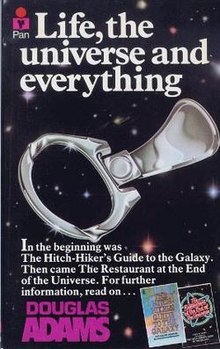
Life, the Universe, and Everything, by Douglas Adams,


The novels in the Hitchhiker series have a complex publishing history. ‘Life, the Universe and Everything’ (the answer to which is, of course, 42),  was originally an outline for a Doctor Who series, Dr Who and the Krikketmen. For some unknown reason the proposal was rejected by the BBC, and it went on to eventually become the third novel of five in the Hitchhiker trilogy. It’s never been filmed, and did not form part of the radio series, which explains why the novel had a less familiar feel than ‘Hitchhiker‘ and ‘Restaurant‘. 

When I read the first two novels each scene was like revisiting an old friend. I could see jokes coming a long way off, but they were still golden. ‘Life’, by contrast, was a lot less familiar; while I recalled the plot and the overall structure, some of the individual events were unfamiliar, and all the more enjoyable for it.

The question I can never avoid asking when reading a series is ‘When will the quality start to dip?’ When will the author start repeating themselves, or ironically referencing themselves, or even worse in a desperate attempt to avoid repetition start taking the characters into ever more unlikely situations. This last option wasn’t possible for Adams, who had already sent his characters to the restaurant at the end of the universe, and I am pleased to say that the quality of the writing, the originality of the ideas, and the jokes do not suffer by comparison with the earlier novels. Possibly the storyline is stretched a little thinly, and any peril is completely missing – Arthur and co. have been blown up and shot at so many times that we know an utterly unlikely escape route is always bound to turn up at the last minute. Plot armour in other words. But the compensation is in the high quality jokes and ideas, such as the immortal creature who decides to insult everyone in the universe, the explanation as to why the bowl of petunias thought “Not again!”, and the concept of bistromathematics.

The novel picks up where ‘Restaurant’ ends, with Arthur stranded on pre-historic Earth. Ford Prefect, his friend from Betelgeuse, arrives to take him to see the cricket at Lords. The game is interrupted, first by their arrival and then in an even more unlikely development by a squad of white robots, who steal the Ashes. On cue Slartibartfast, award-winning creator of Norwegian fjords, arrives in the starship Bistromath, and asks Ford and Arthur for help in saving the universe.

The Bistromath is more powerful than the Heart of Gold, being powered by the mathematics of Italian restaurants (this is the imagination and creativity of Douglas Adams, and if you don’t like it take a good long look at your life). As they travel, Slartibartfast uses a hologramatic film to explain that he is trying to prevent the robots from collecting the legendary Wikkit Gate, which will unlock the planet Krikket, and unleash galaxy-wide armageddon. It seems a little more plausible when Adams tells the story – not much admittedly.

Picking up Zaphod and Trillian along the way, the team fail miserably in stopping the robots collecting the various pieces of the key or unlock the time lock. Our crew instead hopelessly transport to the planet to attempt to negotiate with the Krikkit people. To their surprise, they find that the people seem to lack any desire to continue the war, and are directed to the robot and spaceship facilities in orbit about the planet. With Zaphod and Marvin’s help, the group is able to infiltrate the facilities. There are some definite Star Wars echoes here – an intrepid band of outcasts and renegades fighting to prevent the end of the world – it is a classic story I suppose. Trillian works out (the reader will have been ahead of her I think) that the Krikkiters have been manipulated into their galaxy-hatred and galaxy-destroying capability, and confronts the mastermind behind the evil plan. No, not the Sith. 

I won’t spoil the ending for you, although as Simon Brett says in the introduction to the Pan edition of the novel, “You don’t read Douglas Adams for the plots any more than you read Raymond Chandler for his”. Which might explain why with my varied reading diet of Chandler and Adams I am probably overdue something a bit more plot driven!

Origins

Standard
Book review

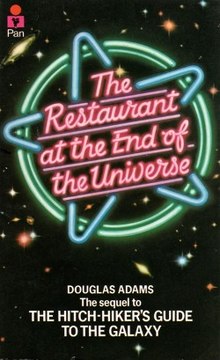
The Restaurant at the End of the Universe by Douglas Adams, 1980

The Restaurant at the End of the Universe, the sequel to The Hitchhiker’s Guide to the Galaxy, picks up immediately where Hitchhiker ends, with our hapless adventurers under attack from the Vogons, despite there being no tea. Having faced imminent death 220pxRestaurantAtTheEndOfTheUniverse.jpgseveral times before, this causes them less concern that you would expect, and another last minute rescue leads to the party (Arthur Dent, earthling, Trillian, hitchhiker, Ford Prefect, researcher for the Hitchhiker’s Guide to the galaxy, Zaphod Beeblebrox, President of the Galaxy, and Marvin, the paranoid android) being separated once again.
Zaphod and Marvin are transported to the offices of The Hitchhiker’s Guide to the Galaxy on Ursa Minor Beta. Zaphod is determined to trace down whoever left a message in his brain, even if it turns out to be himself. The Guide’s offices are taken prisoner and carried to Frogstar World B. FWB is a benighted planet whose economy has been ruined by a critical mass of shoe shops. The intention is to destroy Zaphod’s mind by sending him into the Total Perspective Vortex, a torture device designed to show people how small they are compared to the size of the Universe. Zaphod emerges unscathed because after all, he is Zaphod Beeblebrox.

Through some trickery with artificial universes, the party is reunited long enough for breakfast at Milliways, the Restaurant at the End of the Universe. Marvin has to take the slow route, parking spaceships while waiting for the humans to arrive (or is it return?). The Restaurant at the End of the Universe is one of Adams’s most magnificent creations. I always loved the selectively bred cow that actually wants to be eaten:

“Four rare steaks please, and hurry, we haven’t eaten in five hundred and seventy-six thousand million years.”

The animal staggered to its feet. It gave a mellow gurgle.

‘A very wise choice, sir, if I may say so. very good…I’ll just nip off and shoot myself.” He turned and gave a friendly wink to Arthur. “Don’t worry, sir” he said, “I’ll be very humane”. 

There’s a very special, poetic aspect to the way the end of the universe is described by the show’s host, undercut by the Second Coming of the Prophet Zarquon. We also get to meet Hotblack Desiato at the restaurant, a rock star spending a year dead for tax purposes. After a further narrow escape from imminent death, this time by diving into a star to provide backing effects for a rock concert, which is to be honest a pretty rock and roll way to go, Zaphod and Trillian get to meet the man who runs the universe, while Arthur and Ford discover the origins of life on earth, and why everyone is so bloody useless (which is probably something to do with the fact that we are all descended from hairdressers and telephone sanitisers).

Adams’ commentary on modern life is razor sharp. I especially enjoyed the way the Golgafrinchams (Ark B) make leaves their currency to disprove the argument that money doesn’t grow on trees, and then tackle their galloping hyperinflation by burning down all the forests. Isn’t that austerity economics for you? I was slightly concerned that Restaurant wouldn’t sustain the brilliance of Hitchhiker, but I shouldn’t have worried. Yes there are some uneven patches – I never quite understand the point of Zarniwoop –  but the concepts are extraordinary and the jokes never miss. Marvin continues to be a paradoxical source of joy (“The first ten million years were the worst,” said Marvin, “and the second ten million years, they were the worst too. The third ten million years I didn’t enjoy at all. After that I went into a bit of a decline”). I think it is best not to see ‘Restaurant’ as a sequel but more as the second half of ‘Hitchhiker’, best read one after the other with as short a break as possible. I am minded not to push on with the third, fourth and fifth books of the trilogy – I absolutely understand why they were written, but there is a certain polished perfection to these two novels that might be tarnished by anything that doesn’t meet their sustained genius. What do people think?

Standard
Book review

Hitchhiker’s Guide to the Galaxy, a trilogy in five parts, Douglas Adams, 1979

When the world is demolished to make way for an intergalatic bypass, Arthur Dent, one of only two survivors (and an alien, some dolphins, and two mice) embarks on an extraordinary journey to discover the answer to the great question of life, the universe and everything.

Re-reading ‘Hitchhiker’ after far too many years was a delight. It was like meeting an old friend for a few wonderful hours. Having grown up with the radio series, then the books, the television series, and finally the film, long stretches of the text were as familiar as a long lost childhood toy. Hitchhiker forms a central part of the cultural zeitgeist of the late 70’s and 80’s. Concepts such as the babelfish, the infinite improbability drive, Marvin the paranoid android (“I think you ought to know I’m feeling very depressed”) the Adamsrestaurant at the end of the universe, and life the universe and everything, now have their own existences far beyond the confines of this novel.

There’s a wonderful rhythm and pace to this novel which it is hard to convey from short excerpts, which provides an excellent excuse to quote the extended section from the visit to Magrathea at the end of this review. Adams is a master at setting up jokes, and is never happier than when interrupting the plot development for a bit of silliness. The premise of the guide being allowed to explain the concepts and background to the reader, rather than using character exposition, also works really well and is one of the many pleasures of this fabulous novel.

If I were to describe Hitchhiker as a science fiction novel a proportion of potential readers would switch off. Sci-fi is perceived as a male dominated arena, where character is secondary to world-building. There are certainly a lot of scientific ideas in the novel, and much of it happens in outer space, but Hitchhiker defies simple categorisation. Above all it is funny, funny in wise and interesting ways. Adams had a way of looking at the world which made it fresh, and had fun with language, such as here, when Ford Prefect, the hitchhiker from Betelguese, warns Arthur Dent, (I can never see his name without repeating the silly joke ‘Dentarthurdent’) the novel’s permanently bemused everyman, that jumping into hyperspace feels like being drunk:

What’s so unpleasant about being drunk?”

“Ask a glass of water!”

And here is a wonderful example of Adams’s silliness, combined with the ability to make the reader think, the extended quote promised earlier:

 “Another thing that got forgotten was the fact that against all probability a sperm whale had suddenly been called into existence several miles above the surface of an alien planet. And since this is not a naturally tenable position for a whale, this poor innocent creature had very little time to come to terms with its identity as a whale before it then had to come to terms with not being a whale any more. This is a complete record of its thoughts from the moment it began its life till the moment it ended it.

Ah … ! What’s happening? it thought.

Er, excuse me, who am I?

Hello? Why am I here? What’s my purpose in life?

What do I mean by who am I?

Calm down, get a grip now … oh! this is an interesting sensation, what is it? It’s a sort of … yawning, tingling sensation in my … my … well I suppose I’d better start finding names for things if I want to make any headway in what for the sake of what I shall call an argument I shall call the world, so let’s call it my stomach.

Good. Ooooh, it’s getting quite strong. And hey, what’s about this whistling roaring sound going past what I’m suddenly going to call my head? Perhaps I can call that … wind! Is that a good name? It’ll do … perhaps I can find a better name for it later when I’ve found out what it’s for. It must be something very important because there certainly seems to be a hell of a lot of it. Hey! What’s this thing? This … let’s call it a tail – yeah, tail. Hey! I can can really thrash it about pretty good can’t I? Wow! Wow! That feels great! Doesn’t seem to achieve very much but I’ll probably find out what it’s for later on. Now – have I built up any coherent picture of things yet?

No.

Never mind, hey, this is really exciting, so much to find out about, so much to look forward to, I’m quite dizzy with anticipation …

Or is it the wind? There really is a lot of that now isn’t it? And wow! Hey! What’s this thing suddenly coming towards me very fast? Very very fast. So big and flat and round, it needs a big wide sounding name like … ow … ound … round … ground! That’s it! That’s a good name – ground!

I wonder if it will be friends with me?

And the rest, after a sudden wet thud, was silence.

Curiously enough, the only thing that went through the mind of the bowl of petunias as it fell was Oh no, not again. Many people have speculated that if we knew exactly why the bowl of petunias had thought that we would know a lot more about the nature of the universe than we do now.”

(Gloriously, this quote in Goodreads has the following tags: petunias, sperm-whale).

If you haven’t read Hitchhiker’s by now, chances are you probably won’t, but I am still going to recommend you do anyway. It will only take you an afternoon, at most, and if you hate it then what have you lost? If you love it just a small fraction as much as I and so many other people do, you’re welcome.

Standard