Book review

So long, and thanks for all the fish, by Douglas Adams, 1984

It will not take most readers long to work out that So Long and Thanks for All the Fish, the fourth book in the Hitchhiker’s Guide to the Galaxy trilogy, is a very different type of novel from its predecessors. These were all (more or less) novelisations of other iterations of the story, mainly the radio series in which Hitchhiker first appeared. Fast paced and fizzing with ideas, these earlier novels can be consumed in one sitting. So long, on the other hand, is a much more reflexive novel. Adams tries to capture some of the spirit of Hitchhiker etc, but eventually settles down to a much more traditional, earth -bound romance. 

At the end of Book 3 in the series, Life, the Universe and Everything, Arthur Dent, Adams’s eternal everyman, and his alien friend Ford Prefect were stranded on earth millenia before the present day. Things have now obviously moved on, because Arthur and Ford are no longer together. This is really Arthur’s novel, and Ford fades into the background playing only a minor role towards the end.  Having hitchhiked across the galaxy, Arthur is dropped back on Earth, even though the planet was. as you will recall, destroyed by the Vogons to make way for a hyper-space bypass. Arthur is surprisingly calm about this, and continues to do what he knows best – hitchhike, restlessly trying to understand what has happened to restore the earth, and where all the dolphins have gone? He has a hunch the two things are connected.

On his travels he catches a lift with a man named Russell and his sister Fenchurch. Fenchurch is withdrawn and uncommunicative, and Russell hints that she is mentally unwell. It slowly becomes clear that Fenchurch’s condition is connected to the demolition of the Earth and its subsequent reappearance, which the rest of the population avoids thinking about by claiming it was mass hysteria. Arthur is fascinated by Fenchurch, partly because he is strongly attracted to her, but also because he suspects that she is one of very few people left on earth who might be able to understand what he has experienced.

As the novel unfolds their paths keep crossing and uncrossing. Arthur finds Fenchurch hitchhiking, gives her a lift, but on parting manages to lose her phone number. He then miraculously rediscovers her by searching for the cave he lived in on prehistoric Earth – her flat is on the same spot on this quasi-Earth. There is something strange about Fenchurch, and it is only when Arthur finally works it out that they are able to properly connect with one another. It transpires that Fenchurch was the woman mentioned in passing in the opening chapter of the previous novel who, moments before the earth’s demolition, had stumbled across the answer to life, the universe and everything. Someone who in the previous novel was just a throw-away gag becomes here a central character. The destruction of the earth had interrupted her epiphany, and Fenchurch is now left with a nagging sensation that a tantalising breakthrough is just out of reach – and the thought is making her ill.

Eventually, they are reunited with Ford Prefect, and they set off once again across the universe to visit the planet where God’s Final Message to His Creation is written, in the hope that it might give them some peace. On the way they encounter Marvin, the paranoid android, still as misanthropic as ever, but now some 37 times older than the known age of the universe and on his last circuits.

Neil Gaiman’s introduction reveals some of the pain Adams went through in composing So Long, but if you didn’t know it would probably still be apparent. At one point for example he retells in detail an urban legend (the one about the man sitting opposite you in a cafe who helps himself to your biscuits). It’s exquisitely told, but it’s padding nonetheless. (There was a point to this story, but it has temporarily escaped the chronicler’s mind.) Gaiman reveals that Adams’ editor moved in with him in a vain attempt to ensure that the book was completed to deadline. This might have led to some of the unevenness of tone of the novel, a feeling that every word was an effort and that the end comes as much to a relief as Adams as it did to Marvin. But a bad book by a genius can’t but help but be a work of genius, even if it is flawed. There are many moment to savour in So Long, not least the title which like many of Adams’s phrases has entered the general lexicon. This is not Adams at his best or his most inventive, and the jokes are a little dated (“There is a feeling which persists in England that making a sandwich interesting, attractive or in any way pleasant to eat is something sinful that only foreigners do.”) but it must still be treasured as part of the wider contribution he made to our culture.
 

Standard
Book review

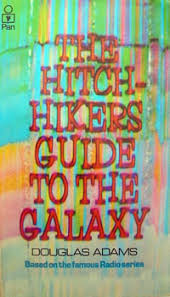
Hitchhiker’s Guide to the Galaxy, a trilogy in five parts, Douglas Adams, 1979

When the world is demolished to make way for an intergalatic bypass, Arthur Dent, one of only two survivors (and an alien, some dolphins, and two mice) embarks on an extraordinary journey to discover the answer to the great question of life, the universe and everything.

Re-reading ‘Hitchhiker’ after far too many years was a delight. It was like meeting an old friend for a few wonderful hours. Having grown up with the radio series, then the books, the television series, and finally the film, long stretches of the text were as familiar as a long lost childhood toy. Hitchhiker forms a central part of the cultural zeitgeist of the late 70’s and 80’s. Concepts such as the babelfish, the infinite improbability drive, Marvin the paranoid android (“I think you ought to know I’m feeling very depressed”) the Adamsrestaurant at the end of the universe, and life the universe and everything, now have their own existences far beyond the confines of this novel.

There’s a wonderful rhythm and pace to this novel which it is hard to convey from short excerpts, which provides an excellent excuse to quote the extended section from the visit to Magrathea at the end of this review. Adams is a master at setting up jokes, and is never happier than when interrupting the plot development for a bit of silliness. The premise of the guide being allowed to explain the concepts and background to the reader, rather than using character exposition, also works really well and is one of the many pleasures of this fabulous novel.

If I were to describe Hitchhiker as a science fiction novel a proportion of potential readers would switch off. Sci-fi is perceived as a male dominated arena, where character is secondary to world-building. There are certainly a lot of scientific ideas in the novel, and much of it happens in outer space, but Hitchhiker defies simple categorisation. Above all it is funny, funny in wise and interesting ways. Adams had a way of looking at the world which made it fresh, and had fun with language, such as here, when Ford Prefect, the hitchhiker from Betelguese, warns Arthur Dent, (I can never see his name without repeating the silly joke ‘Dentarthurdent’) the novel’s permanently bemused everyman, that jumping into hyperspace feels like being drunk:

What’s so unpleasant about being drunk?”

“Ask a glass of water!”

And here is a wonderful example of Adams’s silliness, combined with the ability to make the reader think, the extended quote promised earlier:

 “Another thing that got forgotten was the fact that against all probability a sperm whale had suddenly been called into existence several miles above the surface of an alien planet. And since this is not a naturally tenable position for a whale, this poor innocent creature had very little time to come to terms with its identity as a whale before it then had to come to terms with not being a whale any more. This is a complete record of its thoughts from the moment it began its life till the moment it ended it.

Ah … ! What’s happening? it thought.

Er, excuse me, who am I?

Hello? Why am I here? What’s my purpose in life?

What do I mean by who am I?

Calm down, get a grip now … oh! this is an interesting sensation, what is it? It’s a sort of … yawning, tingling sensation in my … my … well I suppose I’d better start finding names for things if I want to make any headway in what for the sake of what I shall call an argument I shall call the world, so let’s call it my stomach.

Good. Ooooh, it’s getting quite strong. And hey, what’s about this whistling roaring sound going past what I’m suddenly going to call my head? Perhaps I can call that … wind! Is that a good name? It’ll do … perhaps I can find a better name for it later when I’ve found out what it’s for. It must be something very important because there certainly seems to be a hell of a lot of it. Hey! What’s this thing? This … let’s call it a tail – yeah, tail. Hey! I can can really thrash it about pretty good can’t I? Wow! Wow! That feels great! Doesn’t seem to achieve very much but I’ll probably find out what it’s for later on. Now – have I built up any coherent picture of things yet?

No.

Never mind, hey, this is really exciting, so much to find out about, so much to look forward to, I’m quite dizzy with anticipation …

Or is it the wind? There really is a lot of that now isn’t it? And wow! Hey! What’s this thing suddenly coming towards me very fast? Very very fast. So big and flat and round, it needs a big wide sounding name like … ow … ound … round … ground! That’s it! That’s a good name – ground!

I wonder if it will be friends with me?

And the rest, after a sudden wet thud, was silence.

Curiously enough, the only thing that went through the mind of the bowl of petunias as it fell was Oh no, not again. Many people have speculated that if we knew exactly why the bowl of petunias had thought that we would know a lot more about the nature of the universe than we do now.”

(Gloriously, this quote in Goodreads has the following tags: petunias, sperm-whale).

If you haven’t read Hitchhiker’s by now, chances are you probably won’t, but I am still going to recommend you do anyway. It will only take you an afternoon, at most, and if you hate it then what have you lost? If you love it just a small fraction as much as I and so many other people do, you’re welcome.

Standard