Book review

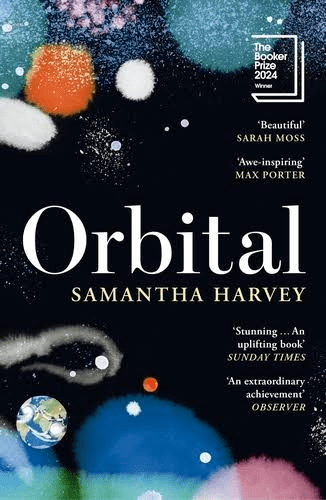
Orbital by Samantha Harvey 2023

Rotating about the Earth in their spacecraft, they are so together, and so alone, that even their thoughts, their internal mythologies, at times convene. Sometimes they dream the same, dreams of fractals and blue spheres and familiar faces engulfed in dark, and of the bright energetic black of space that slams their senses. Raw space is a panther, feral and primal; they dream it stalking through their quarters.

Orbital, which won the 2024 Booker Prize, follows a day in the lives of six astronauts in low-earth orbit on the International Space Station. Italian, Russian, British, American and Japanese astronauts spend their day in a mixture of the mundane – monitoring routine experiments on the behaviour of microbes and mice in space, documenting their bodily functions, eating, drinking, sleeping – and the extraordinary, watching the vastness of space and the earth pinwheeling round. We learn the backstory of each astronaut and how they came to be on the ISS. Simultaneously another mission takes off from earth, this time going back to the moon.

The novel is a poem to the beauty of the earth and its fragile improbability. The prose is extraordinarily lyrical – I could fill this review with examples of the author’s wonderful descriptions of earth as it passes by the space station’ s windows:
There’s the first dumbfounding view of Earth, a hunk of tourmaline, No, a cantaloupe, an eye, lilac, orange, almond, mauve, white, magenta, bruised, textured, shellacked splendour.

and

As they traverse south, the colours change, the browns lighter, the palette less sombre, a range of greens, from the dark of the mountainsides to the emerald of river plains to the teal of the sea. The rich purplish green of the vast Nile Delta. Brown becomes peach, becomes plum: Africa beneath them in its abstract batik. The Nile is a spillage of royal blue ink.

and

Down over the arrowing peninsula of Dakar, crossing the equator, and in the closing minutes of day, the lights of Brazzaville and Kinshasa on either side of the Congo River, tepid in the dusk. Blue becomes mauve becomes indigo becomes black, and night-time down southern Africa in one. Gone is the paint-splattered, ink-leached, crumpled-satin, crumbled-pastel overflowing-fruit-bowl continent of chaotic perfection, the continent of salt pans and red sedimented floodplain and the nerve networks of splaying rivers and mountains that bubble up from the plains, green and velvety like mould growth. Gone is a continent, and here is another sheer widow’s veil of starstruck night.

This is some of the finest descriptive writing I have read in a very long time and I make no apology for quoting it at such length.

Orbital is not just a prose poem on the beauty of the earth. No novel, however slight (the text is less than 140 pages long) could sustain that as its sole theme. It touches on a number of other topics. One of the astronauts is asked to provide a response to the question “With this new era of space travel, how are we writing the future of humanity?” (this is with reference to the new journey to the moon, not the low-orbit space station which is very much showing its age), and the response offered by one of his fellow astronauts is “With the gilded pens of billionaires”, which is at once beautifully lyrical and at the same time recognises the role of the mega-rich in plotting the future course of space exploration. Climate change is addressed as the astronauts watch a tornado as it cuts a devastating route across islands in the Pacific. Chie, the Japanese astronaut, finds out that her mother has died and reflects on the improbability of her birth (her mother survived the atom bombs on Japan at the end of the second world war) and her journey into space.

There are many small stories here – but I would have to accept that the absence of a larger, over-arching storyline was one I missed. Orbital has no real narrative structure, no story in the conventional sense. There is incident – when the mice being experimented on suddenly discover that the absence of gravity means they can effectively fly is a wonderful moment – but the book felt more like an extended short story rather than a novella. While the distinction between these two categories might seem slight |I do think it is significant. It meant that there were points in the book where, however wonderful the prose descriptions of the earth were, I felt that there are only so many of these that I needed.

I will definitely be looking out for more works by this author. Her description of the ‘cosmic calendar‘ concept, used to to visualise the chronology of the universe, scaling its currently understood age of nearly fourteen billion years into a single year in order to help us comprehend the vastness of its scale, was extraordinary, and worth the price of admission on its own. Although this is a familiar concept I don’t think I have ever read it described more lyrically or in fact beautifully as Harvey in this book. She is a great writer, even if here she is not such a great story-teller.
Orbital by Samantha Harvey 2023

Aside
Book review

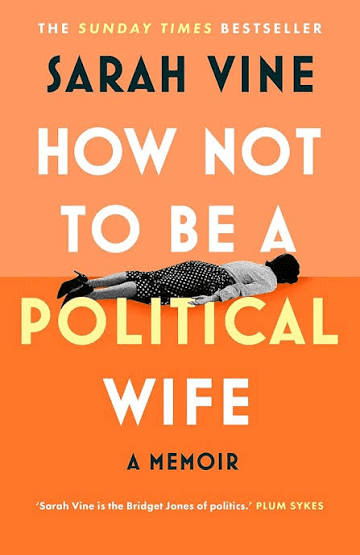
How Not to be a Political Wife by Sarah Vine, 2025

This book’s clumsy title sets the tone for what is, one can be pretty confident, going to be quite a bumpy ride. The book is categorised as a memoir, but more accurately it is a confessional of staggeringly indiscrete proportions, quite calculatedly burning lots of Ms Vine’s bridges with the Cameron vintage Conservative hierarchy. The book serves as an interesting and I suspect deliberate contrast to Sasha Swire’s much more reflective and considered Diary of an MP’s Wife which covers much of the same time period and territory.

Sarah Vine describes herself as a journalist, but more accurately she is a columnist, writing observational pieces about the world as she sees it. She is one of the genre of columnists who specialise in what is now called ‘rage-bait’ – constructing controversial ‘opinions’ and comments to order that she may or may not mean to be taken seriously, but which are going to drive traffic to her newspaper’s website, which nowadays is all that matters.

The author had a front-row seat at some of the most turbulent years of recent British politics. She worked for mainly right-wing newspapers throughout the period covered by the memoir. Her husband Michael Gove was Education Secretary, Chief Whip, and Lord Chancellor in David Cameron’s and Theresa May’s governments, and then held prominent roles in the Conservative administrations after the 2019 general election. He is now editor of the Spectator and, it goes without saying, a member of the House of Lords. In mentioning Mr Gove I am not succumbing to the sexist idea that a woman is only as important as her husband’s job. The fact is his story is an integral part of this memoir – his choices and decisions had a profound impact on the course of her life over this period and he features significantly throughout. In fact she defines herself in this narrative by contrasting what she did with what she believes was expected of her – hence the book’s title. While the introductory chapters on the author’s early life are interesting, the substance of the book is her role as Gove’s wife and partner, inside observer of the recent Conservative governments. This period can be summed up briefly – for the author it was (despite all the privilege and benefits being part of the Government involved) unremittingly awful. Everyone felt entitled to be nasty to you:

Doctors can shed what’s left of their bedside manner with you. Ordinary people no longer need have any consideration for you. Friends no longer trust you. Children are taught to despise you, not respect you. Journalists and policemen no longer need to be impartial or accurate. You have lost those human rights and protections because you are no longer human, you are a politician and you are now the legitimate prey of the only big game hunting still allowed in this country.

It wasn’t just unkind words of course – death threats followed, their children were bullied and they were ostracised from various friendship groups. None of this stopped Vine having her manufactured views on her political opponents of course. She wrote of Ed Miliband’s kitchen, for example, that there was “not much prospect of a decent meal emanating from that mean, sterile, little box.” Minor television celebrity Carol Vorderman is paid back for having the temerity to criticise the later Tory administrations: “One year we had Carol Vorderman, when she was in her pro Tory phase (as opposed to her sucking up to Labour phase): rarely have I encountered such a heavily cantilevered bosom.” Is the state of Carol Vorderman’s bosom really relevant here?

It wasn’t all bad. Vine has happy memories of weekends at Chequers with the Camerons and the rest of the Notting Hill set:

Sam really came into her own when she threw a party, and the party she threw at Chequers for her delayed 40th, in 2014, was probably my last truly happy memory of those gilded days, and almost certainly one of the best parties I’ve ever been to. Sam had transformed the Great Hall into a rave, with glitter balls, lasers and disco lights playing over about 150 people dancing wildly to the music of DJ Sarah HB, short for Hard Bitch. Dave and Sam ruled over the dance floor, always the best dancers, doing their Ceroc double act with enviable grace. Everyone was beautiful and clever and powerful; but for once I didn’t feel like Cinders at the ball. Sam had already complimented me on my Diane von Furstenberg black wrap dress, even though it was a touch too tight around the middle – “those bosoms, Sarah!” – and I was having the time of my life, sipping mojitos and chatting to Sarah Montague in the Rose Garden.

Vine’s main issue is a crippling instance of imposter syndrome. Her dysfunctional relationship with her bullying father (who in the book’s acknowledgements she thanks for “fucking me up so brilliantly” and who lived to see this book published) has left her with the inability to believe she deserves her place in ranks of the country’s privileged few. Money is an obsession – she objects to Gove’s sacking by Cameron as Education Secretary because of the impact it will have on their family income. Her address is not quite in the right postcode. Gove even pays to have an 0207 number (instead of 0208) – an incredibly niche but telling piece of status insecurity that today has not real equivalent.

The heart of the book is her account of the Brexit debacle. Gove promised not to campaign for Brexit, then led the campaign, expressing disbelief that the Cameron’s would see that as a betrayal, even though it destroyed his political career. (In his memoir For the Record, David Cameron directly accuses Michael Gove of disloyalty, stating, “As for Michael, one quality shone through: disloyalty. Disloyalty to me — and, later, disloyalty to Boris”). Vine is able to see that “everyone hated us” without ever really understanding why. If everyone hates you, doesn’t that suggest that you have done something to provoke that response, rather than that everyone was wrong, misjudging you, or being hateful? Gove’s decision to support the Vote Leave campaign and to go on and lead the Brexit campaign, was a turning point in the whole debate – it is arguable that without that decision Boris Johnson would not have supported leave, and potentially that the outcome of the vote would have been different. Certainly Vine’s description of the days and weeks following the Brexit vote does not read like a celebration by the winning side. The suggestion that Cameron should have stayed on as Prime Minister and worked to implement the outcome of the Brexit vote, that his refusal to take responsibility for something he had found hard against was in some way the cause of the utter shitshow that followed, is laughable. Talk about not owning your own mistakes!

Vine has a stunning lack of insight into why people hated her, why they blamed her husband for the disaster that was Brexit, why people stopped being their friends after he stabbed them in the back. She just can’t understand why anyone had a problem with her and Gove’s behaviour. It is all a mystery – which is funny because even the most obtuse reader can easily understand these things. Vine is like a flawed narrator of her own memoir, accidentally revealing insights into her personality and behaviour without having them herself. There are more accurate and more interesting histories of this period, but How Not to be a Political Wife nevertheless gives an original insight into many of the mistakes made by those involved.

How Not to be a Political Wife by Sarah Vine, 2025

Aside
Book review

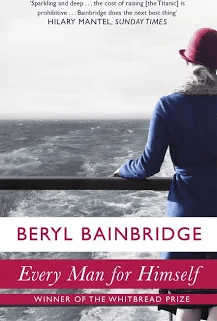
Every Man for Himself by Beryl Bainbridge, 2002

Half past four on the afternoon of 8th April 1912 – the weather was mild and hyacinths bloomed in window boxes – a stranger chose to die in my arms. “Please,” I said, as he pitched forward and clutched me round the waist. We both fell to our knees. Over the road a crocodile of Girl Guides sashayed sing-song through the ornamental gates of the public gardens.

I wrote some time back about my policy of avoiding reading much, if anything, about a novel before reading the novel itself. Apart from the obvious risk of spoilers, pre-reading can influence your reaction to a book, shaping it in a certain direction. For example, if you are told a novel is ‘a work of genius’ it might encourage you to overlook any flaws you identify in it. A similar problem occurred after I read Beryl Bainbridge’s book about the Titanic disaster, Every Man for Himself, when I came across this article she wrote in the Guardian in 2009. In it she describes the process of negotiating a new contract with her publisher:

“I’d been about to seek another publisher, one who would offer me money, and told Baird-Smith that I was willing to stay with him if he granted me a three-book contract, something miraculous I’d heard of in regard to other authors. When he asked me what themes I was considering, from the top of my head I blurted out Scott going to the pole, the sinking of the Titanic and the Crimean war. Baird-Smith then offered me a substantial advance, which shook me; I wasn’t used to payments.”

Bainbridge was true to her word, writing Master Georgie about the Crimean War, The Birthday Boys about the Scott Polar expedition, and Every Man for Himself. Does it matter that Bainbridge was writing to order rather than being genuinely inspired by her subject matter? A bit, yes. Because I think it shows in the novel itself. The writing is rather ‘by the numbers’ and only sporadically shows a real interest in the subject matter. Most of the novel sees the characters in a holding pattern, running up the word count and down the clock until the iceberg strikes.

As a thought exercise, imagine you were the author in this situation, committed to writing a novel about the Titanic. How would you go about addressing the central challenge of this scenario, which is obviously the lack of any suspense about the overall ending? The first thing you would do, I would suggest, is try to make your central character or characters people the reader cares about, wanting to know whether they survive – in other words you reframe the question ‘What happens?’ to ‘What happens to X?’ This would involve giving the character a backstory and the reader a reason to care about them. The other element I think the hypothetical novel would need would be some depth – for example consideration of social issues or class. The differential in survival rates on the Titanic – 62% of first-class passengers survived, against only 24% of third class passengers (41% for second class if you were interested) – has always struck me as something worth detailed analysis. Was it because the first-class passengers were prioritised in the evacuation and in life-boat spaces, or was it more to do with where they were in the ship when the collision occurred? (To be clear, I am 100% sure that this differential has been analysed very fully by historians – I just don’t think the issues have ever been explored by novelists). And then there’s the crew, who had to supervise the evacuation and enforce the ‘women and children first’ protocol, many of whom stayed behind to carry out their duties to the last minute. The Titanic sinking has so many dramatic stories, conflicts, moments of tension and so on that it would be almost impossible to write a novel that didn’t engage the reader in the drama of the situation.

And yet….

Every Man for Himself tells the story of the sinking of the Titanic through the eyes of one of the first-class passengers, 22 year-old Morgan, part of a very wealthy banking family. Morgan is an orphan who was brought up relatives. Before boarding the ship he sees a man who has fallen onto some railings, dying in a rather clumsy piece of foreshadowing. Once onboard he spends his time socialising with the other first class passengers. He shows some interest in the construction of the ship (having worked on some aspects of its design – presumably the author providing us with a reason to care a little more about the outcome?) and finds out that it set sail with a fire in one of the coal holds not completely under control. There are also occasional mentions of warnings from other ships about icebergs ahead. But the Titanic was unsinkable, so there is nothing to worry about…. He is attracted to socialite Wallis Ellery, who flirts with him while all the time having a fling with one of the other passengers, but he recovers fairly quickly when he finds this out.

The Titanic’s evacuation order (which, from what I can tell, was a long-established protocol) was the very opposite of the novel’s title – not ‘every man for himself’ but ‘women and children first’ – an order that was largely voluntarily complied with. I think the author chose this title as a commentary on the behaviour of the first-class passengers prior to the collision, where their personal interests, well-being and finances are prioritised over everyone else. Every man for himself was the spirit of the age.

Bainbridge does her best to differentiate the large cast of characters, but at times they blurred into one another. Everyone seems to know everyone else (Morgan even knows the captain). This privileged social circle is intimate and hostile to outsiders. Morgan describes his first dinner on board thus:

Dinner that evening was a boisterous affair. Ours was a small world and between the soup and the fish we were all constantly bobbing up and down to acknowledge people we knew; but for the intermittent and minute flickerings of the electric lights we might have been dining at the Ritz in Paris. The Thayers stopped at our table, the Daniels, Mrs Snyder, the Speddens of Tuxedo
Park, Colonel Gracie, jolly Mrs Hogeboom with the excessively ritual eccentric Mrs James Brown, her bridge crony from Denver, in tow. As usual, the latter was dressed inappropriately and wore a gigantic hat across whose brim languished an entire stuffed bird. Colonel Astor and his young bride passed by without a nod, leaving Ginsberg on his feet with his hand held foolishly out. He said he knew Vincent, the colonel’s older son, and had often fenced with him.

Most of these characters are not mentioned again and are just passing across the stage, mildly comically, to make the point as to how close this circle is. But it makes it hard to care about the characters who do eventually emerge from the throng. Morgan fails to make any real new associations with other passengers and neither does the reader. Second and third class passengers, and the crew, are restricted to walk on parts. So I am not sure we really care who lives and who dies when the novel reaches its inevitable climax. In other words this was a disappointing effort, going through the motions by a novelist who at her best was very much better than this.

Every Man for Himself, by Beryl Bainbridge, 2002

Aside
Book review

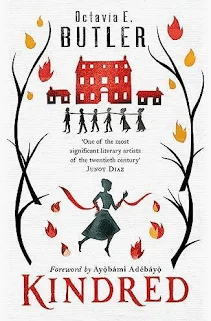
The trouble began long before June 9, 1976, when I became aware of it, but June 9 is the day I remember. It was my twenty-sixth birthday. It was also the day I met Rufus – the day he called me to him for the first time.

Dana and Kevin have just moved into their new apartment in Los Angeles, California. Out of nowhere, Dana starts to feel dizzy and faint, and before she knows it…

“The house, the books, everything vanished. Suddenly I was outdoors kneeling on the ground beneath trees. I was in a green place. I was at the edge of a woods. Before me a was a wide tranquil river, and near the middle of that river was a child, splashing, screaming….Drowning!”

Dana has been transported to somewhere where she is needed, where she can save the life of the drowning child, whose name we later find out is Rufus. But the boy’s parents are not grateful – far from it, they seem to think Dana is responsible for his accident – the father aims a shotgun at her and angrily confronts her. She fears for her life, and in that moment she is transported back to her apartment, where a puzzled Kevin tells her that only moments have passed.

At first the reader thinks they are in a simple time travel novel, where the principal character is summoned into another time and place to intervene in the life of someone with whom they have some kind of connection. Yes and no, because in a moment of dreadful realisation Dana finds out something terrible about the challenge fate has presented her with – the time she is travelling back to is the 1820’s, in the South of the United States of America, and Dana is black. The young boy whose life she is fated to save – she is summoned from the present every time his life is at risk – is the son of a slave-owner. He lives on a plantation. Worse, Dana has no control over when she is summoned nor when she is returned. She works out that she will return to her own time – where time passes at a completely different rate from that in the 1820’s, so several months can pass in the past but only hours in the present – when her own life is threatened. She cannot choose when to return, and putting her own life deliberately at risk seems far too dangerous.

The only positive side to this appalling situation is that, unlike the form of time travel in the Time Traveller’s Wife (for example) she is able to take objects with her into the past, anything she happens to be touching at the time she is summoned, including her partner Kevin. She quickly assembles a small bag of useful items, including a knife and some painkillers, knowing she could be whisked back to the nineteenth century at any time. I would have been tempted to take a gun, preferably a rifle, but I am probably taking the time travel conventions a little too literally! On her subsequent journey to the 1820’s Kevin goes or is taken with her, and after she saves the young man’s life once again, the plantation owner assumes Dana is Kevin’s slave. Dana, recognising names from the family tree in her bible, quickly works out that Rufus is one of her distant relatives, and that she needs to keep him alive long enough for him to father one of her ancestors. But Rufus is white, and she is not, horrifyingly suggesting that the ancestor she is waiting to arrive is the product of an abusive relationship between slave-owner and enslaved.

Novels that attempt to portray the horrors of slavery are faced with an immediate challenge – how to convey the many terrible things that happened – the brutality of every day life, the appalling treatment of the enslaved, the families torn apart by slave-owners simply for monetary gain – without looking away or in any way softening the edges of the realities of the form of chattel slavery of this period, but at the same time not making the novel impossible to read, capturing the reality of what living through this period must really have been like. To take someone from the 1970’s and transplant them into this environment is a brilliant way of making the reader imagine what being in this time must have been like – these are no longer long-dead people who it is easy to think of as statistics, but real, living family members and friends.

Butler takes one step further than just presenting afresh the trauma of slavery, by asking the question – how does one accommodate oneself to living in that situation, living as an enslaved person? Dana is trapped in the nineteenth century for long periods, too far away from the Northern states where slavery was no longer practised or widespread (slavery in the Northern states of the USA ended gradually over several decades; Vermont banned slavery in 1777 and Massachusetts in 1783; other Northern states passed gradual emancipation laws that freed existing slaves slowly, meaning complete freedom for all enslaved people in the North took until the early-to-mid 1800s – and even then ‘runaways’ were subject to the punitive conditions of the Fugitive Slaves Act). Dana is forced to come to terms with the conditions and compromises of her enslavement. Her partner Kevin is trapped in this time period for several years when she is returned to the twentieth century unexpectedly and this experience changes him as well (Dana perceives) even though he commits himself to helping runaway and escaped slaves.

Quite early on Rufus learns of Dana’s origins – he can hardly find a natural explanation for her appearing out of thin air every time his life is at risk – and has to accept the undeniable supernatural element of her existence. Dana slowly comes to an understanding with Rufus – he depends on her to save his life, therefore he must treat her with respect and care for her, protecting her from the unstable temper of his father. But time and again Rufus’s contempt for black people resurfaces – he never gets out of the habit of using the n-word for example, even though he knows he needs Dana to save his regularly threatened life (Rufus is very accident-prone!).

Kindred has an incredibly strong narrative structure. The reader (or this one at least) cares for and wants to find out what happens to Dana, Kevin and even Rufus. I understand why the author included a prologue which effectively spoils the ending of the novel for the reader – we know some important details about the outcome of the novel through this short opening chapter – but personally I don’t think it added anything and removed much of the suspense from the novel’s ending and I would have not used it had I been the author. But even though this is a very strong story, that’s not the primary reason for this being such a ‘must read’ – that derives from its unblinking portrait of the horrors of American chattel slavery.

Kindred by Octavia Butler, 1979

Aside
Book review

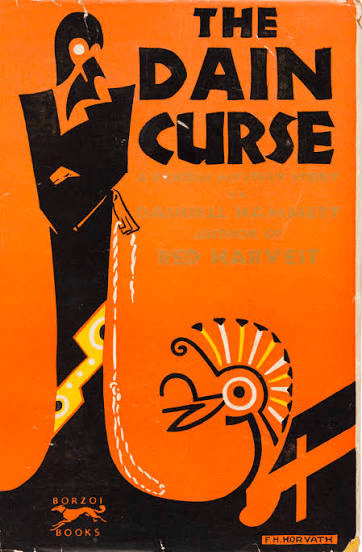
“It was a diamond all right, shining in the grass half a dozen feet from the blue brick wall. It was small, not more than a quarter of a carat in weight, and unmounted. I put it in my pocket and began searching the lawn as closely as I could without going at it on all fours. I had covered a couple of square yards of sod when the Leggetts’ front door opened. “

Oh dear. Having really enjoyed The Maltese Falcon and The Thin Man a lot, I decided to read some lesser known novels by Hammett, in the hope that I might, like the Continental Op in the quote above, find some diamonds in the rough. Unfortunately all I found was ‘rough’, no diamonds!

The Dain Curse is divided into three, loosely linked stories, which equate to the instalments in which the novel was first published in The Black Mask magazine. The first story opens with the Continental Op investigating a diamond robbery from Doctor Edgar Leggett. Dr Leggatt was using the diamonds to test a process of colourisation. The Op is commissioned by an insurance company to see whether the reported theft is legitimate and if possible to recover the diamonds. Dr Leggett’s wife maiden name was Dain and in the course of the investigation it emerges that their daughter Gabrielle believes there is a curse on the whole Dain family which follows them through the generations. This belief appears justified when several murders complicate what at first appears a straightforward investigation. I have to confess that even though I have only just finished reading the novel I can’t recall the precise detail of who murders who, and why, but I suspect that level of detail is not that important – this is an adventure story rather than a mystery. We know the Op is going to find out who committed the murders, all we have to do is enjoy the ride.

Diamonds recovered, the Op thinks his time with the unfortunate Gabrielle is over, but he is soon recalled to investigate a mysterious religious cult to which she has succumbed. The cult’s headquarters double as a clinic, a place of worship, and a retreat for the more vulnerable of the membership. The Op infiltrates the clinic/hostel/church none too subtly, and after the inevitable drugging, murdering and shoot-outs, manages to rescue Gabrielle. Her fiancé takes her away to marry her as quickly as possible before anything else can happen to her, but of course the curse cannot be escaped as easily as that….

The novel ends with at least ten pages of exposition, ten pages of the Op explaining what really happened. This becomes absurdly complex and convoluted and I can’t imagine many readers by this stage (or even earlier) really caring who did what to whom. The solution, including the extremely unlikely evil mastermind behind it all, is of course nonsense. If the novel itself was worth reading then the silly ending would be excusable, but sadly the characters are weak and unconvincing and the prose is flat. If you were considering reading anything by Hammett, a) despite all of the above, don’t let this put you off, and b) don’t choose this. Better still, read anything by Raymond Chandler!

The Dain Curse by Dashiell Hammett, 1929

Aside
Book review

“When he’s fifteen, he and his mother move to a new town and he starts at a new school. It’s not an easy age to do that – the social order of the school is already well established and he has some difficulty making friends.”

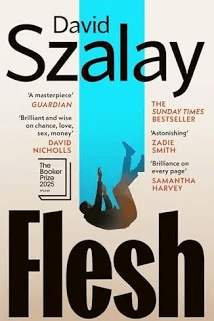
In eight discontinuous chapters, David Szalay tells the story of Istvan, whose surname is never mentioned to preserve his ‘everyman’ status. The novel opens with 15-year-old István living with his single mother (his father is also never mentioned, but his absence from Istvan’s life casts a long shadow. This is a novel about fatherhood among other more prominent themes.) Isolated at school, he begins a sexual relationship with an older, married neighbour. Told from Istvan’s perspective this affair is not perceived as abusive, but he is clearly groomed and the reader can infer how damaging it is. He repeatedly describes the neighbour as ‘old’ and ‘ugly’ and focuses on the flaws in her less-than perfect body. Eventually a violent confrontation with her husband results in his accidental death; István is held responsible (rightly so) and is sent to juvenile detention. As with many critical episodes in his life, this period of detention is skipped over in the narrative, and the next chapter opens with István about to be discharged from five years’ service in the army. He has served in Kuwait and the Iraq War, but we only learn this after the event as we are told about his discharge and attempt to return to civilian society. Another end of chapter time jump sees him moving to London to work as a bouncer at a nightclub. From there he is hired as a chauffeur and bodyguard for a wealthy businessman and he soon begins an affair with the businessman’s wife, Helen.

Helen’s husband has a recurrence of cancer and despite the best treatment money can buy, he dies. Another time jumps sees Istvan and Helen married, Helen pregnant, and her teenage son Thomas bitterly resenting Istvan’s very existence. All of the businessman’s estate has been left to Thomas, held in trust until he turns 25. Helen and Istvan dip into this money (with the connivance of a dodgy lawyer) to fund property development schemes. I am going to stop this plot summary at this point because there some significant spoilers ahead, if I haven’t given too many already. Suffice to say there are some significant challenges ahead for Istvan.

It’s quite some time since I read a book where I was so conscious of the author, sitting behind a screen, tapping out scenes and challenging the reader to find them banal, improbable or unconvincing. His central character – virtually every scene is recounted through Istvan’s eyes, to the extent that the small number of scenes not told from his perspective stand out starkly – finds it very difficult to access or articulate his feelings. To demonstrate this Szalay gives us literally dozens of scenes where Istvan replies in monosyllables to anyone attempting to get him to communicate on anything other than the most basic level. In conversation he either replies any time he is addressed with “I don’t know”, “Yeah” or by repeating the question:

“It’s Istvan right?”

“Yeah”

“Where are you from?”

“Hungary”

“What’s that like?

Istvan isn’t sure what to say. He says what he tends to say when people ask that question.

“It’s okay”

“You go back much?”

“Sometimes”

“Visit family?”

“Yeah”

“You must miss it”

“Yeah, sometimes”

And so on, relentlessly, daring the reader to find this banal. Even scenes of conflict, danger or excitement are described in the same, monosyllabic unengaged tone, demonstrating no awareness of the questioner’s interest in what is being discussed. Szalay has made a brave, radical choice – to take an exciting life and focus on the moments in-between the incident and drama, so all we see are the moments of reflection; and then to create a character almost completely unable to reflect on what has happened to him with any degree of insight or coherence. Istvan’s inability to talk about the events of his life quickly becomes a burden to the reader. We get it, he is inarticulate, the point is really flogged to death. I could have done with fewer of these extended conversations where nothing is said – I doubt if I was the only reader who was tempted to let their eyes slide over a chunk of dull, phatic dialogue to the next paragraph.

Reflecting on this choice while announcing the novel’s Booker Prize 2025 award, the chair of judges, Roddy Doyle explained:

“At the end of the novel, we don’t know what the protagonist, István, looks like but this never feels like a lack; quite the opposite. Somehow, it’s the absence of words – or the absence of István’s words – that allow us to know István. Early in the book, we know that he cries because the person he’s with tells him not to; later in life, we know he’s balding because he envies another man’s hair; we know he grieves because, for several pages, there are no words at all. I don’t think I’ve read a novel that uses the white space on the page so well. It’s as if the author is inviting the reader to fill the space, to observe – almost to create – the character with him. The writing is spare and that is its great strength. Every word matters; the spaces between the words matter. 

If Szalay had chosen to write the scenes between the chapters, telling us directly about the moments that shape Istvan’s life, rather than letting most of it happen ‘off screen’, this would have been a very different novel, far more conventional, less challenging, but I suspect more enjoyable. But while interesting things happen to Istvan, I am not sure he is an interesting character. It will be clear by now that I am ambivalent about Flesh: you have got to admire the author’s audacity and technical skill, and I found the novel an extremely easy, two-day read, but the nagging doubt remains that at the heart of the novel there is a vacancy, a gap. Istvan drifts through life without forming any serious relationships – he is almost surprised when he realises at one point very late in the day that he actually likes his wife – and has nothing of interest to say. Perhaps Szalay was telling us that we are all, like Istvan, just flesh?

Flesh by David Szalay 2025

Aside