“It was a diamond all right, shining in the grass half a dozen feet from the blue brick wall. It was small, not more than a quarter of a carat in weight, and unmounted. I put it in my pocket and began searching the lawn as closely as I could without going at it on all fours. I had covered a couple of square yards of sod when the Leggetts’ front door opened. “
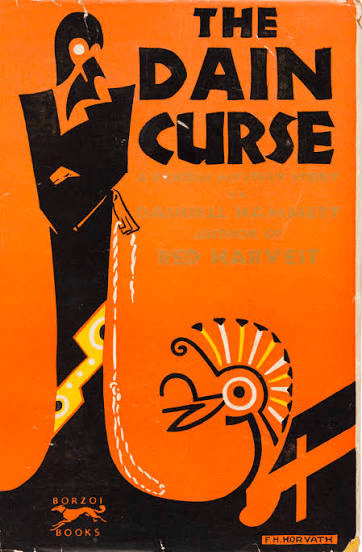
Oh dear. Having really enjoyed The Maltese Falcon and The Thin Man a lot, I decided to read some lesser known novels by Hammett, in the hope that I might, like the Continental Op in the quote above, find some diamonds in the rough. Unfortunately all I found was ‘rough’, no diamonds!
The Dain Curse is divided into three, loosely linked stories, which equate to the instalments in which the novel was first published in The Black Mask magazine. The first story opens with the Continental Op investigating a diamond robbery from Doctor Edgar Leggett. Dr Leggatt was using the diamonds to test a process of colourisation. The Op is commissioned by an insurance company to see whether the reported theft is legitimate and if possible to recover the diamonds. Dr Leggett’s wife maiden name was Dain and in the course of the investigation it emerges that their daughter Gabrielle believes there is a curse on the whole Dain family which follows them through the generations. This belief appears justified when several murders complicate what at first appears a straightforward investigation. I have to confess that even though I have only just finished reading the novel I can’t recall the precise detail of who murders who, and why, but I suspect that level of detail is not that important – this is an adventure story rather than a mystery. We know the Op is going to find out who committed the murders, all we have to do is enjoy the ride.
Diamonds recovered, the Op thinks his time with the unfortunate Gabrielle is over, but he is soon recalled to investigate a mysterious religious cult to which she has succumbed. The cult’s headquarters double as a clinic, a place of worship, and a retreat for the more vulnerable of the membership. The Op infiltrates the clinic/hostel/church none too subtly, and after the inevitable drugging, murdering and shoot-outs, manages to rescue Gabrielle. Her fiancé takes her away to marry her as quickly as possible before anything else can happen to her, but of course the curse cannot be escaped as easily as that….
The novel ends with at least ten pages of exposition, ten pages of the Op explaining what really happened. This becomes absurdly complex and convoluted and I can’t imagine many readers by this stage (or even earlier) really caring who did what to whom. The solution, including the extremely unlikely evil mastermind behind it all, is of course nonsense. If the novel itself was worth reading then the silly ending would be excusable, but sadly the characters are weak and unconvincing and the prose is flat. If you were considering reading anything by Hammett, a) despite all of the above, don’t let this put you off, and b) don’t choose this. Better still, read anything by Raymond Chandler!
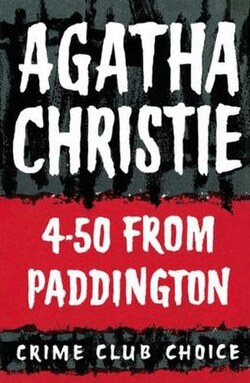
I’ve always felt very slightly guilty at never having read anything by Agatha Christie. TheTuesday Murder Club stories assuaged this a little, although I would never had read them were it not for the association with Richard Osman. The 4.50 from Paddington was a very late attempt to address this shortcoming. It features one of the author’s recurring detective characters, Miss Marple. Overall I think it is quite seriously flawed. The murder mystery element of the story depends on some utterly bizarre behaviour by the protagonist. There are a series of other serious structural flaws, but these could be forgiven if the murderer had not seemed desperately to do everything he possibly could to be caught. Obviously there is no way I can make this point without extensively spoiling the book for you, so if you ever intend to read this please turn away now.
The novel opens as a traditional ‘murder on a train’ puzzle. Mrs McGillicuddy, a friend of Miss Marple, is travelling by train when her carriage passes another train going in the same direction. When the trains are stopped next to each other she sees a woman being strangled. This was obviously a very strange time to choose to strangle someone. She is convinced this is a case of murder. She reports the attack, but the police are unable to find a body or any other evidence.
Miss Marple decides to investigate, of course. By some analysis of train timetables that was quite dull she works out that the body was probably thrown from the train into the grounds of Rutherford Hall, a stately home just outside Brackhampton. She asks her friend Lucy Eyelesbarrow, to help her investigate by taking a job at the hall as a housekeeper. Lucy is a promising character, but I could not move past the fact that Christie asks us to accept that despite her having a First in Mathematics from Oxford she decides to become a housekeeper. A well paid housekeeper, but a domestic servant nonetheless. I can see Lucy serves a useful role in the novel – she is bright and observant, and acts as Miss Marple’s eyes and ears on the ground within the Hall (a more conventional approach would have been for Miss Marple to have somehow get herself invited to stay with the family) but this is still a deeply implausible career choice for a first class mathematician, and is profoundly old-fashioned. Is this really the optimum career choice for a bright young woman in the 1950s? One character observes of Lucy “She scares the life out of me, she’s so devastatingly efficient. No man would ever dare marry that girl”. Sadly, Christie abandoned the character after this novel, and she never reappears.
We are then introduced to the inhabitants of Rutherford Hall: the cranky patriarch Luther Crackenthorpe, his unmarried daughter, Emma. and his sons Cedric, a painter; Harold, a businessman, and Alfred, occupation undetermined. His older daughter Edith died four years before the novel begins, and her husband Bryan and son Alex are part of the extended family. Another son died in the second world war. Local doctor, Dr Quimper frequently comes to the hall to see to Luther and is ‘close friends’ with Emma. These characters are paraded before the reader several times, and it is quite obvious that this is a list of suspects from whom we are being invited to select the killer.
Lucy uses her free time to search the hall’s grounds, and quickly finds the body hidden in a stone sarcophagus in a barn. Having a stone Greco-Roman sarcophagus lying around in one’s barn is typical eccentric aristocratic behaviour, nor worthy of further comment. The police are of course contacted, and resume their investigation into the original murder, led by Inspector Craddock of the Yard (When did local police forces start investigating murders in their area instead of calling in Scotland Yard?) The police conclude that the body is either that of a dancer, Anna Stravinska, who had gone missing from a ballet troupe, or a French woman called Martine. Martine may have married the eldest brother who died in the war – Emma reveals that she received a letter a few weeks before the woman’s body was found, claiming that she had married Edmund just before he died. The police speculate that Martine may have been murdered by one of the Crackenthorpe family to prevent her making a claim on Luther’s estate. However the ‘Martine’ theory doesn’t last long – a neighbour, Lady Stoddart-West reveals that she is Martine, Edmund’s former fiancee. She explains that Edmund died before they could be married, and since she married another man soon after the war, she had resolved not to bring up the painful past by telling the Crackenthorpes about their connection. Even the author has to accept that this is profoundly improbable – a woman forms a relationship with a British soldier who is killed in action, only to subsequently years later marry another soldier who just happens to be a near neighbour of the first. But this revelation leaves the identity of the body in the sarcophagus/the woman on the train a mystery.
Things then take a turn for the worse when the entire household is poisoned and Alfred dies. Dr Quimper diagnoses arsenic poisoning. Harold then receives a delivery of poisoned tablets from Dr Quimper and he dies. One would have thought that the focus of suspicion would fall on the doctor at this point – not only has he provided Harold with poisoned tablets, but in his role as a GP he would have ready access to arsenic and other poisons. But no, the focus is mysteriously elsewhere. In the novel’s denouement Miss Marple arranges for Mrs McGillicuddy to see Dr Quimper in a pose similar to that she saw the murder, by pretending to choke. Dr Quimper helps here, and as he does so Mrs McGillicuddy enters the room, sees the doctor against the window with his hands at Miss Marple’s throat, and cries out, “But that’s him – that’s the man on the train!” Miss Marple then wraps the case up in a few paragraphs. Her explanation is that the dead woman was Quimper’s wife, who would not divorce him due to being Catholic. He killed her to be free to marry Emma, and then murdered Harold and Alfred to increase Emma’s share of any inheritance.
I don’t know if many readers would finish this novel and conclude that the explanation given makes sense. Certainly we are asked to accept many leaps of faith: that the Doctor would murder his wife on a moving train while visible from a passing train just five minutes out from the destination; that he would (somehow) throw her body out of the train onto an embankment, arrive later that day to collect it from where it landed, carry it (again, somehow) through the estate to the barn, and leave it there, all the time unseen and uninterrupted; that while a police investigation is underway, he decides to murder some of the other family members in order to increase the proportion of the family inheritance he will receive, when Luther dies, and if he can successfully woo Emma. And so on. The absurdities pile up. The doctor takes fantastical risks for little reward, when far more straightforward options are before him.
The whole novel had an anachronistic feel – although written in the 50’s and seemingly set then, it really is an old-fashioned Edwardian country house murder story, uncomfortably superimposed onto a murder on a train story. That explains why the Doctor kills Harold and Alfred when he does, despite the heavy police presence in the immediate vicinity – the tradition of the country house murder story demands more murders. Miss Marple is here a peripheral character, wheeled out to resolve the mystery in the final pages simply by deciding what has happened rather than by any process of deduction or the use of evidence. Without Mrs McGillicuddy’s identification of the Doctor on the basis of what he looks like from behind – a defence barrister would have fun with that – there is no other evidence of him having committed any crime. Miss Marple makes a strange comment right at the end of the novel, having delivered her speech to the assembled family on how she ‘solved’ the murder:
“I am really very, very sorry that they have abolished capital punishment, because I do feel that if there is anyone who ought to hang it is Dr Quimper”.
Capital punishment in the UK had not been abolished in 1957 and people were still being killed by the state well into the 1960’s. Perhaps this was just Christie’s comment on the campaign for the abolition of capital punishment which was obviously gaining momentum at this point. But I think she was getting ahead of herself – she would have to get a conviction first.
On a more positive note, one has to give the Doctor credit for his cunning plan to misdirect the investigation by suggesting that the victim was Martine, laying a paper trail away from his ex-wife, only for that plan to be foiled by the stunning coincidence of the real Martine being alive and well and living in the neighbourhood. Also, Lucy is a promising character who ably fills the absence of Miss Marple, even if she is the world’s most unlikely housekeeper. But overall this felt like an author well past her prime using some of her ‘greatest hits’ material to keep her publishers happy. Which means I have missed the mark in looking for Christie at her best, and need to keep looking.
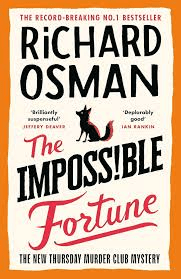
The Impossible Fortune – The Thursday Murder Club 5, by Richard Osman, 2025
The Impossible Fortune was the best selling novel in the UK in 2025. It is therefore proof from any criticism I can level at it. More to the point if you have read the previous four novels in the series you will have long ago decided if this is your cup of tea – if it is then again any criticism will be moot and if it isn’t then you will almost certainly be skipping this review. Nonetheless, I shall press on, because surely the novel deserves more than the unthinking adulation it seems to have received thus far? Equally the ‘read it, review it’ rule will continue to apply in 2026!
Osman has reached the point in the series where recaps of the cast and setting are not required – it is assumed that the reader will be familiar with the context. Also, very few readers will start the series on book 5 and were they to do so (it could happen – I started the Harry Potter series on book 4, Goblet of Fire) there are enough summaries available elsewhere to help them find their feet. We are back at Coopers Chase, the retirement home for active and prosperous pensioners, with Joyce, Elizabeth, Ibrahim and Ron, the founder members of the Thursday Murder Club, and a large and growing cast of secondary characters. A new investigation presents itself on cue, although it is not clear whether it actually is a case of murder or not. The gang don’t worry about this of course – the mystery is what matters. Some valuable crypto-currency is missing – or rather the codes to access it are – and the challenge is to find them before some of the other potential claimants do so.
Still grieving former spy Elizabeth is not at the top of her game and doesn’t provide the insights that usually comes to her so easily. Former trade unionist Ron is worried about his family but finds a way of combining his role in the investigation into the missing crypto with a means of protecting them all, including his precocious grandson, Kendrick. Joyce is a continuing delight and the main source of humour in the novel, especially her relationship with her daughter Joanna, who as the novel opens has just married new character lecturer Paul. Paul has two friends Holly Lewis and Nick Silver (Osman not over-exerting his name giving skills here) who together run a high security ‘cold storage’ business. This is presented as something innovative and shadowy, slightly mysterious, but to me it seemed remarkably similar to the safe deposit box services offered by many banks. Several years ago Holly and Nick were paid for their services in Bitcoin; this has increased in value exponentially over the years and they have now decided to cash it out. But as soon as they have decided to do this Nick finds a bomb attached to his car and very shortly thereafter Holly’s car is blown up, with her in it. Nick cannot be traced and mysterious text messages exchanges with Paul suggest he might have been killed.
This is a problem because to access the crypto-currency a 12 character code is required, half of which is held by Holly and half by Nick. So multiple puzzles present themselves – who tried to kill Nick, who actually killed Holly, where is Nick and how can the crypto-currency be saved?
In the event either of them dies, Holly and Nick have left their access codes with a solicitor, so the final problem in this list is fairly straightforward. Nevertheless the murder club devote most of their efforts to finding the codes which Holly and Nick have also hidden in plain sight. This is where the mystery element of the novel begins to break down somewhat – it is not clear why they have done this. Please note spoilers follow at this point. Just before she is killed by the car bomb, Holly dials a phone number, which eventually turns out to be a disguised form of her code. (Hiding personal number codes, PIN’s etc, in a fake phone number is quite common – so if I wanted to write down my PIN number 1234 in case I forgot it I would create a fake contact Bill’s Pizza and write it down as 07770 001234.) But there is no plausible reason why Holly would dial this number just before she dies; worse still there’s no reason why she would write it down at all as she has memorised it for so long, and no reason why she would dial the number rather than save it as a contact. In other words this is a very poorly constructed attempt to mislead the reader looking to ‘solve’ the mystery. Nick’s code is disclosed in an even clumsier manner, hiding it in text messages to Paul (so for example “I have written a hidden number in this sentences” disguises the number ten) that depend entirely on Paul sending the right replies in the thread. It also depends on Paul showing the messages to Elizabeth and her being able to decipher the code. Again it is totally unclear why he does this, other of course than to provide a simple puzzle for the reader looking to ‘solve’ the novel.
All of which it to miss the point – the mystery element of this series has always been secondary to Osman’s celebration of the liberation of old age. Unencumbered by jobs or responsibility, the Thursday Murder Club members are able to enjoy the later stages of their life by doing pretty much whatever they want. Rules are for other people. Osman also recognises they are so much more than just old people – they all have a lifetime of skills and experience to draw upon. This is a combination that is highly effective when deployed in the solving of murder. Recognising the value and worth of older people rather than seeing them as in god’s waiting room, decrepit or infirm (there’s even a reference to Coopers Chase residents getting frisky in the community hot tub) is at the heart of this series, and it is to be celebrated for that fact.
The Impossible Fortune has a number of sub-plots that are arguably more interesting than the central mystery. Ron’s daughter finally escapes an abusive relationship and in doing so exposes her whole family to a dangerous revenge plot. Connie, the drug dealer imprisoned earlier in the series has been released from prison but continues her unlikely relationship with former therapist Ibrahim, which in this novel finally solidifies into a friendship and even, potentially, a partnership. Joyce enjoys finally being a mother-in-law and her relationship with her daughter is drawn with skill and sensitivity. The novel has lots of good jokes – Joyce coming to terms with technology is a sub-section in its own right:
Joanna has recently introduced Joyce to Rightmove. It’s a website where you can see houses for sale. You click on them and they let you look inside! Thousands of strangers’ houses! Twenty, thirty, sometimes forty pictures. You can see their sofas, their kitchen cabinets, where they’ve put their wooden LIVE, LAUGH, LOVE signs, what they’ve done with their gardens and so on. And this site is free! Joyce doesn’t believe in all progress, self-service checkouts, for example, but she is certainly happy that somebody invented Rightmove.”
A visit from Prince Edward is mined for all it is worth; references to David Tennant and Pierce Brosnan jokingly call back to the 2025 film adaptation of The Thursday Murder Club (and its controversial casting decisions).
Osman knows his audience. The Impossible Fortune is printed double spaced with very large font – the largest I can ever recall seeing. Chapters are a few pages long at most. Nothing is too demanding or difficult. At times it seems he is falling into the trap the books warn against – under-estimating the old. The cosiness factor is kept in check, and the moments of genuine peril, particularly when Jason (Ron’s son) and Kendrick are being shot at are uncomfortably worrying. But we are quickly back to jigsaw puzzles, bourbons and sherry before you know it. The author continues to stubbornly refuse to kill off any of his main characters in defiance of my prediction that he would do so in book 2, but I refuse to back down and have faith that one day this prediction will come true. Osman is the king of cosy crime and you can’t help but feel happy for him. Let’s just hope that if they film the later books that they get the casting right this time round!
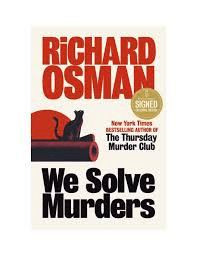
I think it would have been a reasonable assumption that in moving away from The Thursday Murder Club, Richard Osman was going to try something a bit different. He strongly implies as much in the acknowledgements to the fourth book in the series. Yet while We Solve Murders superficially inhabits a totally different world from the TMC series, if you scratch the surface we are right back in Coopers Chase.
We Solve Murders introduces the reader to Amy Wheeler, a bodyguard to the rich and famous. Amy is seriously hard-core, totally unafraid of the dangerous life and death situations she regularly finds herself in. She has a long-distance relationship with her husband, who plays only a very minor role in the book, but seems much closer to her father-in-law, retired copper and widower Steve. Steve loves his quiet life – pub, crossword, and chatting to his late wife – and is very reluctant to be pulled away from this retirement when Amy calls for his help. Amy’s client, Rosie D’Antonio, the world’s second most successful novelist forms the unlikely third wheel of this team as they career around the world trying to do what the novel’s title promises they will – solve murders.
Because someone has been killing influencers – young naïve people with small social media followings who travel to exotic locations to promote brands that mysteriously don’t seem to actually exist. This isn’t really one of the novel’s puzzles – we are told by the novel’s criminal mastermind who narrates occasional chapters that these killings are a retaliation for when his money smuggling operation is called into question. While the use of gullible and well-meaning influencers to unwittingly move money around the world is an innovative idea, I am not sure that’s how money smuggling really works anymore, is it? Surely it’s moved around online nowadays? Not that I claim any expertise in this issue I hasten to add. Amy is set up as the fall guy for the murders, which is a really silly choice as she is not going to allow this to happen without putting up a ferocious fight.
While the novel is set in several exotic locations – a private island off the coast of South Carolina, St Lucia, Dubai, and Dublin (!) – there’s no real sense of place in any of them. They could have been anywhere. I had to wonder whether these locations were chosen more for the inevitable film adaptation than the narrative? There’s also no really sense of peril – Amy, Steve and Rosie are held at gun-point and shot at more than once, but I didn’t for a second think they were going to die. Neither did they if the way they respond is to be believed – plot armour is one thing, but characters behaving as if they know they have plot armour is another!
Rosie is a source of much of the novel’s slapstick comedy – she is an archetypical randy pensioner, and being incredibly rich she can conveniently summon up private jets and helicopters at a moment’s notice. She has a sense of adventure which means she can be extremely reckless, in counterpoint to Steve’s deeply conservative instincts. He always yearns to be back home with his cat, Trouble. The novel’s ending is both predictable and to be honest not that interesting – the exposure of the bad guy’s identity is very much a ‘so what?’ moment. But that’s missing the point, because this is cosy crime after all, however badly disguised as a thriller, and it’s the gentle humour that keeps the pages turning, not any sense of adventure. One of the novel’s climactic scenes happens at a pub quiz, which tells you all you really need to know.
The hard-back edition of this novel has a strangely neutral design – it’s definitely moved away from the distinctive Thursday Murder Club ‘branding’ – but to where? The author’s name dominates the front cover, and the portrait of Trouble is the only real ornamentation on an otherwise stark black and red design. I think it reflects some uncertainty on the part of the publishers – whether to market the novel as ‘more of the same’ (the text “Best selling author of the Thursday Murder Club” appears above the title) or a new direction for the author. I can’t blame Osman for staying close to what has been a hugely successful and rewarding formula for him. It may not seem like it but I did enjoy reading We Solve Murders despite my reservations, but I wasn’t challenged by it in any way. Osman is by now such an accomplished novelist that as a reader you can leave yourself in his hands knowing he is going to safely guide you to the conclusion with everyone you care about in one piece, all ends neatly tucked away and the opening lines to the sequel already inked in. (In fact I fully expected the opening chapter of the sequel to appear at the end of this edition – it’s that kind of book – but it didn’t; instead we are neatly guided back towards TTMC).
In conclusion, you won’t be at all surprised to read that if you enjoy TTMC you will enjoy We Solve Murders. I do and I did.
Sir Charles Baskerville is found dead of a heart attack, his corpse disfigured by an expression of horror. Next to the corpse the footprints of a gigantic hound are found. There is a sinister curse on the Baskerville family dating back to the brutal abduction of a local girl by one of Sir Charles’ ancestors. The girl died escaping from Baskerville Hall and her abductor was killed by a demon hound which has haunted the family ever since. The curse has now returned to the Baskervilles once more. Can Sherlock Holmes work out what’s going on and save Sir Charles’s heir from the curse?
Thus begins the atmospheric classic The Hound of the Baskervilles, the third of Conan Doyle’s four full-length Holmes novels. The formula that Conan Doyle used to construct his detective short stories was well honed by this point, but did not lend itself comfortably to being adapted to novel length. This in part explains why structurally the novel is a mess. But I really don’t want to write a review explaining why The Hound of the Baskervilles is a flawed mystery story, not least because that kind of deconstruction of the novel has been done before. Instead I wanted to focus on at least one of the reasons why the novel works in spite of its plotting weaknesses. Much of its undeniable impact is down to the strong evocation of place created by Watson’s descriptions of Baskerville Hall and the moor.
Watson and Sir Henry, Sir Charles’s successor, newly arrived in the country, travel down to his estate on Dartmoor. They have good reason to feel apprehensive about what they will find. This is Sir Henry’s first visit to Baskerville Hall. He is aware of the family curse, and has been troubled by mysterious events while staying in London which add to the sense of foreboding.
We first see the moor from Watson’s train carriage window:
“Over the green squares of the fields and the low curve of a wood there rose in the distance a grey, melancholy hill, with a strange jagged summit, dim and vague in the distance, like some fantastic landscape in a dream. “
The formal squares of the rural landscape break down into jagged, vague shapes as the train progresses from the farmed countryside to the dream-like moors. The other-worldly quality of the landscape is something Watson returns to time and again.
Our first sight of Baskerville Hall, ancestral home of the Baskerville family, is soon upon us. The point of view narration as Watson provides an almost minute-by-minute account of his journey gives an immediacy to the narrative:
The wagonette swung round into a side road, and we curved upward through deep lanes worn by centuries of wheels, high banks on either side, heavy with dripping moss and fleshy hart’s-tongue ferns. Bronzing bracken and mottled bramble gleamed in the light of the sinking sun. Still steadily rising, we passed over a narrow granite bridge and skirted a noisy stream which gushed swiftly down, foaming and roaring amid the grey boulders. Both road and stream wound up through a valley dense with scrub oak and fir…. a tinge of melancholy lay upon the countryside, which bore so clearly the mark of the waning year. Yellow leaves carpeted the lanes and fluttered down upon us as we passed. The rattle of our wheels died away as we drove through drifts of rotting vegetation—sad gifts, as it seemed to me, for Nature to throw before the carriage of the returning heir of the Baskervilles.
This is fine descriptive writing of a quality not often found in the short stories, where there is rarely the room for Watson to be expansive about landscape or place (although to be fair some of the descriptions of foggy London streets are very evocative). Again the emphasis is on the melancholy atmosphere of the countryside, in which the dying vegetation provides a suitable setting for the scenes that are to follow.
The road in front of us grew bleaker and wilder over huge russet and olive slopes, sprinkled with giant boulders. Now and then we passed a moorland cottage, walled and roofed with stone, with no creeper to break its harsh outline. Suddenly we looked down into a cuplike depression, patched with stunted oaks and firs which had been twisted and bent by the fury of years of storm. Two high, narrow towers rose over the trees. The driver pointed with his whip.
“Baskerville Hall”
(One might reasonably expect a crash of thunder at this point, but sadly, no.) Patched, twisted, stunted, bent – this landscape is described using the language of sickness or illness, and stands in stark contrast to the ordered, productive fields which had come before.
Inside, Baskerville Hall is equally striking, a fine setting for a murder-mystery:
It was a fine apartment in which we found ourselves, large, lofty, and heavily raftered with huge baulks of age-blackened oak. In the great old-fashioned fireplace behind the high iron dogs a log-fire crackled and snapped. Sir Henry and I held out our hands to it, for we were numb from our long drive. Then we gazed round us at the high, thin window of old stained glass, the oak panelling, the stags’ heads, the coats of arms upon the walls, all dim and sombre in the subdued light of the central lamp...the dining-room which opened out of the hall was a place of shadow and gloom. It was a long chamber with a step separating the dais where the family sat from the lower portion reserved for their dependents. At one end a minstrel’s gallery overlooked it. Black beams shot across above our heads, with a smoke-darkened ceiling beyond them. .. A dim line of ancestors, in every variety of dress, from the Elizabethan knight to the buck of the Regency, stared down upon us and daunted us by their silent company.
Again this is impressive descriptive writing. Unusually Watson is not now writing for the magazine readers who follow his accounts of Holmes’s achievements but for Holmes himself, stranded back in London dealing with a tricky blackmail case (or so we are told). So attention to detail, even if it is not immediately clear whether it is relevant to the case or not, is key, and Watson completes his commission diligently. The detailed layout of the Hall is to prove an important aspect of the mystery.
The setting of The Hound of the Baskervilles is a key element of its enduring success as a novel. Holmes fades into the background for much of the narrative, allowing Watson more time to expand his observations and at least start to unpick the mystery.
P.S. On re-reading this post in draft I am conscious that it is mainly extracts from the novel, with little by way of commentary or analysis. That’s not necessarily a bad thing, but I don’t think I can call it a review. I will however let it stand, because the extracts are fine writing, and if they prompt anyone to go on and read the novel itself (free online, or otherwise) then that can’t be a bad thing.