Book review, children's literature, Frances Hodgson Burnett, Narnia, The Secret Garden, Tropes

Supplementary: I want it now! ‘The Secret Garden’ by Frances Hodgson Burnett, 1911 – some further thoughts

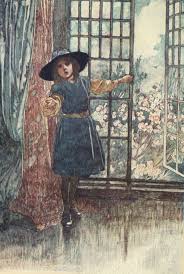
I have been taken to task, with some justification, for describing Mary Lennox the ten year old heroine of ‘The Secret Garden’ as “unlikeable”.

Let’s look at the evidence.

In the novel’s haunting opening chapter, “There’s no one left”, indeed in the novel’s opening line, this is how the author describes her:

“When Mary Lennox was sent to Misselthwaite Manor to live with her uncle everybody said she was the most disagreeable looking child ever seen. It was true, too.”mary-lennox

Not one of the most disagreeable looking children, but the most disagreeable looking – and the narrator agrees!

Born a “a sickly, fretful, ugly little baby”, she is neglected if not abandoned by her parents, and left in the charge of servants and a series of governesses fearful of imposing any discipline upon her. She grows up into “as tyrannical and selfish little pig as ever lived”. She beats and kicks her servant, and calls her ‘“Pig! Pig! Daughter of Pigs”….because to call a native a pig is the worst insult of all’. Even Mary herself accepts “People never like me and I never like people.”

Unsurprising Mary is not usually remembered this way. In film adaptations and book illustrations this aspect of her appearance is quietly forgotten. In the text, once settled in Yorkshire she is quickly healed and transformed by the redeeming power of the Secret Garden. The spoilt nasty orphan is left behind and she becomes a lovable and kind child. As well as a change of character, Mary also changes in appearance. Plenty of exercise, good clean Yorkshire air, and an English diet and climate combine to fatten her up! Mrs Medlock the housekeeper says (chapter 24)

“She’s begun to be downright pretty since she’s filled out and lost her ugly little sour look. Her hair’s grown thick and healthy looking, and she’s got a bright colour. The glummest, ill-natured little thing she used to be”.

Mary’s transformation is shadowed closely by the changes in Colin. The garden has an even more dramatic effect on him, allowing him to walk again and become a happy and polite child. In Colin’s case, the friendship and support of Mary and Dickon have an important role in his recovery.

This story arc – spoilt brat is transmuted physically and emotionally – is a common trope in children’s literature. Edmund Pevensie and Eustace Scrubb* in the Narnia stories (for example) take a similar voyage, quite literally – Eustace takes things the whole way and transforms into a dragon as part of his redemption!

Was it fair to describe Mary as (at that point in her life) “unlikeable”? I’ll let you decide.

* “There was a boy called Eustace Clarence Scrubb, and he almost deserved it. His parents called him Eustace Clarence and his masters called Scrubb. I can’t tell you how his friends spoke to him, for he had none.”

Standard
Book review, Bronte, children's literature, Edwardian literature, Frances Hodgson Burnett, Jane Eyre, The Secret Garden

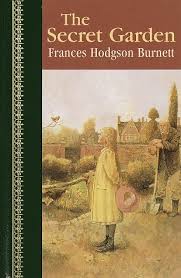
The Secret Garden, by Frances Hodgson Burnett, 1911


burnettFrancis Hodgson Burnett’s ‘The Secret Garden’ is predominantly a children’s novel, but like all good children’s literature its appeal spreads far beyond this audience. I increasingly found myself admiring the author’s craftsmanship, even if I was able to resist some of the more sentimental aspects of the novel.

Set in a soon to disappear Edwardian Yorkshire, where England rules half the globe, servants know their place and doff their caps, the rural poor are apple-cheeked and breed with profusion, ‘The Secret Garden’ is, despite all this historical baggage, delightful. Ten year old Mary Lennox suffers the inevitable fate of all children in literature and is orphaned in the opening pages: “The cholera had broken out in its most fatal form and people were dying like flies.” Parents out of the way, she is whisked away from colonial India to live in a large country house where she wanders the empty corridors, seeing her remote and gruff uncle Archibald Craven just once before he leaves for an extended European tour. Continue reading

Standard
100 Best Novels Guardian list, 20th century Literature, Book review, children's literature, Kenneth Graeme, Wind in the Willows

The Wind in the Willows – Kenneth Graeme – 1908

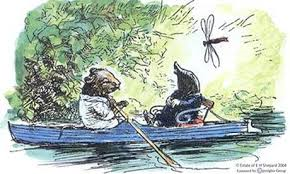
It is an incredibly long time since I last read ‘The Wind in the Willows’, and I returned to it with some nervousness – would it have retained its wit and charm? Unsurprisingly, it is one of those novels which contains depths unnoticed in earlier reads. It is simply wonderful, and if you have a couple of hours spare there are few ways of spending them that would be more rewarding than on the riverbank with Ratty, Mole, Toad, and Badger.
In an interesting article in the Guardian books column back in 2009, ‘Wild Waters are upon us’, Rosemary Hill observed that ‘The Wind in the Willows’ was written within a few years of Beatrix Potter’s ‘The Tale of Peter Rabbit’, E.Nesbit’s ‘The Railway Children’, and J.M.Barrie’s ‘Peter Pan’. Together she argues, very persuasively, these children’s stories came to define the Edwardian Era, “as an idyllic last summer bathed in golden sunshine“, in contrast to the developments in the real world, “a decade of social discontent and growing international tension, when the cracks in the British Empire began to show“. This novel captures brilliant a world of largely suburban contentment – the animals co-exist quite comfortably with the human world, all except perhaps Mr Toad, and their occupations – mainly messing about on boats – are those of middle class people with time on their hands. If ‘Willows’ creates a lost Edwardian idyll, rather than portraying it, the novel is however quite clear that this world is under threat, from development, urbanisation, and not least the dreaded car. The car must have been a rare and slightly frightening sight in 1908, but the way Graeme captures the petrol-head obsession of Toad has close parallels to the car worship of today.

Graeme’s wonderful conceit in ‘Willows’ was to anthropomorphise his characters, but in a very fluid way. At times they are real animals, and in the edition I read on the kindle the illustrations show them as lifelike, to scale creatures. At other times they are human scale. They have human character traits, but also at other times behave like the animals they are, subject to instincts and urges which nevertheless find an echo in the reader. The cast of characters is hugely strong and well defined; we all know a Ratty, Mole, or Badger, let alone a Toad. The supporting cast of characters is equally well sketched in, so we feel great affection for Otter, for example, or his son, Portly. The Chief Weasel only gets a few lines but that was enough for A.A. Milne to give him a much larger part in the stage version, ‘Toad of Toad Hall’. The narrative is also told with a striking economy – there are only two pages between Toad’s escape from his friends at Toad Hall, and the magistrate passing sentence, “twelve months for the theft…, three years for the furious driving, which is lenient, and fifteen years for the cheek“.
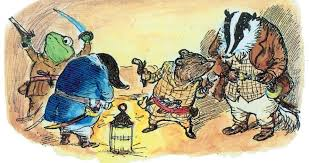

Part of my nervousness about returning to ‘Willows’ lay in the way the Wild Wood and its inhabitants are handled. It is ‘other’ – and can be read as anything alien to the comfortable life of Ratty and company, even if it is home to Badger. At one point the narrator describes it as “low and threatening, like a black reef in some still southern sea“. The alliteration is marvellous, but the point is made – the wild-wooders are like foreigners, tribal natives, dark and threatening. It is like the areas on maps marked ‘here be dragons’.  The insurrection of the wild-wooders, numerous and disrespectful to their betters, and at times actually threatening, seemed to me to be a perfect model for the class struggles of the period. The working class are organising and asking why they have to live lives of poverty and drudge, while the middle classes mess around in boats, doing very little. Their revolution, when it comes, is quickly squashed, and it is made clear they have learnt their place, tugging on their forelocks when the squires of the manor pass by. This of course was wishful thinking – the class problems of 20th century Britain were not as easily resolved as a clip around the ear. However I think the handling of this paradigm does throw a light on the complacent attitude of many to the rise of the organised working class in the early years of the 20th century.

I was equally nervous about the “Piper at the Gates of Dawn’ chapter, that strange, surreal story where Ratty and Mole go searching for Otter’s lost son, Portly, and meet him safe in the arms of Pan. Yes, Pan. Mole sees “the backward sweep of the curved horns, gleaming in the growing daylight; saw the stern, hooked nose between the kindly eyes that were looking down on them humorously, while the bearded mouth broke into a half-smile at the corners; saw the rippling muscles on the arms that lay across the broad chest, the long supple hand still holding the pan pipes only just fallen away from the parted lips; saw the splendid curves of the shaggy limbs disposed in majestic ease on the sward“. Pan saves Portly and returns him to his friends, then wipes their memories, Men in Black fashion. It’s still a really strange, slightly homo-erotic chapter. I can only assume Graeme was trying to introduce the idea that the animals have their own spirituality, their own God, but this must have opened up some really difficult lines of thought for God-fearing Edwardians only just coming to terms with Darwinism and their links with the animal kingdom.
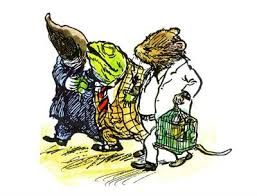
The thing that struck me for the first time on this reading was in relation to the treatment of Toad by his friends when they decide they cannot stand by and see him wreck his life by his addiction to fast cars. The way this is described is almost identical to a modern intervention into the life of a drug addict. His friends sit him down and clearly explain the problem. They describe the waste of money on his addiction, the “regrettable incidents with the police“, and the “weeks in hospital, being ordered about by female nurses“. When he rejects their help they restrain him, keep him under close watch – “he must never be left an instant unguarded. We shall have to take it in turns to be with him, till the poison has worked itself out of his system”. (page 61). Toad has “violent paroxysms” makes “uncouth and ghastly noises“, and lies “prostrate amidst the ruins of chairs” – is not this a wonderfully accurate description of someone going ‘cold turkey’.

Finally, to end on a joke, which made me laugh out loud. Toad is in the most liberal dungeon in the country, chatting to the kindly daughter of the warder. She is trying to explain her escape plan, and says:

“I have an aunt who is a washerwoman”,

to which Toad graciously and affably replies

“There, there, …never mind; think no more about it. I have several aunts who ought to be washerwomen”.

Could Bertie Wooster have said it better?

Standard
Book review, children's literature, Neil Gaiman, The Graveyard Book

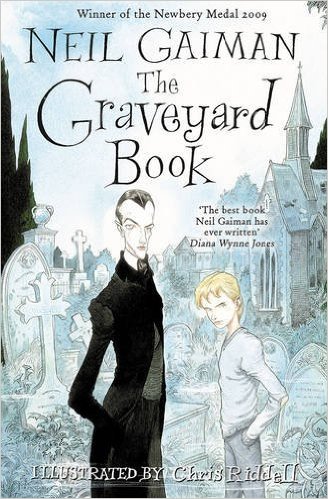
The Graveyard Book – Neil Gaiman –

Among the candidates for award for the best opening line to a children’s novel, this has got to be in with a shout:

“There was a hand in the darkness, and it held a knife. The knife had a handle of polished black bone, and a blade finer and sharper than any razor. if it sliced you, you might not even know you had been cut, not immediately.
The knife had done almost everything it was brought to the house to do , and both the blade and the handle were wet.”

Pretty chilling stuff. ‘The Graveyard Book’ opens with the murder of the parents and sister of a young child, Bod (short for Nobody) who escapes the attacker and ends up in a graveyard. Here he is protected, and eventually brought up by, the ghosts and other phantasmical creatures that live there. I have read that this book draws inspiration from Kipling’s ‘The Jungle Book’. That makes sense – young child brought up by non-humans, gradually comes into contact with the outside world and learns its strange ways, all the while menaced by the killer who claimed the lives of his family, and finally getting his revenge. But to be honest the parallel was not all that obvious when reading this book. Gaiman may borrow the structure of ‘The Jungle Book’, but he makes the material entirely his own. In part that comes from the supernatural element, which he has a lot of fun with. All the ghosts are introduced by their gravestone inscriptions, (“She sleeps, aye, yet she sleeps with angels” or simply “son of the above”) and their lives and deaths all form part of their characters. But Gaiman also adopts a much darker tone for the novel – whether it be in the real menace provided by the murders of Bod’s family, the repeated further attempts on his life, or the sad fate of some of the graveyard’s inhabitants.

‘The Graveyard Book’ will appeal most to pre-teens with a taste for the macabre and supernatural, but there is plenty of interest for all readers, not least (in this Bloomsbury edition) the wonderful illustrations by Chris Riddell. Personally what I enjoyed most, and what I suspect was the original inspiration for the novel, was the extraordinary sense of place. The graveyard itself is really the central character of the book, and Gaiman recreates and imagines it in wonderful detail – I find it hard to imagine that it is not based on a real location. Some novels start with a location, a setting, which then become the backdrop for a series of adventures. In using this approach, in which the majority of the events of the novel are set within the confines of the graveyard itself, Gaiman ran the risk of the whole thing becoming quite claustrophobic, but overcomes this by breaking free from time to time, and by exploring the graveyard itself as if it is Bod’s whole world. Because he spends all his time with ghosts, Bod is utterly unafraid of death, and sees nothing to worry about in the fact someone is determined to murder him. The other principal achievement of the novel is in its creation of a set of villains – the Jacks of All Trades – a sinister, other worldly conspiracy – that are genuinely scary.

Standard
21st century literature, Book review, children's literature, Palacio, Wonder

Wonder, by R.J.Palacio, 2012

‘Wonder’ is an American children’s novel about August “Auggie” Pullman, and 11-year-old living in Manhattan. Auggie has a rare medical condition giving him a severe facial deformity. Until now, Auggie has been home-schooled by his mother, but the book opens at the point his parents decide to enrol him in a private school. It charts through a series of first person narratives his first year at senior school.

The book has become something of a word of mouth success, and I can certainly see why. It is incredibly heart-warming – a classic story of an outsider overcoming adversity. It is full of positive, reassuring aphorisms such as “funny how sometimes you worry a lot about something and it turns out to be nothing” and “When given the choice between being right or being kind, choose kind”.  

If the novel had just followed Auggie through his first year at school through his eyes only, the narrative might have become stale, but Palacio adopts an interesting structure to avoid this. After each few chapters the narrative baton is passed to another character. This person then recaps the previous events from their perspective, giving a new version of events, then takes the story forward. This structure keeps things moving, and together with the very short chapters, most no longer than three pages, often fewer, the books 250 odd pages zip by.

The author has some real insight into the challenges of living with a condition such as that Auggie has, and shows this in various ways. As an example. Auggie has been growing a braid for several years, similar to that worn by trainee Jedi apprentices in the Star Wars universe. In a symbolic act of growing up he cuts this braid off, in an attempt to gain acceptance from his schoolmates. All children, whether living with a disability or condition, or not, will have experienced similar pressures. Auggie is shunned by some of his classmates, bullied, spoken about behind his back, but with the support of his family, friends, and teachers, he overcomes, and ends the year with a school medal for bravery.

Auggie has an older sister just starting high school. She experiences similar challenges – fitting in, dealing with the cool kids, starting dating etc – which gives the book a broader appeal than the 9-12 year olds that will be the majority of its readers. But I suspect the book will not have a wider cross-over appeal into the adult market (despite it being chosen as a book group read according to some of the Amazon reviews I have looked at), unlike, say, ‘The Curious Incident’. It is, despite its subject matter, simply too safe and saccharine. Almost everyone is just so nice. Yes the kids shun Auggie at first, but ultimately it is the instigator of this treatment (Julian) who is the loser, and end up leaving the school. There is a scary piece of bullying by some 13-14 year olds at the end of the novel, but these are brushed off relatively easily, and end up paying the price. Auggie starts wearing a complicated hearing aid part way through the school year, which in any other school would have been the start of a tsunami of jokes about androids and aliens, but in the privileged halls of Beecher Prep goes without comment. The book lacks any serious menace or peril.

Despite these reservations, I would recommend the novel for any child about to change school, or faced with a challenging difference. They will find it reassuring and if just one child is persuaded to be kind instead of mean, it will be worth it.

Standard
100 Best Novels Guardian list, Book review, children's literature, http://schemas.google.com/blogger/2008/kind#post, Kidnapped, Robert Louis Stevenson

Kidnapped, by Robert Louis Stevenson, 1886

Read in a Penguin Classic edition

It’s about time I explained why I am reading what is essentially a children’s book, albeit a Victorian ‘classic’. A few months ago the Guardian completed a two year exercise to publish a list of the top 100 novels written in English. I’ve written previously about how irritating these lists can be, and this was no exception – it contains some strange choices (‘Emma’ over ‘Pride and Prejudice’?) and some books that stretch the definition of ‘novel’ to breaking point (‘Alice in Wonderland’?) I’ve been working my way around the list in recent months, not because of any completest tendencies, undeniable though they are, but simply as a guide for some interesting novels that I probably should have read. There have been some really interesting discoveries (for me) thus far (‘Money’, ‘Disgrace’), a few re-reads (‘The True History of the Kelly Gang’), and some stinkers. Sadly, this falls in the latter category.

The novel is set in the highlands of Scotland, shortly after the second Jacobite rebellion in 1745. The politics of this revolt are central to the novel, but knowledge of the issues is largely assumed, and not given any context. The principal character and narrator is 17-year-old David Balfour. His parents having recently died, he visits his evil uncle, Ebenezer, who arranges for him to be kidnapped and sold into slavery. The kidnappers are incompetent sailors, because after several days of journeying their boat is still off the islands of Scotland, where it collides with a row boat carrying Alan Breck, a leading Jacobite wanted by the British. Breck is a confused figure – pompous, short-tempered, and murderous, yet perceived by Davy as something of a glamorous, slightly heroic character. Alan is a Jacobite who supports the claim of the House of Stewart to Scotland’s throne; David is loyal to King George III, and the tension between them arises from these loyalties. Stevenson uses the Jacobite rebellion as a setting for this novel, but is clearly not that interested in the politics of the situation.  The relationship – a bromance if you like – between Breck and Balfour is at the heart of the novel – they argue, fall out, make up, and repeat, like an old married couple. If you don’t believe in the authenticity of this father/son-like relationship, then the rest of the novel holds few attractions.

The poor sailing continues, and after a short fight and siege over some money Breck is carrying, the ship capsizes. Breck and David are separated. David is stranded on a deserted ‘island’, which he eventually finds out is not an island but a spit of land joined to the mainland at low tide. He sets off to find Breck, but runs into the Red Fox, a real historical figure, who no sooner meets David but is killed by a hidden sniper. David is suspected of involvement in the murder, not unreasonably, and flees, by chance reuniting with Alan as he does so, lurking suspiciously in the woodland. The improbabilities involved here are skirted over.

We arrive at this point fairly briskly, but now the novel descends from here into an extraordinarily extended trudge across the Scottish Highlands. It rains, they walk, it is sunny, they walk, and so it goes on for chapter after chapter, with only the occasionally comically Scottish highlander to break the monotony. John Buchan clearly spent far too long reading this before writing ‘The 39 Steps’ as it contains similar scenes of prolonged walking in the rain – sadly ‘The Deathly Hallows’ has more than a touch of this affliction as well. Eventually they make their way back to the starting point and David’s uncle, who is confronted, confesses, and comes to financial settlement with David.
The parallels between this novel, written in 1886, (and published, like much Victorian fiction, in serial form in a magazine) and the earlier ‘Treasure Island’ (1881) are unavoidable. An impoverished, inexperienced, but self-respecting teenage hero goes to sea. Here he faces a crew of thugs. Supported by a strong role-model, he valiantly wins the day, following a siege scene very reminiscent of that at the island fort. A long voyage of wandering & discovery follows. Stevenson clearly knew a trustworthy model for a boy’s adventure story when he found one.

The novel is written with a large amount of colloquial scots. I am not sure whether the language is authentic, but it descends often into what reads like parody:
“Ye have a fine, hang-dog, rat-and-tatter, clappermaclaw kind of look to ye, as if ye had stolen the coat from a potato-bogle” (190)

Stevenson is a more interesting writer than this – Dr Jekyll and Mr Hyde is a fascinating portrait of the schizophrenic nature of Victorian society – but ultimately this is a tired children’s story no longer read by children.
Standard
Book review, children's literature, Edgeworld Chronicles, Stewart and Riddell

The Nameless One – Book 1 of the Cade Saga – Chris Riddell and Paul Stewart – 2014


I make absolutely no apology for reading and reviewing a children’s novel. Stewart and Riddell are probably the best in their field at the moment, and have created a memorable series of characters and worlds, not only in the marvellous Edge Chronicles, but elsewhere with creations such as Barnaby Grimes and Goth Girl.
While strong pre-teen readers will get the most out of these books (this edition runs to 350 pages) they would also be enjoyed by later teens, adults looking for some nostalgic light relief, or even precocious 10/11 year olds.

‘The Nameless One’ picks up the saga after a four year break since ‘The Immortals’ was published in 2010. ‘The Immortals’ tied together a lot of threads, and had the feeling of a series closer – but I am delighted that Stewart and Riddell have decided to continue the series after a break, and have published the second in the Cade saga, ‘Doombringer’.

The Edge Chronicles are Stewart and Riddell’s finest creation, a wonderfully detailed and realised world peopled with fantastic creatures such as banderbears and wig wigs, and locations such as the floating city of Sanctaphrax. The flora and fauna of the world is sketched in exquisite, careful detail, and the characterisation is strong. The central characters changes over the course of the series, but there is a strong narrative thread running through all 12 books published thus far, with returning characters and situations. In this novel the third Age of Flight has arrived, and with it the debate about what if anything is beyond the Edge is causing friction amongst the academics of Great Glade. We follow the adventures of Cade Quarter, nephew of the descender Nate Quarter, as he flees Great Glade and tries to build a life for himself in the Deepwoods. This quickly becomes a survivalist story, because while cade has everything he needs to survive, including some important companions, the Deepwoods are a dangerous place for a city boy, including the memorable and gory carnivorous bloodoak.

The level of genuine peril is to be honest low – we always know that however bleak the situation Cade will survive into the sequel. But as readers of earlier novels in the series will know, survival is not always guaranteed, and there are losses along the way. The narrative development in this novel reminded me of the first in the chronicles – ‘Into the Deepwoods’ – where a lot of time is spent establishing a core set of characters and situations, and lots of plotlines are laid down for later progression. I really enjoyed returning to the Edge, admittedly partly out of nostalgia, and look forward to seeing how Cade’s story develops.

 
Standard