
Clown Town by Mick Herron, 2025
Clown Town is the ninth novel in Mick Herron’s Slow Horses series, which you may be more familiar with as the television series featuring Gary Oldman. In addition to the nine sequential novels there are also seven other novels set in the Slow Horses ‘universe’ giving the background stories of and additional detail about the characters. I appreciate it is a strange decision to start a series on book nine, but in my defence I have watched the television series up season 6 (which is mid-run) which combines the sixth and seventh novels in the main series. This does mean I have inadvertently skipped book 8, but I think the damage done is limited.
The Slow Horses series follows a group of outcast spies, people who have broken the rules or otherwise offended the powers that be, but who have not sinned seriously enough to be sacked. Instead they are cast away to the outpost known as Slough House, into a team of rejects and mavericks, run by the uber-maverick himself, Jackson Lamb (the character played by Gary Oldman in the television series). While the Slow Horses are meant to be desk-bound, analysing data, the strong suggestion is that they are being tortured with mundane tasks to try to force them into resigning. Instead, mainly out of boredom, they seek opportunities for field work, which often proves dangerous.
Clown Town opens with River Cartwright still on medical leave from the events in book 8. He is managing the closure of his grandfather’s estate – his grandfather being a former senior spy. River is ostensibly the ‘hero’ of the series, the alpha male action man, but Herron debunks this whole idea by making River consistently mess things up. (In the television series River is almost constantly running after the bad guys, barging bemused commuters out of the way). Clown Town is no different in that respect. River nurtures the faint hope that one day he might be allowed back into ‘The Park’ the main headquarters of the security services. Everyone else seems to know this is never going to happen.
Part of the probate process involves moving River’s grandfather’s library to his old college and for reasons I didn’t understand/weren’t properly explained the books have to be re-shelved in exactly the same order as in their original location. In this process River notices a book is missing – or rather the archivist he is working with notices this. To complicate matters further this is a book that does not exist – no book of that name and author was ever published. This leads River to suspect that this was not really a book at all, but a way of hiding a cache of documents.
This is of course all complete nonsense. Why would River’s grandfather have hidden top secret documents on a bookcase instead of, say, in a safe? And if you are going to do that why hide it in a fake book that doesn’t exist, instead of a boring Victorian novel that would not draw attention to itself. This was not a case of his grandfather leaving clues for River to follow after his death, it is just implausible plotting. Later in the novel there is another example of the reader being asked to suspend their critical judgment. Lamb is planning something that requires his presence at a location in London to be untraceable, so he asks Roddy Ho, Slough House’s resident technical wizard, to disconnect all the CCTV within a certain radius. Roddy is unsurprisingly inept at this task, which will cause Lamb some serious problems in book 10. But this invites us to ignore the fact that many houses have smart doorbells that can track the movement of cars passing by, and lots of cars, delivery vans, and others have mobile recording that make any secret journey across London impossible. So even had Roddy been able to disable all the CCTV cameras in the area, Lamb journey would be easy trace. Perhaps I am being pedantic here, because this detail was not overly important in the scale of things, but it did stand out as being a problem that someone like Lamb would normally easily avoid.
Back to the plot. River tracks down Charles Stamoran, a former friend of his grandfather who gained access to the archive and stole the missing ‘book’. He tells River he destroyed the contents, claiming they were some embarrassing porn, but River is dubious. In fact the hidden evidence links back to “Operation Pitchfork,” a brutal, Troubles-era black ops mission involving an MI5 enforcer and the IRA, an operation that everyone is now keen to forget. A group of retired operatives, led by Stamoran, use a recording of a meeting where the black op is discussed, to blackmail ‘First Desk’ Diana Taverner. Taverner is untroubled by the attempted blackmail but recruits the aging spooks to take out one of her enemies. The novel builds to a bloody climax that by the end of the narrative is not quite fully resolved, leaving the reader eagerly waiting for novel ten.
Herron roots his stories very firmly in a real political context. A thinly disguised Keir Starmer, for example, makes an appearance (Herron is not a fan) and the deeply unpleasant former Home Secretary Peter Judd could easily be mistaken for Boris Johnson – Herron keeps just the right side of the libel laws. Contemporary historical and political references are woven into the narrative but I don’t think you need to be a politics student to follow the plot. Whether Clown Town can be read as a standalone novel without some prior knowledge of the series – either through the novels or the faithful to the books television series – is another question. I am sure it could be read and appreciated on its own, but knowledge of the characters’ backgrounds lends another level to the narrative. So if darkly humorous spy novels appeal to you, either don’t start here – or watch the television shows first (they are highly binge-able).
Herron’s cast of characters is well established at this point in the series, and there is always a risk when this happens they start to become predictable. We know Lamb will be rude to, well, everyone, and his questionable personal hygiene will feature, as will his tradecraft that might help his team of ‘joes’ survive. We know Lady Di (First Desk, the boss of MI5) will plot her own advancement with no regard for who gets in her way (the final showdown between her and Lamb can’t be far off), that the Slow Horses will be inept, and that Roddy Ho, the narcissistic computer hacker will continue to make everyone cringe. Within these constraints, Herron moves his pieces around the board adeptly, avoiding any hint of self-parody. We come, with Lamb, to care about his joes, even if they are a bit rubbish.
Several of the reviews quoted on the inside cover of the paperback edition of Clown Town emphasise the humour of the novel – the word ‘hilarious’ is used. Certainly there is humour here, sometimes childish (for example the insults the characters throw at one another) and there are plenty of fart jokes. But the real tone of the novel is very dark, even angry – Herron thinks of Parliament and our other institutions of state as a national version of Slough House, full of rejects and incompetents.
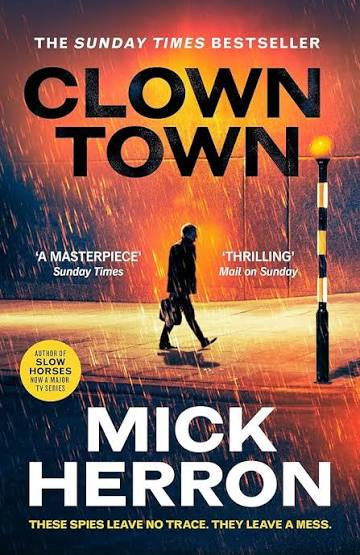
Clown Town is an excellent antidote for viewers impatient for the next episode of the series to be released, but it does inevitably include spoilers which cannot be avoided. So pick a lane – either watch the television series and enjoy the twists and turns as they are revealed, or read the books and know, broadly, what is going to happen but enjoy the episodes anyway. I did have one final moan and that is with the paperback cover, shown above. It is horribly generic and any number of other spy novels use this template. The strap line used under the author’s name – “These spies leave no trace. They leave a mess” is a clumsy attempt at humour that might mislead an unwary browser into thinking they are buying a comedy spy novel, which is a long way from the whole picture. The novel deserves a better presentation than this by Herron’s publisher Baskerville the literary crime and thriller imprint of John Murray Press.

