Book review, Pure Juliet, Stella Gibbons

Pure Juliet, by Stella Gibbons, 2016

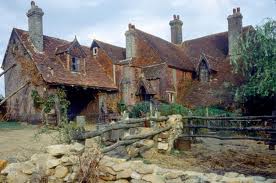
Pure Juliet’ tells the story of Juliet Slater, a working class girl from London, who just happens to be a mathematical genius. It is one of an increasingly popular genre, the lost novel. Originally written by Stella Gibbons in the 1970’s, it was not published in her lifetime (she died in 1989) but was recently “discovered” by her family and has been marketed by the publishers with this narrative, rather than “the author didn’t think this was quite good enough yet but never got round to revising it” which is probably closer to the truth.pure-juliet

Cultural references set the first section of the novel, in which Juliet completes her A levels and leaves home to stay with an adoptive aunt, Miss Pennecuick, in her isolated country house in rural Hertfordshire, in the late 1970’s – punk rock, Friends of the Earth, and Star Wars are mentioned. Continue reading

Standard
20th century Literature, Cold Comfort farm, Stella Gibbons, The Bachelor

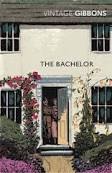
The Bachelor by Stella Gibbons

Oh dear. If you have read anything I have written previously about Stella Gibbons it will be immediately obvious that I rate Cold Comfort farm as one of the best books ever written. Hyperbole? perhaps, because I would recognise the book is not without its flaws, but if I had to choose one book for a life time of desert island living this would be it. It is by far and away the book I have reread the most in my life. But sadly nothing Stella Gibbons ever wrote approached the genius of CCF. In bringing her catalogue back into print Vintage have done us a mixed blessing – while it is exciting to read anything she wrote, the disappointment is inescapable. I will keep reading her to try to capture the magic of CCF, but with steadily decreasing expectation and hope.


The Bachelor is a perfectly decent romantic novel of manners set in 1940s wartime London and the Home counties (a thinly disguised St Albans). The romantic entanglements of the lead characters and supporting cast is handled well, but it isn’t where the interest of the novel resides. To be honest it was the strangely detached description of the war and its impact on the lives of the characters was were I derived my most interest in this novel. The war is a fact of life, a backdrop to pretty much everything the characters do – rationing, the blackout, characters missing on service, the Home Guard, refugees, prisoners of war and evacuees are all there – but everyone just gets on with their lives as if it was a temporary piece of nastiness that sooner or later will pass, which of course it did. The novel was published in 1944 and I suspect written near then, because the threat of invasion or defeat is not even hinted at. The portrayal of the middle class characters who oppose the war and appear to treat it as a case of a misunderstanding between countries taken too far was interesting – these are not conscientious objectors or pro-German or pro-Nazi supporters, more ideological pacifists who think the conflict can be talked away. This pacifism is tolerated as an eccentricity rather than disloyalty or treason.


Towards the end of the novel the war comes more into the foreground. Kenneth the bachelor of the title is in London looking for Vartouhi, the feisty refugee who is less than half his age, (this is not seen as a problem by anyone) who has left his employment after a row with his sister Constance, and is working in a milk bar. He tracks her down in a depressed, bombed out part of London similar to the streets where “Starlight” is set, albeit twenty years later. The extent of the bomb damage is depressing if not to say upsetting, and through this landscape comes Vartouhi, followed by her “boyfriend”, a Canadian soldier with the unlikely name of Raoul who is clearly well on the way to being a psychopath. Although Vartouhi is cheerfully unafraid of the menacing Raoul, Kenneth quickly realises he is dangerous, and sees him off with a show of bravery that seems to draw upon his years in the trenches in the Great War. This section of the novel stands out as a compelling piece of narrative compared to much of the sleepiness of the rest of the book.

So why he “oh dear”. Well first this novel is the reason for my prolonged absence from this blog – it was incredibly heavy going. More than a few pages a night would send me off. The plot consistent solely of the predictable romantic affairs which resolve themselves as expected from the beginning, but take over 400 pages to do so. Very little else happens. The major plot incidents involve an argument about a bedspread – albeit a bedspread loaded with sexual symbolism – and a Christmas visit from an aged relative.
Gibbons handled romance with a delightfully light touch in CCF – the relationship between Flora and Charles is covered in a few lines of text – but when she says “This is forever isn’t it darling?” and he says something romantic about how nice her hair smells, it is utterly convincing. The relationships in the Bachelor are believable enough, but the characters take a very long time reaching the same point as Flora and Charles.
I remain Gibbons’s ardent admirer, and won’t give up on her back catalogue, but now for something completely different….

Standard
20th century Literature, Christmas at Cold Comfort Farm, Stella Gibbons

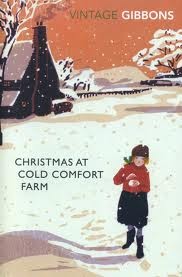
Christmas at Cold Comfort Farm, by Stella Gibbons, 1940

OK, last entry on Cold Comfort for now,although to be fair it has been an obsession for more years than I care to remember, and this writing has a certain cathartic/therapeutic role. “Christmas” it needs to be said straight away is a short story – not even that really, more a portrait. It runs to less than 20 pages in the Vintage edition recently published, and bless them for doing so. I can forgive the fact they do little to publicise the fact that this is not a novel, but a collection of stories, only one of which is about Cold Comfort.

The original novel was published in 1932; this short story dates from 1940, and Conference, which I wrote about earlier in the month dates to 1959, astonishingly late given the subjects being satirised. But I have written enough about Conference, save to say that the glimpse we have of Elfine, out riding with her sons, is worth the book on its own. Back to Christmas. Gibbons rediscovers her light comic touch here, and the vision of a Cold Comfort unredeemed by Flora’s reformation, anarchic and dark, is to be treasured. Adam Lambsbreath delivers presents to the clan, disturbing Seth with a “friend” and being shot at by Amos with the goat-gun in the process, and then Christmas dinner degenerates into predictable anarchy. Elfine escapes with Dick on horseback, and the farm settles back into its long wait for Flora, Aunt Ada flapping weakly at anyone in range of the Milk Producers Weekly Bulletin and Cowkeepers Guide. One word – brilliant.
Standard
100 Best Novels Guardian list, Book review, Cold Comfort farm, Conference at Cold Comfort Farm, humour, Starkadder, Stella Gibbons, Uncategorized

Conference at Cold Comfort Farm by Stella Gibbons, 1949

More on Cold Comfort – not that I am obsessed or anything. The original novel, Stella Gibbons’s first, was published in the early 1930’s. It has a wonderful period feel – although it is set a few years in the future, and there are glimpses of how the world has changed, with video phones and passing references to a recent war, for example. Despite this the world described is comfortably Edwardian, with strong echoes of Waugh and Saki in the opening chapters on Flora and Mrs Schilling’s life in London. The move to deepest darkest Sussex, even then surely not as isolated and backward as Flora describes it, provides a contrast to the metropolitan life she has temporarily abandoned. That contrast is kept in focus by the introduction of Mr Mybug (what a great name – he is Flora’s pest, but she has a soft spot for him nonetheless) with his gloriously stupid theories about Bramwell Bronte.
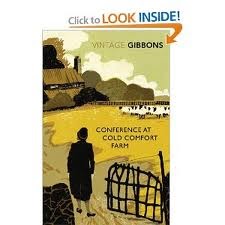
Mybug “works” in the novel as a contrast to the mad rural folk around him and as a foil for Flora, but the decision to take his character and turn it into the central theme of the Cold Comfort sequel, Conference at Cold Comfort Farm, has to be one of the most bewildering a writer has ever made. The yearning to return to the Starkadders, especially when her subsequent novels had never made the same mark as her first, must have been irresistible. We all wanted to know what had happened to the farm and the cast of characters – but cared very little about the intellectuals that Mybug represented. Yet in the sequel the original cast of characters is largely forgotten or treated as marginal. We are introduced to a series of grotesque caricatures of writers and artists from Mybug’s world at whom we are invited to sneer. It is car crash writing, and how it got past an editor I will never know. It is disrespectful to the original novel, and if it has been written as fan-fic it would have been rejected by Gibbons’s estate with barely a glance.

And yet I still love it. Written in the 1950’s, with of course the world an utterly darker place, it was out of print for a long time. I originally came across it as a library copy, and pounced, desperate to know what had happened to Flora, Charles, Seth, Reuben, and the whole grisly crew. We go back to a farm transformed into a prettified National Trust venue that has been turned, utterly improbably, into a conference centre. Flora goes down to help Mr Mybug run a cultural event there for no good reason (she has a large family with Charles by now) and not much happens until the Starkadders return and all is righted. Everything funny from the original novel, including the invented language (sukebind, mollocking) has gone. But it is still Cold Comfort Farm, and we love it. We love our parents when they grow old, we love footballers who retire and get fat because of their past glories, we love the town we grew up in even though they have paved over it and erected a shopping centre – we love them despite all that, not because of it, and I still treasure the glimpses of the world Stella Gibbons unforgettably created in her original burst of genius.

Standard
100 Best Novels Guardian list, 20th century Literature, Book review, Cold Comfort farm, humour, Stella Gibbons

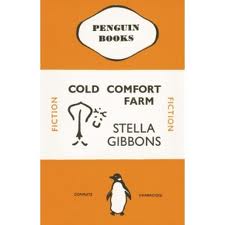
Cold Comfort Farm – a classic

I have a confession to make – I love Cold Comfort Farm so much that I/we named my firstborn after two of the principal characters. I figured this would at least give him a great conversation opener when he finally gets interested in girls.
CCF is in my top three works of fiction of all time. On my desert island it would share a shelf with the Collected Works of Shakespeare, and, oh, probably the Gormenghast trilogy (if I could get away with having a trilogy).
The clichés about CCF are all, sadly, true. Stella Gibbons never wrote another word coming close to its genius, and the introductions to her recently reissued novels by Vintage acknowledge as much. That’s not to say her other work isn’t worth reading, (and I will write separately about Conference at Cold Comfort Farm, and Christmas at CCF) but you can never for a second forget that they are written by the same person who wrote Cold Comfort Farm. The contrast can be painful.
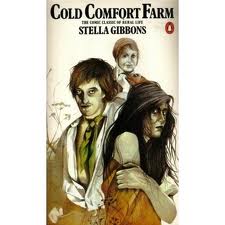
(this cover illustration is wrong is so many different ways, but is from the first edition I owned)
Anatomising why the novel is such a delight is in some respects pointless – it doesn’t bear too much analysis and inspection. The plot is flimsy, the minor characters deliberately (and joyfully) muddled up, the purple prose is flagged for the reader’s ease of appreciation. But some observations can’t be resisted. The romance between Flora and Charles, drawn with an economy that Austen would be proud of, is a particular delight. At the end of the novel (spoiler alert) they fall into one another’s arms, and are virtually speechless with genuine delight. Another joy is the use of names – Urk and his water voles, Richard Hawk-Monitor the local gentry from Haut-Couture (“Howchicker”) hall, Adam Lambsbreath (Adam has strong echoes of Joseph, the irascible and largely incoherent rustic who haunts Wuthering Heights) and of course, Aunt Ada Doom, matriach of the Starkadders.
The cliche that one could not love someone who did not love (insert cultural artifact of choice) is over-used, but I am so glad that the person I chose to spend my life with loves Cold Comfort as much as I do.
Standard