Book review

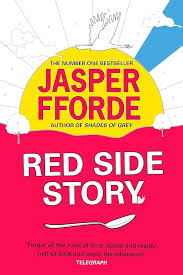
Red Side Story by Jasper Fforde, 2024

Red Side Story is the sequel to the wonderfully imaginative Shades of Grey (2009), which I should stress straightaway has absolutely no connection with the book with ’50’ in its name. Fifteen years is a long time to wait for a sequel (unless you are George R R Martin) and I was worried that the author had lost interest in the fascinating world of chromatacians (bear with me) that he had created, or couldn’t work out where to take the story. But all our patience has definitely been rewarded.
As we know from Shades of Grey, the story is set in a version of the UK (more specifically, Wales) where every aspect of your position in society depends on your ability to perceive parts of the colour spectrum. Colour vision is extremely limited in this society. Some people – ‘Greys’ – have no colour vision at all and are the equivalent of untouchables; others are divided into the colours they can see with more senior roles given to those with the better colour sensitivity. Society is governed by an extremely rigid set of rules set out in Munsell’s ‘Book of Harmony’. Technology is largely forbidden, with a few exceptions. It is a bizarre, but at the same time recognisable world. It is also quite brutal – people are killed (by being shown a shade of green which acts like a deadly poison) for any small infraction of the rules. There are signs of the civilisation that came before the Something that Happened’ five hundred years earlier, but very little understanding of that society.

The novel picks up where Shades of Grey left off. IN East Carmine on the fringes of Red Sector West, Eddie Russett and Jane Grey, having discovered that there is something profoundly wrong with their society, have determined to do something about it. But first they have to escape the trumped-up murder charges they are due to imminently face. Eddie has also recently found out that his perception of the colour red is very high, meaning he is highly valued in the marriage market. But once his seed has been sown any protection he derives from his colour perception will be gone. Slowly Eddie and Jane piece together clues that show them their society could possibly be a vast social engineering experiment, monitored by drones that they have been taught to think as swans. Everyone carries a bar code imprinted on their fingers, allowing the ‘swans’ to locate them at any time – hence the reason wearing gloves is not allowed.

The novel’s parables aren’t hard to unlock – they aren’t meant to be. Treating people as unequal simply because of their physical characteristics is bad. Dogmatic adherence to out of date rules of dubious authority is stupid. We should be able to love who we want to love, not have to trade our fertility like cattle. And so on. But the novel is at no point preachy – this is just Eddie and Jane’s world, and they are heroic in their struggles to find the truth, risking their lives over and over again. I don’t think there’s ever any doubt they will succeed.

Red Side Story can be read as a standalone novel, but I would recommend reading Shades of Grey first. Not because you really need it to work out what is going on in the later novel, but because it is a great story. Fforde is a unique author – comparisons to Pratchett (in the Independent’s review below) for example are wide of the mark. Possibly the nearest in terms of imaginativeness would be the wonderful Douglas Adams and there really is no higher praise. The inventiveness of Fforde’s stories is just the start – what is really impressive is the way he manages to sustain an idea and populate a believable universe without drawing on folk tales or mythologies as most fantasy authors do. This makes him instantly recognisable as an author. Add to this mix his consistently progressive narratives and some great jokes (and there I will accept a comparison with Pratchett, because some of the puns are a bit painful – for example the menacing Undertoad) and you have an author in superb control of his material and a wonderful, whimsical and at the same time brutal story.

The internet seems to think there will be a third novel in the series – I do hope so, and that we don’t have to wait 15 years!

What other reviews have said: a selection

‘Fforde is one of literature’s most enjoyable visionaries, and his long-awaited Shades of Grey sequel will be eagerly seized upon by his admirers… The jokes are excellent, the pacing breathless and the last line a classic’ Observer

‘Fforde’s books are more than an ingenious idea. They are written with buoyant zest and are tautly plotted . . . and are embellished with the rich details of a Dickens or Pratchett’ Independent

‘No summaries can do justice to the sheer inventiveness, wit, complexity, erudition, unexpectedness and originality’ ​The Times

Red Side Story by Jasper Fforde, 2024

Aside
Book review

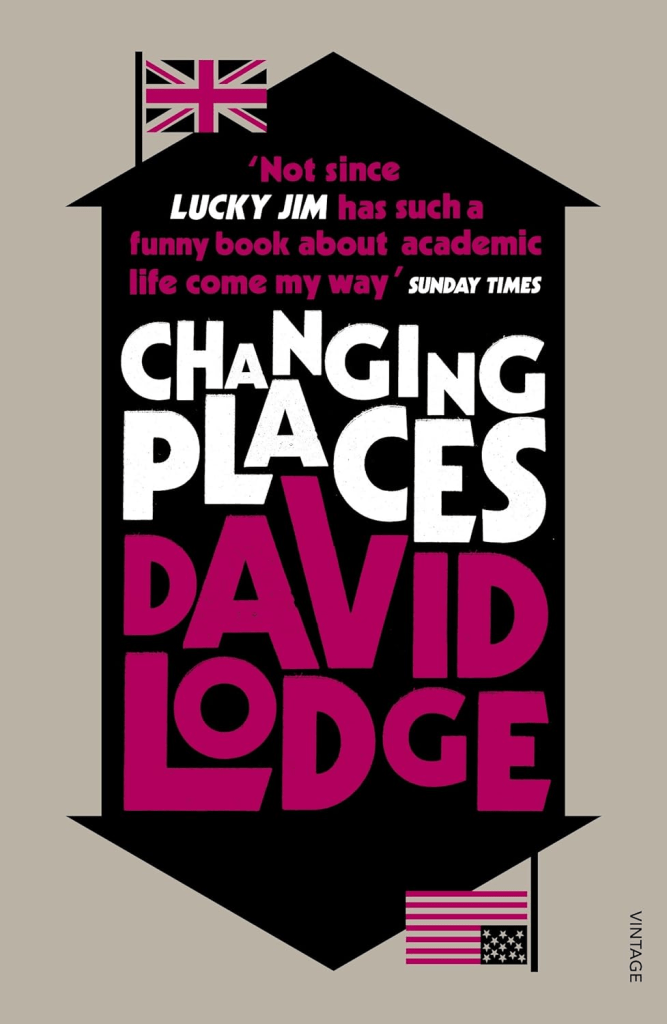
Changing Places, by David Lodge, 1975

Although Changing Places was written in 1975, it is set in 1969, and those six years are significant. The events of the novel take place in parallel on campuses in England and America, and the spirit of the sixties is abroad in both. Protest and counter-culture are in the air. By 1975 Nixon was out of the White House, the Vietnam War was coming to an ignominious end, the Beatles had split up and flower power was a distant memory.

To an extent this made Changing Places anachronistic even when it was published. It was looking back nostalgically at a period in time which was very close but also gone for good. That anachronism has inevitably widened over time. Professors sleeping with their students and one another’s wives may have been the height of liberation in the sixties – today it just looks creepy.

The novel is a classic trading places situation comedy. Two English professors, mild-mannered Philip Swallow, and charismatic American Morris Zapp, swap roles in their respective universities, thinly disguised versions of Birmingham, UK and Berkeley, California. They find themselves in very unfamiliar territory both academically and socially and much of the novel’s humour derives from their struggles in their new environments in traditional fish out of water manner. Both men almost inevitably have affairs while on their academic sabbaticals; more surprising is their involvement in the student protests that sweep their campuses. While Swallow finds himself accidentally involved in the demonstrations, Zapp is well-suited to his role as mediator between students and faculty.

Lodge has fun with the format of the novel, at one point continuing the narrative through news headlines and stories and later using a screenplay format. This serves to keep the story fresh and moves it along at pace. A significant time jump two thirds of the way through, moving quickly past some of the events that had been sign-posted and are now seen in hindsight, adds to the sense of pace. The novel ends with the two couples convened in a New York hotel room trying to decide their fates. The author has fun with the idea first articulated in Northanger Abbey that the reader knows the novel is coming to a close (and therefore a resolution of any outstanding plot points) by the “tell-tale compression of the pages” but chooses instead to leave issued unresolved – until the sequel of course.

The acid test for any comic novel has to be ‘is it funny?’. The quote on the front cover of the edition I read (shown above) has a comparison to Lucky Jim, a novel that I think has largely fallen out of fashion in recent years and is now equally anachronistic. There was a time when the Kingsley Amis novel would have been in my top ten novels list, but it hasn’t aged well. I think a more interesting comparison would be with Malcolm Bradbury’s The History Man which was published in the same year as Changing Places and which takes a much more unblinking, less affectionate look at British academic life. Is Changing Places funny? It’s mildly amusing, nothing more; the satire is so gentle as to be hardly noticeable. I now need to decide whether to read the sequel, with a nagging suspicion that it might simply be more of the same. Only one way to find out I suppose.

Changing Places, by David Lodge, 1975

Aside
Book review

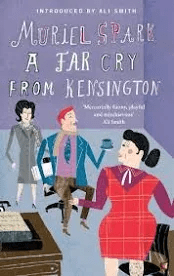
A Far Cry from Kensington by Muriel Spark, 1988

Muriel Spark is on my auto-buy list. When browsing in second hand bookshops I have a few authors I always buy if I can find them. As long as the book is reasonably priced, in decent condition, and I don’t already have it, I will always buy novels by, among a small number of other authors, Muriel Spark. Her novels are always interesting and worth reading, and A Far Cry from Kensington was no exception.

Set in 1955, A Far Cry is narrated by the no-nonsense Mrs Hawkins, a thinly disguised semi-autobiographical portrait of the author. It centres on a “rooming house” in (you guessed it) Kensington – a large house divided into separate one room apartments – where a diverse set residents live under the care and supervision of the landlady, Milly. It is a comfortable community of people in transit, typical of post-war London, settled by individuals and couples looking to establish themselves in London and in life.

Mrs Hawkins works in publishing. Some of her reminiscences (the narrative is told in flashback, some thirty years later) are based on Spark’s own time working in this field. Initially she works for the Ullswater and York Press, a chaotic publishing house that is heading for bankruptcy. I haven’t researched the novel sufficiently to say this for certain but I would put good money on the fact that Ullswater Press has a real-life equivalent that went bust in the mid-1950s, causing something of a scandal at the time as the proprietor was subsequently jailed for fraud.

The novel’s villain is Hector Bartlett, a bad writer who has influential friends who try to secure publication of his writing. Hector takes to accidentally-on-purpose bumping into Mrs Hawkins on her daily walks in the park near her office, attempting to leverage this casual relationship into an introduction to her boss. Hector the writer is described thus

“Hector Bartlett, it seemed to me, vomited literary matter, he vomited and sweated, he excreted it…His writings writhed and ached with twists and turns and tergiversations, inept words, fanciful repetitions, far-fetched verbosity and long, Latin-based words.”

Hector the man is if anything even more harshly described:

Red hair en brosse, brown corduroy trousers, tweed coat with leather patches on the sleeves, a yellow tie, and a green check shirt….with a pronounced stoop of the shoulders which made him seem older than he was… His face was round with a second fat chin”.

Mrs Hawkins describes him to his face as a ‘pisseur de copie” a urinator of journalistic prose, and never backs down from this undeniably confrontational phrase. Spark denied that Bartlett was a portrait of anyone specific in post-war literary London, which I suppose must be right given how libellous it would otherwise have been!

Bartlett uses his influence with Emma Loy, a successful novelist, to have Mrs Hawkins sacked from Ullswater Press and subsequently from another job in publishing when she continues to use this description of him and also refuses to rewrite his copy to make it acceptable for publication. This doesn’t have a significant impact on her career and even if it would have done she is not the kind of character to back down, even in the face of a direct plea from Ms Loy. She can’t stand him, and her instincts prove spot on when there are further revelations about his damaging behaviour towards other women in the novel.

A Far Cry isn’t just a series of anecdotes about the publishing world. While the residents of the boarding house all have their brief moments centre stage, Wanda, the Polish emigre seamstress, has a defining role when she receives a threatening letter, which leads to a downward spiral that, we eventually find out, was caused by the vengeful pisseur de copie.

Central to the novel is the bizarre practice of ‘radionics’.  Radionics is a form of quack therapy that survives to this day (There is a Radionics Association that awards three-year diplomas and sells crystal pendulums). It claims that diseases and other medical conditions can be diagnosed and treated by applying electromagnetic radiation such as radio waves to the body from an electrically powered device. It ‘works’ only through the placebo effect. Mrs Hawkins has no time for it and it is no surprise that Hector Bartlett is an enthusiast proponent of the concept, using it to manipulate other characters in the novel. People undoubtedly do fall prey to this sort of scam, and while radionics may have faded out somewhat, certainly in the UK, other forms of manipulation have of course taken its place. Initially I found this all a bit clumsy, but on reflection the fact that there are many modern forms of the same pseudo-science that people fall prey to every day made me reconsider and feel more charitable towards the idea as a plot device.

This is a complex and rewarding novel in which Mrs Hawkins’ narration, even with the benefit of thirty years of hindsight, reveals only glimpses of what is ‘really’ going on – for example the identity of the anonymous threatening letters to Wanda is only revealed in passing at the end of the novel, the revelation pivoting on the spelling of the word “organisers”. The reader sees the events of the novel through the eyes of 1955 Mrs Hawkins as she experiences them in real time, with only occasional reassuring interjections by the 1980’s narrator. I have enjoyed other Spark novels more, but I could admire the artistry of A Far Cry without being blown away by its sophistication.

A Far Cry from Kensington by Muriel Spark, 1988

Aside
Book review

Uproar!: Satire, Scandal and Printmakers in Georgian London by Alice Loxton, 2024

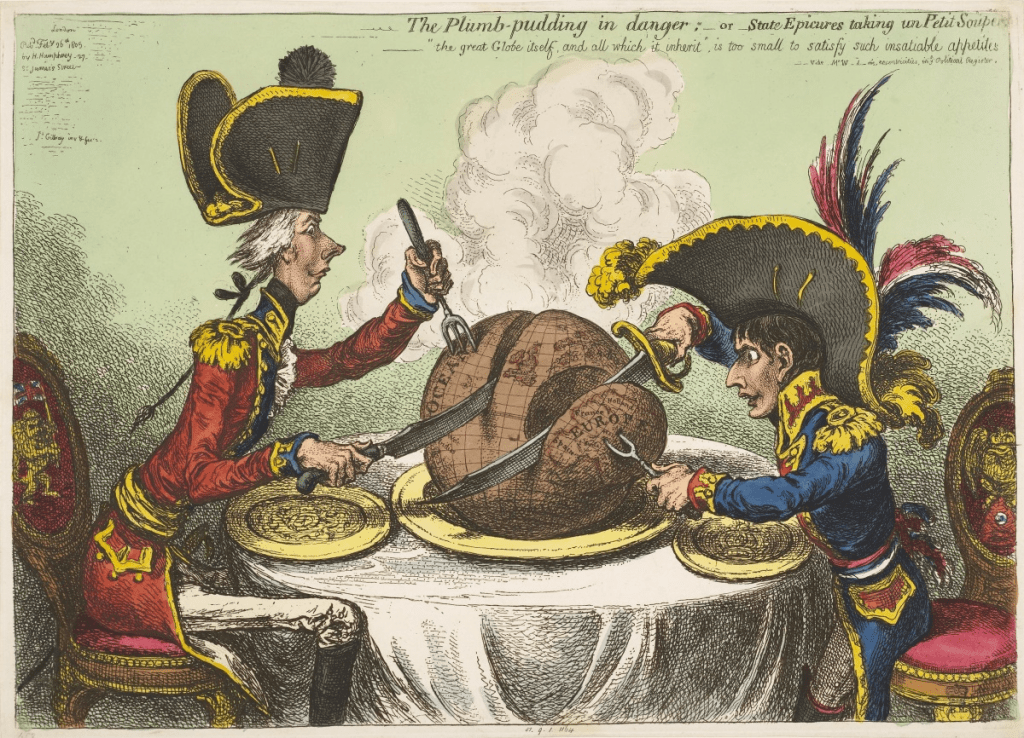
Uproar! is a jaunty look at the work of the golden era of satirical printmakers in Georgian Britain. These are names you will have heard of – Cruickshank, Rowlandson and Gillray, you will definitely have seen some of their work, such as the famous and much copied sketch of Pitt and Napoleon carving up the world like a plum(b) pudding (below).

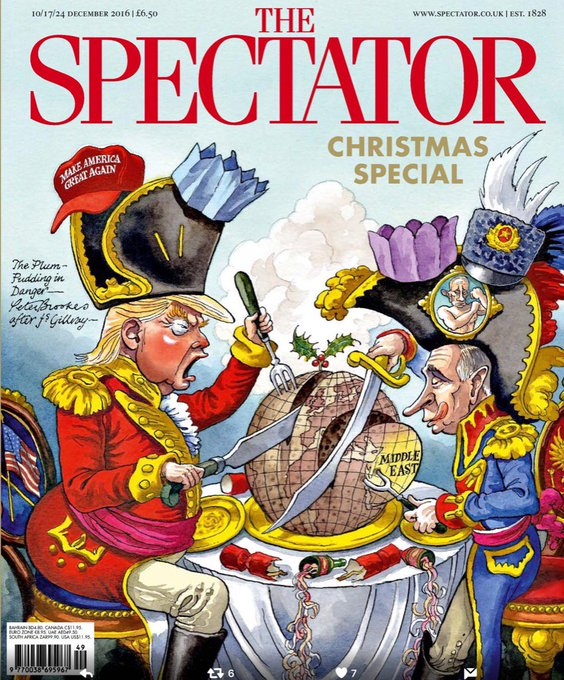
While writing the previous sentence I wondered whether this sketch would work if the characters were replaced with more contemporary figures such as Trump and Putin – and viola:

Previously I knew very little about these caricaturists, although many of their sketches were very familiar. Loxton charts their rise as important influencers of public opinion in the context of the technological changes (which allowed the prints they produced to be published quickly and cost effectively) and the political upheaval occurring at the same time – the loss of the American colonies, the French revolution, and the rise of Napoleon. It’s a compelling story briskly told alongside brief biographies of the main characters.

Being picky, I found the author’s attempts to make the account relevant by a liberal sprinkling of contemporary culture reference a bit annoying. The X Factor, Carry On films and The One Show are all referenced. (“If joining the Royal Academy under Sir Joshua Reynolds was the chance to get a five-minute interview on The One Show, studying with Pigalle in Paris was the equivalent of being sent to Hollywood” and later “Much like the X-Factor starlets staying at Simon Cowell’s LA Mansion”). Do these images really add to the point being made, or do they feel like an author slightly desperate to make boring old history relevant? I could have done without them, particularly because most of the references are so out-of-date – would the average Millennial even know what the Carry On films were?

However, with this qualification, the author makes a compelling case regarding the importance of printmakers to Georgian politics and society. The comparison to Spitting Image is equally strangely old-fashioned, but for readers of my generation it works – Spitting Image definitely had a impact on late-twentieth-century politics. Arguably that impact was zero – politicians used to love being in the limelight by being portrayed in grotesque latex – but that’s the nature of satire; you can never be certain whether it influences political events. Certainly the image of a stone-grey John Major eating his peas has stayed with me!

The final chapter, in which the author attempts to summarise the impact and importance of the Georgian caricaturists, felt a bit confused. Their significance at the time did not outlast the Georgian period. Once Gillray, (Isaac) Cruickshanks and Rowlandson had died, all around the same time as George 3rd and the end of the Regency, society was ready to move on to a new era of Victorian conservatism, in which the extravagance of the caricatures was considered indecent and disrespectful. But to say they were ‘cancelled’ is to misuse a phrase from the era of social media. Reputations rise and fall but the work of these printmakers and satirists has definitely survived and remains relevant, as the Trump/Putin examples above demonstrate. Loxton I think fairly describes their influence as ” undeniably one of the most powerful forces in Georgian Britain; their prints not only reacted to world events, but propelled political change, they shaped public opinion; they built up careers; they shredded reputations.” She even goes so far as to claim that these printmakers were the reason Britain didn’t see its own version of the French Revolution, which seems quite a stretch, and argue they had a direct influence on artists as varied as Blake, Lewis Carroll, and even Salvador Dali.

One false note was the author’s claim that ‘Victorian commentators’ were responsible for inflating the reputation of William Blake above those of his contemporary illustrators. This is bizarre. Blake’s reputation rests largely on his poetry, which isn’t mentioned, and his art is as far from the satirical cartoons of Gillray etc as can be imagined. But that aside this is a really useful summary of the politics and history of this I think unfairly neglected art form and its impact on social change in Georgian Britain.

Uproar!: Satire, Scandal and Printmakers in Georgian London by Alice Loxton, 2024

Aside