Book review

The Eyre Affair, by Jasper Fforde, 2001

When I was drafting my review of Fforde’s recent novel, Early Riser, I planned to refer back to an earlier review of his first published novel, The Eyre Affair – only to find that in fact I hadn’t written it! I must have read this novel before I started my blog, although I have reviewed some of the later novels in what was to go on to become the Thursday Next series.Fforde
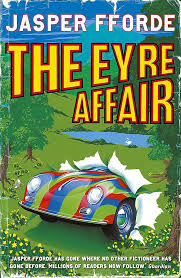
The Eyre Affair is a brilliantly original genre-busting novel. It follows the adventures of Literary Detective Thursday Next, on the trail of a genuinely sinister villain, Acheron Hades. The novel is set in a strangely recognisable parallel universe, in which England and Imperial Russia are still fighting the Crimean War, Wales is an independent nation, and where literature is given its rightful value by society (one of my favourite scenes is where Thursday and her on/off boyfriend Landen Parke-Laine go to a performance of Richard III which is a parody of the audience-participation showings of the Rocky Horror Picture Show).

Some of the jokes – a character is called Braxton Hicks, for example – are groan-inducing, but the literary references are very clever. There’s a throw-away joke about Cardenio and the repartee about the Shakespearean authorship “question” for example shows a depth of knowledge and love of literature you won’t find in many mystery/adventure/detective novels, let alone comedies.

Thursday is a strong central character around which Fforde builds his narrative. She is a veteran of the Crimean war, where she lost her brother in a modern version of the Charge of the Light Brigade. She is in the career doldrums when she is unexpectedly recruited to track down criminal mastermind Acheron Hades, her former university professor.  Hades is a formidable and ruthless criminal, kills without hesitation or any trace of remorse, and nearly kills Thursday herself until the fortunate intervention, and this is where it gets really wild, of Mr Rochester from Jane Eyre. Yes, that Mr Rochester. Because in this universe it is possible, somehow, to move from the world of literature to what I am going to refer to as the round world, and vice-versa.

This fluidity between worlds allows Thursday and others to intervene in texts and change their outcomes. Some of what happens to Thursday, such as the supernatural message that leads her to change her life, is paralleled in the events of Jane Eyre, but Thursday is no Jane. She is not a passive figure but a woman of action and ideas.

Fforde’s achievement is that he doesn’t just parody genres, he delivers a series of interwoven narratives that all succeed in their own right. The detective story is an enjoyable mystery; the adventure elements are exciting, and the romance between Thursday and Parke-Laine, albeit kept in the background, is believable and touching, and plays its part in the novel’s finale. Fforde’s world building relies on the contrast between the familiar and the bizarre – for example in this world the dodo has been genetically re-engineered. Best of all, for me, were the literary jokes, which are done with respect for the source material. Both of the novel’s endings, one in Jane Eyre, the other in the ‘real world’ are borrowed from the Bronte text but with a clever twist.

Basically, I loved it. I can’t understand why it’s not been adapted for television I will never know, I can see it working brilliantly.


Standard
Book review

An Author Ian Likes: in memorium, Sir Terry Pratchett

Perfectly put

stuffianlikes's avatarStuff Ian Likes

(This post was originally written on the original stuffianlikes blog the day after Sir Terry passed. I’ve tidied up some grammatical errors and added a couple of pictures but this is otherwise the way it appeared 4 years-minus-a-day-ago)

I usually dwell on these posts for bloody ages but this one needs to be gotten down quickly or it will never be done.

It’s 1985. I’m a weedy, bespectacled kid of 15 with acne, bad hair and a desire to see more of other worlds. I see a new book on the shelves of Angus & Robertson on my weekly trip into Hobart to bookshop crawl. The Colour Of Magic, by Terry Pratchett. It’s thin but the cover looks great and the blurb sounds pretty cool (I have no idea who Jerome K. Jerome is but I still think Douglas Adams is funny so half of it has worked) so I’ll…

View original post 898 more words

Standard
Book review

Small Gods (Discworld 13) by Terry Pratchett, 1992

It feels appropriate (if unplanned) to publish this review on the sad fourth anniversary of Sir Terry’s untimely death.

By this point in the Discworld saga, he was really hitting the peak of his powers. This was a writer who is really confident with his material, able to tackle large themes and ready to take risks. And for any writer religion is arguably the biggest risk – you are always going to upset someone. Small Gods is a fascinating discussion of the nature of divinity. That makes it sounds very serious, but that was the author’s genius – to write about serious themes in a very funny way.

The novel is set in Omnia, a kingdom in the continent of Klatch, new to Discworld at this point I believe, and bearing an uncanny resemblance to a medieval Catholic country in the grip of a frenzied search for any trace of heresy. Pratchett has given Om a far-eastern name, and mixes up his religious references freely, but the use of torture by the Quisition to enforce religious conformity and stamp out free thinking, has only one true origin. In Omnia religion has become a distorted version of itself, with torture and fear being its dominant characteristic. In these circumstances true belief in the God Om himself has begun to wither, so much so that the God Om finds himself reincarnated in the body of a tortoise. It seems he is destined to return to the world of once great but now Small Gods who exist on the borders of reality, desperate for believers from whom they derive their existence.

By a million to one chance, and therefore a literary certainty, Om in his tortoise form encounters the novice Brutha, the only remaining true believer in Omnia. Brutha’s idetic memory is used Vorbis, the head of the ExQuisition, to memorise the way through a labyrinth used to guard the library of Ephebe. Vorbis is one of Pratchett’s scariest monsters, a psychopath so controlled and uncaring that he is able to retain his position at the head of the Omnian church by fear alone. An underground movement, reminiscent of the early Christian church, survives in secret, passing its belief in the Disc-shape of the word through its slogan “The Turtle Moves”. The scene is set for a clash of beliefs in which someone is going to die. Guessing who isn’t a challenge, but the journey – in this case a physical journey through the desert – is where the transformation of Brutha from a menial drudge to a prophet occurs.

As always with Pratchett his wit and wisdom shines through. Here he is on religious repression, for example:

“Fear is a strange soil. It grows obedience like corn, which grow in straight lines to make weeding easier. But sometimes it grows the potatoes of defiance, which flourish underground.”

or here on the miracle of our existence:

“Humans! They lived in a world where the grass continued to be green and the sun rose every day and flowers regularly turned into fruit, and what impressed them? Weeping statues. And wine made out of water! A mere quantum-mechanistic tunnel effect, that’d happen anyway if you were prepared to wait zillions of years. As if the turning of sunlight into wine, by means of vines and grapes and time and enzymes, wasn’t a thousand times more impressive and happened all the time…”

Sir Terry’s death was such a loss, but he left us a wonderful collection of novels that are a fine legacy.

Standard
Book review

Paris Echo, by Sebastian Faulks, 2018

Have you ever got the end of a novel and asked “What was the point of that, then?” In a sense I know this is a futile question – there is no ‘point’ to Van Gogh’s Sunflowers or Beethoven’s Fifth. Equally not all novels have a point – they exist as a work of the author’s creativity and can’t be judged for their utility. I can think of some exceptions to this rule – there is a very definite point to Gulliver’s Travels, for example, or Animal Farm, but most novels are not didactic – they just tell a story, introduce some characters, and tell us something about the human experience. Continue reading

Standard