Book review

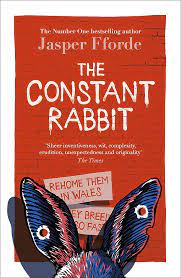
The Constant Rabbit, by Jasper Fforde, 2020

Jasper Fforde is one of our most consistently inventive writers. In The Constant Rabbit he has once again shown this with a surreal allegory which at its heart is about difference. What could so easily have been a heavy-handed satire on Brexit and racism becomes a thoughtful discussion of how people cope with discrimination, both from the perspective of the discriminated against and that of the prejudiced. But I was left wondering whether Fforde at times overstepped the invisible line between dark humour and bad taste.

The central premise of the novel is that in 1965 an “anthropomorphising event” in the UK transformed a small number of rabbits into intelligent, talking, human-scale rabbits. By 2020 their population has grown to over a million. In response to concerns about their impact on the country, the United Kingdom Anti-Rabbit Party, originally a fringe protest group, has taken office in Westminster. Attacks on the rabbit community by hate groups such as TwoLegsGood (a nod to Orwell, of course) are frequent and the courts have decided that rabbits do not merit the protection of the law (any more so than any other animal). For their ‘protection’ the Government is planning to herd all rabbits into an isolated community ominously labelled the Mega-Warren. Society has subtly changed after the years of human/rabbit coexistence, with institutions such as RabCoT, the Rabbit Compliance Task Force, emerging to deal with the Event. Rabbits have developed their own culture of course, a blend of animal and human behaviours, which Fforde expounds on in detail – it’s a strangely recognisable version of our own society but adapted to cope with rabbit life-spans, libidos and compulsion for digging burrows.

Other animals were anthropomorphised as well, most notably foxes, who now murderously predate the human rabbit population without fear of consequences or reprisal. It must be pretty terrifying to be a rabbit in these circumstances, but (we are told) they are used to a life where sudden death is an every day possibility, so are not as bowed by the experience as one might expect. There’s a long and respected tradition of authors using animals as avatars for humanity, looking at our behaviour towards animals as a lens through which to see our behaviour towards one another. This tradition dates through Swift’s Houyhnhnms and beyond to Greek drama. Apart from Beatrix Potter and Watership Down rabbits have rarely been at the centre of this tradition – I suspect mainly because they aren’t very anthropomorphic.

The narrative is told from the point of view of Peter Knox, a rabbit “spotter”. As most humans are unable to distinguish one rabbit from another, spotters play a niche role in enforcing laws against the rabbit population. Knox is uncomfortable with his role within an oppressive state apparatus that spies on its population. He lives with his daughter in the village of Much Wenlock, a rural idyll full of small-mindedness and anti-rabbit bigotry. Into this dangerous and toxic environment comes Constance. Constance was Peter’s friend in university until she was expelled for the offense of being a rabbit. While at university Peter had a huge crush on her, and meeting her again caused all those feelings to come flooding back. Cross species relationships are frowned upon in this alternative reality, but not unheard of. We are invited to think of Connie as cross between Jessica Rabbit and the (inappropriately sexualised) Caramel Bunny. She is also several times smarter than Peter, and manipulates him very easily into supporting the rabbit resistance and leaking sensitive information from his work. Once Peter is sucked into this intrigue, forced to choose between his job and his sympathies for the oppressed rabbit-kind, the adventure rapidly accelerates towards a showdown between the apparatus of the state and the rabbit population.

This was at times a slightly awkward mix of political allegory and lowbrow humour. There are powerful echoes of different national and liberation struggles throughout the novel, from apartheid – the rabbits are prevented from going to university and forced to live in fenced-off communities; to Palestine, the civil rights movement in the USA – rabbits live in fear of sudden attacks from mobs in which they are ‘jugged’ (that is to say, murdered in a grotesque parody of lynching), and many others. Some of the targets are fairly explicit – the Anti-Rabbit Party, lead by Nigel Smethwick, is an obvious reference to UKIP/The Brexit party and Nigel Farage – indeed Rabxit is mentioned a few times.

I never thought I would say this of Fforde, who usually has a very deft touch with his humour, but some of this was in poor taste. Are lynchings, or ‘jugging’, the rabbit equivalent, really a source of humour? I must admit Fforde lost me here – to try to draw laughs out of the obvious parallels with the lynching of black Americans was tasteless (the term ‘jugging‘ comes from the traditional practice of cooking an animal inside a jug which is placed in a pan of hot water). I appreciate this is dark humour for the purposes of satire, and we will all have our own lines that should not be crossed, but this was for me inappropriate – the satire is dark enough as it is. In this world foxes are able to kill rabbits with impunity, and take pleasure in doing so – the main fox character Torquil Ffoxe (Peter’s menacing boss) is credited with killing several thousand rabbits before he meets his well deserved end, and at one point is shown with a bloodied corpse of a rabbit in a sack in his office. This is gruesome stuff, but the tone of the novel rarely acknowledges the bleakness of rabbits’ lives – they are shown as happy-go-lucky, sexually adventurous characters who make a significant contribution to society including serving in the military. They are the good guys from whom humanity could learn a lot.

Satire has no obligation to identify solutions – it points out what’s wrong with the world but doesn’t have to tell us how to sort it out. True to form there’s no call to action here other than to be nice to one another, the standard liberal response to racism and bigotry. The novel’s ending suggests that there is no solution other than escape, an option not available to most oppressed sections of society. If it makes us look afresh at the oppression of marginalised people across the world then it has done its job.
Standard
Book review

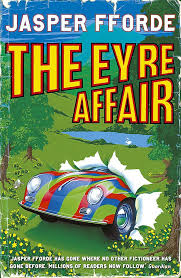
The Eyre Affair, by Jasper Fforde, 2001

When I was drafting my review of Fforde’s recent novel, Early Riser, I planned to refer back to an earlier review of his first published novel, The Eyre Affair – only to find that in fact I hadn’t written it! I must have read this novel before I started my blog, although I have reviewed some of the later novels in what was to go on to become the Thursday Next series.Fforde

The Eyre Affair is a brilliantly original genre-busting novel. It follows the adventures of Literary Detective Thursday Next, on the trail of a genuinely sinister villain, Acheron Hades. The novel is set in a strangely recognisable parallel universe, in which England and Imperial Russia are still fighting the Crimean War, Wales is an independent nation, and where literature is given its rightful value by society (one of my favourite scenes is where Thursday and her on/off boyfriend Landen Parke-Laine go to a performance of Richard III which is a parody of the audience-participation showings of the Rocky Horror Picture Show).

Some of the jokes – a character is called Braxton Hicks, for example – are groan-inducing, but the literary references are very clever. There’s a throw-away joke about Cardenio and the repartee about the Shakespearean authorship “question” for example shows a depth of knowledge and love of literature you won’t find in many mystery/adventure/detective novels, let alone comedies.

Thursday is a strong central character around which Fforde builds his narrative. She is a veteran of the Crimean war, where she lost her brother in a modern version of the Charge of the Light Brigade. She is in the career doldrums when she is unexpectedly recruited to track down criminal mastermind Acheron Hades, her former university professor.  Hades is a formidable and ruthless criminal, kills without hesitation or any trace of remorse, and nearly kills Thursday herself until the fortunate intervention, and this is where it gets really wild, of Mr Rochester from Jane Eyre. Yes, that Mr Rochester. Because in this universe it is possible, somehow, to move from the world of literature to what I am going to refer to as the round world, and vice-versa.

This fluidity between worlds allows Thursday and others to intervene in texts and change their outcomes. Some of what happens to Thursday, such as the supernatural message that leads her to change her life, is paralleled in the events of Jane Eyre, but Thursday is no Jane. She is not a passive figure but a woman of action and ideas.

Fforde’s achievement is that he doesn’t just parody genres, he delivers a series of interwoven narratives that all succeed in their own right. The detective story is an enjoyable mystery; the adventure elements are exciting, and the romance between Thursday and Parke-Laine, albeit kept in the background, is believable and touching, and plays its part in the novel’s finale. Fforde’s world building relies on the contrast between the familiar and the bizarre – for example in this world the dodo has been genetically re-engineered. Best of all, for me, were the literary jokes, which are done with respect for the source material. Both of the novel’s endings, one in Jane Eyre, the other in the ‘real world’ are borrowed from the Bronte text but with a clever twist.

Basically, I loved it. I can’t understand why it’s not been adapted for television I will never know, I can see it working brilliantly.


Standard
Book review

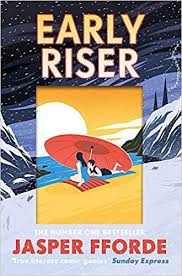
Early Riser, by Jasper Fforde, 2018

This is a really welcome return to writing ffor Fforde after a ffour year hiatus. (sorry).

I am guessing, but my suspicion is that his inspiration for this novel was the question “What if the last Ice Age had not finished when it did?” We know that human evolution – or probably more accurately the development of human civilisation – was profoundly affected by the most recent Ice Age. It can’t be a coincidence that the glaciers began to retreat around 11,700 years ago, and we can start to trace the rise of civilisation as we know it from around 10,000 years ago. But what if the ice had never gone away – what would human civilisation look like?fforde

Fforde builds his world around this premise, or something very similar to it. In this chilly world humans hibernate, and it is part of his slow reveal technique that it is not until around 250 pages in that we discover what we should have probably already worked out, that humans have retained body hair more akin to our monkey cousins than our current-day down.

This world is shown through the eyes of Charlie Worthing, a trainee Night Consul. The Night Consuls are a police force who maintain order while 99% of the population sleep through the winter, protecting the sleeping from the Villains and others who choose not to hibernate. Charlie is very much the innocent abroad, who tries to do the right thing but is constantly stumbling into situations where his presence is at best a complicating factor.

In this alternative world, death during the winter is a frequent occurrence, not just for the Night Consuls. Go to sleep thin and you don’t wake up. The drugs people take to stop calorie sapping dreams can also take their toll, leaving some survivors as little more than brain dead and very hungry zombies. Charlie’s first job as a consul is to escort one such walker to a research facility, and when his companion is stolen, Charlie goes in pursuit, setting off a chain of events that cause mayhem in this sector of snow-bound Wales.

Fforde’s world building is wonderful – he has really given a huge amount of thought to what life in his world would be like. It is in many ways a quite sinister dystopia – fertility rights are traded down generations for example. He has also created a detailed vision of what dream manipulation might look like. As a detective story the novel is slightly less successful – Charlie is a hapless hero who is always on the spot when someone else is blown away by one of the freaky new percussive weapons people have, or predated by one of the WinterVolk – semi-mythological creatures who people the winters, along with the surviving mega-fauna such as mammoths. Somehow he always survives, and for me this pattern became a little predictable – Charlie and A.N.Other character set out to explore mysterious scenario a, b, or c, peril threatens and A.N.Other is blasted to kingdom-come with Charlie watching open-mouthed alongside them.

The novel is chock-full of in-jokes and contemporary references, (and not-so contemporary references – Rick Astley features, for example) and the winter-world  is very recognisable, even if given a tweak. There is a Jane Bond film franchise, with one controversial male casting. References to the Welsh setting and the class war with the English give the novel a very specific set of cultural references that may not travel well – the novel is not yet published in the US, and it will be interesting to see how it is received there.

Quibbles aside, it is fantastic to have Fforde back. I don’t know if Charlie Worthing will be appearing in any sequels – I have a hunch not – but anything he writes is definitely worth reading. Highly recommended. If you haven’t read Fforde before then I also cannot recommend ‘The Eyre Affair’ highly enough – it is brilliant.

Standard