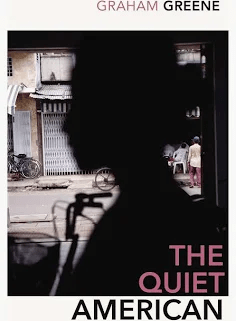
“After dinner I sat and waited for Pyle in my room over the rue Catinat; he had said “I’ll be with you at latest by ten”, and when midnight struck I couldn’t stay quiet any longer and went down into the street.”
Over the years, in recognition of his reputation as one of England’s greatest novelists, I have read several novels by Graham Greene – Our Man in Havana, Brighton Rock; The End of the Affair; The Third Man; and Dr Fischer of Geneva – with the aim of finding out for myself what entitled him to that status. All are impressive in their own way. Brighton Rock is a chilling portrait of a psychopath; The Third Man is an outstanding detective story, and so on – but none of them have struck me as being anywhere nearly as impressive (while still being very distinctively by Greene) as The Quiet American.
The short (less than 180 pages) novel is set in mid-1950’s Vietnam. At this time the origins of the Vietnam War were developing, with the French colonial rulers struggling to impose order upon a growing Communist insurgency and their American allies slowly being dragged into the conflict. The narrative contains an account of the domino theory which came to dominate American foreign policy for decades. If you are not familiar with this theory it argues that one country ‘lost’ to communism would lead to others in the region falling to communism like a row of toppling dominos.
“They want enough rice, I said. They don’t want to be shot at. They want one day to be much the same as another. They don’t want our white skins around telling them what they want.”
“If Indo-China goes…”
“I know the record. Siam goes. Malaya goes. Indonesia goes.”
Narrated in the first person by the cynical and aging English journalist Thomas Fowler, The QuietAmerican tells the story of a love triangle between Fowler, his much younger Vietnamese mistress Phuong, and a naive American ‘economic attaché’, Alden Pyle. Through this story Greene challenges the American involvement in Vietnam and eerily predicts the future course of the conflict. Greene’s was a war correspondent for The Times and Le Figaro in French Indochina 1951–1954 and the novel is clearly based on this experience, with his point of view being closely identified with his narrator, Fowler. The novel is told in flashback, with Fowler recalling his brief relationship with Pyle before the latter is murdered by insurgents.
It becomes clear very early on in the novel that Pyle is a CIA agent organising support for a local right-wing militia, seen by the American as a useful third force in opposition to the communists.
Fowler has a live-in lover, Phuong, who is only 20 years old and was previously an exotic dancer. Phuong has an ambitious sister who intend to arrange a marriage for Phuong to a Westerner. She originally thought that Fowler might marry Phuong, but he is already married. His wife back in the UK is a staunch Catholic unprepared to consider divorce, despite his record of infidelity. Pyle falls immediately in love with Phuong and asks Fowler to give her up, promising he will give her everything he, Fowler, cannot. At the same time Fowler’s editor asks him to return to England, offering him a promotion. Despite the American offering much more than Fowler can, Phuong chooses to stay with the Englishman. Pyle, always attempting to be ‘honourable’ withdraws and tries to make himself scarce. But he and Fowler are thrown together once again when they end up in a guard tower outside Saigon under attack from the insurgents. Pyle saves Fowler’s life much to his irritation. Back in Saigon, injured but recovering, Fowler lies to Phuong that his wife has agreed to a divorce. When this lie is exposed Phuong moves out an in with Pyle, realising that Fowler is never going to marry her.
The novel’s climax comes when the evidence pointing to Pyle’s involvement in a attack killing civilians becomes undeniable. Pyle attempts to justify his support for General Thé, commander of the ‘third force’ behind these attacks, explaining his theories about what is best for the Vietnamese. As a journalist, Fowler has some trusted contacts with the Viet Minh, predecesors of the Viet Cong, one of whom approach him asking for his tacit help in ending Pyle’s support for General Thé. He realises, but does not admit to himself, that this most likely means Pyle will be murdered. He goes through with the arrangement, and the result is already known. Despite his involvement, even culpability, Fowler manages to be angry at Pyle’s death, telling the American Economic Attache “They killed him because he was too innocent to live. He was young and ignorant and silly and he got involved. He had no more of a notion than any of you what the whole affair’s about, and you gave him money and York Harding’s books on the East and said “Go ahead. Win the East for Democracy”.
This was a devastating portrait of American involvement in Vietnam, extraordinarily prescient, predicting the whole course of the war. No wonder the book was seen as anti-American – it certainly isn’t sympathetic to the US. Greene obviously wrote from bitter experience. As a political statement the novel is powerful, but it succeeds on a number of other levels. The description of how women are treated in 1950’s Saigon is depressing. Phuong’s relationship with Fowler is predominantly commercial – he looks after her financially, with the implied promise of future support, and she is return allows him access to her body. She is a step above the prostitutes working the streets of Saigon or at the House of the Five Hundred Girls, shown fighting desperately for ‘business’ – but she is treated little better by the Americans. Granger, the obnoxious journalist working as part of the press corps in Vietnam, asks of Fowler’s relationship with Phuong:
“Where’d he find her? You got to be careful in this town.” He added gloomily “Thank God for penicillin”. Later he describes her as “a piece of tail”, even though it is clear that her relationship with Fowler is more than that of client and prostitute. Fowler’s narration portrays Phuong as docile and interested only in gossip about the British Royal family. He sees other Vietnamese women purely as sex objects:
“Up the street came the lovely flat figures – the white silk trousers, the long tight jackets in pink and mauve patterns slit up the thigh.”
The Quiet American is taut, precise, atmospheric, and chillingly prescient. In Fowler, Greene has created a complex, flawed, and in many ways unpleasant anti-hero with whom the reader cannot help but identify, despite his culpability in Pyle’s murder. Highly recommended.
“I have just buried my boy, my poor handsome boy of whom I was so proud, and my heart is broken. It is very hard having only one son to lose him thus, but God’s will be done. Who am I that I should complain? The great wheel of Fate rolls on like a Juggernaut, and crushes us all in turn, some soon, some late—it does not matter when, in the end, it crushes us all
Allan Quatermain is the sequel to King Solomon’s Mines and the second novel in a series of adventures for the eponymous hero (although chronologically it is the last in the series). It sees our hero reunited with Captain Good and Sir Henry Curtis, his original travelling companions in adventure in KSM. The novel opens on the shockingly downbeat note above – Quatermain’s son Harry has just died of smallpox, contracted in a hospital where he was working as a doctor. Quatermain is understandably devastated and decides to abandon the sedentary life of a country gentleman and return to where his heart lies, Africa, in search of one last great adventure. Good and Sir Henry decide on the spot to join him, and no sooner said than done, the gang is back together again, on their way to lands unknown.
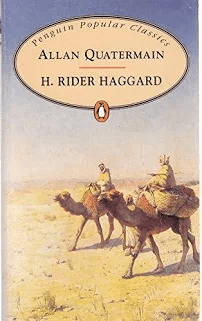
I’ve used this illustration because it was the edition I read, but there are no camels mentioned in the text so far as I can recall!
One of the many conventions of the adventure novel of the late nineteenth and early twentieth century (and still seen in films today) was that however large the continent being explored, the adventurers always almost immediately bump into someone they know. Here Quatermain and party meet Zulu chief Umslopogaas on their arrival in Africa and persuade him and his small group of soldiers to join them. Umslopogaas is an interesting portrait, the very definition of the ‘noble warrior’ trope that recurs throughout this genre. Although he is defined by racist ideas about the savagery of African tribesmen, it is not an unsympathetic portrait – in fact Umslopogaas is a hero and role model, loyal to Quatermain and fearless in battle.
Thus assembled the explorers set out from the coast of east Africa into the unknown. They have heard of a lost race of white- or light-skinned people who they decide to track down. Again Rider Haggard is relying safely on another trope of the genre, the ‘lost race’ story where explorers journey into isolated, uncharted territory and discover an undiscovered or hidden civilisation. The rumours of the lost race are always borne by someone who escapes from the lost world and survives an exhausting journey, only to expire almost as soon as his story is told. Thus:
“I was sitting on the veranda, when a poor, miserable, starved-looking man came limping up and squatted down before me. I asked him where he came from and what he wanted, and thereon he plunged into a long rambling narrative about how he belonged to a tribe far in the north, and how his tribe was destroyed by another tribe, and he with a few other survivors driven still further north past a lake named Laga. Thence, it appears, he made his way to another lake that lay up in the mountains, ‘a lake without a bottom’ he called it, and here his wife and brother died of an infectious sickness—probably smallpox—whereon the people drove him out of their villages into the wilderness, where he wandered miserably over mountains for ten days, after which he got into dense thorn forest, and was one day found there by some white men who were hunting, and who took him to a place where all the people were white and lived in stone houses…. he seems, according to his account, to have gone through sufferings and hardships innumerable, and to have lived for weeks on roots and berries, and such things as he could catch and kill. But somehow he did live, and at last by slow degrees made his way south and reached this place.”
As soon as his story is told his end is nigh:
“I told him to return on the morrow, bidding one of my headmen look after him for the night. The headman took him away, but the poor man had the itch so badly that the headman’s wife would not have him in the hut for fear of catching it, so he was given a blanket and told to sleep outside. As it happened, we had a lion hanging about here just then, and most unhappily he winded this unfortunate wanderer, and, springing on him, bit his head almost off without the people in the hut knowing anything about it, and there was an end of him and his story about the white people”.
But first they have to travel through Maasai territory. Following a violent quarrel with their bearers, the group find that are being tracked by a Maasai war party intent on punishing them. They seek sanctuary at the home of a Scottish missionary, Mr. Mackenzie, who has established a very civilised home in the deep jungle. As well as building a heavily fortified and extensive mission house, Mackenzie has tamed the jungle and established a small oasis of ‘civilisation’. It is described as being like a Garden of Eden, full of plants imported from the UK:
“We been walking up the slope of the hill, the lower portion of which was fenced off, sometimes with quince fences and sometimes with rough stone walls, into Kaffir gardens, just now full of crops of mealies, pumpkins, potatoes, etc. In the corners of these gardens were groups of neat mushroom-shaped huts, occupied by Mr Mackenzie’s mission natives, whose women and children came pouring out to meet us as we walked. Through the centre of the gardens ran the roadway up which we were walking. It was bordered on each side by a line of orange trees, which, although they had only been planted ten years, had in the lovely climate of the uplands below Mt Kenia, the base of which is about 5,000 feet above the coastline level, already grown to imposing proportions, and were positively laden with golden fruit…. What a garden it was! I have always loved a good garden, and I could have thrown up my hands for joy when I saw Mr Mackenzie’s. First there were rows upon rows of standard European fruit-trees, all grafted; for on top of this hill the climate was so temperate that nearly all the English vegetables, trees, and flowers flourished luxuriantly, even including several varieties of the apple, which, generally, runs to wood in a warm climate and obstinately refuses to fruit. Then there were strawberries and tomatoes (such tomatoes!), and melons and cucumbers, and, indeed, every sort of vegetable and fruit…. I do not think I ever saw such roses, gardenias, or camellias”.
The not-so-subtle message here is that Imperialism can tame and bring order to the wildest of environments. This little England is threatened when Mr. Mackenzie’s daughter is kidnapped by the Maasai war party who demand the life of one of the Britons as ransom. Instead they counterattack, and using their rifles and guns are able to defeat the much larger group, slaughtering every one of them and feeding them to the crocodiles. That’s the sentence for threatening a white woman. Mackenzie’s cook, Alphonse, a cowardly French cook, joins the party at this point, and for the rest of the novel fulfils a straightforward comedic role of the ‘funny foreigner’.
Following this short break they push on into the interior. Another trope is quickly upon them. The race of white-skinned people they are searching for live in an area of Africa isolated by mountains and other impenetrable geographical features, as is almost always the case. Compare for example the Lost World which is cut off from the outside world by virtue of being on a volcanic plateau, Shangri-La in a hidden Himalayan valley or Herland on another of those isolated and unscalable plateaus that litter the African landscape.
The party accidentally find their way into this region by canoeing along an underground river, through which they find the lost world of Zu-Vendis. Zu-Vendis is ruled by two queens, sisters Nyleptha and Sorais. While this society is an absolute monarchy, the peace is kept by a precarious alliance between the powerful priesthood and another group of wealthy feudal lords. The novel reaches its climax when both sisters fall in love with Curtis, and his choice of one over the other triggers a bloody civil war.
Allan Quatermain is a guilty pleasure, an unashamed adventure novel. If at times it seems a bit ‘by the numbers’ with a lot of predictable elements, this in part is because the author originally established many of the tropes he uses. I am sure that other, earlier authors wrote about lost tribes, noble savages and so on, but Rider Haggard is the founding father of the genre. He is unapologetically imperialist – or at least Quatermain is. He boasts about the vast amount of elephants he has shot without a hint of regret or remorse. To the Englishmen in this novel black lives, with a few exceptions, are disposable. All of the Wakwafi soldiers who sign on to join the party with Umslopogaas are killed off during the journey, but none are named nor mourned and their deaths are passed over casually. Even the portrait of Alphonse, intended as comical, is at this distance racist. So this is a period piece that has not aged well and I have no doubt I would never have read it if it wasn’t part of a second-hand bookshop bargain haul. But at the same time I don’t regret doing so either. In part this is because books of this genre were part of the standard reading material (of boys in particular) when I was growing up, and nostalgia is a powerful force, but also gaining a better understanding of how the world was seen by many Europeans in the late nineteenth century is a useful means to appreciate the nature of imperialism. It’s still escapism of course – while Quatermain and friends were exploring a fictional Africa of maybe a hundred years earlier, the reality of imperialism was being exposed in novels such as Conrad’s Heart of Darkness. The contrast is stark.
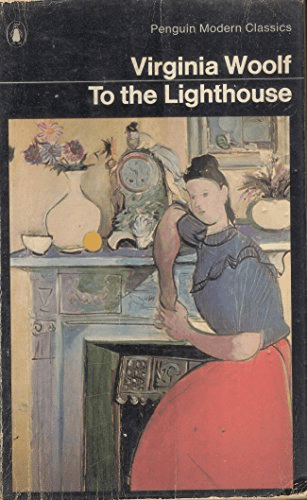
“Yes, of course, if it’s fine tomorrow,” said Mrs. Ramsay. “But you’ll have to be up with the lark,” she added.”
The narrative style of To the Lighthouse is usually described as ‘stream of consciousness’. While there is no strict definition of this term, it struck me while reading the novel that this term is not quite right. Stream of consciousness, as demonstrated by Molly Bloom at the end of Ulysses for example, is a direct representation of the thoughts of the character in the first person. (“Yes, I said yes, I will, yes” etc). Whereas To the Lighthouse has an omniscient narrator who sits on the shoulders of Woolf’s characters and transcribes their thoughts in the third person. Normally this transcription is unfiltered and may as well be in the first person, but very occasionally the narrator interprets or passes comment on the character’s thoughts and feelings. The representation of consciousness is one of the most striking features of this novel – thoughts are chaotic, easily interrupted or distracted, and sometimes include intrusive or unwelcome. But the narrator is always there, inserting a slight distance between the character and the narrative. Take for example the opening paragraph of chapter 12. The narrator is watching Mrs Ramsay and her husband, and describes what they do as well as what they think:
“She folded the green shawl about her shoulders. She took his arm. His beauty was so great, she said, beginning to speak of Kennedy the gardener, at once he was so awfully handsome, that she couldn’t dismiss him. There was a ladder against the greenhouse, and little lumps of putty stuck about, for they were beginning to mend the greenhouse. Yes, but as she strolled along with her husband, she felt that that particular source of worry had been placed. She had it on the tip of her tongue to say, as they strolled, “It’ll cost fifty pounds,” but instead, for her heart failed her about money, she talked about Jasper shooting birds, and he said, at once, soothing her instantly, that it was natural in a boy, and he trusted he would find better ways of amusing himself before long. Her husband was so sensible, so just. And so she said, “Yes; all children go through stages,” and began considering the dahlias in the big bed, and wondering what about next year’s flowers, and had he heard the children’s nickname for Charles Tansley, she asked. The atheist, they called him, the little atheist. “
It is Mrs Ramsay who thinks her husband is sensible and just, not the narrator, but the slim distance between the two perspectives is important. Crucially it allows the point of view to flit between characters, so within a few lines of this paragraph the narrative is assumed by Mr Ramsay, a much more introspective, internally focussed point of view. What the narrator does not do is step away from the characters’ thoughts and provide any exposition. We are thrown into the middle of the Ramsay family holiday without being told who the family members are, who are their guests and servants, their occupations, or indeed anything to provide us with context. Who are these people? Slowly, through the narration and the conversation the reader is able to piece together an overview of the setting. The Ramsays are a large middle-class family on holiday in the Isle of Skye in Scotland. As well as their eight children they have several house-guests and a number of domestic servants. The house is on the coast and overlooks a bay where a large lighthouse is situated. Some of the children want to take a boat-trip out to the lighthouse the following day, but it is a long and rough journey and cannot happen unless the weather is fine, which it usually isn’t. Mr. Ramsay—a professor of philosophy—harshly tells the children the trip will be impossible.
In the first, longest section of the novel, the Ramsays are hosting a diverse group of intellectuals and artists at their holiday home. The narrative focuses on a single day during which Mrs Ramsay match-makes between her guests, reads her youngest son, James, a story, flatters the ego of her grumpy husband, and floats around the house noticing things. In the evening a grand dinner is served (more on which below) and the day ends with Mr and Mrs Ramsay reading alongside one another but failing to connect or communicate. The sketch is predominantly autobiographical – Mrs Ramsay is thinly-disguised a portrait of Woolf’s mother who died when Woolf was only 11, and was obviously deeply missed. To the Lighthouse is in many ways Woolf’s way of exorcising her grief at the loss of her mother.
The second, much shorter section of the novel, “Time Passes” was described by Woolf as a corridor between the The Window, set before the first World War, and The Lighthouse, the third section of the novel set some ten years later. The holiday home is viewed through the eyes of the domestic servant employed by the family to act as a caretaker for the house, and when they eventually decide to come back to renovate and clean it. Time Passes is a quite literal description of what happens. In the intervening decade Mrs Ramsay and two of her children die, and the house deteriorates badly in apparent sympathy with the family:
For now had come that moment, that hesitation when dawn trembles and night pauses, when if a feather alight in the scale it will be weighed down. One feather, and the house, sinking, falling, would have turned and pitched downwards to the depths of darkness. In the ruined room, picnickers would have lit their kettles; lovers sought shelter there, lying on the bare boards; and the shepherd stored his dinner on the bricks, and the tramp slept with his coat round him to ward off the cold. Then the roof would have fallen; briars and hemlocks would have blotted out path, step and window; would have grown, unequally but lustily over the mound, until some trespasser, losing his way, could have told only by a red-hot poker among the nettles, or a scrap of china in the hemlock, that here once some one had lived; there had been a house.
Here the abandoned home symbolises the state of the nation, damaged to the point of destruction by World War I. In casual, almost brutal parenthesis, the deaths of Mrs Ramsay and two of her children are announced. Alongside so much death in the Great War, in which almost no town, village or family was untouched, these announcements act as reminders of the everyday losses that the country suffered.
[A shell exploded. Twenty or thirty young men were blown up in France, among them Andrew Ramsay, whose death, mercifully, was instantaneous.]
In the final section of the novel, some of the surviving family members and a few former guests return to the reopened summer home. A grieving Mr Ramsay insists that the family must finally complete the long-delayed boat trip to the lighthouse and forces his now-teenage children, James and Cam, to join him. The teenagers deeply resent their father’s tyrannical, mourning behaviour and form a silent pact of resistance against him. The trip to the lighthouse is both an attempt to recover the lost pre-War days which in hindsight seemed so peaceful and to reconnect with his children, who as moody teenagers no longer respect their mourning father. Much of this section of the novel is told from the perspective of Lily Briscoe, one of the original house guests, a painter who sets up her easel in the exact spot she did a decade earlier. Remembering her earlier visit she also mourns for Mrs Ramsay. The novel ends as the fishing boat reaches the lighthouse and they disembark. The lighthouse is a multi-faceted symbol that works in a number of ways during the course of the novel, but here for me represents death or the end of life’s journey.
I wanted to take a closer look at some of the minor characters in To the Lighthouse, more specifically the domestic servants. The cook, Muriel, is first mentioned in chapter 10. Mrs Ramsay is wondering whether some of her house guests have returned from their walk, so she asks one of her children (Cam) to “ask Mildred if Andrew, Miss Doyle, and Mr. Rayley have come back?” She wonders “What message would Cam give the cook?” which tells us, indirectly that Muriel is not a family member or guest but a member of staff, and specifically the cook. Cam returns to tell her “that there was an old woman in the kitchen with very red cheeks, drinking soup out of a basin” whose message is that “”No, they haven’t, and I’ve told Ellen to clear away tea.” Ellen is another servant who is part of the support team that the household relies on but takes for granted. Chapter 10 ends with Mrs Ramsay finishing her reading of a story to James, and “In a moment he would ask her, “Are we going to the Lighthouse?” And she would have to say, “No: not tomorrow; your father says not.” Happily, Mildred came in to fetch them, and the bustle distracted them. But he kept looking back over his shoulder as Mildred carried him out, and she was certain that he was thinking, we are not going to the Lighthouse tomorrow; and she thought, he will remember that all his life.” James is six at this point, a bit old for being carried out by an old woman I would have thought, but this does suggest that Mildred is not just a cook but has child-caring responsibilities as well.
Mildred is next referred to during dinner preparations, where the main dish, a boeuf en daube, is described as “Mildred’s masterpiece”. When this dish is finally served (and there is strong suggestion that the cook has exaggerated its complexity to Mrs Ramsay – it is just a slow cooked stew) Mrs Ramsay accepts her guests praise for the dish without acknowledging Mildred’s hard work:
“an exquisite scent of olives and oil and juice rose from the great brown dish as Marthe (another anonymous servant), with a little flourish, took the cover off. The cook had spent three days over that dish. And she must take great care, Mrs. Ramsay thought, diving into the soft mass, to choose a specially tender piece for William Bankes. And she peered into the dish, with its shiny walls and its confusion of savoury brown and yellow meats and its bay leaves and its wine, and thought, This will celebrate the occasion–a curious sense rising in her, at once freakish and tender, of celebrating a festival, as if two emotions were called up in her, one profound–for what could be more serious than the love of man for woman, what more commanding, more impressive, bearing in its bosom the seeds of death; at the same time these lovers, these people entering into illusion glittering eyed, must be danced round with mockery, decorated with garlands.
“It is a triumph,” said Mr. Bankes, laying his knife down for a moment. He had eaten attentively. It was rich; it was tender. It was perfectly cooked. How did she manage these things in the depths of the country? he asked her. She was a wonderful woman. All his love, all his reverence, had returned; and she knew it.“It is a French recipe of my grandmother’s,” said Mrs. Ramsay, speaking with a ring of great pleasure in her voice.“
Later, after dinner, Mrs Ramsay wanders ethereally away from her guests to go and check on the children.
“She turned the handle, firmly, lest it should squeak, and went in, pursing her lips slightly, as if to remind herself that she must not speak aloud. But directly she came in she saw, with annoyance, that the precaution was not needed. The children were not asleep. It was most annoying. Mildred should be more careful. There was James wide awake and Cam sitting bolt upright, and Mildred out of bed in her bare feet, and it was almost eleven and they were all talking. What was the matter? It was that horrid skull again. She had told Mildred to move it, but Mildred, of course, had forgotten, and now there was Cam wide awake, and James wide awake quarreling when they ought to have been asleep hours ago. What had possessed Edward to send them this horrid skull? She had been so foolish as to let them nail it up there. It was nailed fast, Mildred said, and Cam couldn’t go to sleep with it in the room, and James screamed if she touched it.”
Cam is the youngest Ramsay daughter, at seven only a year older than her brother James. In this home (at least) they share a bedroom. Mrs Ramsay is annoyed with Mildred “out of bed and in her bare feet” because the children are not asleep. So as well as being the family cook, we can infer that Mildred is directly responsible for putting the children to bed. I doubt she sleeps in the same room as them, so the fact she is ‘out of bed’ suggests she has heard the children arguing and has got up to try and calm them down, when Mrs Ramsay walks in and blames her for the children’s misbehaviour and arguing. This reveals a contemptuous attitude towards a senior member of staff, which is compounded by the comment that Mildred “of course” had forgotten to move the skull. The ‘of course’ suggests Mrs Ramsay expects to be disappointed by her servants, as if Mildred hasn’t been busy cooking a stew for three days! Later in this paragraph Mildred explains that the skull is nailed fast, making it clear that she had not forgotten about it all, just that she was unable to move it. Of course, no apology is even considered. Servants are there to do as they are told.
The domestic female staff of the Ramsay household are ignored, neglected, taken for granted, disrespected, and under-valued. So what we have to try and work out is whether this is a subtly drawn portrait by Woolf of entitled middle-class people treating their servants – their employees – with a lack of respect, or whether this is a reflection of the way Woolf herself took her family servants for granted. It is a difficult call to make – we have to read the text closely to work out who the servants are (as opposed to the eight children and the various house guests) and Mrs Ramsay’s inner monologue doesn’t really help us. But there is another portrait of a servant in the novel that throws light on this issue. In Time Passes, we are introduced to Mrs McNab. Although she is the family’s housekeeper, she does not merit a mention in The Window. The portrait of her in Time Passes is largely unsympathetic. She walks with a lurch, rolling like a ship at sea. The narrator doesn’t explain why she walks this way, but it could have been caused by rickets, a common condition for working people at the time (particularly Hebridean people with limit access to some foodstuffs) caused by a calcium deficiency. What Woolf’s narrator is noticing is that old servants walk in a ‘funny’ way without considering why. She also ‘leers’ instead of looking directly at things, which we are told is because she is ‘witless’. And as working class people often do (when written by middle-class authors) she sings to herself:
“As she lurched (for she rolled like a ship at sea) and leered (for her eyes fell on nothing directly, but with a sidelong glance that deprecated the scorn and anger of the world–she was witless, she knew it), as she clutched the banisters and hauled herself upstairs and rolled from room to room, she sang.,,, a sound issued from her lips–something that had been gay twenty years before on the stage perhaps, had been hummed and danced to, but now, coming from the toothless, bonneted, care-taking woman, was robbed of meaning, was like the voice of witlessness, humour, persistency itself, trodden down but springing up again, so that as she lurched, dusting, wiping, she seemed to say how it was one long sorrow and trouble, how it was getting up and going to bed again, and bringing things out and putting them away again.”
Not satisfied with patronising and caricaturing this hard-working housekeeper, Woolf continue to denigrate her. She is “bowed down … with weariness…. creaking and groaning on her knees”. Her “sidelong leer which slipped and turned aside even from her own face, and her own sorrows, stood and gaped in the glass, aimlessly smiling”. The narrator attempts to capture Mrs McNab’s thoughts, but for once the attempt falls flat:
“Visions of joy there must have been at the wash-tub, say with her children (yet two had been base-born and one had deserted her), at the public-house, drinking; turning over scraps in her drawers. Some cleavage of the dark there must have been, some channel in the depths of obscurity through which light enough issued to twist her face grinning in the glass and make her, turning to her job again, mumble out the old music hall song….Mrs. McNab continued to drink and gossip as before.”
Even the washer-woman, the narrator speculates, must have some fond memories of her children, even though two of them were illegitimate. A kind interpretation would be that Woolf is here acknowledging that even working class woman, condemned to a life of drudgery and child-bearing, have an internal life, hopes and dreams – but I am not convinced, and that final dismissive summary – “Mrs McNab continued to drink and gossip as before” – makes me wonder whether Woolf really thought of her servants as authentic, valuable human beings. There is evidence to suggest her relationships with her own servants were troubled – see Alison Light’s account in Mrs Woolf and the Servants for example.
I appreciate this aspect of the novel is simply one part and should not be given overdue emphasis. It certainly didn’t spoil the novel for me. But equally I did not want to ignore it, when the more obvious aspects of the novel – the Modernist exploration of consciousness, the complex narrative point of view, and the abundant use of symbolism – have been so thoroughly explored elsewhere. To be fair to Woolf she does not ignore her servant characters completely, as was often the case in earlier novels (see this post for more on the invisibility of servants in nineteenth century novels), they are given names and thoughts, but they are marginalised and disrespected, which is not much better.
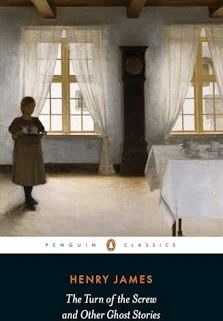
The Turn of the Screw was initially published as a serial in an American weekly magazine from January to April 1898. In many ways it is a simple, old-fashioned ghost story. Stories featuring the supernatural and ghosts in particular were immensely popular in the nineteenth century. They were a way of helping people cope with the grief arising from high mortality rates (especially infant mortality) and sudden deaths from what are today simple, curable conditions. In other words ghost stories offered a way to process grief. The dead aren’t gone, they are just in another place. (Hence also the creepy Victorian tradition of taking photographs with the dead posed as if they were alive). It was also the case that the advance of science in the nineteenth century challenged traditional religious belief and ghost stories provided a way of reconciling the two apparently contradictory ideas. Science can’t, they say, explain everything. Supernatural tales satisfied the need to prove the soul survived after death, and that we are not just animals, even if we are descended from them. Add to all that the explosion of periodical presses and mass-produced magazines in this period which fuelled demand for short, thrilling stories. These stories were particularly popular at Christmas time, and of course Dickens had both tapped into and amplified this association with A Christmas Carol and others.
James follows this tradition by setting the framing narrative of his story on Christmas Eve (which is otherwise irrelevant to the rest of the story). His unnamed narrator and friends gather around a fire. One of them reads a manuscript telling the story of a governess hired by a man who has recently been appointed the guardian of his young niece and nephew following the deaths of their parents. He lives in London but has a country house in Essex where the children live.
The governess assumes the narration from this point. She tells of her interview with the children’s guardian in which he explains he wants no involvement in their care. Arriving at his grand country house in Essex she meets Flora, the beautiful and well-mannered young girl for whom she will be responsible, and Mrs. Grose, the housekeeper. There are a number of other unnamed servants who remain peripheral figures. She quickly learns that Miles, Flora’s brother, has just been expelled from his residential school and will be returning home shortly. The reasons for his expulsion remain mysteriously sinister. Both children are apparently delightful and well-behaved, and the governess cannot imagine what Miles could have done to lead to his expulsion.
For a short period everything seems normal, and the governess establishes a simple domestic routine revolving around the care and tutoring of the children. But one evening while out for a walk, she sees a strange man looking out from one of the house’s towers. (A house with towers? Well yes, in traditional ghost stories all houses follow a gothic architectural template which contribute to the creepy atmosphere). This causes her to wonder:
“Was there a “secret” at Bly—a mystery of Udolpho or an insane, an unmentionable relative kept in unsuspected confinement?”
These references are carefully chosen. The Mysteries of Udolpho is widely considered the Ur-text of the gothic genre, and serves to manage the reader’s expectations of the story they are reading. Charlotte Bronte’s 1847 Jane Eyre built on this tradition by cementing the insane relative in the attic trope into gothic fiction. The important element of the latter story is that the apparently supernatural events of the novel are eventually shown to have a naturalistic explanation. In Northanger Abbey published eighty years earlier Jane Austen had already effectively parodied the conventions of this genre, pointing out that a young woman’s heightened expectations of mysterious events in a strange setting could be self-fulfilling. So our expectations are that there will be a normal explanation for the stranger in the tower, and anything else creepy that the governess experiences. Or will there?
The strange man reappears to the governess one afternoon, staring at her through a window. She tells Mrs. Grose about this man, describing him in detail. Mrs. Grose identifies him as Peter Quint, a servant on the estate who died recently. (Some critics interpret the ghosts in The Turn of the Screw as figments of the governesses imagination. Of course that’s a perfectly valid interpretation, but James leads the reader away from that explanation at this point in the story by having the governess able to identify the man very accurately. Can he be imaginary if she can describe him so clearly. If the reader wants to they can imagine a scenario in which someone else has previously told her about Quint, but there is no textual evidence for this.)
It is not long before a second ghost appears. While walking by the estate’s lake with Flora, the governess sees a woman dressed in black. Back at the house she describes this woman to Mrs. Grose who tells her it had to be Miss Jessel, the children’s previous governess who died in mysterious circumstances. It is then also revealed that Quint and Miss Jessel were involved in a relationship that scandalised the staff of the house. They were also very close with the children. Further encounters with the ghosts leads the governess to be convinced that there is a relationship of some kind between them and the children, but the nature of that relationship is never clear.
The governess does not know what to do. Speaking to the children’s guardian has been forbidden. They do not appear to be in any immediate danger, but she never lets them out of her sight. A final encounter with the ghost of Miss Jessel, which Flora and Mrs Grose both claim to be unable to see (fuelling the idea that the ghosts are figments of the governesses imagination) leads to Flora becoming very distressed. Finally Flora is sent away from the house, accompanied by Mrs Grose to London to seek shelter with her guardian, leaving the governess and Miles alone with the ghosts. The governess sees Quint and she grabs Miles, apparently to protect him. In the novel’s closing sentence he dies in her arms and the text stops suddenly with this revelation. The unexplained death of Miles is lazy writing of the worst variety as far as I am concerned, simply a way to end the story rather than acting as any kind of effective resolution.
Is this a successful ghost story? Is it spooky, disturbing? James’s technique to build the atmosphere is simple – everything is left implied, ambiguous and opaque. Almost all sentences in which the supernatural events of the story are discussed trail off unfinished. Ideas are hinted at but the reader is left to fill in the gaps. As ghost stories go this is highly effective. James uses the innocence of the children as a powerful symbol of the potential of evil, even in the young. The ambiguity of the social place of the governess, not a servant but not a member of the family, occupying that undefined space in between the two, is used as a further source of narrative tension, complicated by the fact that the governess in this story is effectively the acting head of the house. It is revealed that Miss Jessel and Peter Quint were romantically involved and their relationship scandalised the household:
“And he so dreadfully below,” said Mrs. Grose. I felt that I doubtless needn’t press too hard, in such company, on the place of a servant in the scale; but there was nothing to prevent an acceptance of my companion’s own measure of my predecessor’s abasement.“
James sometimes – too often – uses the technique of ambiguity and implication to leave the reader having to follow the narrative thread. At times this makes the story difficult to follow. I wrote about this feature of his writing in my review of The Golden Bowl which I found to be extremely difficult to read. James’s sentence structures were often so ridiculously complex that they lost, to me, all meaning. I was reassured by some commenters that this was a feature of James’s writing towards the end of his career and his earlier work was more accessible. However The Turn of the Screw was published only six years before The Golden Bowl, so I should have been prepared. Despite this, some sentences from this novella left me completely at a loss:
It took of course more than that particular passage to place us together in presence of what we had now to live with as we could—my dreadful liability to impressions of the order so vividly exemplified, and my companion’s knowledge, henceforth—a knowledge half consternation and half compassion—of that liability.
I think what James is saying here that now that the narrator and Mrs Grose both knew that the house was haunted, they had to live with it. It’s not just that this sentence is totally unclear, it is also ugly. I have no problem with writing that makes the reader pause, reread, and reconsider, but this doesn’t do that – it just confuses and irritates.)
It’s not just long rambling sentences that are the only issue here – James can make even shorter sentences totally confusing.
The good thing, after all, was that we should surely see no more of him. This was not so good a thing, I admit, as not to leave me to judge that what, essentially, made nothing else much signify was simply my charming work.
Or how about?
Nothing was more natural than that these things should be the other things that they absolutely were not.
I have said all I want to say on this feature of James’s writing in the post linked to above, so I am not going to labour the point, but at the same time I couldn’t ignore it.
The bottom line is this – if you enjoy ghost stories you will love The Turn of the Screw. It is an extremely effective example of the genre. If you don’t appreciate this type of thing, and find it childish, you won’t be converted and it will leave you cold and perhaps even slightly irritated.
In an interview in 1960, Muriel Spark gave this account of the origins of Memento Mori:
“It happened that a number of old people I had known as a child in Edinburgh were dying from one cause or another, and on my visits to Edinburgh I sometimes accompanied my mother to see them in hospital. When I saw them I was impressed by the power and persistence of the human spirit. They were paralysed or crippled in body, yet were still exerting characteristic influences on those around them and in the world outside.”
Author’s stories about the origins of their novels always have to be taken with a pinch of salt, but if this account is correct then it suggests that Spark approached her story and her characters with empathy and compassion. Older people, in this account, are impressive and even dignified, they are “exerting characteristic influences on those around them” – which is rather an ambiguous turn of phrase don’t you think? Spark went on to say “I saw a tragic side to this situation and a comic side as well”.
I think anyone who has spent time with people coming to the end of their lives can appreciate that the tragedy of death can on occasion be illuminated by moments of black or even absurd comedy, which relieves the sadness of the situation. But dying people are still people and I am not sure that Spark delivers on her intention of illustrating the complexity of this situation in her portraits of her characters, many of whom are rather awful. To be fair the smaller number of younger characters are all pretty appalling as well!
The plot of Memento Mori revolves around a group of older (aging, but not dying, other than in the sense that we are all dying sooner or later) metropolitan people: brothers and sisters, husbands and wives, and friends and lovers. The extensive cast includes at its core Dame Lettie Colston, her brother Godfrey, retired head of a brewing company, his wife Charmian, a successful novelist, and Charmian’s former maid, Jean Taylor. Apart from Mrs Taylor, these are upper-middle class people who can afford maids and housekeepers. Mrs Taylor is bedridden and lives in a nursing home, the ‘Maud Long Medical Ward’, with eleven other “grannies”. Grannies is the slightly disparaging title given to the patients by the staff, not all of who are happy with the description:
“Miss or Mrs Reewes-Duncan threatened for a whole week to report anyone who called her Granny Duncan. She threatened to cut them out of her will and to write to her MP. The nurses provided writing paper and a pencil at her urgent request.”
Calling someone by a title they don’t choose or like is disrespectful and a mild form of bullying. The ‘grannies’ exercise the little autonomy they have in their lives by threatening to change their wills whenever anyone crosses them, even though most of them have little or nothing to bequeath. Life in the ward is reduced to the bare essentials, a dull routine of meals and conversation, most of which revolves around discontent with the nursing staff or the daily horoscopes read out for them all by Granny Valvona. These characters act as a form of chorus to the rest of the events of the novel. Outside the ward, former lovers and old friends call in for tea and something stronger and little happens to disturb their calm and pleasant existence – until the day Lettie starts to receive anonymous phone calls with the message “Remember you must die.” Instead of taking this reminder as an encouragement to live life to the full while you can, Lettie finds it menacing and upsetting. Other members of the group start to receive similar calls and respond in the same way. The police are baffled and begin to suspect that no such calls are being made. Is this a shared delusion or just a childish prank? A retired policeman is hired to investigate, but makes no progress and falls under suspicion himself. Eventually a new normal emerges in which the calls are mostly accepted as part of the routine of life, and any menace they contained is thus neutralised.
Most readers will have anticipated that one of the peripheral characters – and there are plenty of possible suspects – would at some point be exposed as the mystery caller, but this never happens. The caller is never identified nor caught. It is suggested that there might be a supernatural or psychological explanation for the calls, but this is not followed up. I felt rather short changed by this lack of a resolution. If you build your novel round a mystery then surely you need to have an outcome in which the mystery is explained? I appreciate that is very old-fashioned of me. I know Godot never arrives, that the world is not neat and tidy and mysteries remain unsolved. But this is not an existential novel on the unknowingness of the universe, it is a domestic comedy in which the anonymous calls are a central part of the plot. Imagine reading a version of The Hound of the Baskervilles, at the end of which Holmes and Watson wander off shrugging their shoulders saying, “Yeah, it might have been a dog, who knows”.
Other subsidiary plot lines are less frustrating and in some respects compensate for this decision. Lisa Brooke, a friend of the group, dies early in the novel, leaving a substantial estate to be argued over by her husband, her siblings and her housekeeper, Mrs Pettigrew. Mrs Pettigrew is the novel’s villain, blackmailing the people she looks after, nosing her way into their secrets and forcing them to change their will or risk exposure.
Writing in the Guardian in 2010, David Lodge agreed with Martin Stannard’s conclusion in his 2009 biography of Spark that Memento Mori “remains one of the great novels of the 1950s,” I can’t agree. I admire Spark as a writer but this is one of the least interesting of her novels that I have read. It patronises and looks down on the elderly and treats them as disposable objects rather than well-rounded characters. Instead of giving a voice to the elderly, rarely centred in fiction, it objectifies them. I kept being reminded of Kingsley Amis’s The Old Devils, which has many of the same flaws but at least invests the elderly characters with some passion and lust for life. It is not a coincidence that Amis was a lot closer in age to his characters than Spark was, and could therefore portray them with more empathy. To illustrate this point consider the following exchange between Godfrey, his wife Charmain and his sister Lettie. Bear in mind that Charmian has suffered a stroke, possibly several, and is struggling with cognitive decline, made all the worse by the fact that she was once a successful author:
“Would you like me to read you the obituaries, dear?” Godfrey said . . .
“Well, I should like the war news,” Charmian said.
“The war has been over since nineteen forty-five,” Dame Lettie said. “If indeed it is the last war you are referring to. Perhaps, however, you mean the First World War? The Crimean perhaps . . .?”
Is this funny, in a ‘you have to laugh’ way, or is it mocking someone with memory loss? Arguably Charmian has the last laugh – her books are reissued, she is ‘rediscovered’ and becomes popular, and recovers much of her cognition. Spark ends her novel with a quick summary of what happens to all her characters after the events of the novel, and unsurprisingly (almost) all of them die one way or another. Memento Mori indeed.