Book review

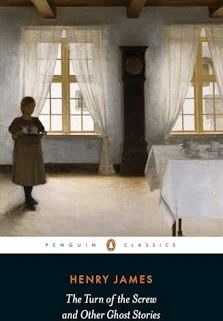
The Turn of the Screw was initially published as a serial in an American weekly magazine from January to April 1898. In many ways it is a simple, old-fashioned ghost story. Stories featuring the supernatural and ghosts in particular were immensely popular in the nineteenth century. They were a way of helping people cope with the grief arising from high mortality rates (especially infant mortality) and sudden deaths from what are today simple, curable conditions. In other words ghost stories offered a way to process grief. The dead aren’t gone, they are just in another place. (Hence also the creepy Victorian tradition of taking photographs with the dead posed as if they were alive). It was also the case that the advance of science in the nineteenth century challenged traditional religious belief and ghost stories provided a way of reconciling the two apparently contradictory ideas. Science can’t, they say, explain everything. Supernatural tales satisfied the need to prove the soul survived after death, and that we are not just animals, even if we are descended from them. Add to all that the explosion of periodical presses and mass-produced magazines in this period which fuelled demand for short, thrilling stories. These stories were particularly popular at Christmas time, and of course Dickens had both tapped into and amplified this association with A Christmas Carol and others.
James follows this tradition by setting the framing narrative of his story on Christmas Eve (which is otherwise irrelevant to the rest of the story). His unnamed narrator and friends gather around a fire. One of them reads a manuscript telling the story of a governess hired by a man who has recently been appointed the guardian of his young niece and nephew following the deaths of their parents. He lives in London but has a country house in Essex where the children live.

The governess assumes the narration from this point. She tells of her interview with the children’s guardian in which he explains he wants no involvement in their care. Arriving at his grand country house in Essex she meets Flora, the beautiful and well-mannered young girl for whom she will be responsible, and Mrs. Grose, the housekeeper. There are a number of other unnamed servants who remain peripheral figures. She quickly learns that Miles, Flora’s brother, has just been expelled from his residential school and will be returning home shortly. The reasons for his expulsion remain mysteriously sinister. Both children are apparently delightful and well-behaved, and the governess cannot imagine what Miles could have done to lead to his expulsion.

For a short period everything seems normal, and the governess establishes a simple domestic routine revolving around the care and tutoring of the children. But one evening while out for a walk, she sees a strange man looking out from one of the house’s towers. (A house with towers? Well yes, in traditional ghost stories all houses follow a gothic architectural template which contribute to the creepy atmosphere). This causes her to wonder:

“Was there a “secret” at Bly—a mystery of Udolpho or an insane, an unmentionable relative kept in unsuspected confinement?”

These references are carefully chosen. The Mysteries of Udolpho is widely considered the Ur-text of the gothic genre, and serves to manage the reader’s expectations of the story they are reading. Charlotte Bronte’s 1847 Jane Eyre built on this tradition by cementing the insane relative in the attic trope into gothic fiction. The important element of the latter story is that the apparently supernatural events of the novel are eventually shown to have a naturalistic explanation. In Northanger Abbey published eighty years earlier Jane Austen had already effectively parodied the conventions of this genre, pointing out that a young woman’s heightened expectations of mysterious events in a strange setting could be self-fulfilling. So our expectations are that there will be a normal explanation for the stranger in the tower, and anything else creepy that the governess experiences. Or will there?

The strange man reappears to the governess one afternoon, staring at her through a window. She tells Mrs. Grose about this man, describing him in detail. Mrs. Grose identifies him as Peter Quint, a servant on the estate who died recently. (Some critics interpret the ghosts in The Turn of the Screw as figments of the governesses imagination. Of course that’s a perfectly valid interpretation, but James leads the reader away from that explanation at this point in the story by having the governess able to identify the man very accurately. Can he be imaginary if she can describe him so clearly. If the reader wants to they can imagine a scenario in which someone else has previously told her about Quint, but there is no textual evidence for this.)

It is not long before a second ghost appears. While walking by the estate’s lake with Flora, the governess sees a woman dressed in black. Back at the house she describes this woman to Mrs. Grose who tells her it had to be Miss Jessel, the children’s previous governess who died in mysterious circumstances. It is then also revealed that Quint and Miss Jessel were involved in a relationship that scandalised the staff of the house. They were also very close with the children. Further encounters with the ghosts leads the governess to be convinced that there is a relationship of some kind between them and the children, but the nature of that relationship is never clear.

The governess does not know what to do. Speaking to the children’s guardian has been forbidden. They do not appear to be in any immediate danger, but she never lets them out of her sight. A final encounter with the ghost of Miss Jessel, which Flora and Mrs Grose both claim to be unable to see (fuelling the idea that the ghosts are figments of the governesses imagination) leads to Flora becoming very distressed. Finally Flora is sent away from the house, accompanied by Mrs Grose to London to seek shelter with her guardian, leaving the governess and Miles alone with the ghosts. The governess sees Quint and she grabs Miles, apparently to protect him. In the novel’s closing sentence he dies in her arms and the text stops suddenly with this revelation. The unexplained death of Miles is lazy writing of the worst variety as far as I am concerned, simply a way to end the story rather than acting as any kind of effective resolution.

Is this a successful ghost story? Is it spooky, disturbing? James’s technique to build the atmosphere is simple – everything is left implied, ambiguous and opaque. Almost all sentences in which the supernatural events of the story are discussed trail off unfinished. Ideas are hinted at but the reader is left to fill in the gaps. As ghost stories go this is highly effective. James uses the innocence of the children as a powerful symbol of the potential of evil, even in the young. The ambiguity of the social place of the governess, not a servant but not a member of the family, occupying that undefined space in between the two, is used as a further source of narrative tension, complicated by the fact that the governess in this story is effectively the acting head of the house. It is revealed that Miss Jessel and Peter Quint were romantically involved and their relationship scandalised the household:

“And he so dreadfully below,” said Mrs. Grose. I felt that I doubtless needn’t press too hard, in such company, on the place of a servant in the scale; but there was nothing to prevent an acceptance of my companion’s own measure of my predecessor’s abasement.

James sometimes – too often – uses the technique of ambiguity and implication to leave the reader having to follow the narrative thread. At times this makes the story difficult to follow. I wrote about this feature of his writing in my review of The Golden Bowl which I found to be extremely difficult to read. James’s sentence structures were often so ridiculously complex that they lost, to me, all meaning. I was reassured by some commenters that this was a feature of James’s writing towards the end of his career and his earlier work was more accessible. However The Turn of the Screw was published only six years before The Golden Bowl, so I should have been prepared. Despite this, some sentences from this novella left me completely at a loss:

It took of course more than that particular passage to place us together in presence of what we had now to live with as we could—my dreadful liability to impressions of the order so vividly exemplified, and my companion’s knowledge, henceforth—a knowledge half consternation and half compassion—of that liability. 

I think what James is saying here that now that the narrator and Mrs Grose both knew that the house was haunted, they had to live with it. It’s not just that this sentence is totally unclear, it is also ugly. I have no problem with writing that makes the reader pause, reread, and reconsider, but this doesn’t do that – it just confuses and irritates.)

It’s not just long rambling sentences that are the only issue here – James can make even shorter sentences totally confusing.

The good thing, after all, was that we should surely see no more of him. This was not so good a thing, I admit, as not to leave me to judge that what, essentially, made nothing else much signify was simply my charming work.

Or how about?

Nothing was more natural than that these things should be the other things that they absolutely were not.

I have said all I want to say on this feature of James’s writing in the post linked to above, so I am not going to labour the point, but at the same time I couldn’t ignore it.

The bottom line is this – if you enjoy ghost stories you will love The Turn of the Screw. It is an extremely effective example of the genre. If you don’t appreciate this type of thing, and find it childish, you won’t be converted and it will leave you cold and perhaps even slightly irritated.
The Turn of the Screw by Henry James, 1898

Aside
Book review

Conversations with Lord Byron on perversion 163 years after his Lordship’s death by Amanda Prantera, 1987

This novel is very much a curiosity. With only three Goodreads reviews and now out of print, you may struggle to get hold of a copy. The reference to perversion in the title is misleading – there are no discussions about any form of sexual deviancy, unless homosexuality was considered such in 1987, (which it wasn’t) and it feels as if it was included as a cynical effort to increase sales. But the main interest of the novel is its very early but also quite advanced discussion of what we now term Artificial Intelligence.

Lord Byron was an interesting figure. His in part self-created reputation as a legendary seducer of women caused him to be a scandalous figure in early nineteenth century English society. Inoculated to an extent from the full consequences of his actions by his aristocratic status, he nevertheless broke a lot of taboos, and eventually had to leave the country. His poetry was arguably less successful than his seduction technique and his readership nowadays is largely restricted to university syllabuses. But he is an excellent choice for the central character of a novel about AI. Prantera imagines a computer programme in which every known piece of information about Byron’s life and works is entered into a database to create a simulation of his Lordship’s consciousness. The research team set up to develop the program then go on to interrogate it, hoping it will connect its fragments of information in new ways, thereby providing answers to academic puzzles about Byron’s life – particularly his romantic life – such as whether he wrote his love poems “To Thyrza” to his Cambridge friend John Edleston.

Predictably the program develops a consciousness close to Byron’s own, Its interior monologue forms much of the second part of the novel, its voice imitating Byron’s memoirs and letters. His time at Cambridge is the focus of this ‘memory’, and a potential explanation of his enigmatic relationship with Edleston is developed. Edleston is initially presented to the reader as an angelic voiced young chorister, who falls in love with the older (but still young, only 17) more experienced Byron. Tempted, Byron resists any sexual contact with Edleston seemingly repulsed by the idea of homosexual sex. Finally he can resist no longer and it is at this point that the novel’s ‘big’ secret is revealed – like many attractive young men in fiction before him (for example virtually all of Shakespeare’s comedies) Edleston is a young woman disguised as a boy! As the novel hints at several points that Edleston has a secret which would relieve Byron of his homosexual hesitation, this comes as no surprise whatsoever. The opportunity to write about a trans or bisexual character is thrown away – this is simply a disguise used by a privileged aristocrat/minor royal in order to have fun at an all-male university, nothing to do with sexual identity. Byron had no reason to worry about his sexual orientation – he was only attracted to Edleston because (s)he was a girl all along, not because he was in any way sexually confused. This of course does a disservice to same-sex attracted people and in particular to the transgressive Byron himself.

What of the novel’s discussion of artificial intelligence? Surprisingly it was quite accurate in its fundamental concepts – load the computer with as much data as possible and then leave it to start making connections itself. The computer used in the research programme has an algorithm which learns through its interactions with the operators, finding patterns to simulate a characterisation of Byron’s intelligence and personality. The layering of different personality traits and characteristics for the programme is strongly reminiscent of the neural networks used today in AI in which layers of “neurons” are used for complex tasks such as image and speech recognition. It also has a Natural Language Processing facility which allows it to understand and generate human language, very much in the way that chatbots and voice assistants work today. The only dated aspect of this portrait of a very early AI is the fact that every output from the programme needs to be printed out and photocopied in order to be studied by the researchers. But apart from that this was a very interesting insight into how AI was seen in the 1980’s and how little, surprisingly, it has progressed since then, even if it has moved from the pages of fiction into the real world. When compared to the almost unfailing inaccuracy of the typical prediction of the development of technology from this period, which anticipated we would all be travelling in flying cars and eating our meals in pill form, it feels spot on.

Conversations with Lord Byron on perversion 163 years after his Lordship’s death by Amanda Prantera, 1987

Aside
Book review

Short stories by Robert Louis Stevenson: The Body-Snatcher, A Lodging for the Night, Markheim, Thrawn Janet & The Misadventures of John Nicholson

These stories were included in the Vintage edition of Dr Jekyll and Mr Hyde (and other stories), which I finally got round to reading several years after the event. (That is, I read the short stories long after having read Dr Jekyll). To what extent they were ‘padding’ to make the original novella into a fuller length text, or were stories worth republishing in their own right, is something I will consider in this review.

The website devoted to all aspects of Stevenson’s life and works, (‘The RLS website) says

“Stevenson has an important place in the history of the short story in the British Isles: the form had been elaborated and developed in America, France and Russia from the mid-19th century, but it was Stevenson who initiated the British tradition.”

Which is a bold claim when you think about the short stories and novellas Dickens wrote, to give just one example. The site also claims that many of his stories:

“have an affinity with the Strange Case of Dr Jekyll and Mr Hyde in their setting in the labyrinthine modern city, and the subject matter of crimes and guilty secrets involving respectable members of society.” 

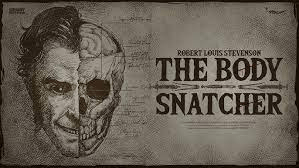
The Body-Snatcher is definitely one such dark, gothic tale. The title tells you almost all you need to know – it is set in Edinburgh at the time of the Burke and Hare murders when corpses were in such demand for dissection by medical students that grave robbing become common-place and eventually led to murder to provide more bodies. The story is told from the perspective of a laboratory assistant who unwittingly becomes embroiled in the cadaver trade. The story’s climax comes on a ubiquitously dark and stormy night when a corpse is robbed from a remote country churchyard and supernatural events intervene. It’s a classic horror story that must have chilled Stevenson’s Victorian audience and would make a highly atmospheric radio play.

A Lodging for the Night, subtitled A Story of Francis Villon is another gothic morality tale. Rather far-fetched claims have been made by some critics that this story can be precisely identified as the first modern version of the genre – I have to say that sounds implausible. There’s nothing dramatically original about the form or content. The story opens with the narrator describing a snow-covered Parisian night in 1456. Francis Villon, a poet is drinking and gambling in a small cabin in the grounds of a cemetery with a few friends. While Villon tries to compose a poem, the gambling turns sour and one of the participants is stabbed and murdered. His corpse is robbed and although Villon apparently had no part in the murder he takes his share of the robbery. He flees into the night, but not before his purse is stolen, leaving him destitute. He eventually seeks refuge in a stranger’s home. The remainder of the story is a protracted exchange between the amoral Villon and his host, a former knight who lives by a strict code of conduct. When Villon finally leaves he appears to have learnt nothing from his host.

Markheim is set in a pawn shop. The titular character visits to buy a gift but when the opportunity arises he murders the pawnbroker with a view to stealing from him. While he tries to decide what to do next, someone enters the house, looks briefly into the room Markheim and the body are in, “looked at him, nodded and smiled as if in friendly recognition, and withdrew again.” Markheim cries out, and the stranger returns, asking “Did you call me?”. Again the rest of the story is an exchange between this other-worldly visitor and the murderer. The visitor offers to tell Markheim where the pawnbroker’s money can be found. It soon becomes clear that he knows all about Markheim’s descent into criminality, and has no faith in his ability to change the course of his life. He even offers to help him escape when the pawnbroker’s maid returns home unexpectedly early. But there is wonderful twist in the tale which I won’t spoil for you. This is a genuinely innovative story that subverts the readers expectations without a hint of sentimentality. It’s the gem of the collection.

Thrawn Janet is written in a broad Scottish dialect, and I have to admit at times I struggled with the language. It is not that it is impenetrable. In sentences such as “There was Janet … wi’ her neck thrawn … like a body that has been hangit, and a girn on her face like an unstreakit corp. ” most of the language is conventional English words, and others are simply transliteration of other everyday terms – “hangit” for “hanged”, “corp” for “corpse”, and so on. There are occasional words that need to be looked up – thrawn means twisted for example – but usually the sense is clear. (There is incidentally a version of the story available on the internet ‘translated’ into English, which seems a bit unnecessary!). Janet is housekeeper to a young Scottish preacher. The local people suspect her of being a witch. When they try to prove it by dunking her in the local pond, the preacher intervenes and makes her publicly swear she is not in league with the devil. From that point, Janet’s appearance is changed – twisted neck like someone who has been hanged. Later, after meeting a strange “black man” (the implication being this is the devil), the preacher finds Janet hanging dead in her room. As with Markheim, the supernatural is portrayed as being a tangible and real presence in people’s lives.

The collection ends with what is conventionally known as a shaggy dog story, although I can’t be sure it was conceived as such. The Misadventures of John Nicholson has the eponymous central character go through a series of mishaps, but always ends up on his feet, able to rely on either dumb luck or his family to bail him out. Even though his implicated in at least two series robberies and a murder, he walks away without any series consequences. It’s a weak ending to the collection with no gothic elements, a loose narrative structure and not much point.

So were these stories just padding, or are they worth reading in their own right? Yes and no. Dr Jekyll is such a powerful story because it has something to say about the nature of humanity, civilisation, and the duality of good and evil. It’s also a genuinely interesting story. Some of these shorter stories have interesting insights into similar issues. Clearly none have the same impact as Dr Jekyll, and some are disappointingly predictable, others, particularly Markheim with its clever subversion of the reader’s expectations, are definitely worth reading in their own right rather than simply as companion texts.

Short stories by Robert Louis Stevenson

Aside
Book review

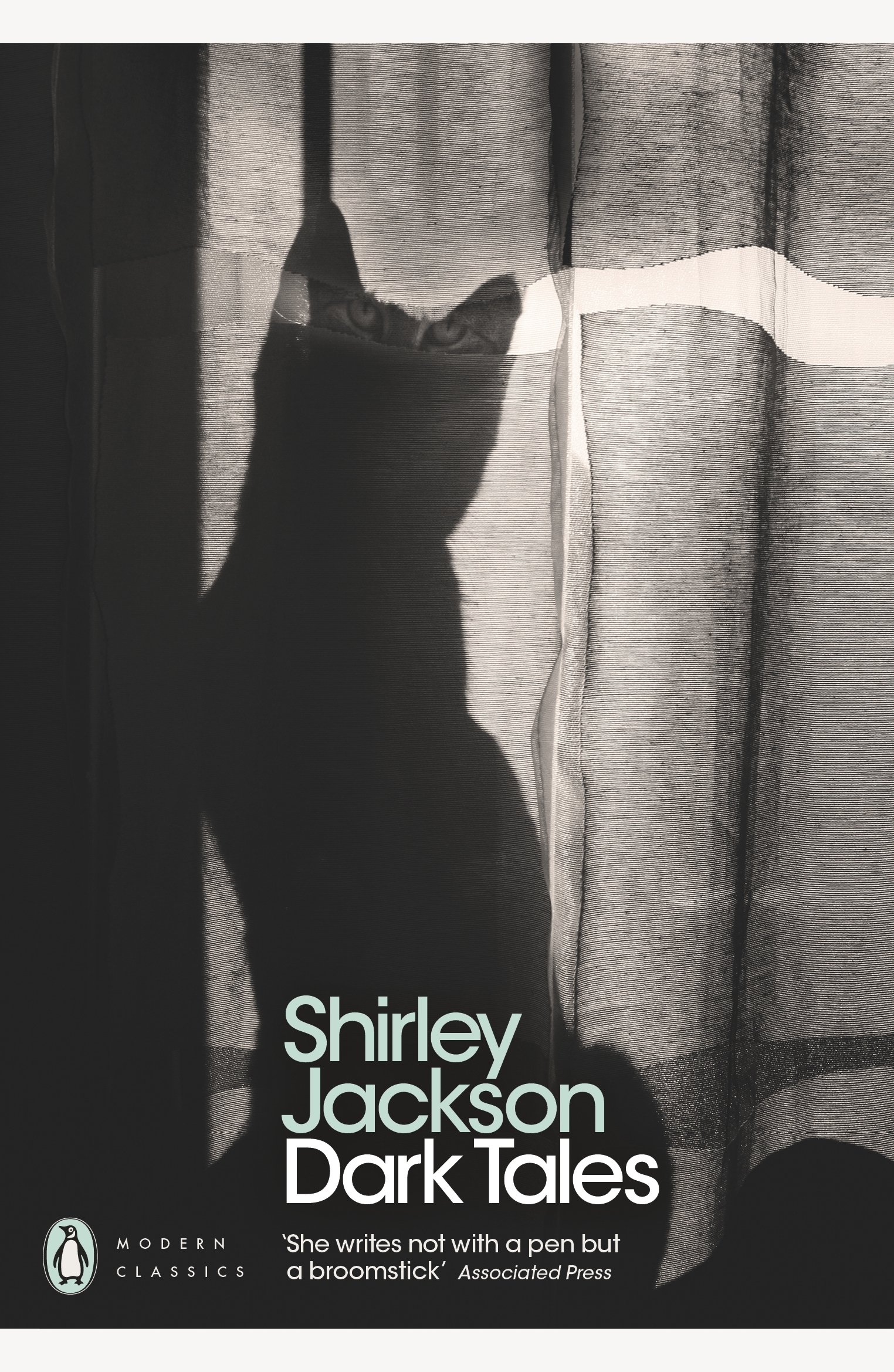
Dark Tales, by Shirley Jackson, 2017

Shirley Jackson established a reputation as a horror writer with the publication of her haunting short story ‘The Lottery‘ in the New Yorker in 1948. This anthology of stories drawn from across her writing career includes a wide variety of gothic tales. The publishers describe them as “deliciously dark stories” which I think both doesn’t do them justice and at the same time over-states their value. Which I know is contradictory, but I’ll try and explain what I mean.

When the stories are effective – principally when they do not rely on the supernatural – then they are far more than “deliciously dark”, which is more suited as a description for chocolate than a short story. The opening tale, for example, The Possibility of Evil, is a portrait of an old lady who writes poison-pen letters to her fellow townsfolk, mainly out of boredom and a sense of her own superiority. This story contains not a hint of the supernatural, but is very effective, with a wonderful, punchy ending. Louisa, Please Come Home was another story that made an impact on me. In it a teenager runs away from home – why it is not clear – and when she is found after living in a nearby town for several years, only to be rejected by her family as not their real daughter.

Other stories in the collection are not as strong. They often lean too heavily on the supernatural to provide the surprise element of the story. In The Bus is a good example of this weaker category. A stranded woman gets a lift to a familiar house that turns out to be her childhood home and she can’t escape it. Home boils down to a pair of ghosts who like to sit in cars. 

Jackson’s style can come over as formulaic when the stories are read in a single volume of this kind. She opens with mundane, everyday settings, then slowly introduces the creepier elements, usually without announcement, blurring the lines between the supernatural and the real world. The first person narrative helps to confuse the reader – is this “really” happening or is the narrator having a dream or vision? The menace of small town America is a common theme throughout this volume but overall it doesn’t bear comparison to Jackson at her best.

Standard
Book review

At the Mountains of Madness by H.P. Lovecraft, 1931

Lost world novels were very popular during the end of the major period of European colonisation in the late nineteenth and early twentieth century. King Solomon’s Mines for example establishes many of the characteristics of the genre, and is sometimes considered the first lost-world narrative. European explorers set out to an unexplored part of the lovecraftworld, often protected by some great natural barrier which has previously prevented it from being explored, and discover a great civilisation which they set out to subdue. Rudyard Kipling’s The Man Who Would Be King (1888), Arthur Conan Doyle’s The Lost World (1912), Edgar Rice Burroughs’ The Land That Time Forgot (1918), are all classic examples of this genre. As time went on, unexplored lands were becoming hard to find, which perhaps explains why Lovecraft’s At the Mountains of Madness is set in one of the last remaining wildernesses on earth, the Antarctic.
It seems certain that Edgar Allan Poe’s The Narrative of Arthur Gordon Pym of Nantucket, written almost a century earlier than Lovecraft’s novella, was also an inspiration, hinting as it does at there being undiscovered mysteries at the South Pole, and is explicitly referenced in the later novel at several points.

Written ostensibly as a warning against a forthcoming Antarctic expedition, the first person narration by the geologist and explorer William Dyer, a professor at Arkham’s Miskatonic University, tells the story of his earlier disastrous expedition.

The novel adopts a traditional horror structure of hinting at unknown terrors to be revealed, and only describing them with reluctance after long delays. This is a conventional way of building suspense, but as a warning to the world not to disturb the Antarctic it is hardly convincing. The reader is always happy to suspend disbelief if given a decent enough reason to do so, but when the narrator behaves irrationally and unrealistically like this it undermines the credibility of the relationship between the reader and the text.

The details of the expedition are thoroughly and exhaustively set out, and initially all goes well. The narrator reminds us what we are told we already know, namely that the expedition’s advance party reported the discovery of the remains of prehistoric life-forms unknown to science, before being mysteriously wiped out.  Some form of dissection experiment has been done on one of the slaughtered explorers. Another member of the party is missing – did he go mad and massacre everyone one before heading out into the snow?

Dyer and a fellow explorer, Danforth, fly across the mountain range against which the advance party had pitched camp and discover a massive abandoned city, unlike anything found elsewhere on earth. They explore the city and find murals which tell the history of this lost civilisation. It is at this point that Lovecraft aficionados will start to sit up and listen, as more of the myth of ancient aliens with which Lovecraft is most closely associated is laid out. This city was built by the “Elder Things” in the very early days of the earth’s history, with the help of “shoggoths” — bio-engineered creatures they created to act as their slaves. It takes Dyer and Danforth a while to put the pieces together, and I suspect most readers will be there well ahead of them, but they finally work out that the slaughter at the camp was caused by the Elder Things who have somehow been reanimated. That’s not the end of their problems, because it seems that while the Elder Things killed out of curiosity, hence the attempts at dissection, the shoggoths have also survived and are getting peckish.

There are a number of problems with this novel, not least the structure which makes little sense in the context of it being presented as a warning to the world. There is no character development whatsoever, indeed almost no characterisation – all the explorers are diligent, good at their jobs, but completely anonymous and interchangeable. In terms of the plot the aliens are all there is – there’s no-one working secretly to undermine the expedition, sending secrets to an enemy nation keen to capture the alien technology. The aliens themselves are dull. Virtually all of the first half of the novel is a long set up for the visit to the lost city, where the interpretation of the murals tells the history of the Elder Ones. Devotees of all things Cthulhu will enjoy the canonical detail about the Elder Ones and their intergalactic struggles with the Mi-Go – but it left me cold. The horror element of the story is very limited in impact, and as an adventure story it also misses out – the first person narrative tells us that Dyer survives his ordeal, were that to be in any doubt. The novella is at least short, and I can now honestly say I have given Lovecraft the benefit of the doubt. This is a curiosity, nothing more, and unless you are into alternative mythologies, and I can’t imagine why you would be, I would give this a miss.


Standard
Book review

The Murders in the Rue Morgue and other stories, by Edgar Allan Poe

I was pretty dismissive of ‘The Fall of the House of Usher‘ last month, but I thought I would give Poe a second chance. This is a collection of his shorter stories including:

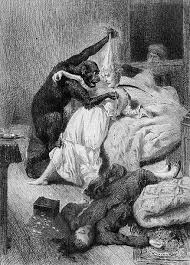
a) The Murders in the Rue Morgue (1841) is best known for developing the template for the modern detective story. Two women are brutally murdered in a classic locked room mystery. Numerous witnesses overhear what they believe to be the murderers. An amateur detective, Monsieur Dupin, investigates, accompanied and narrated by a poefaithful sidekick on hand to record his powers of deduction. The mystery has a farcical and preposterous solution involving an orang-utang, but the features of the detective fiction, including the demonstration of analytical powers before the main crime occurs, the incompetent and bumbling police, deductive analytical processes, even the habit of remaining secluded when not on a case, they are all there. Conan Doyle acknowledges as much by explicitly referencing Dupin in an early Holmes story. This tale is full of holes – the room in which the deaths occur just happens to have a window with a secret catch allowing it to open undetected, for reasons never clearly explained, and the introduction of an orang-utang as the mystery killer made me laugh out loud.
Incidentally I know the illustration here is ridiculous as well (as being gruseome – as are all the others you can find online) but there isn’t a way of illustrating the story without being ridiculous.

b) ‘William Wilson‘ is a well-constructed portrait of schizophrenia. If it was published today it would be unsuccessful – modern readers schooled in the ideas of psychotherapy will recognise very early in the many clues that the two characters, with the same name, appearance, age etc are one and the same person, but to readers of the 1840’s the story’s conclusion may well have been shocking.

c) ‘The Masque of the Red Death‘ is by comparison a dud, in which the supernatural is used as a deus ex machina that we see coming a long way off, and has little else to commend it.

d) ‘The Pit and the Pendulum‘. In this story the narrator is thrown into prison by the Inquisition, and awaits death by means of either a – well, you can guess. The tension is built slowly and effectively, and the prison/torture chamber is ingeniously recreated. The outcome, the narrator’s survival, is ensured by his ability to tell the tale, but his escape from the Inquisition is well managed.

e) ‘Hop-Frog‘ returns to a more fairy-story theme begun in ‘The Masque of the Red Death’.  Set in an unidentified European country in the Middle Ages, a cruel king is unkind to his court jester, and suffers revenge appropriate to his offences.

f) ‘The Case of Amontillado’. A collection of short stories within the horror genre would not be complete without a take featuring someone walled into their grave, and this is it. It is reasonably well done but takes a considerable effort to suspend belief long enough to be in any way disturbed by the outcome, given that it is flagged so early on.

g) ‘The Tell-Tale Heart‘. “I made up my mind to take the life of the old man”. This is a well-written short story in which a man commits a murder, but is betrayed by the sound of the still beating heart. It’s a convincing portrait of psychopathy, in which the speech patterns of the killer, the use of repetition

h) ‘The Man that was Used Up‘ is an extended shaggy dog story not worth the short time it would take to read; the joke falls very flat despite the prolonged set up, at least in part because the narrator is such a boor.

Overall these stories are interesting early examples of the horror genre, and are worth reading for the introduction to the model for Sherlock Holmes if nothing else. I am not sure to what extent Poe’s original readers would have found these stories scary or horrific; they have not aged well as our appetites for blood and guts has become more extreme. Usually attempts at humour fall flat, and it is the simpler stories such as ‘The Tell-Tale Heart’ which are the more effective.


Standard
Book review

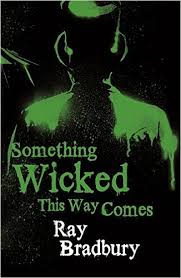
Something Wicked This Way Comes, by Ray Bradbury, 1962

I am trying to work out if this is a Young Adult book or not, and would appreciate any advice anyone can offer. Because if it is I clearly shouldn’t have read it. Only kidding of course – just pointing out that putting labels on novels is sometimes not helpful.

‘Something Wicked This Way Comes‘ (and what a wonderful title by the way) tells the dark, macabre story of Jim Nightshade and Will Halloway, two appropriately nameBradburyd 13 year old small-town American boys, and their visits to ‘Cooger and Dark’s Pandemonium Shadow Show’, a distinctly 1950’s American carnival.  Sneaking into the carnival after it closes, they witness the proprietors using a spectral merry-go-round with supernatural powers, specifically the ability to age, or reduce the age of, anyone who rides it. Discovered, they are pursued by the carnival owners and their enslaved exhibits (the Dust Witch, the Skeleton, the Dwarf, and Mr Electrico). The rest of the novel tells the story of their pursuit and their struggles with the malevolent carnival characters.

There are a number of themes here that have gone on to become standard features of gothic horror novels. I can’t be sure to what extent Bradbury  simply developed these traditions, or originated them, but he without doubt had a significant influence on writers such as Stephen King, (who wrote his own coming of age novel, Stand by Me) and Neil Gaiman, both of whom have acknowledged their debt to Bradbury. Characters bewitched into different, powerless, forms appear here, as does the idea of a community that mysteriously reappears every generation, once every thirty years. The novel even has the idea of a library as a supposedly safe space from which a fight-back against the forces of the night can be launched (Buffy, anyone?).

Carnivals are inherently spooky, particularly those with freak-shows. They come to life at night, appear overnight and disappear as quickly. They are not the kind of place you want to get lost in. Bradbury uses this carnival as a potent symbol of sin and evil – “(it) survives living off the poison of the sins we do each other, and the ferment of our most terrible regrets“(chapter 40).

The ‘however’ you have been expecting is now overdue. The element of genuine suspense, the belief that Will and Jim might actually come to harm, is missing. The dust-witch is killed with a smile, and laughter is used to make the night recede. Evil melts away in the face of a chuckle. The freaks and their puppet masters are conquered far too easily. The blurb to this edition quotes a Washington Post review which refers to this text as a “timeless rite of passage” novel. More specifically it is a coming of age story – in the course of the few hours span of the novel, Jim and Will quite literally grow up, taking an inadvertent circuit on the time-travelling merry go round. Which brings us back to the Young Adult question. Evil that is defeated without too much stress, and teenagers growing up – these are classic ingredients of the YA genre. If further proof were needed, the film of the book was made by Disney! But I still liked it.


Standard