Book review

The Murders in the Rue Morgue and other stories, by Edgar Allan Poe

I was pretty dismissive of ‘The Fall of the House of Usher‘ last month, but I thought I would give Poe a second chance. This is a collection of his shorter stories including:

a) The Murders in the Rue Morgue (1841) is best known for developing the template for the modern detective story. Two women are brutally murdered in a classic locked room mystery. Numerous witnesses overhear what they believe to be the murderers. An amateur detective, Monsieur Dupin, investigates, accompanied and narrated by a poefaithful sidekick on hand to record his powers of deduction. The mystery has a farcical and preposterous solution involving an orang-utang, but the features of the detective fiction, including the demonstration of analytical powers before the main crime occurs, the incompetent and bumbling police, deductive analytical processes, even the habit of remaining secluded when not on a case, they are all there. Conan Doyle acknowledges as much by explicitly referencing Dupin in an early Holmes story. This tale is full of holes – the room in which the deaths occur just happens to have a window with a secret catch allowing it to open undetected, for reasons never clearly explained, and the introduction of an orang-utang as the mystery killer made me laugh out loud.
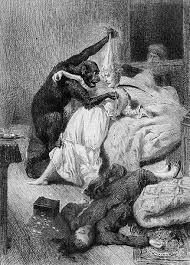
Incidentally I know the illustration here is ridiculous as well (as being gruseome – as are all the others you can find online) but there isn’t a way of illustrating the story without being ridiculous.

b) ‘William Wilson‘ is a well-constructed portrait of schizophrenia. If it was published today it would be unsuccessful – modern readers schooled in the ideas of psychotherapy will recognise very early in the many clues that the two characters, with the same name, appearance, age etc are one and the same person, but to readers of the 1840’s the story’s conclusion may well have been shocking.

c) ‘The Masque of the Red Death‘ is by comparison a dud, in which the supernatural is used as a deus ex machina that we see coming a long way off, and has little else to commend it.

d) ‘The Pit and the Pendulum‘. In this story the narrator is thrown into prison by the Inquisition, and awaits death by means of either a – well, you can guess. The tension is built slowly and effectively, and the prison/torture chamber is ingeniously recreated. The outcome, the narrator’s survival, is ensured by his ability to tell the tale, but his escape from the Inquisition is well managed.

e) ‘Hop-Frog‘ returns to a more fairy-story theme begun in ‘The Masque of the Red Death’.  Set in an unidentified European country in the Middle Ages, a cruel king is unkind to his court jester, and suffers revenge appropriate to his offences.

f) ‘The Case of Amontillado’. A collection of short stories within the horror genre would not be complete without a take featuring someone walled into their grave, and this is it. It is reasonably well done but takes a considerable effort to suspend belief long enough to be in any way disturbed by the outcome, given that it is flagged so early on.

g) ‘The Tell-Tale Heart‘. “I made up my mind to take the life of the old man”. This is a well-written short story in which a man commits a murder, but is betrayed by the sound of the still beating heart. It’s a convincing portrait of psychopathy, in which the speech patterns of the killer, the use of repetition

h) ‘The Man that was Used Up‘ is an extended shaggy dog story not worth the short time it would take to read; the joke falls very flat despite the prolonged set up, at least in part because the narrator is such a boor.

Overall these stories are interesting early examples of the horror genre, and are worth reading for the introduction to the model for Sherlock Holmes if nothing else. I am not sure to what extent Poe’s original readers would have found these stories scary or horrific; they have not aged well as our appetites for blood and guts has become more extreme. Usually attempts at humour fall flat, and it is the simpler stories such as ‘The Tell-Tale Heart’ which are the more effective.


Standard
Book review

The Fall of the House of Usher, by Edgar Allan Poe, 1837

When I finish reading a text I will often consult the internet for some perspective – reviews, commentary, background, etc. My reading about ‘The Fall of the House of Usher‘ was largely un-illuminating – lots of people writing about how wonderful the story is – gothic, macabre, atmospheric are the terms most often used – but no-one able to clearly articulate why. It seems either you ‘get’ Poe or you don’t, and so far I don’t.usher

Here, for example, is some commentary in the journal of the Edgar Allan Poe Society of Baltimore (and let’s not pass too quickly over the fact that there is an Edgar Allan Poe Society of Baltimore) written by someone from the Tennessee Technological University (which sounds a really august centre of learning):

“Many readers consider Edgar Allan Poe’s ‘The Fall of the House of Usher’ to be one of the greatest short stories in all of world literature”.

Do they, really? I can’t find any evidence for that, and none is cited, which for an academic publication is disappointing. The writer continues:

“Few would disagree, at least, that it is one of Poe’s most popular and justifiably famous works.”

If this hyperbole were a one-off then I would be unjustified in quoting it, but that is far from the case – the reviewers on Goodreads, Amazon/com and Amazon.uk are near unanimous that Poe is a genius (which I am sure explains the whole marrying your 13 year old cousin thing) and that his story-telling and prose is outstanding. The editor of the Penguin Classics edition, David Galloway, describes ‘The Fall‘ as “one of Poe’s finest tales ….whose richness and totality of effect entitles it to unquestioned place among the short-fiction masterpieces of all time. Perhaps no other single short story has exerted such profound influences on other artists as Poe’s ‘Germanic’ tale“. Unquestioned place? Not ‘an unquestioned place’ – has the author’s gothic way of expressing himself transferred itself to the editor?

So what is it I am missing? I decided to give ‘The Fall‘ a further look following this research – surely the story has more to offer than I originally thought?

“During the whole of a dull, dark and soundless day in the autumn of the year, when the clouds hung oppressively low in the heavens, I had been passing alone, on horseback, through a singularly dreary tract of country, and at length found myself, as the shades of the evening drew on, within view of the melancholy House of Usher”. 

Poe establishes his themes and techniques as soon as possible – he piles up the adjectives, alliteratively where possible, keeps on adding subordinate clauses one after the other, and is slow to tell the reader what is going on, even though the tale is told in the past tense (or more strictly the pluperfect – “I had been passing alone”). This is almost a prose poem, and makes it quite easy to copy and/or parody. Indeed, so over the top is Poe’s writing that it can easily be read as self-parody.

Poe also establishes early on that the phrase “The House of Usher” means both the family, and their home. Thus the term “fall” used in the story’s title tells us that both the house and the family are to meet their end in the course of the tale. The description of a “fissure, which, extending from the roof of the building in front, made its way down the wall in a zigzag fashion” together with a long description of the decayed fabric of the house, suggests a likely fate for both the house and the family. The additional suggestion a little later that the house has gained a form of sentience from the family, builds even closer links between the two.

Switching to the present tense, to give a more immediate sense to the narrative, the narrator describes his host, Roderick Usher, clearly suffering from a psychological illness of an undefined nature – he is pale and lethargic, suffering from nerves and ‘fear’. His sister, Madeline, has a mysterious sickness that doctors cannot treat. The narrator tries to cheer Roderick up – he listens to him play the guitar, and reads him stories, but without effect.

“I have just spoken of that morbid condition of the auditory nerve which rendered all music intolerable to the sufferer, with the exception of certain effects of stringed instruments. It was, perhaps, the narrow limits to which he thus confined himself upon the guitar which gave birth, in great measure, to the fantastic character of the performances. But the fervid facility of his impromptus could not be so accounted for. They must have been, and were, in the notes, as well as in the words of his wild fantasias (for he not unfrequently accompanied himself with rhymed verbal improvisations), the result of that intense mental collectedness and concentration to which I have previously alluded as observable only in particular moments of the highest artificial excitement. 

It would be ridiculous to hold Poe to any normal standard of coherence or clarity in what is a tale of the supernatural, but his characters’ behaviour is still puzzling. The Lady Madeline passes away from her mysterious illness, and Roderick announces that he plans to inter her body in one of the vaults within the main family house, rather than the nearby burial grounds. The reasons given are, as always, ambiguous and vaguely sinister. The vault is lined with metal walls and a heavy iron door. Our last look at the corpse sees that she has “a faint blush upon the bosom and face, and that suspiciously lingering smile upon the lip which is so terrible in death.”

Any reader versed in the conventions of the gothic will be able to fill in the rest of the narrative without assistance from the author (or reviewer).

I could continue to delve into the depths of this narrative to try and find some additional value, but there comes a point when you just have to accept that certain styles of writing are just not to your taste. If you enjoy overblown, over the top, over-written gothic horror then this will be your cup of tea. But don’t be disappointed if you don’t find it the masterpiece that some believe it to be.

Standard