Book review

In Between the Sheets by Ian McEwan, 1978

In hindsight I don’t think I should have gone back to this very early collection of short stories by McEwan, his second volume after the well received First Love, Last Rites. They read as works by an immature writer (although McEwan was thirty when they were published), out to shock but largely failing to do so, containing none of the control or focus that is such a feature of his later works (and which should be so much easier to pull off in this format).

In Between the Sheets by Ian McEwan

There are seven stories in total:

“Pornography” is about a deeply unpleasant character who sells pornography. Although he is suffering from an unspecified venereal disease he continues to sleep with two women. Even to their faces he shows them little or no respect. The story takes a disturbing direction when they find out he has been sleeping with both of them (nowadays a far less shocking revelation) and decide to punish him. This felt like a disappointing episode of ‘Tales of the Unexpected’, where the ending is stale and predictable but also unbelievable.

Reflections of a Kept Ape” is told from the point of view of a pet monkey. The ape has an urbane outlook on life, and has just ended a sexual relationship with his female owner. Again McEwan seems to be working hard to shock, and failing.

Two Fragments” is set in post-apocalyptic London where society is breaking down but people are still working hard to preserve relationships and protect their families. To be fair to McEwan he doesn’t try to avoid the obvious fact that this is a fragment of a longer piece, possibly a long-abandoned novel which had been recycled to add to this collection. It’s a moderately interesting scenario, but it doesn’t go anywhere – I finished reading it yesterday but I have already forgotten how (and whether) the story is resolved, which tells you what an impression it made.

Dead As They Come” was for me the stand-out story of the collection. An extremely wealthy businessman tells the reader about his obsession with a mannequin. He sees her in a shop window, becomes obsessed with her, buys her and conducts a brief, torrid and of course entirely one-way relationship with her. The narrator seems himself as a grand lover wooing someone aloof and unobtainable:

But soon I loved her completely and wished to possess her, own her, absorb her, eat her. I wanted her in my arms and in my bed, I longed she would open her legs to me.

The one joke – that he sees her immobility as variously aloofness, concentration, rest etc – is well done. The story shows the dangers of sexual obsession. But I am not sure it was much more than just the one extended joke.

In Between the Sheets” is a really strange story, which in a collection that includes a story about someone having sex with their pet monkey is saying something. It is told from the point of view of the father of a young daughter. He is estranged from his wife, the daughter’s mother, and is trying to find a way to remain in her life. He is disturbed by her approaching puberty, although the narrative does not suggest there is any element of attraction in his thoughts, even if his behaviour is sometimes inappropriate given her age. The daughter has a midget friend who adds an element of the bizarre to the tale (not that midgets are bizarre I should emphasise, simply the way the character is portrayed here). The story ends ambiguously.

To and Fro“. I can honestly say I have no idea what To and Fro was about – its incoherence made it almost unreadable.

Psychopolis” is a more conventional portrait of a British traveller in America, not fitting in and feeling alienated.

Mm

“We went to a club where singers and stand-up comedians performed in the hope of being discovered. A thin girl with bright red hair and sequined T-shirt reached the end of her passionately murmured song on a sudden shrill, impossible top note. All conversation ceased. Someone, perhaps kalkholdigi, dropped a glass. Halfway through, the note became a warbling vibrato and the singer collapsed on the stage in an abject curtsy, arms held stiffly in front of her, fists clenched. Then she sprang to her tiptoes and held her arms high above her head with the palms flat as if to forestall the sporadic and indifferent applause. “They all want to be Barbra Streisand or Liza Minnelli,” George explained as he sucked a giant cocktail through a pink plastic straw. “But no one’s looking for that kind of stuff anymore.”“

This story had echoes of Hunter S Thompson or Jack Kerouac, travelogues with lots of alcohol being consumed, people entering and leaving the narrative arbitrarily, and little or no plot line. Narratives like this where the characters are only loosely introduced, events are or feel random, and the narrator feels disengaged with his story feel experimental, and I am glad McEwan went on to embrace more traditional formats. He is a great example of a writer who can work within the novel format to do new things (Sweet Tooth being a great example), rather than having to abandon the constraints of format altogether.

If you are a McEwan completist then you will need to read this, but for anything else I wouldn’t bother. McEwan has written some wonderful novels since this, and I am sure there are more to come.
Standard
Book review

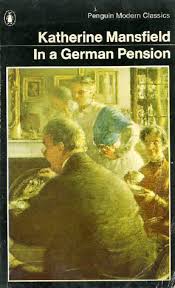
In a German Pension, by Katherine Mansfield, 1911

In a German Pension joins that small subset of books that the author didn’t want to see republished. It was Katherine Mansfield’s first published collection, although most of the stories had been previously published in various magazines. Because of the war and problems with the publisher (it went into liquidation) the book was quickly forgotten, and when the idea of republishing it was later floated by her then husband, John Middleton Murry, Mansfield refused. She considered the stories juvenalia and feared, I am sure rightly, that they would contribute to post-war anti-German sentiment.

In a German Pension: 13 Stories by Katherine Mansfield

Have the stories weathered the passage of the following century, or should Mansfield’s wishes have been respected? I would strongly argue the former – the tone of the collection might be uneven, and some of the portraits are caricatures, but overall this is a powerful group of stories in which the focus is not so much the German residents of the pension (a boarding house) with which the earlier stories are concerned, but the role of women in German and European society in the later stories which emerges as a more dominant theme.

The stories were written after her stay in a German spa before the first world war broke out. Mansfield was there to recuperate after a miscarriage. The collection is formed of thirteen stories, some only a few pages long, with the whole collection barely a hundred pages in total. The early stories are slightly whimsical observations of the characters in the pension, observed by a narrator who captures the chatter of the residents with the minimum of commentary. The Germans are boorish and judgmental towards the English narrator, although already the themes of maternity and women’s role in society are beginning to emerge:

“Is it true,” asked the Widow, picking her teeth with a hairpin as she spoke, “that you are a vegetarian?”

“Why, yes; I have not eaten meat for three years.”

“Im—possible! Have you any family?”

“No.”

“There now, you see, that’s what you’re coming to! Who ever heard of having children upon vegetables? It is not possible. But you never have large families in England now; I suppose you are too busy with your suffragetting. Now I have had nine children, and they are all alive, thank God. Fine, healthy babies—though after the first one was born I had to—”

“How wonderful!” I cried.

“Wonderful,” said the Widow contemptuously, replacing the hairpin in the knob which was balanced on the top of her head. “Not at all! A friend of mine had four at the same time. Her husband was so pleased he gave a supper-party and had them placed on the table. Of course she was very proud.”

This is carefully nuanced writing. What is not said is as important as what is, and the reader is able to gain a picture of the narrator’s situation without it ever being made explicit. After a few more short stories in which German attitudes to class are lightly mocked, the collection takes a more serious turn. Frau Brechenmacher Attends a Wedding is a chilling portrait of an abusive marriage. Herr Brechenmacher is a bully who orders his wife around. She has five children under the age of nine, but is looking forward to a night off attending a wedding celebration. This is how the author closes the story:

“They walked home in silence. Herr Brechenmacher strode ahead, she stumbled after him. White and forsaken lay the road from the railway station to their house—a cold rush of wind blew her hood from her face, and suddenly she remembered how they had come home together the first night. Now they had five babies and twice as much money; but

“Na, what is it all for?” she muttered, and not until she had reached home, and prepared a little supper of meat and bread for her man did she stop asking herself that silly question.

Herr Brechenmacher broke the bread into his plate, smeared it round with his fork and chewed greedily.

“Good?” she asked, leaning her arms on the table and pillowing her breast against them.

“But fine!”

He took a piece of the crumb, wiped it round his plate edge, and held it up to her mouth. She shook her head.

“Not hungry,” she said.

“But it is one of the best pieces, and full of the fat.”

He cleared the plate; then pulled off his boots and flung them into a corner.

“Not much of a wedding,” he said, stretching out his feet and wriggling his toes in the worsted socks.

“N—no,” she replied, taking up the discarded boots and placing them on the oven to dry.

Herr Brechenmacher yawned and stretched himself, and then looked up at her, grinning.

“Remember the night that we came home? You were an innocent one, you were.”

“Get along! Such a time ago I forget.” Well she remembered.

“Such a clout on the ear as you gave me…. But I soon taught you.”

“Oh, don’t start talking. You’ve too much beer. Come to bed.”

He tilted back in his chair, chuckling with laughter.

“That’s not what you said to me that night. God, the trouble you gave me!”

But the little Frau seized the candle and went into the next room. The children were all soundly sleeping. She stripped the mattress off the baby’s bed to see if he was still dry, then began unfastening her blouse and skirt.

“Always the same,” she said—“all over the world the same; but, God in heaven—but stupid.”

Then even the memory of the wedding faded quite. She lay down on the bed and put her arm across her face like a child who expected to be hurt as Herr Brechenmacher lurched in.”

That last line is like a punch in the face – “She lay down on the bed and put her arm across her face like a child who expected to be hurt”. The narrative is now much darker. Women are cursed with eternal pregnancies which are dangerous and potentially fatal (“my insides are all twisted up with having children too quickly” on character observes) and children are a burden not a joy. The stories are often told from the perspective of servants who are also oppressed, a situation which finds its apotheosis in The Child Who Was Tired, in which an exhausted child is expected to be the principal carer for her younger siblings, and finds the burden too much:

“I don’t believe Holy Mary could keep him quiet,” she murmured. “Did Jesus cry like this when He was little? If I was not so tired perhaps I could do it; but the baby just knows that I want to go to sleep. And there is going to be another one.”

She flung the baby on the bed, and stood looking at him with terror.

From the next room there came the jingle of glasses and the warm sound of laughter.

And she suddenly had a beautiful marvellous idea.

She laughed for the first time that day, and clapped her hands.

“Ts—ts—ts!” she said, “lie there, silly one; you will go to sleep. You’ll not cry any more or wake up in the night. Funny, little, ugly baby.”

He opened his eyes, and shrieked loudly at the sight of the Child-Who-Was-Tired. From the next room she heard the Frau call out to her.

“One moment—he is almost asleep,” she cried.

And then gently, smiling, on tiptoe, she brought the pink bolster from the Frau’s bed and covered the baby’s face with it, pressed with all her might as he struggled, “like a duck with its head off, wriggling”, she thought.

She heaved a long sigh, then fell back on to the floor, and was walking along a little white road with tall black trees on either side, a little road that led to nowhere, and where nobody walked at all—nobody at all.”

Powerful, distressing stuff. Mansfield may have wanted to forget this collection when she moved on to later work, but I am glad these stories remain in print. The anti-German sentiment has faded and we can now see these stories as a very personal and rather touching narrative.

The collection can be read online for free here.

Standard
Book review

The Murders in the Rue Morgue and other stories, by Edgar Allan Poe

I was pretty dismissive of ‘The Fall of the House of Usher‘ last month, but I thought I would give Poe a second chance. This is a collection of his shorter stories including:

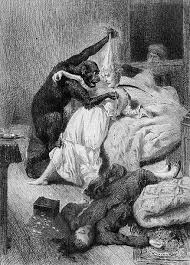
a) The Murders in the Rue Morgue (1841) is best known for developing the template for the modern detective story. Two women are brutally murdered in a classic locked room mystery. Numerous witnesses overhear what they believe to be the murderers. An amateur detective, Monsieur Dupin, investigates, accompanied and narrated by a poefaithful sidekick on hand to record his powers of deduction. The mystery has a farcical and preposterous solution involving an orang-utang, but the features of the detective fiction, including the demonstration of analytical powers before the main crime occurs, the incompetent and bumbling police, deductive analytical processes, even the habit of remaining secluded when not on a case, they are all there. Conan Doyle acknowledges as much by explicitly referencing Dupin in an early Holmes story. This tale is full of holes – the room in which the deaths occur just happens to have a window with a secret catch allowing it to open undetected, for reasons never clearly explained, and the introduction of an orang-utang as the mystery killer made me laugh out loud.
Incidentally I know the illustration here is ridiculous as well (as being gruseome – as are all the others you can find online) but there isn’t a way of illustrating the story without being ridiculous.

b) ‘William Wilson‘ is a well-constructed portrait of schizophrenia. If it was published today it would be unsuccessful – modern readers schooled in the ideas of psychotherapy will recognise very early in the many clues that the two characters, with the same name, appearance, age etc are one and the same person, but to readers of the 1840’s the story’s conclusion may well have been shocking.

c) ‘The Masque of the Red Death‘ is by comparison a dud, in which the supernatural is used as a deus ex machina that we see coming a long way off, and has little else to commend it.

d) ‘The Pit and the Pendulum‘. In this story the narrator is thrown into prison by the Inquisition, and awaits death by means of either a – well, you can guess. The tension is built slowly and effectively, and the prison/torture chamber is ingeniously recreated. The outcome, the narrator’s survival, is ensured by his ability to tell the tale, but his escape from the Inquisition is well managed.

e) ‘Hop-Frog‘ returns to a more fairy-story theme begun in ‘The Masque of the Red Death’.  Set in an unidentified European country in the Middle Ages, a cruel king is unkind to his court jester, and suffers revenge appropriate to his offences.

f) ‘The Case of Amontillado’. A collection of short stories within the horror genre would not be complete without a take featuring someone walled into their grave, and this is it. It is reasonably well done but takes a considerable effort to suspend belief long enough to be in any way disturbed by the outcome, given that it is flagged so early on.

g) ‘The Tell-Tale Heart‘. “I made up my mind to take the life of the old man”. This is a well-written short story in which a man commits a murder, but is betrayed by the sound of the still beating heart. It’s a convincing portrait of psychopathy, in which the speech patterns of the killer, the use of repetition

h) ‘The Man that was Used Up‘ is an extended shaggy dog story not worth the short time it would take to read; the joke falls very flat despite the prolonged set up, at least in part because the narrator is such a boor.

Overall these stories are interesting early examples of the horror genre, and are worth reading for the introduction to the model for Sherlock Holmes if nothing else. I am not sure to what extent Poe’s original readers would have found these stories scary or horrific; they have not aged well as our appetites for blood and guts has become more extreme. Usually attempts at humour fall flat, and it is the simpler stories such as ‘The Tell-Tale Heart’ which are the more effective.


Standard
Book review

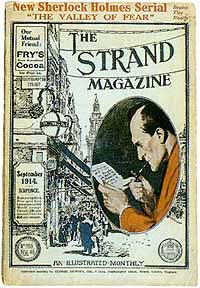
The Valley of Fear, by Arthur Conan Doyle, 1914

vall-00

The Valley of Fear‘ is last and the least well-known of Conan Doyle’s four Holmes novels (the others being ‘The Study in Scarlet’, ‘The Sign of the Four’, and The Hound of the Baskervilles’). It features a brief appearance by that Napoleon of crime, Professor Moriarty. We last saw Moriarty some 20 years earlier in the 1893 tale ‘The Final Problem‘, Conan Doyle’s unsuccessful attempt to kill Holmes off.

The novel opens with Holmes receiving an encrypted message from an informer within Moriarty’s criminal network. A follow-up message intending to provide the encryption key instead informs Holmes he has changed his mind, for fear of discovery. Nevertheless Holmes is able to decrypt the message. It is a warning that a murder plan is underway, naming the intended victim, a Mr Douglas of Birlstone Manor. Minutes later, Inspector Macdonald arrives with news that the victim identified in the note has been killed. Holmes deduces this is all Moriarty’s work, but his suspicions are dismissed by the officer.

Continue reading
Standard

Conan Doyle’s ‘The Adventures of Sherlock Holmes’ contains 12 short stories, all originally published in the Strand magazine between June 1891 and July 1892. Some are better known than others, but all follow a fairly rigid format – a curious case is brought to Holmes’s attention by a flustered individual, often incognito, Watson’s support is engaged, and the case is then swiftly resolved. Disguises are often deployed, trusty service revolvers are pocketed, and Lestrade is ritually humiliated. In every story Holmes performs the deductions which are his hallmark, usually at the opening of the story, although rarely if ever are these deductions anything to do with the case in point.

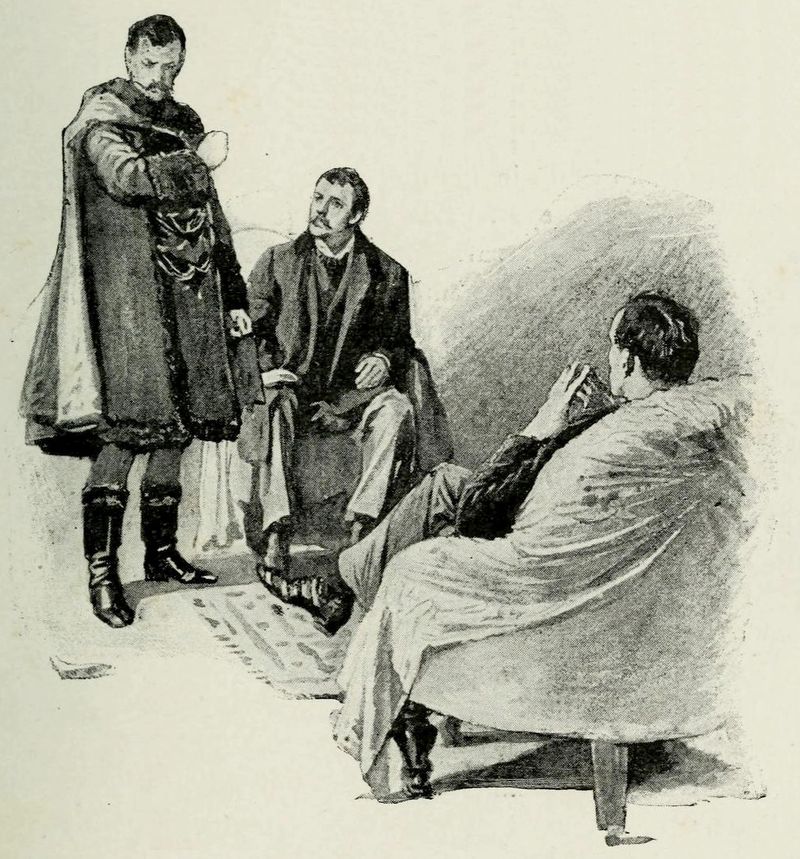
A Scandal in Bohemia is the story in which Irene Adler, ‘the woman’, makes her one and only appearance in Conan Doyle’s stories. It is a simple case of blackmail which is resolved without Holmes’s assistance, because Irene marries and decides not to pursue her victim. Holmes counts it as one of his very few failures, which suggests his definition of success is somewhat flexible, but there is no suggestion of any attraction between the two, more a mutual respect.800px-A_Scandal_in_Bohemia-04

The Red-Headed League is one of Holmes’s more ridiculous cases. A pawn broker is duped into leaving his store all day for several weeks to allow a tunnel to be dug from the premises to a nearby bank. The bank robbers could surely have found easier ways to do this than the invention of the League, which would have drawn a lot of attention to themselves, left clues all over the place, cost a lot of time and effort to establish, and could have fallen apart at any time.

A Case of Identity is one in which someone assumes a flimsy disguise, which Holmes sees through but fails to tell his client he has resolved the case. See ‘The Man with the Twisted Lip’

The Boscombe Valley Mystery. In this story Holmes bizarrely allows a murderer to go free, and a guilty man to spend months in prison, simply because the murderer is dying.

The Five Orange Pips sees Holmes allow his client to be brutally murdered and the murderers to escape the country, if not justice. Another great success!

The Man with the Twisted Lip. Someone assumes a flimsy disguise which Holmes sees through, again.

The Adventure of the Blue Carbuncle. In this story Holmes starts with the missing gem falling into his lap, and then working back to find out who stole it – an easier approach than the other way round I would have thought.

The Adventure of the Speckled Band. Conan Doyle thought this his finest Holmes story, but it is riddled with preposterous plot points.

The Adventure of the Engineer’s Thumb. A good headline, but a story in which Holmes detects absolutely nothing. Perhaps explains why this has not been an adaptor’s favourite.

The Adventure of the Noble Bachelor. A missing person story depending for its resolution of a previous relationship in America – the States is the setting for several of Holmes’s client’s backstories.

The Adventure of the Beryl Coronet. I think the real mystery – why a member of the royal family comes to pawn an incredibly valuable coronet for a fraction of its value – is ignored, instead focusing on whodunit in which footprints in the snow provide all the answers.

The Adventure of the Copper Beeches. A governess is recruited at highly inflated wages to impersonate a kidnapped heiress. Another case where the villains employ ridiculously complex means to pursue their villainy, when many other simpler options are available.

To Victorians, Holmes’s deductions and flashes of brilliance must have been dazzling, and to this day there are readers who hold Holmes in the highest possible regard. He is not the character most often portrayed on film for nothing. In recent years ‘Elementary’ and ‘Sherlock’ have given new life and new depths to the character. For me Holmes probably works best in this short story format where the weaknesses in his deductive method and approach aren’t too visible.

19th Century literature, Book review, Conan Doyle, Detective, Detective fiction, Holmes, Holmes and Watson, Sherlock

The Adventures of Sherlock Holmes, by Arthur Conan Doyle 1892

Gallery