
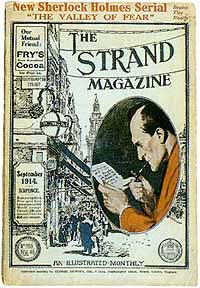
‘The Valley of Fear‘ is last and the least well-known of Conan Doyle’s four Holmes novels (the others being ‘The Study in Scarlet’, ‘The Sign of the Four’, and ‘The Hound of the Baskervilles’). It features a brief appearance by that Napoleon of crime, Professor Moriarty. We last saw Moriarty some 20 years earlier in the 1893 tale ‘The Final Problem‘, Conan Doyle’s unsuccessful attempt to kill Holmes off.
The novel opens with Holmes receiving an encrypted message from an informer within Moriarty’s criminal network. A follow-up message intending to provide the encryption key instead informs Holmes he has changed his mind, for fear of discovery. Nevertheless Holmes is able to decrypt the message. It is a warning that a murder plan is underway, naming the intended victim, a Mr Douglas of Birlstone Manor. Minutes later, Inspector Macdonald arrives with news that the victim identified in the note has been killed. Holmes deduces this is all Moriarty’s work, but his suspicions are dismissed by the officer.
The mystery is by Holmes’s standards, relatively straightforward. The victim, blasted in the face with a sawn-off shotgun, is not Douglas, who is hiding in a secret room in the house, but his attempted murderer. There is business with a card found beside the corpse, muddy boot-prints, a missing wedding ring, and so on, but this is all an attempt to put our detective off the scent. That old reliable the deaf housekeeper is deployed to confuse the timeline of the murder. If this mystery had been the subject of a Holmes short story it would have been wrapped up by tea-time, but the constraints of the longer format require complexities that add little to the plot.
With the discovery that Douglas is alive, a new mystery emerges – why was Moriarty involved in the plot to murder Douglas, and why did Douglas, having survived the attack, try to pass off the dead man as himself? The answer is found in his murky past. As with the much earlier ‘A Study in Scarlet‘, a former life in the USA led to him attracting some powerful and revengeful enemies, who have finally tracked him down. The second half of the novel provides this back story. Douglas, real name Birdy Edwards, had been a Pinkerton agent, and had infiltrated a gang, the Scowrers, in the eponymous Valley of Fear. Acting as a gang member on the run from Chicago, he gains their trust, becoming a key figure within the group. Finally he is exposed as an agent, but not before he takes the chance to capture all the gang leaders. From this point on he is a marked man.
This is a strange reprise for Holmes. ‘Baskerville‘ had been published (serially) in 1901-2, and the supply of Holmes short stories had slowed almost to a halt. ‘Valley of Fear‘ with its oblique reference to Tennyson’s ‘Valley of Death’ perhaps, was published (again in serial form) in the early months of the First World War, although there is no other reference this setting. Instead the novel is set in the much earlier period before the confrontation at the Reichenbach Falls.
The second half of the novel, devoid of any appearance by Holmes, is a powerful evocation of an American mining community full of hard and reckless men, where life is cheap and the rule of law more a set of suggestions. Gang members use the language of class war to justify the murder of anyone who opposes them. The portrait of McGinty, the gang leader, is one of Conan Doyle’s most sinister villains. The two halves of the novel are welded loosely together by a short coda at the end which tells of Douglas’s eventual demise.
I am sure I have quoted him before, but when thinking about Conan Doyle I always come back to what Raymond Chandler wrote about him in ‘The Simple Art of Murder‘:
“Every detective story writer makes mistakes, of course, and none will ever know as much as he should. Conan Doyle made mistakes which completely invalidated some of his stories, but he was a pioneer, and Sherlock Holmes after all is mostly an attitude and a few dozen lines of unforgettable dialogue”.
Chandler over-states his case – the Holmes stories created a whole cast of characters who outlived their creator and took on a life of their own. I would find it easy enough to find more than a few dozen lines of unforgettable dialogue in the canon. But the argument that his plots do not stand up to close scrutiny is surely right. In this novel the behaviour of Holmes’s informer is bizarre – why write a message in code, when the address is unencrypted, and the fact of his having written two letters to Holmes would be enough to cause Moriarty to question his honesty. Why does Holmes expose the truth about Douglas’s survival when belief in his death would have helped him escape the relentless revenge of the Scowrers? Why was the fact that the dead man had been redressed in Douglas’s clothes not immediately apparent from the absence of blood which a shotgun blast would have caused? Why throw the clothes into the moat, weighed down with a dumb-bell, when they could have been hidden in the secret room? Work hard enough and these things can be rationalised away, but there’s an awkwardness to everyone’s behaviour, an unnaturalness (Douglas’s wife doesn’t even pretend to grieve his ‘death’, for example) which emerges in the longer format. In a short story these things would have been easier to gloss over.
One of the wonders of the times we live in is that the complete Holmes stories are available online free of charge. I have been enjoying the 56 or so short stories, even though they blur together after a while. This novel was a welcome change of pace, and despite all my quibbling I did enjoy it. But I am looking forward to going back to the shorter format, although I doubt I will be able to suspend my nitpicking and just enjoy the ride.


After years of familiarity with the entire canon, I do feel that the short stories work better than the long ones, although I almost make an exception for The Sign of Four. The two long stories with the lengthy sections set in the US I do find unsatisfactory because it feels like there is so much padding. Atmospheric, yes, but when it’s Holmes I want, ultimately they won’t do.
LikeLiked by 1 person
Agreed. Looking forward to the final set of stories.
LikeLiked by 1 person