
Why reread ‘Animal Farm‘? I could spin you a line that the novel has a new importance in our post-Brexit world, but the honest answer is that my list of reviews looks a bit sparse without this novel. I can’t really claim to have read extensively across the great novels written in English without including ‘Animal Farm’ can I?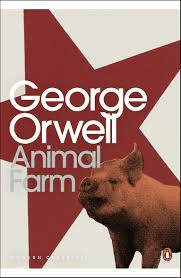
At the same time I was interested to see how it had changed. To be clear, I don’t mean the words on the page will have changed, of course. But all literature exists in a specific cultural context, and as that context has changed dramatically since ‘Animal Farm’ was first published, and even since I first read it (in the 70’s, I guess) the novel is bound to be different.
When first published the novel was read as an outspoken attack on Stalinism. It’s hard to argue against this reading – Orwell confirmed that interpretation himself in various articles and in an introduction to the novel which was ultimately only published much later. But if the novel only has a historically specific interpretation, as a commentary on the now defunct Soviet Union, then is it any longer of interest? When written in 1943 and ’44, opposition to Stalinism was an inconvenient position to hold. Stalin was our brave ally, pushing the Nazis back into Germany after having endured horrors during the previous years of the war. It was a curious time to be focussing on how Stalin had betrayed the revolution. By the time the novel was published the world had changed entirely. Hitler was gone, the war in the Far East was just over, and the first few days of the new Cold War had begun. All of a sudden attacks on Stalin were more than fashionable, they were useful, and ‘Animal Farm’s anti-Stalinism went from being something of an embarrassment to be promoted.
‘Animal Farm‘ is still taught in schools as a reductive exercise in transcribing Russian history into a farmyard parable. In this reading Snowball = Trosky, Napoleon = Stalin, and errr, then it begins to get a bit tricky. Is Old Major, the pig who prophesises the coming of animalism, Marx, or Lenin? He can’t be Lenin surely, because he dies before the revolution, whereas Lenin very definitely didn’t, but many guides will tell you he is an amalgam of the two. This difficulty – in drawing precise parallels between the novel and Russian history – extends to the events of the novel. An early review, in the New Republic (published in 1946) observed:
” The young dogs are alone selected for schooling; later they appear as the secret police. Is this a picture of Soviet education? The pigs not only keep the best food for themselves, but also become drunkards, taking over the pasture reserved for retirement of the superannuated in order to raise the necessary barley. Of course prohibition was abolished early in the revolution, but have the leaders drunk too much and has social insurance been abolished? There is a pathetic incident when Boxer, the sturdy and loyal old work horse, is sent off to be slaughtered and turned into dog food and bone meal, under the pretext that he is being hospitalized. Just what part of Soviet history corresponds to this?”.
While this reading is overly literal, it is the one readers are almost always encouraged to adopt – but not too far. X = Y when it works, but when Z = A, B and a bit of C, then we must not over-simplify, this is a parable after all. That’s having your cake and eating it surely?
If the ‘message’ or moral of ‘Animal Farm‘ is that all violent revolutions are doomed to failure, Orwell fails to tell us why. They just are. The animal’s revolution is betrayed because the pigs are greedy and selfish, and at the same time cleverer than the other animals. There is little here to help the reader understand the inherent problems with revolution itself. In this reading Orwell is presented as arguing for the status quo, with perhaps some incremental improvements in the lives of the animals/worker to be granted by the bosses when it suits them. It is hard to square this reading with Old Major’s scathing analysis of the wrongs animals suffer under Mr Jones.
“And even the miserable lives we lead are not allowed to reach their natural span…. no animal escapes the cruel knife in the end. You young porkers who are sitting in front of me, every one of you will scream your lives out at the block within a year. To that horror we all must come—cows, pigs, hens, sheep, everyone. Even the horses and the dogs have no better fate. You, Boxer, the very day that those great muscles of yours lose their power, Jones will sell you to the knacker, who will cut your throat and boil you down for the foxhounds. As for the dogs, when they grow old and toothless, Jones ties a brick round their necks and drowns them in the nearest pond.” (1.10)
This is not demagoguery, it is genuine passion, even if the comments about Boxer foreshadows his eventual fate at the hands of the pigs.
Major has a vision of what life might be like free from human oppression:
“Is it not crystal clear, then, comrades, that all the evils of this life of ours spring from the tyranny of human beings? Only get rid of Man, and the produce of our labour would be our own. Almost overnight we could become rich and free. What then must we do? Why, work night and day, body and soul, for the overthrow of the human race! That is my message to you, comrades: Rebellion! I do not know when that Rebellion will come, it might be in a week or in a hundred years, but I know, as surely as I see this straw beneath my feet, that sooner or later justice will be done. Fix your eyes on that, comrades, throughout the short remainder of your lives! And above all, pass on this message of mine to those who come after you, so that future generations shall carry on the struggle until it is victorious.”
This message, the argument for revolution, for never giving up, resonates just as strongly as the conclusion that all revolutions will ultimately fail. It carries more conviction and passion. Orwell obviously wasn’t a revolutionary socialist, but he wasn’t a conservative either, even if his texts are sometimes used to support right-wing positions he would not have agreed with. Famously he wrote in 1946 that:
“Every line of serious work that I have written since 1936 (i.e. since his involvement in the Spanish Civil War) has been written ….against totalitarianism and for democratic socialism.” (Why I Write). In 1946 the left had been profoundly compromised by its support for Stalinism, and history has come down on Orwell’s side on that issue. In reframing the choice – between totalitarianism and democratic socialism – when most thoughts were focussed on the battle against fascism – Orwell was ahead of his time. In 2018 we face a different set of choices. Few people now have any illusions about what was the USSR, but the “evils of this life” remain as pressing as ever. What Orwell would have made of Trump and Brexit I can’t imagine.
 The Reading Bug
I like your analysis, partly because it chimes in with mine, I’m sure. When I taught this book at school I always strove to get away from the reductionist approach. I think Orwell’s message is about eternal vigilance, not taking your eyes off the ball: the animals think everything is hunky-dory after the Revolution and let their guard slip, not challenging the gradual chipping away at the initial equality. Then it’s too late. Somewhere, education is the key: like the proletariat, most of the animals aren’t too bright, and aren’t aware of this, and thus are easily bamboozled… Orwell was an interesting and perceptive thinker, and had understood what Stalin was up to from his experiences in the Spanish Civil War. I’ll stop now, as I can feel myself slipping into teacher mode…
LikeLiked by 1 person
Eternal vigilance – hadn’t thought of it that way, but it’s a really good way of looking at it. Thanks. The backsliding starts virtually straight away – Napoleon takes the cows milk on the day of the revolution I think.
LikeLike
This is making me want to dig back into a different Orwell classic- 1984 is getting a lot of mentions over here in the Americas, but I don’t remember the novel well at all. Animal Farm is one I definitely remember suffering from the way it was taught in school; I really wonder if confining it to the literature side of things (the way it was done for me) is a mistake. We did get a brief summary of the Russian characters the different animals are based off of, but it wasn’t until I took a class in modern Russian history years later in college that I actually realized how little of the depth I got when we did Animal Farm in eighth grade. Going back to it in conjunction with Russian history and some of Orwell’s other writings could be really interesting as an exercise.
Also I should let you know that even though I don’t comment nearly as much as I should, I always look forward to reading your book reviews. They’re always very well-written and extremely thoughtful, and I find out about so many interesting books because of what you do here. I’d never have thought to check out The Mayor of Casterbridge, for instance, without your writeup of it here, but it sounds like a really worthwhile reading experience and one I’d like to make time for.
LikeLiked by 1 person
Thank you. I’ve reviewed 1984 elsewhere in this blog, would welcome your thoughts. Really appreciated your feedback – I write mainly for myself but it’s still really nice to know people are reading. When are you going back to your blog?
LikeLike
Of course! I may not always comment, but I always check out your posts. I’m not sure when I’ll return mine just because my spare time really doesn’t exist anymore, but I’m kicking around a couple of project ideas, one of which would involve my writing about one of the really long books I’m currently reading as I’m reading it, rather than doing one review. If I go with that, I might end up posting something next month.
LikeLiked by 1 person
Pingback: Book review: The Island of Doctor Moreau by H. G. Wells, 1896 | The Reading Bug
Pingback: Animal Farm – Me and My Green Coat
This is actually the first review I read that shone the light on the fact that Orwell, despite his accurate portrayal of revolutions, did not tell us how to make revolution successful or what is the alternative of it. Actually, I enjoyed the novel so much and I love how it can fit into any contexts in more than just one aspect. Yet the lack of this element made me annoyed a bit. I absolutely loved your critical review. I made a review of this novel in my blog, but more about the symbolic aspect of the novel, I wish you can check it.
LikeLiked by 1 person
Thanks, I will check your review out. I am a huge fan of Orwell’s writing but sometimes he was not as constructive as I wanted him to be.
LikeLike
Pingback: Book review: Inside the Whale and other essays, by George Orwell – The Reading Bug
Pingback: Review: Anti-semitism in Britain, by George Orwell, 1945 – The Reading Bug