
The Singapore Grip by J G Farrell, 1978
I finished J G Farrell’s The Singapore Grip with a sense of relief, which is not a good sign is it? At over 650 pages it was hard work. I had really enjoyed Farrell’s previous novel, Troubles, which was intelligent and entertaining. I had more mixed feelings about his Booker prize-winning The Siege of Krishnapur, which completely erased the voices of the local residents and portrayed every incident from the perspective of the English settlers. The Singapore Grip suffers from a very similar problem – the story is told almost exclusively from the perspective of the English people living in Singapore, and (with only a couple of exceptions) the Malayans and Chinese residents of the peninsula are there for comic effect.
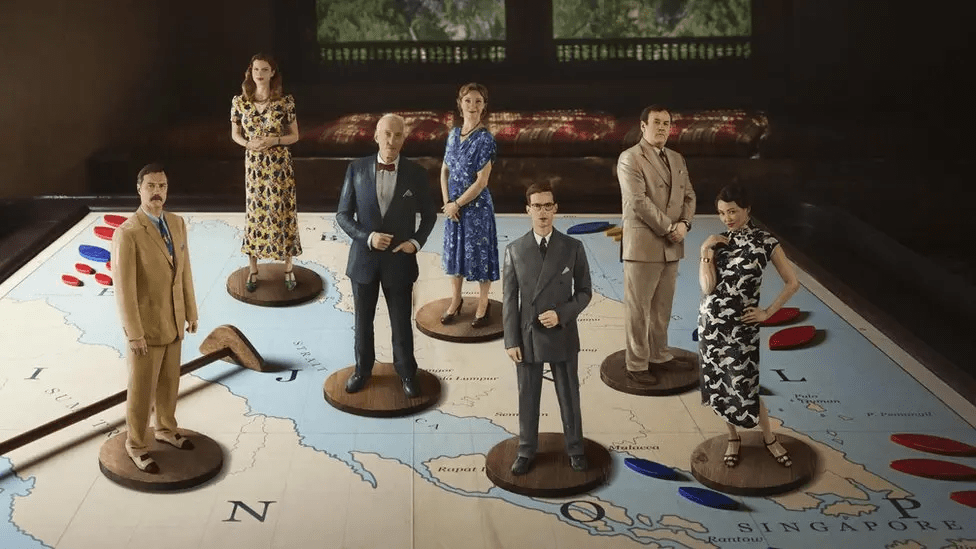
The novel is set in (as you may have guessed) Singapore, and portrays the final days of British government of the island and the Japanese invasion of 1942. The complacent colonial elite, solely interested in exploiting the land for its natural resources, principally rubber, are represented by Walter Blackett, an imperiously dense rubber merchant, and his daughter Joan and son Monty. Often described as a satirical novel, colonialism is a soft target for a novel written in the 1970s. The Blackett’s privileged lifestyle rests upon their attempting to recreate middle class English society as closely as possible, with tea parties and drinks before dinner, even while the society is collapsing all around them as the Japanese come ever closer. The novel’s conscience is embodied by Matthew Webb, son of Walter Blackett’s late business partner, newly arrived to the island (leaving behind a Europe at war) who has previously worked for the League of Nations. Matthew expresses doubts about the society he finds and believes a better world is possible. He symbolically rejects the colonialists by refusing to marry Joan, an arranged marriage that would have secured the future of the company, and instead pursues a relationship with an Asian woman.
There are a number of reasons why this novel was such hard work. The plot meanders and never surprises – we always know the Japanese are going to invade and conquer the island. Whether certain characters escape before the invasion is not a key plot point, as a reader might expect – some of them have chances to leave and let them pass. Walter in particular is focussed on rebuilding his commercial empire after the war, rather than how to survive it. The large cast of characters is not interesting or attractive enough for us to care greatly what happens to them. The critique of colonialism is heavy handed and repetitive – the absurdity of manipulating the supply of rubber to ensure profit from the estates is maximised is explained more than once. Worst of all, on-English voices are silent, with a few exceptions. The Frenchman, François Dupigny, is thrown in for some contrast, but his character is never really developed. After rejecting Joan, Matthew starts a relationship with Vera Chiang, reputed to be the daughter of a Russian princess and a Cantonese tea merchant. Despite this character’s potential she is largely a one dimensional caricature of a mysterious Eastern seductress, and I don’t think we ever are given an insight into her interests or thoughts, only seeing her through Matthew’s eyes.
There is one chapter that stands out from the parade of mildly inconvenient but still privileged things happening to the Europeans. This chapter is written from the perspective of the members of the invading Japanese force and shows them as reckless and driven by a profound sense of honour and determination. Although this is again a cliche it is at least a new voice and perspective from that of the European voices that dominate the rest of the novel. When we read on the final pages that any local people suspected of collaborating with the conquered English were massacred by the Japanese it is almost said as an afterthought, with no real sense of horror at the scale or brutality of the killings.
The novel’s title is a salacious joke, a single entendre, a reference to a sexual practice said to have originated in Singapore. Matthew is regularly teased by people he meets because he doesn’t understand the phrase, not that it really matters. Attempts to interpret the phrase as a reference to the control exerted by the island or its occupiers on society are well-meaning but redundant.
When the novel was adapted into a television series in 2020 by the BBC, critics complained that “Asian characters are merely heavily accented ciphers, silent chauffeurs, exotic dancers, giggly prostitutes, monosyllabic grunts and half-naked Yogis …. Asian womanhood is represented as lurid temptation and subservient availability.” That seems to me a fair representation of the novel as well. I am glad I finished it as I have a pathological aversion to investing time in a novel and not getting to the end (I’d rather not start in the first place) and the excellent Troubles had given me every reason to try again with Farrell. This was his last novel before a premature death in an accident and a disappointing way to finish.

