Book review

“The school at which I was science-master was desirably situated, right in the centre of the town, By walking only a few yards the masters and boys could find themselves in a café or a public-house. I used to frequent a café in the market-place. It was on the first floor, and underneath was a shop where coffee was roasted. A delicious aroma drifted through the maze of market stalls, mingling with the smell of celery, apples and chrysanthemums: you could pick up in the middle of the place and follow it to the source, where, in the shop-window, a magnificent roasting-machine turned with a flash of red enamel and chromium plate.”

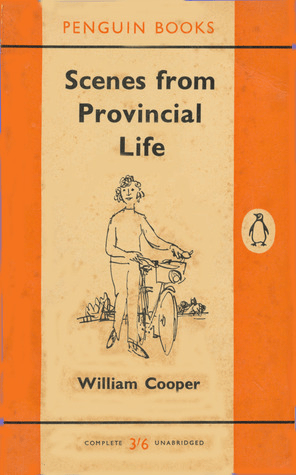
Remarkably it seems that Scenes from Provincial Life, a novel once described as ‘a post-war literary landmark’ by Anthony Burgess and as ‘seminal’ by John Braine, is now out of print. It has received only seven reviews on Goodreads. I first came across the novel in the mid-1980’s in the classic Penguin edition shown here. I remember finding it charming and amusing, but recalled little else about it. You will not be surprised such is the fallibility of memory that returning to the novel I found it much changed!

Scenes from Provincial Life, with a title knowingly looking back to earlier nineteenth century ‘small town’ literature, features as its protagonist a new type of central character, one who came to dominate fiction of the 1950’s: male, (inevitably), but also young, sexually active, educated and (crucially) not financially independent. Unlike so many of the people in (for example) the average Bloomsbury novel, these characters have to work for a living. And their jobs are not things that happen ‘off-screen’ as diversions from the central events of the novel, the love affairs and melodramas, but are actually places they go and things they spend time doing. Kingsley Amis’ Lucky Jim is probably the best known example of this genre, but Scenes, published in 1950, came before it and showed the way. Joe Lunn is a physics teacher in a not very good secondary school in a provincial town (widely acknowledged as being Leicester). He is not a very good teacher, under threat of dismissal for his flagrant disregard for the petty headmaster’s rules and not at all worried about the prospect. He has other things to worry about, not least the fact that this is the spring of 1939 and war seems unavoidable. (Joe thinks the alternative to war, capitulation to Germany, would be even worse). He finds his work boring and pointless. He is not much older than his sixth form students and finds it easier to relate to them than his peers.

Joe’s social circle involves his girlfriend, Myrtle, Tom, an accountant, and Stephen, Tom’s much younger boyfriend. The portrait of an openly gay relationship (open within his social circle, but not out in the modern sense) was highly unusual, not least because it is presented as unexceptional and unproblematic. Stephen and Tom’s relationship is portrayed as slightly hysterical with lots of ups and downs, ultimatums and so on, but Joe never passes judgment on them as a gay couple.

But the central relationship of the novel is that between Joe and Myrtle, which is based on a mutual and enthusiastic sexual attraction. They spend weekends at Joe’s cottage (which it seems he either hires for weekends only or that can afford to rent both this cottage and his room in a boarding house, where overnight guests are forbidden by moralistic landladies). Either way, the cottage is the place where they can enjoy one another’s company without the intrusion of prying eyes. Joe, a few years older than Myrtle, is very keen on having as much sex as possible with her, but is very clear that he is not interested in marriage. In the 1930’s, when the novel is set, and even into the 1950’s when it was published, pre-marital sex obviously happened, but the implied understanding was that it would, sooner or later, lead to marriage, rather than being a fun occupation in its own right. There is even, in chapter two, a very clear but not quite explicit description of oral sex that I think could have been shocking to Cooper’s 1950’s readers, even those who had managed to get their hands on a still-banned copy of Lady Chatterley’s Lover. Sex is fun and uncomplicated in a very 1960’s post pill way. Myrtle does have a pregnancy scare at one point, which she successfully treats with copious amounts of gin.

As the year passes, the international situation deteriorates and it becomes clear that war is coming ever closer. Joe and his friends develop a plan to emigrate to America – Tom in particular is keen to leave, being Jewish. These plans never really get off the ground and I had the feeling that such talk was common in some quarters in 1939, the alternative being too grim to contemplate. J0oe tries to involve Myrtle in this plan, but as he never mentions the ‘m’ word (marriage) she is not interested. Joe and Myrtle’s relationship begins to struggle as he stubbornly refuses to accept her hints about getting engaged and in response she starts to spend time going to parties with other men. If this is intended to make him jealous it succeeds, but not sufficiently to change his mind on the matrimony front. To complicate matters Tom tells Joe that he is planning to ask Myrtle to marry him – other than to make Stephen jealous it is not clear why he is going to do this, and neither Joe nor Myrtle take the offer seriously.

A comedic sports day chapter is entertaining, but as soon as the narrative returns to the love affairs of the cast the novel slows back down. Joe really wants to end his relationship with Myrtle, but she continues to sleep with him, which acts as a serious disincentive to him ending it, but he also does not want to appear caddish, and would rather it be Myrtle herself who ends things. This she finally does. Cooper closes the novel with a quick summary of how the characters fared during and after the war. I was surprised while preparing this post to find out that Cooper published several sequels to this novel, charting the later lives of Joe, Myrtle and friends. I am in two minds as to whether to read these – I am not sure that the characters are sufficiently compelling to justify several follow up novels – but I might! I doubt they are in print however.

I wonder who comes closer to the truth – the novelists and critics of the 1950’s who saw in Scenes from Provincial Life something important and significant, or the modern judgment which is to have largely forgotten the novel? It is possible that both views are right – Scenes was important when first published because it marked a break with the dominant Modernist novel of the interwar years, but that in itself is not enough to preserve its value as a novel in its own right once stripped of its historical and cultural context. I am not entirely convinced it had the cultural impact that some have claimed – after all George Orwell and others were writing novels about young, educated but not very well-off young men looking for new types of relationships that did not involve marriage back in the 1930s. But at the same time this template has proven remarkably resilient and you will find many writers of today writing to this pattern, using these themes. Scenes deserves to be remembered and read, and recognised as an important cultural landmark, even if hindsight now tells us that the turning point it seemed to represent didn’t last that long.
Scenes from Provincial Life by William Cooper, 1950

Aside
Book review

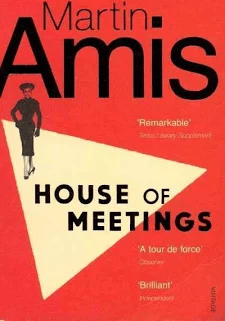
House of Meetings by Martin Amis, 2006

I can’t remember the last time I did not finish a book. Over the course of this blog I have probably left unfinished fewer than four or five books – the only one that springs to mind is Lies Inc by Philip K Dick, which was unreadable. So I think it says something that I came very close to abandoning House of Meetings some forty pages from the end. Only sheer stubbornness kept me going. It’s not that it is a bad book, it was just not very interesting. Which is fairly extraordinary – how could any writer make Stalin’s gulags dull?

House of Meetings is also at times harrowing. It is a historical novel framed as a prolonged confession by an unnamed, eighty-four-year-old Russian narrator. Addressed to his American stepdaughter, Venus, the text is an attempt to explain and come to terms with the narrator’s turbulent life – his violent past and the destructive relationships that defined his youth. If you impose a chronological order on the novel, the narrative begins in late 1940s Moscow, where the narrator and his younger half-brother, Lev, both fall in love with Zoya, a striking nineteen-year-old Jewish woman. Of course that is not what happens on the page, where the narrative is fragmented, told in snatches of memory, interspersed with commentary on contemporary events such as the Beslan school shootings.

The narrator is a handsome, (he says) and physically strong World War II veteran who has been deeply hardened emotionally by the conflict, including having participated in the brutal mass rapes and other atrocities committed by the Red Army during its advance through Germany. These crimes are described as just something that happened – the narrator takes no moral responsibility for his behaviour and even seems to think it was justified in some way. (“In the last months of the war, when I raped in uniform – we were, by then, so full of death (and the destruction of everything we had and knew) that the act of love, even in travesty, felt like a spell against the riot of murder.”) Lev, by contrast, is a frail, stuttering poet, a pacifist, and an idealist. Zoya chooses the gentler brother, marrying Lev just before the Soviet state begins a fresh reign of terror which sees the brothers thrown into a gulag.

The narrator adapts quickly to the lawless, violent hierarchy of the camp, but Lev suffers immensely despite the narrator’s attempts to shield him. In 1956, during a period of relaxed rules following Stalin’s death, Lev is granted a highly prized conjugal visit. Zoya travels thousands of miles to meet him in a designated wooden cabin known as the “House of Meetings.” The narrator, consumed by envy, is tormented by not knowing what happens in the House, even though this surely requires very little imagination.

Following their eventual release, the brothers’ lives diverge. The narrator defects to the West, eventually settling in America. Here he improbably becomes a wealthy arms dealer. Lev returns to Zoya, but he is broken by his time in the gulag, and their marriage does not survive. The novel ends in 2004, as the elderly narrator travels back to Siberia and the camp, this time as a tourist. During this final voyage he opens a long ignored letter from Lev telling him what happened in the House of Meetings, something that has haunted the narrator for some reason. Far from being a climax this is simply an ending, with nothing of interest being revealed.

This novel was ill-conceived and ill-advised. There is an extensive literature of the gulag written by survivors to which this adds nothing. His commentary on contemporary Russian politics is dated and dull, and the narrator’s portrait of the gulags is strangely banal. The references to the atrocities being committed by Chechen terrorists are thrown in casually and do not serve any function – if we are supposed to infer that little changes in Russia and it remains as barbaric as ever, then the point is moot and badly put. I did not care about the characters in the novel, and apart from the brothers none of them were drawn with any care or interest. Zoya in particular was very one-dimensional with no real existence outside her role as the third element of the love triangle. No doubt that is because that is how the narrator saw here – just as a woman rather than as a real person, and why he obsessed with what she did or didn’t do in the House of Meetings with his brother. Just what he thought they did, and why he could not get over that brief visit, I could not understand nor care about.

I’d like to find something positive to say about this novel to conclude this review, but I have racked my brains and I can’t. I’ve looked back at some of my reviews of earlier novels by Amis (who died in 2023) and find that I loathed Lionel Asbo and Yellow Dog, so I suppose the fact that I found House of Meetings merely banal represents something of an improvement!

House of Meetings by Martin Amis, 2006

Aside
Book review

How Far Can You Go? by David Lodge, 1980

“It is just after eight o’clock in the morning of a dark February day, in this year of grace nineteen hundred and fifty-two. An atmospheric depression has combined with the coal smoke from a million chimneys to cast a pall over London. A cold drizzle is falling on he narrow nondescript streets north of Soho, south of the Euston Road. Inside the church of Our Lady and St Judge, a greystone, neo-gothic edifice squeezed between a bank and a furniture warehouse, it might still be night.“

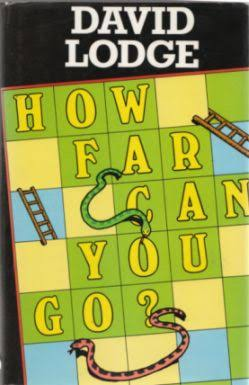
How Far Can You Go? charts the lives of a group of English Catholic students from the early 1950’s to the late 1970’s, a period of dramatic change in the UK and within the church. The novel is organised chronologically into themed chapters that track the group’s lives within the context of the social and theological changes of the period with a particular focus on the evolution of Catholic teaching. The novel opens by introducing the group of students as they gather at a cold and dark Catholic church for an early-morning mass prior to lectures at University College London. All the students have been taught and believe the church’s teachings on sin, guilt, and sexual abstinence. Compliance with the teachings of the church is compared to a twisted board game (hence the illustration on the novel’s front cover):

The name of the game was Salvation, the object to get to heaven and avoid Hell. It was like Snakes and Ladders: sin sent you plummeting down towards the Pit; the sacraments, good deeds, acts of self-mortification, enabled you to climb back towards the light.” The author is the unnamed eleventh character in the novel, regularly intruding into the narrative by breaking the fourth wall.

‘How They Lost Their Virginities’ is the (self-explanatory) next section of the novel which details how the awkward, guilt-ridden students transition from youthful chastity into their early sexual experiences and marriages. Or most of them do – one character becomes a nun, with the inevitable vow of chastity that involves, and another is a closeted gay man who is scared of sex, worrying that it will damn his soul. Most of the other students wait until marriage before having sex, largely due to the same fear of damnation. In some cases they wait for several years, with the stress and anxieties this inevitably brings.

‘How Things Began To Change’ takes the novel into the 1960s. The characters marry, have children, and begin a long struggle with the strict Church ban on ‘artificial’ contraception. Hopes for a relaxation of the church’s teachings on this issue are dashed in ‘How They Lost The Fear Of Hell’ with the publication of the papal encyclical Humanae vitae (HV) in 1968, which reaffirmed the ban. The young people, now not so young, have increasingly large families, and the burden of near constant pregnancy or abstinence puts pressure on their compliance with the church’s teachings. Around them society grows more permissive and some of them abandon ‘natural’ contraception for methods that actually work, feeling liberated when doing so.

From here, the fairly linear story begins to fragment as the characters’ lives go their different ways, each of them finding their place in the world and ways to reconcile their faith with their day-to-day lives. Some get divorced, have affairs, suffer mental breakdowns, or experiment with charismatic, personalised versions of faith. One couple, Dennis and Angela, have a child with Down’s Syndrome. The references to the child being a ‘Mongol’ are a shocking remind of how, until quite recently, people with Down’s were commonly referred to. The birth of a child with Down’s Syndrome is presented as a curse from God and this is followed shortly by the death of their daughter, Anne, when she is run down in the road by a car. Here the author once again breaks the fourth wall:

“I have avoided a direct presentation of this incident because frankly I find it too painful to contemplate. Of course, Dennis and Angela and Anne are fictional characters, they cannot bleed or weep, but they stand here for all the real people to whom such disasters happen with no apparent reason or justice. One does not kill off characters lightly, I assure you, even ones like Anne, evoked solely for that purpose”.

This intrusion of the author into the narrative might have seemed very modern or even post-Modern in 1980, but it has not aged well. It is largely redundant (we know Dennis and Angela and Anne are fictional characters, but have chosen to temporarily engage with them as ‘real’ characters as part of the experience of reading the novel) and intrusive, reminding the reader that this is just a novel and that we have no real reason to care about the characters – other than as avatars for anyone we know who has ever suffered. Lodge anticipates this response: “People who find religious belief absurd are often upset if a novelist breaks the illusion of reality he has created”. No, I was not upset, just mildly irritated at the unnecessary intrusion of another, no less illusory character, the author.

The novel ends with a transcript of the documentary filmed at a progressive Catholic retreat organised by some of the characters. The film causes a minor scandal, showing as it does people pushing at the boundaries of the church’s teaching on how religious observance is to be conducted (that is, seriously, without celebration, music or fun).

Underpinning the narrative is a liberal assumption that the course of the church’s teaching is fixed and inevitable, and in particular that sooner or later the rules about contraception will be relaxed. This is presented as something that is simply unavoidable, a matter of time, and I am sure that is how it must have felt in the 1960’s and ’70’s. Lodge’s characters would I think have been shocked to find out that in 2026 the Catholic Church still maintains that artificial contraception is an ‘intrinsic evil’ – it is “always morally wrong and can never be justified by any good intention or difficult situation”. There was nothing inevitable about the liberalisation of Catholic teaching, however it must have seemed half a century ago. Which, unless you are a dogmatic, committed Catholic, makes How Far Can You Go? rather sad. “Thus far and no further” is the answer none of Lodge’s characters, nor I suspect Lodge himself, would have expected.

Why am I (still) reading David Lodge? He was an important figure in the British literary scene in the 1980’s and was nominated and shortlisted twice for the Booker Prize in that decade. I think his standing has diminished significantly since then and his work is commonly perceived as outdated. Which I think is right, but I find it hard to resist a first edition hardback in a second-hand bookshop for just a couple of pounds, so here we are.

How Far Can You Go? by David Lodge, 1980

Aside
Book review

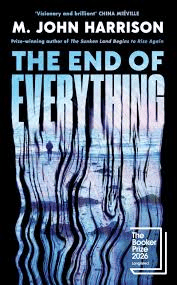
The End of Everything by M John Harrison, 2026

For years Phillip Tennent lived at the end of the sea, where artefacts were washed up every day. Scavengers, professional and otherwise, came and went. Turnover was higher than you’d expect given the relaxed lifestyle, the constant good weather, the ease with which some sort of existence could be pursued.

The End of Everything defies categorisation. The term ‘dystopian fiction’ helps a little – the novel is set in an indeterminate future where society as we know it has largely broken down, although there is still some form of social order. It could also be categorised as science fiction, as the world is now occupied by an alien race known as the iGhetti who seem to have come to an accommodation with humanity, and co-exist alongside them – or, it is unclear, they might be destroying the world very slowly. There are also ‘bad patches’ – areas in the countryside where the normal rules of time and space have ceased to exist, and weird things happen. It’s best not to get caught in a bad patch – you might not be able to get out. ‘Speculative fiction’ is just too broad a genre to be of any help here. In the end the label that helped me come to terms with this novel the most was new weird fiction, a term that Harrison himself coined.

The search for a genre label might appear to be an attempt to put Harrison’s text into a framework that limits it, ties it down, but The End of Everything easily sidesteps any such attempt. It is unlike anything I have read before, and was consciously unsettling and disturbing. The narrative, such as it is, follows a beachcomber named Phillip who finds an ‘artefact’, something other-worldly left behind or created by the aliens. This artefact is never directly described, but it is alive, or has features that mimic life – it grows and adapts and can even be eaten, but is hard if not impossible to kill. It appears to be able to adapt to its environment and develop in ways that mimic the things around it – in this case Philip. Philip takes the artefact to his 70-year-old aunt Marnie, an artist suffering from early-stage Alzheimer’s disease. defends her townhouse and starts her own journey from gallery to gallery. Phillip decides to dispose of the artefact, and heads away from the coast. Following a ‘dispute’ with her neighbours, Marnie embarks on her own nomadic journey up the coast.

The disturbing scene which describes this dispute appears early on in the novel and firmly establishes the tone. I would not read this if you are in any way squeamish. Marnie lives in a ramshackle house. One day a fourteen year old boy climbs into the extension of her house and, finding her sleeping in the room below, urinates on her.

“He turned to run away and put his foot through the extension roof. Totten plaster pattered down inside. His left leg dangled into the room beneath, scrabbling for purchase. He began to call out in a high voice. “I have you now, you little bastard” Marnie told him. She wiped herself off and went inside, where she rummaged about in the kitchen until she found a metre or two of old electrical flex. This she fastened round the boy’s ankle, anchoring the other end to the heaviest object she could find, which happened to be the bed, to limit the movement of the leg. Once she was satisfied, she went outside again and pulled herself up on the edge of the extension roof until she could look at him.

“How do you feel about this now?” she said. The boy was in half-sitting half-kneeling position, his visible leg quivering with the strain of supporting him…. Marty went back inside. After some consideration, she grasped the tethered leg in both hands and hung from it. “No one in the street likes you”, she shouted. “Do you hear?” Then she found a knife in a cupboard, cut into the boys femoral artery and stepped quickly away from the spray of blood. She stood there for a moment watching the leg flail and spurt…. She watched for a minute or two as the boy lost energy, then turned away and leaned on the balcony rail, looking up and down the row at the overgrown gardens…. She went to talk to the boy’s father, who lived a couple of doors down. They sorted things out between them, and the father sent someone to lever his dead son out of her extension roof…..

After breakfast the boy’s father called, with delegation comprised of half a dozen other people who lived along the street. “Some of us feel you went too far”, he said, implying perhaps that he didn’t. ….The general feeling, the father said, the feeling of everyone there, was that Marnie should leave. “I can see I can see why you might say that” she said, although she couldn’t. ” I’ve lived here longer than any of you, but I can see why you might say that.”

I’ve quoted this awful, upsetting scene at considerable length (even though I have edited it down substantially, shown by the ellipses) because it is such a striking, unsettling episode. Killing a young boy (turns out he was actually 12, not 14 as Marnie believes) is done so casually, and with so few consequences, as if she has committed some minor social faux pas, rather than murder. Marnie is asked, politely, with typical British understatement, to move on, but other than that she is free to go. We are not in a typical dystopian world where life is cheap because of the breakdown of social order – instead this is a world where killing people casually, almost disinterestedly, is accepted, not normal, but not distressing either. This is not the only casual killing in the novel – Marnie has a gun, and uses it when she feels the need – but it is the one that stands out the most, coming early in the novel and setting the tone for what is to come. The reader has no frame of reference to respond to this incident – this is unlike any other dystopia, any end of the world written about before. Obviously the author’s intention is to unsettled the reader, to remove any solid ground from under them. Mission accomplished.

The rest of the novel follows this template. You never quite know what is happening. There is a narrative structure, of sorts, but it is not that important. Neither are the principal characters. People are introduced, things happen, nothing really makes much sense.

I turned to the internet for help in framing my reactions to the novel, and come across this review by sci-fi blogger At Boundary’s Edge. The blogger observes in one very telling sentence that “Harrison isn’t telling us a story. He’s selling us an experience.” This makes a lot of sense. Don’t read the novel to find out ‘what happens’ or to enjoy the story, because there really isn’t much of one. Instead, immerse yourself in the experience of reading a M John Harrison novel, like taking a drug that you aren’t sure how you are going to react, whether the experience is going to be a good one or not, but it is definitely going to be an experience. Another reviewer over on Goodreads wrote: “There’s using confusion and warped perception as a literary tool, and then there’s this. As soon as it started approaching interesting concepts, it swiftly turned away to then prattle on about nothing of substance… It shouldn’t be this much of a slog to get through a 200 page book.” And there we have it. Because I did find it hard to make my way to the end of The End of Everything. There was no-one to care about, no plot to resolve or end, even the mildly interesting puzzle of what the artefact might be or become is left unclear – and I was left feeling a little embarrassed at my need for clarity or resolution. Alongside the weirdness there is plenty of lyrical descriptive writing suggesting Harrison is a skilled and capable writer, but this is definitely a case where for me the strangeness went that little bit too far. The Booker Prize panel obviously disagreed, long-listing this novel for the 2026 award, but I would be shocked if it makes it any further in the process.

The End of Everything by M John Harrison, 2026

Aside