House of Meetings by Martin Amis, 2006
I can’t remember the last time I did not finish a book. Over the course of this blog I have probably left unfinished fewer than four or five books – the only one that springs to mind is Lies Inc by Philip K Dick, which was unreadable. So I think it says something that I came very close to abandoning House of Meetings some forty pages from the end. Only sheer stubbornness kept me going. It’s not that it is a bad book, it was just not very interesting. Which is fairly extraordinary – how could any writer make Stalin’s gulags dull?
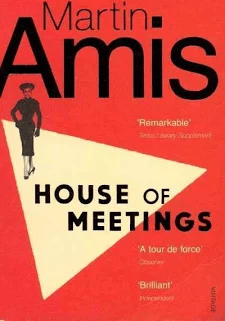
House of Meetings is also at times harrowing. It is a historical novel framed as a prolonged confession by an unnamed, eighty-four-year-old Russian narrator. Addressed to his American stepdaughter, Venus, the text is an attempt to explain and come to terms with the narrator’s turbulent life – his violent past and the destructive relationships that defined his youth. If you impose a chronological order on the novel, the narrative begins in late 1940s Moscow, where the narrator and his younger half-brother, Lev, both fall in love with Zoya, a striking nineteen-year-old Jewish woman. Of course that is not what happens on the page, where the narrative is fragmented, told in snatches of memory, interspersed with commentary on contemporary events such as the Beslan school shootings.
The narrator is a handsome, (he says) and physically strong World War II veteran who has been deeply hardened emotionally by the conflict, including having participated in the brutal mass rapes and other atrocities committed by the Red Army during its advance through Germany. These crimes are described as just something that happened – the narrator takes no moral responsibility for his behaviour and even seems to think it was justified in some way. (“In the last months of the war, when I raped in uniform – we were, by then, so full of death (and the destruction of everything we had and knew) that the act of love, even in travesty, felt like a spell against the riot of murder.”) Lev, by contrast, is a frail, stuttering poet, a pacifist, and an idealist. Zoya chooses the gentler brother, marrying Lev just before the Soviet state begins a fresh reign of terror which sees the brothers thrown into a gulag.
The narrator adapts quickly to the lawless, violent hierarchy of the camp, but Lev suffers immensely despite the narrator’s attempts to shield him. In 1956, during a period of relaxed rules following Stalin’s death, Lev is granted a highly prized conjugal visit. Zoya travels thousands of miles to meet him in a designated wooden cabin known as the “House of Meetings.” The narrator, consumed by envy, is tormented by not knowing what happens in the House, even though this surely requires very little imagination.
Following their eventual release, the brothers’ lives diverge. The narrator defects to the West, eventually settling in America. Here he improbably becomes a wealthy arms dealer. Lev returns to Zoya, but he is broken by his time in the gulag, and their marriage does not survive. The novel ends in 2004, as the elderly narrator travels back to Siberia and the camp, this time as a tourist. During this final voyage he opens a long ignored letter from Lev telling him what happened in the House of Meetings, something that has haunted the narrator for some reason. Far from being a climax this is simply an ending, with nothing of interest being revealed.
This novel was ill-conceived and ill-advised. There is an extensive literature of the gulag written by survivors to which this adds nothing. His commentary on contemporary Russian politics is dated and dull, and the narrator’s portrait of the gulags is strangely banal. The references to the atrocities being committed by Chechen terrorists are thrown in casually and do not serve any function – if we are supposed to infer that little changes in Russia and it remains as barbaric as ever, then the point is moot and badly put. I did not care about the characters in the novel, and apart from the brothers none of them were drawn with any care or interest. Zoya in particular was very one-dimensional with no real existence outside her role as the third element of the love triangle. No doubt that is because that is how the narrator saw here – just as a woman rather than as a real person, and why he obsessed with what she did or didn’t do in the House of Meetings with his brother. Just what he thought they did, and why he could not get over that brief visit, I could not understand nor care about.
I’d like to find something positive to say about this novel to conclude this review, but I have racked my brains and I can’t. I’ve looked back at some of my reviews of earlier novels by Amis (who died in 2023) and find that I loathed Lionel Asbo and Yellow Dog, so I suppose the fact that I found House of Meetings merely banal represents something of an improvement!