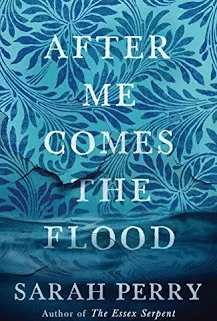
After Me Comes the Flood was Sarah Perry’s promising first novel, published two years before her breakthrough work, The Essex Serpent. After Me tells a deceptively simple story: five weeks into a heatwave, the novel’s central character, John Cole, shuts his customer-less London bookshop and sets out to visit his brother on the Norfolk coast. When his car breaks down somewhere in Norfolk, he leaves his car and wanders into a wood where he stumbles upon a large house. Knocking with the intent of asking for help, he is welcomed by the members of the household – strangely it seems he is expected and is welcomed by name. They mystery is quickly explained – this is a group of friends who previously lived together in a mental health clinic nearby and who now look after one another. A new group member with a very similar name to John’s was due to arrive, although has been delayed and John is mistaken for him. He sustains the idea that he is the other John Cole, although there is every indication that the household would have welcomed him if he explained the misunderstanding.
There is a mysterious gothic quality to John’s stay at this house. The residents are introduced slowly, telling how they came to live in this unusual sanctuary. Hester is in her sixties and is the matriarch of the house. John consistently describes her as ugly, saying she appears “poorly assembled, as though she had been put together from left over pieces” (which is a bit mean!). Eve is a pianist; Elijah a former preacher who has lost his faith; Claire and Alex, brother and sister, are childish and childlike (John initially mistakes Claire for a young girl) and finally there’s Walker, an accountant who met the others at the hospital but who was not a patient there. Near the house is a reservoir and Alex is frightened that the bank holding it in place might at some point burst, and that the house will be swept away in the ensuing biblical flood. This threat looms over the rest of the novel increasing the sense of menace.
It would be fair to say that After Me is definitely an atmospheric and character-driven novel, but at the same time not very much happens. The events of the novel, such as they are, are spread over one week, with each chapter representing a day. John gets to know the residents, and slowly gets comfortable with his deceit, reminding himself daily to either tell them the truth or leave, but never quite getting round to doing either. One day the household takes a trip to the coast and Alex briefly goes missing with a young boy he had befriended while playing innocently on the beach. The suspicion cast on him by the boy’s mother throws a shadow over the day and upsets Alex more than the others realise. This is probably the nearest the novel comes to anything that could be described as incident.
Perry’s subsequent novels rest heavily on supernatural themes. Here such things are hinted at but there are naturalistic explanations for all the strangeness John initially encounters. There is also an under-developed theme running through the novel relating to the short Anglo-Saxon poem Wulf and Eadwacer which is never really resolved. We find out who has been sending the poison-pen letters to Alex which have caused him so much distress, but the reasons for the obscure classic illusion remain unclear.
I do have a issue with the novel’s ending. The threatening reservoir looms over the novel like the sword of Damocles and it would have been a shock had it not played a central role in the novel’s resolution. It is hard to resist the impression that having assembled her characters, drawn all the lines between them, and placed them in a moderately interesting setting, Perry was at a loss as to what to do with them all next. The novel’s ending felt far too convenient and obvious, a simple way to bring matters to a close.
I am conscious that I haven’t found anything interesting to say about After Me, which I am disappointed about. But I can’t help wondering whether the problem is mine as a reviewer or the author’s as a novelist. This is after all a novel in which not much happens, the characters are not really engaging and where the ending is very predictable. The prose is perfectly adequate, but I don’t think I can recall a single line or phrase that jumped out and asked to be remembered. If I appeal to the jury of the internet to decide where the problem lies I think it is revealing that on Goodreads this novel has an average reader score of 2.78, by far the lowest score for any of her subsequent novels, and has twice as many one-star reviews as five-star.. Many of those one-stars will have been by disappointed readers of The Essex Serpent looking for more of the same, which is of course a bit unfair. If you have read After Me and found more in it than I managed to find, I would love to hear from you in comments. What am I missing?
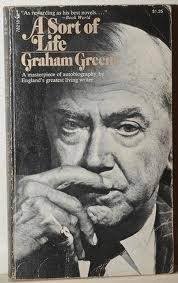
This autobiography focuses on Greene’s early life, the years up to the point he married, by which point he had published his three novels. The memoir ends in 1932 when he achieved his first major success as a novelist with Stamboul Train. Most of A Life of Sorts focusses on his in some ways idyllic Edwardian childhood, growing up the son of a headmaster and one of six children in leafy Berkhamstead. This was a life of considerable privilege – at one point Greene reels off a list of servants (although his family were perceived as the poor relations compared to another clan of Greene’s living at the nearby hall). They even had an orchid house! This start in life gave Greene a privileged education, psychotherapy in Harley Street when he threatened to run away from school, private tutors and entrance to Oxford without any of the nonsense about qualifications or suitability (he twice failed to win a scholarship but ‘we still lived in a world of influential friends,’ and the history tutor at Balliol who admitted him was ‘an old pupil and disciple of my father’s’).
At times the narrative is reduced to a simple list of Greene’s likes and dislikes: his childhood hobbies, the qualities most admired in men, favourite pastimes and favourite holiday resorts are all described in detail, without telling us much about the author other than he seemed to have lived an life of luxury. His enormous family are sketched with vivid pen-portraits of the principal characters and Greene takes the opportunity to name-drop the many distinguished and famous people that were a part of or acquainted with his extended family. Like many Edwardians of the upper-middle class Greene could trace his family money back to the Caribbean sugar plantations, which were run on slave labour for centuries. His paternal great-grandfather, Benjamin Greene, was a prominent West India merchant who owned extensive plantations in the Caribbean and held hundreds of enslaved people. He passionately opposed the abolition of slavery in the 1830s and later received substantial government compensation when it was outlawed. Greene never acknowledges the source of this blood money.
Boarding school, even though it was in the same village as his family home, was a dreadful and traumatising experience for Greene. He writes of the indignities and filth of this deeply unhappy period in his life which haunted him into adulthood. The psychological distress is vivid to him forty years later and an obvious trigger for several clumsy suicide attempts. His life of advantage continued after university (where he describes being drunk from morning to night – great training for his chosen career in journalism). A job as a subeditor on the Times falls into his lap with minimum effort. His novels are published without the years of rejection faced by many writers, although Greene is dismissive of the literary merit of his early work.
As well as descriptions of Greene’s childhood, this account contains some ‘teasers’ – glimpses of his future career in espionage. There are some significant omissions from this account as well. His wife is mentioned in passing of the “by this time I had decided to get married” variety. Equally his conversion to Catholicism, which was to play such a significant part in his adult life, is presented almost as administrative decision rather than anything to do with his faith: “I cannot be bothered to remember—I accept. With the approach of death I care less and less about religious truth. One hasn’t long to wait for revelation or darkness.” Despite this Greene still manages to mention a conversation about the supposedly heretical nature of his books with a very tolerant Pope.
I wouldn’t call it a matter of policy, but generally I tend to avoid reading autobiographies. They rarely give a fair portrait of the author, who inevitably presents a partial or distorted view of their life, not necessarily in an attempt to deceive (although that definitely happens) but because they don’t have the necessary distance or perspective. Biographies often give a very different account of the events recorded in autobiographies. To give one obvious example, in this first volume of Greene’s memoirs, his experience of playing Russian roulette features prominently. Greene describes these attempts in detail, suggesting they derived from an attempt to relieve his existential boredom with life: “I remember an extraordinary sense of jubilation, as if carnival lights had been switched on in a dark drab street. My heart knocked in its cage, and life contained an infinite number of possibilities.” But his most recent biographer, Richard Greene (apparently no relation) concluded that “There is no evidence, apart from Graham’s word, that he ever tried to kill himself by playing Russian roulette…it was merely part of Graham’s self-created daredevil myth. His brother, with whom he shared a bedroom, said the revolver had no bullets. Most likely, Graham played the potentially fatal game with blanks or empty chambers.” In other words Greene invented these events, probably as part of the self-mythologising that we all do to a greater or lesser extent. I am sure he genuinely believed that these things happened – his accounts suggests no doubt or ambiguity when it comes to this part of his childhood, although other memories are qualified or even in some cases directly contradicted when he quotes, in footnotes, the clearer memories of others. But it seems equally certain that his memories of these incidents were wrong. Their inclusion in this memoir gives us an insight into how Greene perceived himself – even in his sixties he still nursed his self-image as a wounded survivor.
J, shortlisted for the 2014 Booker Prize, is set in a dystopian(ish) future after a catastrophic event known only as ‘WHAT HAPPENED, IF IT HAPPENED’. Later in the novel different variants of this expression are used, such as WHAT HAPPENED (that is, without the qualifier) indicating the speaker’s distance from the orthodox view of this event. Precisely what ‘the event’ was is never made explicit, but enough is revealed towards the end of the novel to suggest that it was a mass killing of a minority in society in which ordinary citizens participated. Several decades have passed since this event, but society is still haunted by it, seeking ways of restoring balance to an increasingly violent and disordered world.
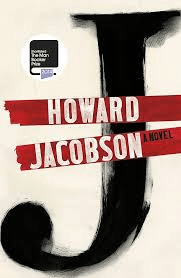
The central narrative of J is on the surface a traditional romance. Kevern, a woodworker, and Ailinn, an artist, begin a rather sweet love affair. Kevern is socially isolated and finds it hard to make friendships. He is rather neurotic and exhibits symptoms of obsessive compulsive disorder – for example he repeatedly returns to his front door to make sure it is locked and that his hallway is arranged as he needs it to be. The reader comes to realise that he has been taught to do this by his parents as a way of ensuring that he can tell if his house has been broken into. In other words it is a security measure, although precisely who or what he needs to be worried about is initially unclear. Kevern was also taught by his father to place two fingers over his lips when using any word beginning with the letter J. This we can conclude was a way of training his son never to acknowledge his Jewish identity – the words Jew and Jewish are never used in the novel and illustrate how Jewishness has been effectively extinguished by WHAT HAPPENED. The letter J becomes in the novel a symbol of the near complete erasure of Jewish people in this society and also points to the hidden identity of any Jewish survivors. The novel’s true title is actually the letter “J” with two lines struck through it – this double-crossed “J” (see above) evokes the anti-Semitic trope of the “double-crossing Jew,” serving as a visual reminder of the deep-seated prejudice that exists even in a society that claims to have addressed this prejudice. Ironically the government has since WHAT HAPPENED forced all citizens to take Jewish-sounding surnames in a twisted attempt to illustrate that anti-Semitism no longer exists. But this attempt to rewrite history and deny the existence of anti-Semitism is not working – society remains violent and troubled. We eventually come to realise that Kevern and Ailinn’s relationship has been engineered as a social experiment to see if the reintroduction of Jews to society may help rebuild society by providing a scapegoat for society’s ills. When they find this out the impact on them is devastating.
Jews are not the only people who have seen their identity reduced to simplified markers in this society: “A compliant society meant that every section of it consented with gratitude – the gratitude of the providentially spared – to the principle of group aptitude. People of Afro-Caribbean origin were suited by temperament and physique to entertainment and athletics, and so they sang and sprinted. People originally from the Indian subcontinent, electronically gifted as though by nature, undertook to ensure no family was without a functioning utility phone. What was left of the Polish community plumbed, what was left of the Greek smashed plates.“
The publisher of J compared the novel to the dystopias written by Orwell and Huxley. So far there is no evidence that the comparison has stood the test of time – for example J has an average score on Goodreads of just under 3 (on a scale of 1-5). I understand the reservations many reviewers have expressed about J on this site and elsewhere. Jacobson really makes the reader work hard – the point of view narration from members of a society where forgetting WHAT HAPPENED is a national preoccupation means we are only given glimpses of the past and have to piece things together slowly. (The ending of the novel is also unforgivably bad, but we shouldn’t define a novel just by how it ends). This is a thought-provoking novel that I suspect will be read in years to come when other Booker prize shortlisted novels have long been forgotten. It is hard for me as a non-Jewish person to fully appreciate the issues Jacobson discusses, but I believe that this portrait of being Jewish in a society in which the whole concept of Judaism has been effectively eradicated will resonate with many Jewish people.
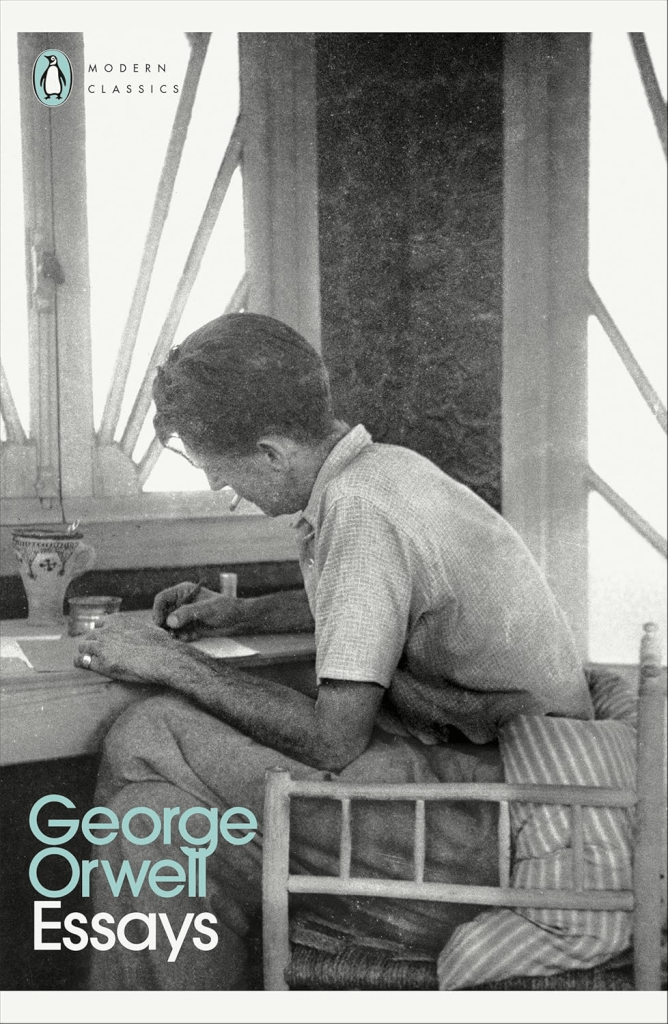
My deep dive into Orwell continues with the Penguin Modern Classics collection of his essays, edited by Bernard Crick, one of Orwell’s earlier biographers.
In the extremely unlikely event that someone asked me to edit a collection of the great man’s essays, the first task I would set myself would be to understand what is an essay? Which of the many articles Orwell wrote would qualify for inclusion, and which would be excluded? There is a simple textbook definition of the term ‘essay’, ‘a short piece of writing on a particular subject’ but that isn’t particularly helpful – a letter of complaint to the council would fit that bill. He published different collections during his lifetime, and since then they have been republished in multiple different formats. Some collections of Orwell’s essays have over 240 items (for example the Everyman’s Library Contemporary Classics edition – to get to this high a number they must have included the weekly columns that Orwell wrote for Tribune from 1943 to 1947). This Penguin Modern Classics edition has 41 essays, which tallies with the count in Orwell’s bibliography on Wikipedia.
The next thing I would do is try to decide how to group the essays? Would I present them chronologically? That would have the benefit of showing Orwell’s progression as a writer, although some of the essays were published long after they were written, such as his account of his days at his prep school, St Cyprians, Such, Such Were the Joys, which was considered so libellous that publication had to wait until the 1950’s when everyone mentioned was safely dead. I think I would instead group the essays thematically. Memoirs such as A Hanging, Shooting an Elephant, Marrakesh, Bookshop Memories and so on would form one category. Another would be literary analysis – Dickens, Kipling, Cervantes, etc. A third would be popular culture including Boy’s Weeklies and The Art of Donald McGill – and finally a politics section.
When Orwell initially wrote these essays they were published in a wide variety of magazines including: Tribune (which is still in print) where he was literary editor after he left the BBC, Horizon, a magazine edited by his old schoolfriend Cyril Connolly, the Evening Standard, for years the principal London evening paper, as well as a number of more obscure and short-lived publications, such as Polemic, which only managed eight issues and Gangrel which only ran to four, but published his seminal essay “Why I Write”. It is fairly obvious from this wide spread of magazines and papers that Orwell wasn’t enormously fussy (or couldn’t afford to be fussy) about where his work was published – although of course he would have had red lines in terms of pro-Communist and pro-fascist publications.
The reason why I have made this point at such length is that I have no idea why this collection was printed in this particular order. It’s not chronological, thematic, alphabetical, or any other structure or design that I can discern. Perhaps I am missing something but the random nature of the collection, if intentional, did not work at all. The changes in tone from whimsical to academically serious were often jarring. The editing of the text did not help either because the date of publication of each essay was only included as an endnote. The date of publication matters – something written in 1942 about what the world might look like after the end of the war lands completely differently from the same topic written in 1946. But you have to check the end of the essay to find this out, even though it is information needed up front. Crick’s introduction to the selection is also really rather strange. At times it seems that he doesn’t particularly like Orwell’s work. At one point he comes close to calling Orwell dishonest, claiming “One can tell lies or spin stories in monosyllables and simple sentences.” and later “Orwell himself seemed to believe that it is more difficult to lie in monosyllables than in polysyllables, but like many people he confused meaning with truth”. This is leading up to his suggestion that A Hanging and Shooting an Elephant are stories rather than essays, and therefore do not belong in this collection. Which begs the simple question, if Crick did not think these are essays, why include them?
Which is all a pity, because the essays themselves are (of course) outstanding. I have some personal favourites. The Burma essays, A Hanging (1931) and Shooting an Elephant (1936), are comparatively early but exceptional, very concise masterpieces that speak to the human condition and the impact of imperialism. In many ways they would be more impressive if they were entirely fictional. The Art of Donald McGill introduced me to the idea that popular culture (in this case, comedic holiday postcards) can be looked at seriously and tell us something about society. His essay Boys’ Weeklies had the same impact (criminally, this edition does not include the response to Orwell’s theory that the author of the Greyfriars stories must be a collective identity, which explained why the stories themselves were so heavily stylised; Frank Richards’ reply to Orwell can be found here, and it is a serious oversight that it was not included in this collection.) Orwell the man always shines through in his work but never more so when he is writing about the simple but very English pleasures of life such as what makes a great pub, how to make a cup of tea (neither of which are included in this collection) or his thoughts on the common toad. And of course Orwell’s political insight and perspective are a guide to both the politics of the period but more importantly provide us with tools to navigate our own troubled times.
This isn’t a book to be read from beginning to end straight through (although you could) but rather it is to be dipped into and referred back to as occasion demands.
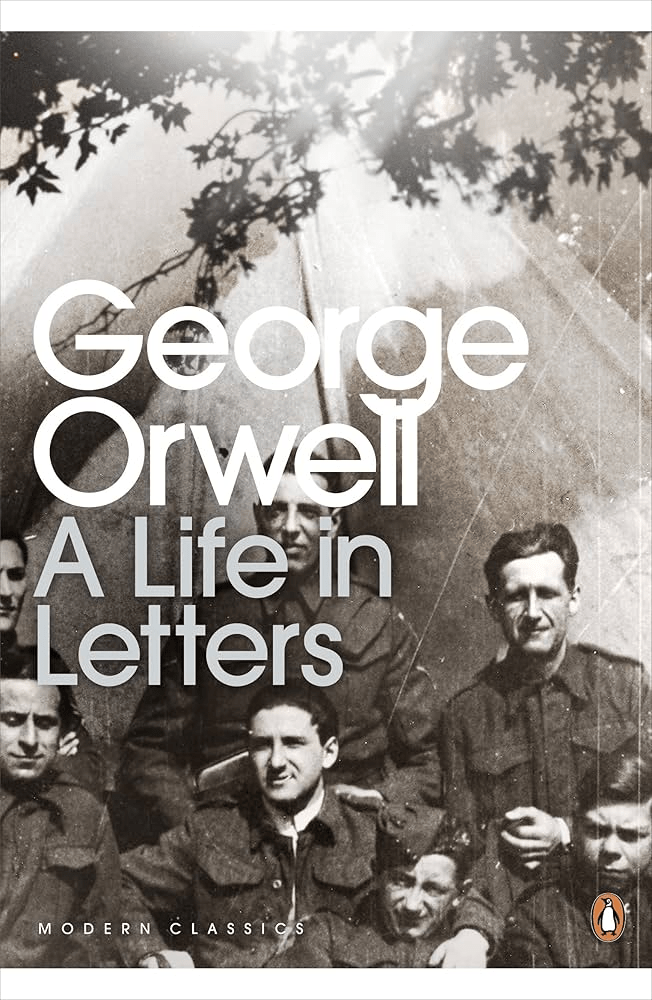
George Orwell, A Life in Letters, edited by Peter Davison, 2010
A Life in Letters is a fascinating collection that took me an inordinately long time to read, simply because of the multiple ‘side quests’ it sent me on. A great example of this is Orwell’s exchange with Anne Popham (pages 293, 307 & 321). Anne was Orwell’s downstairs neighbour in Canonbury Square, and one of the many young women that Orwell propositioned after his wife’s death. (“I wonder if you were angry or surprised when I sort of made advances to you that night before you went away“) According to Anne there was nothing ‘sort of’ about it. In an interview in the Guardian on her 100th birthday she recalled the incident as follows:
“In his flat there was a table, the baby, and its nurse. We had strong Indian tea, with brown bread and treacle. After tea, he told the nurse to take the baby away, and then he said, ‘Come and sit on the bed’. So I went and sat on the bed in the corner, and he came and sat beside me.” She laughs in disbelief at the memory. “In no time at all, his arms were round me, and he was kissing me. I was shocked. I said, ‘What are you up to ?’ and I pushed him away. Later on, I decided this must be how Old Etonians got on with girls, as if no one could resist them. He said, ‘I’m sorry’ and asked about my work, and I said, ‘I’m governing Germany’.”
Anne had an extraordinary life (the interview in the Guardian linked above is a good start) of which the encounter with Orwell played a minor part, but it does tell us a lot about his state of mind following the death of his wife the previous year. It is in this exchange (Orwell’s letter 18th April 1946) in which he makes the claim that “What I am really asking you is whether you would like to be the widow of a literary man?” One can never be completely certain of the extent to which this is being said seriously or is simply a ‘line’, but I am reasonably sure that Orwell himself would not have been able to answer that honestly either – he knew his health was poor and he was looking for a mother for Richard, his adopted son, but at the same time he was making plans for the future and did not have a terminal diagnosis. As a sexually frustrated bachelor in his early forties he would hardly be the first man to chance his arm with a young women with a tragic sob story, on the basis that sooner or later he might be lucky. It is in this same letter that Orwell claims that he did not suffer from jealousy: “I don’t much care who sleeps with whom. It seems to me what matters is being faithful in an emotional and intellectual sense. I was sometimes unfaithful to Eileen and I also treated her very badly, and I think she treated me badly too at times.”
This collection would make a superb companion text to any biography of Orwell. It can be read on its own of course, but combining it with a biography would work really well, with Orwell’s own words accompanying narrative about the events of his life. It would reveal his tendency to downplay things in a very British stiff-upper-lip way, such as his health problems, his distress at the death of his wife (“I don’t know whether you will have heard from anyone else the very bad news. Eileen is dead” opens a letter to Lydia Jackson, one of Eileen’s close friends, dated 1 April 1945, Eileen having died two days earlier. This isn’t Orwell being uncaring or brutal, it is him trying to cope with his grief and carry on doing the right thing.) and his pride in the success of his later books.
Another thing that shines out of the pages of this collection is Orwell’s entirely unsentimental love of the countryside. Very few personal letters go by without lines on the progress of his garden, how many pounds of potatoes have been harvested, how many eggs the hens have laid, and so on. This was more than a hobby, it was a part of his life and he clearly found the loss of gardening when he was laid up in various hospitals and sanitoriums (or away in Spain or Morocco) highly frustrating. It does make me think that the short period he was on Jura, enjoying living off the land, was one of the happiest of his life, even though it was tinged with sadness as he was having to make this home without Eileen, who seemed to have shared his dream of escape to the Hebrides.
Over half of the letters in this collection date from 1945 or later, that is to say the last five full years of his life (he died in January 1950). In part this must be a reflection of the fact that by 1945 Orwell was increasingly well known, so recipients of his letters were much more likely to have kept them. He may have also kept copies himself, certainly of business letters. I don’t have access to the 20-volume Complete Orwell that Davison edited, so I can’t be sure, but this edition doesn’t contain any letters from Orwell’s five years in Burma, which suggests either that he didn’t send any, which is profoundly unlikely, that none of the letters from that time have been found, (quite possible) or that none of them have anything particularly interesting to say. Whatever the reason it does mean that this aspect of his life is unrecorded in this collection, which is a gap. If I am being pedantic I would also say that this collection contained just a few too many letters from Orwell to his literary agent arranging details of publication, distribution, translation and so on – this aspect of his life as an author could have been illustrated just as clearly with fewer examples. But the scholarship of this collection is formidable, with detailed and clear footnotes to every letter, an extensive set of biographical notes of the main recipients of Orwell’s letters, every typo that was Orwell’s not the editor’s marked clearly and of course a detailed index. Even though I have read all the biographies of Orwell I still learnt a lot about his life and work from this collection. Just to offer one example, I previously thought of Jura as a remote and wild place, which it was, but assumed it was madness to decamp there with Orwell’s health so precarious and it being so hard to reach. But he only summered there, spending winters in the Canonbury Square flat in London that he retained the tenancy of (often letting others stay there) and the island had a mild climate. It also seems they ate better there than on the still rationed mainland, with access to fish, lobsters and crabs from the sea, rabbits and venison from the land, eggs and meat from the chickens they kept, and vegetables from the garden. It was also easier to keep warm on Jura compared to London, because there was plenty of natural fuel – peat and wood – available, compared to the capital where everything was scarce and rationed. It does seem rather idyllic and it is not surprising they had so many visitors, at one stage having to set up a tent in the garden to accommodate the overflow.
Davison enriches this collection enormously by interspersing letters from Orwell with those from others such as his childhood sweetheart Jacintha Buddicom. Most revealing are those from Eileen to her friend Norah. These letters are full of impish humour and provocation and were the basis of the 2023 book Wifedom. The author of Wifedom took everything Eileen says in these letters as gospel, when it is plain as anything that she is invariably joking, usually by way of comic exaggeration. Letters between Eileen and Orwell are few and far between. Obviously that is because husband and wife tend not need to write to another. Eileen’s last unsent letter to her husband (29/3/45) is heartbreakingly sad. She was a much more interesting and lively correspondent than Orwell, and the fact that her letters are often interrupted and written over several days, if not longer (instead of throwing away a mislaid draft she would resume writing with an apology for the delay) adds to their charm. The exercise of compiling a complete edition of Orwell’s letters is one that may never end – very recently more letters were discovered by relatives of his correspondents. Last year Darcy Moore, a great Orwell scholar, discovered another lost letter from 1942. I doubt it will be the last.
Sadly the editor of this collection, Peter Davison, who was also the editor of the twenty volume complete Orwell, died in 2022 – I do hope that the Orwell Society or his literary agents appoint someone to continue Davison’s work. The Society has introduced a Peter Davison award for Orwell scholarship, which I suppose goes some way towards this aim. While mentioning the Orwell Society I should also recommend this excellent review of the Collected Letters on their site.
The final year of Orwell’s life was spent a sanatorium and then a hospital where he seemed to have received little by way of actual medical treatment, spending the time just resting, surrounded by growing piles of books. Resting for Orwell still meant undertaking a lot of correspondence, as well as a little journalism and book reviewing. He obviously knew he was very seriously ill but at the same time held out hope for a recovery that might give him a few more years. He had lots of visitors, many of them members literary aristocracy and was clearly much loved – many people expressed concern for his health and the need to ‘do something’ to save him. Forty-six is a ridiculously early age to die, especially for a writer who in Animal Farm and 1984 had fully discovered their own voice. These two novels alone have sold over forty-one million copies. This achievement is not the end of the story. Earlier this month I was watching the television show Countdown. Someone used the word “unperson” without reference to Orwell even though he coined the word in 1984. This to me just emphasises (albeit in a very minor, incidental way), the extent to which Orwell’s thoughts and ideas have permeated Western culture and language; they are just now part of the way we think rather than something that needs to be referenced or explained. Sales of 1984 spike every time world events seem particularly Orwellian such as when Trump’s press spokesperson coined the phrase ‘alternative facts‘. That more than anything else was his contribution.
(If you say the title of this novel out loud (or in your head) does the line continue “now, entertainers”? i.e. the refrain from Nirvana’s Smells Like Teen Spirit? Or is it just me?)
Here We Are is set in the late 1950’s, and tells the story of three characters: Ronnie Deane, a stage magician, Jack Robins (stage name, Jack Robinson) a singer and comedian, and Evie, Ronnie’s assistant. Having been friends since doing National Service, Ronnie and Jack are performers in the summer season show on Brighton pier. Jack is the show’s main host, and secures a spot for Ronnie on the bill, encouraging him to get an assistant to provide some glamour to his act. Ronnie is a talented magician who evolves his act steadily with ever more sophisticated illusions. Jack is a literal ‘Jack the Lad‘ handsome and with a succession of young women on his arm. Evie joins Ronnie as his glamorous assistant.
Having established this context, the narrative then gives us the characters’ back stories. Ronnie was evacuated at the beginning of World War 2 from the London slums to a large house called in Oxfordshire. He loved it there and blossomed under the love and care of the Lawrences, a childless couple who came to treat him like their own son, the one they never had. His lifestyle improved dramatically, as did his self-confidence. He was taught magic by Mr Lawrence (stage name ‘Lorenzo’) and this becomes an passion for him.
We learn less about Jack and Evie’s background, perhaps because it is less important to the novel’s turning point. The narration jumps forward almost fifty years and picked up by Evie, now 75 years old, looking back on the events of the summer on the pier. We find out that although she was engaged to Ronnie that summer, becoming close as they worked together on the increasingly complex magic show, when he went to London to visit his dying mother she slept with Jack. Ronnie easily finds this out when he returns – she really makes no attempt to hide what happened. But there is no big explosion of anger from Ronnie, who continues to perform their act.
The summer season is coming to an end and Ronnie’s magic show is becoming ever more complex and sophisticated, attracting ever larger audiences. The reader is told that Evie has no idea how the illusions are performed, although the inner pedant in me would insist that magician’s assistant are a key part in performing most illusions. At the fateful final show Ronnie performs some breath-taking, unbelievable illusions, then disappears, never to be traced again. Jack marries Evie and goes on to have a very successful career in television and film. After Jack’s death Evie makes one final attempt to find Ronnie, travelling to Evergrene, the house in Oxfordshire where he was evacuated to, but it is abandoned and empty.
And that’s it. This is quite a slight (I could say flimsy) novel. The portrait of Ronnie as an evacuee, who found his life immeasurably improved by the experience, was interesting. The description of the dying days of the end of the pier show being overtaken by television and film has been done many times before – there were echoes of Archie Rice in the portrait of Jack for example. The novel’s key moment depends on the suggestion that Ronnie’s magic trick was more than an illusion, an act of genuine magic, almost supernatural, which was unnecessary. The nostalgia for a bygone age of simple post-war pleasures isn’t overdone. Evie has few regrets at the end of her life, looking back over the events of that summer in Brighton with a certain fondness, even if what happened to Ronnie is never resolved. These components were all individually fine, but the sum of the parts was underwhelming. I suspect in 12 months I won’t recall what happened to Ronnie and his friends, perhaps because in the end not much did.
I think most readers would expect a decapitation to feature at some point in a novel with the title A Severed Head. Murdoch plays with that expectation throughout the novel, giving us several false alarms. Early on, a passenger in a car puts their head out of the side window to help navigate through thick London fog, and “we proceeded for a while with our heads hanging out on opposite sides. Honor Klein’s body sagged and jolted beside me like a headless sack, and I could feel again the rough material of her coat grazing my hand. Great orange flares at Hyde Park Corner showed us the way into Knightsbridge, and by their light I stole a glance at my companion. I saw only her hunched shoulders;”
False alarm, Honor has not been beheaded by a passing bus. Later it is revealed that Honor, described by the narrator as moving ‘like the animation of a corpse”, owns a samurai sword, and has been trained in its use, which she demonstrates theatrically. Is Honor going to be this novel’s biblical Judith who in the Bible beheaded the Assyrian general Holofernes to save her people? But again, all is good, only a napkin is harmed in the display. Towards the end of the novel another character sends the narrator a box through the post. When he opens it he finds “A lot of dark stuff inside. I stared at it with a sort of puzzled revulsion, wondering what it was. I stood up and moved the box to the light to see it better. I felt I did not want to touch it. At last I did very gingerly touch it, and as I did so I realised it was human hair.” Worry not, this is not an early version of the final scene in Se7en. This is just hair, sent by a very troubled former lover as a sign of her psychological distress. Disappointingly, no head is ever actually severed from anyone’s shoulders. Instead the severed head is a metaphor. Honor Klein explains: “Because of what I am, and because of what you saw, I am a terrible object of fascination for you. I am a severed head, such as primitive tribes and old alchemists used to use, anointing it with oil and putting a morsel of gold on its tongue to make it utter prophecies. And who knows but that long acquaintance with a severed head might not lead to strange knowledge.”
But there are worse things than decapitation…
The novel revolves around the complex love lives of some appalling middle-class people in 1960’s London, Oxford and Cambridge. The novel is narrated by Martin Lynch-Gibbon, a 40-something wine merchant. Martin is married to Antonia and is having an affair with the much younger PhD student Georgie. Georgie is defined by her lack of catering and housekeeping skills which mark her out as an unsuitable partner for Martin in any long-term relationship.
One day out of the blue Antonia announces that she has been having an affair with her psychoanalyst (and their mutual friend), Palmer. This is conveyed as a piece of minor bad news, like a missed dental appointment or a head cold, nothing to get upset about. Martin at first refuses to accept this affair means the end of their marriage, but is very easily persuaded by Antonia and Palmer to behave gracefully and accept the new status quo. This decision is aided by Martin’s man-crush on Palmer.
Martin then visits his brother Alexander. Antonia has already written telling him about the divorce. Alexander is a shadowy character – we learn very little about him other than that he is a sculptor who has been working on a bust of Antonia (another severed head?) and that Martin believes, accurately as it turns out, that he always steals his girlfriends. At this point in the novel the final main character is introduced, the katana wielding Honor Klein, a lecturer in anthropology at Cambridge University, who comes to visit her half-brother, Palmer. Martin is unable to charm Honor and their relationship is at best uncomfortable. Honor seems to have no social skills and makes clear her dislike of Martin. She rapidly becomes his enemy by finding out about his affair with Georgie and revealing it to Antonia, who has the gall to act hurt. Honor also introduces Georgie to Alexander, which Martin feels threatened by.
Martin is a bully and a drunk, although of course he does not see himself as such. He describes himself as “a very tall, reasonably good-looking man. I used to be a good boxer, and passed when I was younger as a raffish, quarrelsome and violent fellow“. The choice of language here is arresting – to pass as a ‘raffish fellow’ is to fool people into believing you are such, even though you do not believe yourself to be so. This is in other words false modesty along the lines of ‘some people though I was gorgeous, but I couldn’t possibly comment’. But passing as violent and quarrelsome, and boasting of his boxing ability? You don’t need to ‘pass’ as violent, you either are or you aren’t. This is Martin telling us he is violent but believing it is part of his charm rather than a confession. He is also a pseudo-intellectual, writing a monograph on obscure historical events but never quite getting round to finishing it and of course a wine-snob.
Martin’s relationship with Honor deteriorates and he soon gets into a drunken physical fight with her in which she is strangely passive. He hits her (having done the same to Georgie earlier) and comes dangerously close to raping her. He apologises but confesses in the narration that this apology is insincere. Despite the violence and betrayal, Martin abruptly decides he is now madly in love with Honor. Of course he is. If he can be in love with Georgie and Antonia, what is to stop him falling for a third woman – this was the 1960’s after all? He follows her to Cambridge, breaks into her house, and discovers her in bed with Palmer. Yes, that Palmer, her half-brother. If anything the bewildering merry-go-round of partnerships, couplings and affairs now begins to accelerate, and many readers will have to resort to taking notes to keep track of who is sleeping with who. Antonia breaks things off with Palmer and returns to Martin. Alexander gets engaged to Georgie even though they have known each other only a few weeks. Georgie attempts to kill herself. Martin confesses his love to Honor who is not particularly interested in this news. Antonia confesses to a long-term and continuing affair with Alexander which was one of the few pairings left unannounced. At one point I began to fear for the family parrot. Only Rosemary, Martin’s sister, remains aloof from all this random coupling and uncoupling.
These are appalling people who never do a day’s work, drink like fish, and will sleep with anyone, while all the time presenting themselves as noble and sophisticated. Translate these relationships to a different class and they would appear utterly sordid. The characters all speak in sweeping abstractions which are meant to sound profound but to me were empty:
“Your love for me does not exist in the real world. Yes, it is love, I do not deny it. But not every love has a course to run, smooth or otherwise, and this love has no course at all . . . But that is remote from love and remote from ordinary life. As real people we do not exist for each other.”
“It was for me a moment of great peace. I did not know then that it was the last, the very last moment of peace, the end of the old innocent world, the final moment before I was plunged into the nightmare of which these ensuing pages tell the story.”
So what on earth was Murdoch thinking? Or to put it yet another way, what am I missing? I have read a lot of reviews on this novel online, and no-one seems to agree on this point. Some critics describe it as a satire – on 1960’s sexual mores I suppose, although in 1961, the year of its publication, the swinging sixties hadn’t really got going. Others point out the biographical elements of the novel, of which enough said. Some see it as a comedy, which if that’s right then the humour hasn’t aged well. I have also seen the novel compared to a Jacobean tragedy, but the elements of tragedy are largely missing, unfortunately. This is a consequence free environment in which no-one gets hurt seriously – even Georgie’s suicide attempt ends well. Perhaps the closest genre comparison is farce – Carry on Beheading?
Yet there is obviously considerable depth to the text, even if I was unable to see it clearly. For example Murdoch sprinkles the novel with references to the philosophies of the Far East, contrasting their ways of thinking with Western ideologies. She uses the characters’ clothing to portray their personalities and relationships in a manner that is far more detailed than just about any other twentieth-century writer I can think of. When we first are introduced to Georgie, Martin boasts of her eclectic and sexual appearance – she wears “peacock-blue stockings, barbarous necklaces and velvet pants and purple underwear and black openwork tights which drove me mad.” By the time she is introduced to Antonia and Palmer, she is transformed, wearing a “shabby brown short, blue pullover, and black stockings looking like a child”. Antonia on the other hand is defiantly flamboyant and sophisticated, wearing “a striped silk blouse and cinnamon coloured skirt….normally Antonia put on different clothes three or four times a day” (clearly someone with a lot of time on her hands!). Murdoch uses Martin’s recognition of Antonia’s clothing to also signal the varying distance of their relationship, so when he sees her for the first time in open association with Palmer she is wearing “a brown cashmere pullover and a string of pearls, neither of which I had seen before” and later at the meeting with Georgie “a dark green dress of light Italian wool which I had bought her in Rome”. Palmer is equally flamboyant in his choice of clothing. His dress of choice is a “cream coloured embroidered robe of Chinese silk” and more often than not he is naked underneath. Martin’s attraction to Palmer is always simmering near the surface of his focus. Alexander appears first in costume, a “creamy white smock, self consciously old-fashioned….dressed to represent a miller in an opera.” The one character whose clothing is never described, to any degree, is Honor. She remains a complete enigma, with only Martin’s repeated focus on her ‘Jewish’ facial characteristics as any sort of description (he writes about her “sallow Jewish mask,” “curving Jewish mouth”, “waxen Jewish face” and that “only the curve of her nostril and the curve of her mouth hinted, with a Jewish strength, a possible Jewish refinement) which he feels is important but it is hard to see why.
My point is that Murdoch spent a lot of time working on the detail of this element of the narrative, and I am sure similar points could be made about other aspects of the text. For me, that is some compensation for the simply irritating behaviour of the protagonists, but not enough. The review I finally found myself agreeing with was in the New York Times when the novel was first published (god bless the internet) which called it “clumsy and unconvincing”, which just about sums it up.
If you had to guess what a novel by tv’s lexicographer Susie Dent would be about I think most people would assume that it would be a) in the cosy crime genre, b) feature a main character who is a lexicographer, or a related profession, and c) involve word puzzles and clues that lead to the resolution of the mystery. And the author obviously hates to disappoint her audience, because that is exactly what she has produced. I was expecting the novel to be a lazy, genre-driven cash-in on the author’s public persona (of which there are many out there at the moment) but I am delighted to say it was so much better than that. There are still some predictable elements, of course, including the loving descriptions of academic Oxford, the word puzzles, and the short chapters that keep the pages turning. But these are more than compensated for by the high quality writing and the well constructed plot.
Set in Oxford and featuring a team of lexicographers working for the Clarendon English Dictionary, the setting and structure of Guilty by Definition also provides the author with plenty of opportunities to weave into the text anecdotes about the origins of words and phrases, keeping the fans of Countdown and Dictionary Corner satisfied. These word-related anecdotes are sometimes rather obviously shoe-horned into the narrative (often something about a word or phrase will just occur to the narrator and have to be explained) but I think Dent just about keeps on the right side of this not being irritating or distracting.
The plot follows Martha Thornhill, senior editor of the Clarendon English Dictionary. She and her team seems to have gloriously relaxed jobs tracing the origins of words and phrases. Also working for the CED but not part of Martha’s team is Jonathan Overton, a Shakespeare expert who has published widely on the bard’s coinages and who is a minor media celebrity. One day they receive a letter from an anonymous correspondent who signs themself ‘Chorus’. This letter contains a word puzzle, which when solves leads to the answer 2010, which is the year that Martha’s sister, Charlie, went missing. Thus begins a reopening of the investigation into Charlie’s disappearance. This moves along at a fair pace, with new developments and discoveries about Charlie’s past every few pages. Further letters and puzzles from Chorus move the action along every time the investigation begins to lose focus. It is revealed that Charlie was on the trail of a literary discovery, which as well as being hugely valuable would rewrite much of what we know about Shakespeare’s invention of new words. In lexicography terms this could be up there with the Rosetta Stone or the double helix structure of DNA.
Guilty by Definition is well plotted and well written. The final reveal of what happened to Charlie and what she had discovered hits exactly the right balance between not being too obvious but at the same time not too obscure. I was able to work out ‘whodunnit’ fairly early on, the list of possible suspects being quite small, but this didn’t spoilt the read for me in any way. The novel has lots of independent women characters who are not defined by their appearance or sexuality and who are not traditional stereotypes, which was a refreshing change from much genre fiction. The three main lexicographers, Safi, Martha and Alex form a strong team that would translate very well onto the television screen (with Oxford as a photogenic background) and I would be astonished if they do not reappear in further word-based mystery sequels. I look forward to them.