
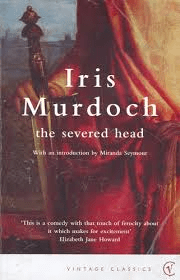
A Severed Head, by Iris Murdoch, 1961
I think most readers would expect a decapitation to feature at some point in a novel with the title A Severed Head. Murdoch plays with that expectation throughout the novel, giving us several false alarms. Early on, a passenger in a car puts their head out of the side window to help navigate through thick London fog, and “we proceeded for a while with our heads hanging out on opposite sides. Honor Klein’s body sagged and jolted beside me like a headless sack, and I could feel again the rough material of her coat grazing my hand. Great orange flares at Hyde Park Corner showed us the way into Knightsbridge, and by their light I stole a glance at my companion. I saw only her hunched shoulders;”
False alarm, Honor has not been beheaded by a passing bus. Later it is revealed that Honor, described by the narrator as moving ‘like the animation of a corpse”, owns a samurai sword, and has been trained in its use, which she demonstrates theatrically. Is Honor going to be this novel’s biblical Judith who in the Bible beheaded the Assyrian general Holofernes to save her people? But again, all is good, only a napkin is harmed in the display. Towards the end of the novel another character sends the narrator a box through the post. When he opens it he finds “A lot of dark stuff inside. I stared at it with a sort of puzzled revulsion, wondering what it was. I stood up and moved the box to the light to see it better. I felt I did not want to touch it. At last I did very gingerly touch it, and as I did so I realised it was human hair.” Worry not, this is not an early version of the final scene in Se7en. This is just hair, sent by a very troubled former lover as a sign of her psychological distress. Disappointingly, no head is ever actually severed from anyone’s shoulders. Instead the severed head is a metaphor. Honor Klein explains: “Because of what I am, and because of what you saw, I am a terrible object of fascination for you. I am a severed head, such as primitive tribes and old alchemists used to use, anointing it with oil and putting a morsel of gold on its tongue to make it utter prophecies. And who knows but that long acquaintance with a severed head might not lead to strange knowledge.”
But there are worse things than decapitation…
The novel revolves around the complex love lives of some appalling middle-class people in 1960’s London, Oxford and Cambridge. The novel is narrated by Martin Lynch-Gibbon, a 40-something wine merchant. Martin is married to Antonia and is having an affair with the much younger PhD student Georgie. Georgie is defined by her lack of catering and housekeeping skills which mark her out as an unsuitable partner for Martin in any long-term relationship.
One day out of the blue Antonia announces that she has been having an affair with her psychoanalyst (and their mutual friend), Palmer. This is conveyed as a piece of minor bad news, like a missed dental appointment or a head cold, nothing to get upset about. Martin at first refuses to accept this affair means the end of their marriage, but is very easily persuaded by Antonia and Palmer to behave gracefully and accept the new status quo. This decision is aided by Martin’s man-crush on Palmer.
Martin then visits his brother Alexander. Antonia has already written telling him about the divorce. Alexander is a shadowy character – we learn very little about him other than that he is a sculptor who has been working on a bust of Antonia (another severed head?) and that Martin believes, accurately as it turns out, that he always steals his girlfriends. At this point in the novel the final main character is introduced, the katana wielding Honor Klein, a lecturer in anthropology at Cambridge University, who comes to visit her half-brother, Palmer. Martin is unable to charm Honor and their relationship is at best uncomfortable. Honor seems to have no social skills and makes clear her dislike of Martin. She rapidly becomes his enemy by finding out about his affair with Georgie and revealing it to Antonia, who has the gall to act hurt. Honor also introduces Georgie to Alexander, which Martin feels threatened by.
Martin is a bully and a drunk, although of course he does not see himself as such. He describes himself as “a very tall, reasonably good-looking man. I used to be a good boxer, and passed when I was younger as a raffish, quarrelsome and violent fellow“. The choice of language here is arresting – to pass as a ‘raffish fellow’ is to fool people into believing you are such, even though you do not believe yourself to be so. This is in other words false modesty along the lines of ‘some people though I was gorgeous, but I couldn’t possibly comment’. But passing as violent and quarrelsome, and boasting of his boxing ability? You don’t need to ‘pass’ as violent, you either are or you aren’t. This is Martin telling us he is violent but believing it is part of his charm rather than a confession. He is also a pseudo-intellectual, writing a monograph on obscure historical events but never quite getting round to finishing it and of course a wine-snob.
Martin’s relationship with Honor deteriorates and he soon gets into a drunken physical fight with her in which she is strangely passive. He hits her (having done the same to Georgie earlier) and comes dangerously close to raping her. He apologises but confesses in the narration that this apology is insincere. Despite the violence and betrayal, Martin abruptly decides he is now madly in love with Honor. Of course he is. If he can be in love with Georgie and Antonia, what is to stop him falling for a third woman – this was the 1960’s after all? He follows her to Cambridge, breaks into her house, and discovers her in bed with Palmer. Yes, that Palmer, her half-brother. If anything the bewildering merry-go-round of partnerships, couplings and affairs now begins to accelerate, and many readers will have to resort to taking notes to keep track of who is sleeping with who. Antonia breaks things off with Palmer and returns to Martin. Alexander gets engaged to Georgie even though they have known each other only a few weeks. Georgie attempts to kill herself. Martin confesses his love to Honor who is not particularly interested in this news. Antonia confesses to a long-term and continuing affair with Alexander which was one of the few pairings left unannounced. At one point I began to fear for the family parrot. Only Rosemary, Martin’s sister, remains aloof from all this random coupling and uncoupling.
These are appalling people who never do a day’s work, drink like fish, and will sleep with anyone, while all the time presenting themselves as noble and sophisticated. Translate these relationships to a different class and they would appear utterly sordid. The characters all speak in sweeping abstractions which are meant to sound profound but to me were empty:
“Your love for me does not exist in the real world. Yes, it is love, I do not deny it. But not every love has a course to run, smooth or otherwise, and this love has no course at all . . . But that is remote from love and remote from ordinary life. As real people we do not exist for each other.”
“It was for me a moment of great peace. I did not know then that it was the last, the very last moment of peace, the end of the old innocent world, the final moment before I was plunged into the nightmare of which these ensuing pages tell the story.”
So what on earth was Murdoch thinking? Or to put it yet another way, what am I missing? I have read a lot of reviews on this novel online, and no-one seems to agree on this point. Some critics describe it as a satire – on 1960’s sexual mores I suppose, although in 1961, the year of its publication, the swinging sixties hadn’t really got going. Others point out the biographical elements of the novel, of which enough said. Some see it as a comedy, which if that’s right then the humour hasn’t aged well. I have also seen the novel compared to a Jacobean tragedy, but the elements of tragedy are largely missing, unfortunately. This is a consequence free environment in which no-one gets hurt seriously – even Georgie’s suicide attempt ends well. Perhaps the closest genre comparison is farce – Carry on Beheading?
Yet there is obviously considerable depth to the text, even if I was unable to see it clearly. For example Murdoch sprinkles the novel with references to the philosophies of the Far East, contrasting their ways of thinking with Western ideologies. She uses the characters’ clothing to portray their personalities and relationships in a manner that is far more detailed than just about any other twentieth-century writer I can think of. When we first are introduced to Georgie, Martin boasts of her eclectic and sexual appearance – she wears “peacock-blue stockings, barbarous necklaces and velvet pants and purple underwear and black openwork tights which drove me mad.” By the time she is introduced to Antonia and Palmer, she is transformed, wearing a “shabby brown short, blue pullover, and black stockings looking like a child”. Antonia on the other hand is defiantly flamboyant and sophisticated, wearing “a striped silk blouse and cinnamon coloured skirt….normally Antonia put on different clothes three or four times a day” (clearly someone with a lot of time on her hands!). Murdoch uses Martin’s recognition of Antonia’s clothing to also signal the varying distance of their relationship, so when he sees her for the first time in open association with Palmer she is wearing “a brown cashmere pullover and a string of pearls, neither of which I had seen before” and later at the meeting with Georgie “a dark green dress of light Italian wool which I had bought her in Rome”. Palmer is equally flamboyant in his choice of clothing. His dress of choice is a “cream coloured embroidered robe of Chinese silk” and more often than not he is naked underneath. Martin’s attraction to Palmer is always simmering near the surface of his focus. Alexander appears first in costume, a “creamy white smock, self consciously old-fashioned….dressed to represent a miller in an opera.” The one character whose clothing is never described, to any degree, is Honor. She remains a complete enigma, with only Martin’s repeated focus on her ‘Jewish’ facial characteristics as any sort of description (he writes about her “sallow Jewish mask,” “curving Jewish mouth”, “waxen Jewish face” and that “only the curve of her nostril and the curve of her mouth hinted, with a Jewish strength, a possible Jewish refinement) which he feels is important but it is hard to see why.
My point is that Murdoch spent a lot of time working on the detail of this element of the narrative, and I am sure similar points could be made about other aspects of the text. For me, that is some compensation for the simply irritating behaviour of the protagonists, but not enough. The review I finally found myself agreeing with was in the New York Times when the novel was first published (god bless the internet) which called it “clumsy and unconvincing”, which just about sums it up.

